This is the thirty-nineth in a Series of Reminiscences by E. R. Brown. Brown was born in Pulaski County on August 9, 1845. His writings are abstracted from the “Pulaski County Democrat” on microfilm housed in the Pulaski County Public Library, Winamac, Indiana. Find links to earlier entries at the end of this article.
Published in “Pulaski County Democrat,” December 31, 1922
(Continued from last month)
It will be noted that Col. Wilkinson seems to say that 8 hours were spent in the movement to the northwest. But counting from 9 o’clock the hour when the change of direction was made, that would make it 5 o’clock when he turned back, whereas he says he reached his former road at 5 o’clock. It will be noted, further, that he seems to say that the total distance traveled that day was 30 miles. But if that was what he really meant to say it is highly improbable.
He was on the road for 15 hours and fails to mention any lengthy detention anywhere, while I know that at the worst an average of two miles an hour was too slow for mounted men going over the routes he did. Of course there is a liability of errors in copying, misprint and the like. Yet here is where my experience with official reports comes in.
In all fairness, it may be said that most of them are prepared by men not much accustomed to expressing themselves in writing. So for them to make statements not sufficiently guarded to leave their meaning clear, or even to make those whose natural meaning is distinctly different (if not directly opposite) from what is intended, is very common. Many of us, more accustomed to writing, will occasionally do the same if not very careful.
My conclusion is what Col. Wilkinson really meant to say in the first place was that it had required 8 hours from the time of starting in the morning to reach the point from which he turned back, and in the other instance that he had traveled 30 miles extra by making the detour.
This conclusion is not only justified by the above facts as to official reports and at the same time conform to other conditions as they must have been. It likewise furnished a reasonable explanation for what would otherwise be a hopeless muddle. Aside from other considerations, we may be sure that it was a dry time. It was the middle of August. Two days before the Wabash had been forded without incident and Eel River had been dashed across as if it had not been there.
The following day the Tippecanoe was evidently encountered near its mouth, without even being referred to. Hence, all early settlers know that this prairie could not have afforded many obstacles to the passage of mounted men dry as it was then for a considerable distance from its southern edge, while much of it must have been unusually favorable to men on horseback.
After entering the prairie, Little Indian Creek, Big Indian Creek and the head waters of Dickey Creek would be encountered in their order before coming to Mud creek. All of these were bordered with some boggy land, at least in places, and a stranger to the country or one not careful to select the best route might indeed get into mud and water “to the saddle skirts” as this report states.
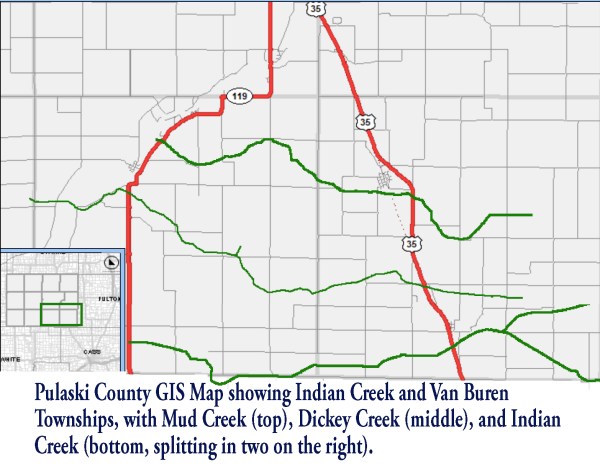
Yet less than 50 years afterwards, all of these water courses were repeatedly crossed by plenty of people with fairly well loaded wagons. Not much over 60 years afterwards, before there were improved roads, I myself was with my father when he crossed all of them without serious difficulty at a much wetter time, his wagon being loaded with wheat. It was not child’s play, of course, yet it could be done and was done habitually.
On the contrary, most of Mud Creek in this prairie with its bordering boggy land, particularly on the north side, was practically impassable even to a man on horseback at all times. I became familiar with it early in life, it being part of my duty to go there frequently on horseback in search of cattle.
From the west line of section two in what is the Civil township of Indian Creek as well as Township 29, range 2 west, eastward two miles or more it barred all travel north and south except on foot the year around. I never crossed it any other way myself or knew of anyone else doing so. Whichever side I went to first, I frequently found it necessary to go to the other side and I invariably rode around it. If there was occasion to go into it the invariable rule was to leave the horse and go on foot.
I consider it morally certain therefore, that Mud Creek slough was where this redoubtable officer met his Waterloo. Considering the facts he mentions – the distance with other conditions as they must certainly have been, no other conclusion in the case is possible. The distance from where he changed his course from west to northwest to this Mud Creek slough would be some 12 miles or a little more and with Kentucky horses the round trip could easily be gone over between 9 a.m. and 5 p.m., all the more as he speaks of encountering no difficulties in returning, as those acquainted with the route he seems to have taken know he would not.
Though not clear as to what he gives as the distance he traveled, we have seen that it also must favor this conclusion. And the timber being on his left when he was finally brought to a halt, instead of in front of or behind him, clinches the matter with me.
Both Little Indian and Big Indian, besides offering no serious obstacles to crossing as already mentioned, would also be too near the road he left and later returned to to be considered. The head waters of Dickey Creek were farther away and offered more serious obstacles to his progress. But if he was halted there it will still be in this county and the matter of the groves he mentions almost forbids its consideration because 60 years afterward there was almost no timber there particularly so on its north side, while to a person out in it some distance there was absolutely no timber to his left or right.
This would be true of all three of these streams. All of them ran east and west and any timber along them could not be to the left of one crossing them from the south.
(To be continued next month)
Links to Earlier Articles
- Part one(Common Inconveniences) October 2018 newsletter.
- Part two (Land) June 2019 newsletter.
- Part three (Trees & Timber) November 2019 newsletter.
- Part four (The River) February 2020 newsletter.
Later editions are carried as separate posts.
- Part five (Public Roads)
- Part six (Schools)
- Part seven (Markets & Trading Points)
- Part eight (It’s Mills)
- Part nine (Wild Game)
- Part ten (Feathered Wild Game)
- Part eleven (Animal Pests & Birds of Prey)
- Part twelve (Fishing in the Early Days)
- Part thirteen (Wild Fruit)
- Part fourteen (Early Commerce on the Tippecanoe)
- Part fifteen (It’s Homes and Home Life)
- Part sixteen (House Raisings)
- Part seventeen(Clothing a Family)
- Part eighteen (Log Rollings)
- Part nineteenth (First Trip to Winamac)
- Part twenty (Grubbings and Wood Choppings)
- Part twenty-one (Apple Peelings)
- Part twenty-two (Sausage Makings)
- Part twenty-three (Parties and Amusements)
- Part twenty-four (Early Wheat Raisings)
- Part twenty-five (Quilting Parties)
- Part twenty-six (Early Religious Practices)
- Part twenty-seven (Early Church Buildings)
- Part twenty-eight (Early Clergymen)
- Part twenty-nine (Early Funerals)
- Part thirty (Cold Winters and Wet Summers)
- Part thirty-one (The Morals of Early Settlers)
- Part thirty-two (Its Wet Lands)
- Part thirty-three (Early Sickness)
- Part thirty-four (Changes in People)
- Part thirty-five (Historical Markers)
- Part thirty-six (Early Operation of Pulaski Mills)
- Part thirty-seven (The Pulaski Dam)
- Part thirty-eight (A Matter Of Long Ago, Indeed, Part 1)