This is the twentieth in a Series of Reminiscences by E. R. Brown. Brown was born in Pulaski County on August 9, 1845. His writings are abstracted from the “Pulaski County Democrat” on microfilm housed in the Pulaski County Public Library, Winamac, Indiana. Find links to earlier entries at the end of this article.
Published in “Pulaski County Democrat,” June 20, 1922
In connection with gatherings peculiar to early days heretofore written about, perhaps other similar ones should be mentioned. That our first settlers found no bushes or grubs here has already been stated. The clearing of land then was thus much simplified. Though some snags and stools remained where grubs had been burned away they were not large.
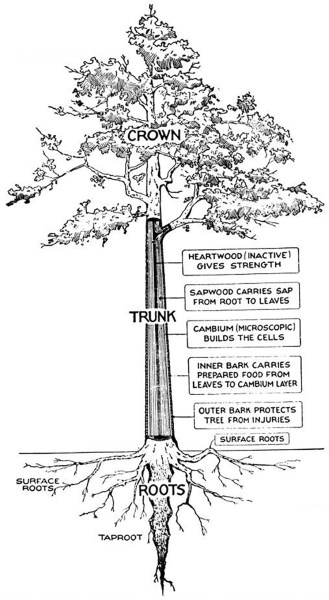
With my recollection a man could grub an acre or more in a day. Still later a forty acre tract on the second farm above Pulaski, now owned by Mr. Miller was plowed without being previously grubbed – a heavy steel plow kept very sharp and drawn by several yokes of oxen being used. But grubs grew fast and digging them out became a serious problem. White oak and burr oak often grew in connected bunches, having stools a yard square with a large tap root hard to get at or cut off. And no implements being available facilitating the use of horses or oxen, all grubbing was done by hand.

So grubbings, similar in character to log rollings, were common. As I recall them, they were mostly promoted and patronized by the younger set and a dance following was the principal lure. The laws of the realm kindly provide that no man is bound to incriminate himself, and, without being specific I will only say that pleasant memories come trooping back as I write these lines. I know that results in the way grubs were taken out always seemed to compensate for food eaten and I would hope for wear of the cabin floor also.
Wood choppings, likewise similar in character to log rollings, were common too. They were not for the purpose of supplying ordinary firewood, except in the case of needy or sick persons, which were different, but the wood cut was for burning charcoal. Blacksmiths then used this exclusively in their forges, thus creating a regular demand for it.
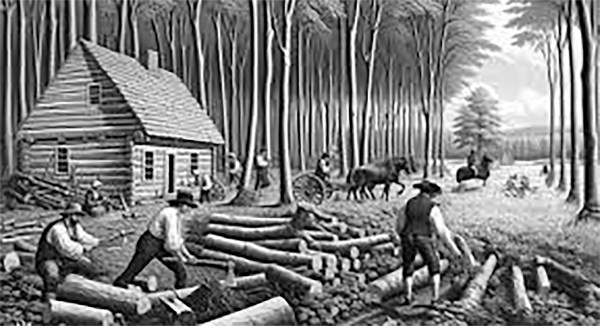 My recollections of these wood choppings are more distinct and agreeable than of the other gatherings referred to, the reason being not far to seek. A Hoosier boy at that date could usually swing an ax all right before he was knee high to a duck and boys always have liked to do what they can do best.
A Hoosier regiment in the Civil War composed mostly of youngsters was the whole show in the Eastern army when it came to cutting timber as was often necessary. High officers would sit in their saddles for long periods, to watch with amazement four persons chopping down the same tree, two working on each side, one right-handed, the other left and deftly interchanging their strokes.
Soft wood – quaking aspen, cottonwood, willow, etc. – was preferred for charcoal and to chop these with a sharp axe was a holiday in itself to the average farmer of the early fifties.
Links to Earlier Articles
- Part one (Common Inconveniences) October 2018 newsletter.
- Part two (Land) June 2019 newsletter.
- Part three (Trees & Timber) November 2019 newsletter.
- Part four (The River) February 2020 newsletter.
Later editions are carried as separate posts.
- Part five (Public Roads)
- Part six (Schools)
- Part seven (Markets & Trading Points)
- Part eight (It’s Mills)
- Part nine (Wild Game)
- Part ten (Feathered Wild Game)
- Part eleven (Animal Pests & Birds of Prey)
- Part twelve (Fishing in the Early Days)
- Part thirteen (Wild Fruit)
- Part fourteen (Early Commerce on the Tippecanoe)
- Part fifteen (It’s Homes and Home Life)
- Part sixteen (House Raisings)
- Part seventeen (Clothing a Family)
- Part eighteen (Log Rollings)
- Part nineteenth (First Trip to Winamac)