This is the twenty-eighth in a Series of Reminiscences by E. R. Brown. Brown was born in Pulaski County on August 9, 1845. His writings are abstracted from the “Pulaski County Democrat” on microfilm housed in the Pulaski County Public Library, Winamac, Indiana. Find links to earlier entries at the end of this article.
Published in “Pulaski County Democrat,” August 31, 1922
I know that devoted, earnest men were here from the first and with singular self-denial and fortitude and a zeal and passion for the cause that were really apostolic, preserved in their work until many of them lost their health and some died as martyrs to the faith. But most of these early heralds of the cross, the vanguard of the churches and vedettes of a new era as they were, felt obliged to cover so much territory and divide their time among such a scattered population that came to know them intimately. Moreover, many represented denominations which changed their ministers frequently and most of the latter were young men, who making good on the frontier, were in demand in older sections.
Our first settlers remembered much about these men later; they had been impressed and helped by their stirring evangelism. But beyond knowing their names and being able to recall something of what they had heard them say, their recollections were indefinite. In such cases the only recourse is to the written records of the various churches.
Those of local churches are often found to be fragmentary, with some periods entirely missing. Those of dioceses, conferences, presbyteries, synods, classes and associations are better. When the time comes for our local churches to celebrate interesting events or anniversaries it will be for some enterprising person to gather the facts about all former pastors or supplies and they can be published with other parts of the program.
I am fortunate in having the published record of the one hundred and fiftieth anniversary of the church in New Jersey with which my father’s people were connected and it recounts in brief the life story of all who ever ministered to it. So, I have a history of the Presbyterian church in the state of Iowa, in which every local church [minister] living and dead is mentioned, and the outstanding facts of all ministers are concisely stated.
The Methodist church in Winamac would seem to be the oldest one not only here but in the county, being organized in August 1834. The Catholic church here seems to have been organized in 1858, the Christian church in 1860 and the Presbyterian in 1883. If the Methodist church at Star City is the lineal descendant of the old church near the mouth of Mill Creek, as it evidently is of Mount Zion, it would be a close second to the Winamac church, while Olive Branch in Harrison is not far behind. There was a Presbyterian church organized in Winamac very early, though not until after 1839. It was allowed to go down later, so the present church here could not be regarded as its successor. The Methodist church at Medaryville, being organized in 1852, has its seventieth anniversary this year. If not too late it might lead off in the matter of giving long delayed credit to those to whom great credit is unquestionably due, both ministers and laymen.
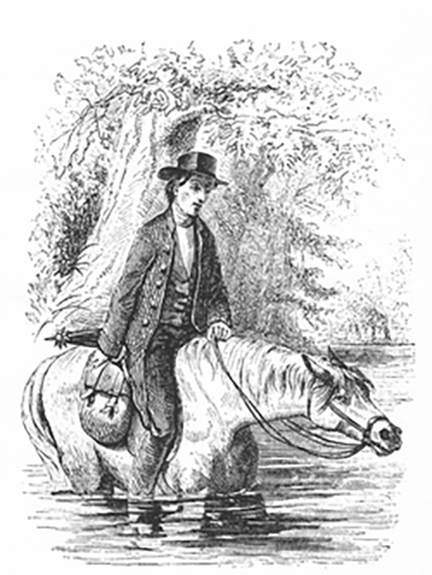
Years ago, I often heard Rev. T. S. Webb, at Crawfordsville. He was then a tall, rugged elderly gentleman of much force, with a fine record as pastor of the Methodist church there, and of course I was surprised to find that long before that he had been at my father’s house. Before the time of any bridges, he had ridden up and down the Tippecanoe, often swimming the smaller streams and sometimes the river itself horseback, preaching in the cabins of settlers, sharing their scant accommodations and humble fare, often finding every member of the family down with ague or fever and not infrequently dispensing the comfort and encouragement of the gospel around the plain cheap coffin of one who had succumbed. He was doing notable work in Crawfordsville and had evidently done the same at that earlier date.
I later met in Cincinnati two Presbyterian ministers, Dr. W. M. Cheever and Dr. O. A. Hills, and was again surprised to find that they too had similar experiences to those of Mr. Webb. The one had lived at Monticello and the other at Rensselaer, but both had considered Pulaski county as part of their extended parishes. Both had become prominent; their names being widely known. Rev. T. S. Milligan, who lived long near Gosport in Owen county and Rev. S. N. Steele, of sacred memory, had preceded the other two men just mentioned, when few white people were here. They evidently blazed the trails in these parts for the Presbyterian denomination. Mr. Steele died young, though not before he had accomplished much good. Dr. Wright, Dr M. M. Post and Rev. M. Bell of Logansport are also known to have preached in the county in those early years.
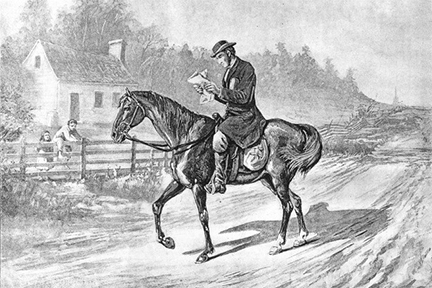
The only Protestant ministers I personally remember as having lived in the county in those far gone years who were supposed to devote their whole time to the work, were Rev. Mr. Boise of the M.E. church, who lived in Pulaski soon after it was laid out and Rev. M. Capias, a Lutheran, whose home was in section thirty-five in Monroe township. Both remained but a short time but both were earnest workers while in the field. Rev. Jonas Michaels, still remembered with true regard by many, comes toward what I could consider the close of the pioneer period, and his sleeping dust is in our cemetery, the only one of the early ministers with no other occupation that I know of being buried in the county. First and last he accomplished a great deal of good, and his name is certainly written in heaven. He has the distinction of having promoted the first Protestant house of worship in Winamac.
I remember personally most of the early ministers of the county who lived here but had other occupations. Elijah Tillman lived for many years on the farm in Indian Creek township, afterwards owned by Harrison Watts. He was of the New Light faith. Later he moved to Cass county. Wesley Borders of Harrison township and David Light of Tippecanoe were Methodists, Robert Drake of Beaver township was a United Brethren, Joseph Witham of Salem township was an old-fashioned Baptist and Ephraim Dukes, also of Harrison, possibly the widest known, was of the Christian church. All were good men living on farms and laboring hard in their fields much of the time but devoting themselves also to their high calling of preaching the gospel, seldom missing an opportunity to do so. I have heard them all deliver earnest messages. Marrying people was about their only clerical duty with material compensation and being highly respected they had many calls of that kind. All of them did splendid work also in attending funerals and ministering to the sick.
A most commendable though marvelous change has come in seventy years in the salaries of paid clergymen. Of course, people here were very poor, and there was little wealth anywhere. To prevent suffering in their families our pioneers did not dare give much away to any person or cause. Still, in a large measure the same was true of others that a clerical friend once said was true of his people. He said it was a part of their creed that a minister must be humble and in order to be humble had to be poor. So, they had promised God that if He would keep him humble they would see to it that he was kept poor. How poor they generally were is well illustrated by the following incident.
About this time Dr. Lyman Beecher, father of Henry Ward Beecher, the great preacher and of Harriet Beecher Stowe, the author of Uncle Tom’s Cabin, was occupying a prominent position in Cincinnati. Few men of his day were more prominent or useful. Yet in writing to an elder son he said in substance, “We are really hard pressed for enough to eat. If we had the money, there is little in the stores. But our garden is coming on. We hope our radishes will be big enough to use next week and then we shall have plenty, thank God.”
Links to Earlier Articles
- Part one(Common Inconveniences) October 2018 newsletter.
- Part two (Land) June 2019 newsletter.
- Part three (Trees & Timber) November 2019 newsletter.
- Part four (The River) February 2020 newsletter.
Later editions are carried as separate posts.
- Part five (Public Roads)
- Part six (Schools)
- Part seven (Markets & Trading Points)
- Part eight (It’s Mills)
- Part nine (Wild Game)
- Part ten (Feathered Wild Game)
- Part eleven (Animal Pests & Birds of Prey)
- Part twelve (Fishing in the Early Days)
- Part thirteen (Wild Fruit)
- Part fourteen (Early Commerce on the Tippecanoe)
- Part fifteen (It’s Homes and Home Life)
- Part sixteen (House Raisings)
- Part seventeen(Clothing a Family)
- Part eighteen (Log Rollings)
- Part nineteenth (First Trip to Winamac)
- Part twenty (Grubbings and Wood Choppings)
- Part twenty-one (Apple Peelings)
- Part twenty-two (Sausage Makings)
- Part twenty-three (Parties and Amusements)
- Part twenty-four (Early Wheat Raisings)
- Part twenty-five (Quilting Parties)
- Part twenty-six (Early Religious Practices)
- Part twenty-seven (Early Church Buildings)