This is the twenty-fourth in a Series of Reminiscences by E. R. Brown. Brown was born in Pulaski County on August 9, 1845. His writings are abstracted from the “Pulaski County Democrat” on microfilm housed in the Pulaski County Public Library, Winamac, Indiana. Find links to earlier entries at the end of this article.
Published in “Pulaski County Democrat,” August 3, 1922
 Our first farmers were much pleased and encouraged, perhaps agreeably surprised, when they found our soil so well adapted to winter wheat. From the start it yielded well and graded high in quality. I have early recollections of how charming the country looked, in the month of June when more than half of the fields stood thick with a luxurious growth of it, while most of the other fields were smiling in corn or clover. Few sights of a pastoral character are more delectable or will linger more pleasantly in mind, if once under its spell, than a golden field of fine wheat as, ready for the reaper, it sparkles in the sunlight, bending, swaying and rippling in a moderate breeze.
A rule seldom varied from, was to seed the first two crops on the new land to wheat. Then followed two crops of something else, generally corn, when, by fallow plowing it went back to wheat again. Later rye and clover were raised more and were worked in to rotate the crops and at the same time to get as much wheat as possible.
In wheat raising barely two implements were known, a two-horse walking plow and an A-shaped harrow. The ground was plowed, the seed was sown broadcast, by a man swinging a bag around his shoulders, and hurling handfuls over the field as he walked across it. This was followed by the harrow to cover it up.

Harrowing was often considered a boy’s work, as few raised on a farm will need to be told. If the field was rough or cloddy, a log of wood was frequently tied on the harrow to keep it from bouncing around, which will show what was liable to happen to the boy as he held to the harrow bow, with or without the log. In exceptional cases the ground was harrowed before sowing.
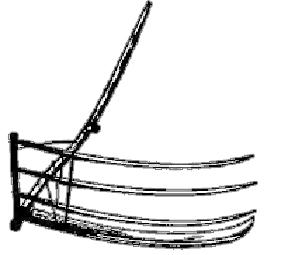 Like other ancient implements, the sickle lost its place for cutting grain about the time settlement began, being replaced by the cradle. I saw different men formerly accustomed to using them show how they did it. Evidently more speed was possible than might be thought. Without a doubt the ‘reapers’ of ancient Bethlehem, referred to in the delightful story of Ruth, used sickles closely resembling those discarded here less than ninety years ago.
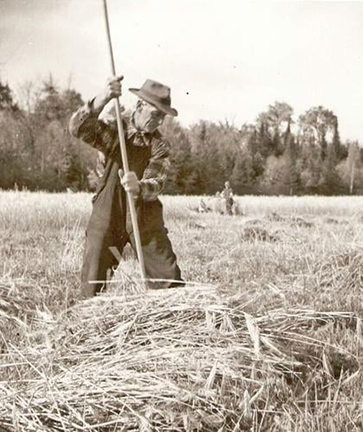 The latter resembled those still used for trimming lawns but were much longer, less curved and one side was creased like a file, making the edge tooth-shaped. I think all must still know what a grain cradle was, though not used for so many years. Some men could cut as much as five acres in a day with a cradle but three acres was considered a fair average. Following the cradlers, men with wooden hand rakes rolled the grain into sheaves, then bound them with bands made of the grain itself. Sometimes one man raked and bound all a cradler cut, more frequently a boy or girl did the raking, while the man did only the binding.
An ambitious boy or girl, to earn more money, would occasionally do the raking after two cradlers. It will thus be seen that wheat harvest was a notable event on an early Pulaski County farm, calling for several people and continuing as long as two weeks or more. To have four cradlers was not unusual. That, with extra hands to pick and shock and extra help in the house, required twelve to fifteen people, not counting children. Work began early and continued late.
Besides the three meals in the house, a forenoon and afternoon ‘piece’ was served in the field. A jug of whiskey stood aside the water bucket. There was always plenty of talk, usually noisy and hilarious. The cradlers were the king bees. Rivalry between them was rife, mostly good-natured but sometimes otherwise.
The unwritten laws of the craft required that they take turns in leading, time their strokes in unison, observe regular distances, etc. Occasionally these laws were violated, with consequent trouble. In one long harvest on our farm, we had a free-lance cradler and the field was in a ferment the whole time. When he led he would forge ahead and shout back in sharp, irritating tones, “Come on, you half hands”. When he followed the others accused him of crowding them and angry words were passed.
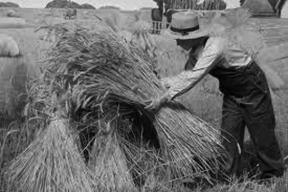 After being cut, wheat was stacked at once or put into barns. The larger, oblong stacks were called “ricks” and the scene of several of these ricks clustered near the farm buildings, which most will recall as characteristic of that day, betokened plenty and prosperity.
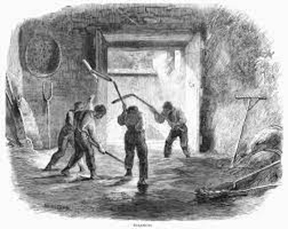 Before the advent of threshing machines this wheat was thrashed by trampling with horses or oxen, or with flails. This was an all-winter job, often lasting till the following harvest. For trampling, the wheat was placed in a circle on a floor or hard piece of ground, and the animals went around and round on it, men with pitchforks stirring it, so as to keep un-thrashed parts on top.
A flail consisted of two pieces of wood, the one serving as a handle being about five feet long, the other being shorter and heavier. The two were joined together at one end of each of them by a stout cord of thong of leather. By taking hold of the longer piece and using a swinging motion, a terrific blow could be delivered with the shorter piece. Flails continued to be used for thrashing buckwheat long after their use for other thrashing was discontinued.
When I came to study Latin I was interested to learn that the word tribulum meant the same as flail. So when I found that the word tribulation came from tribulum (a flail) I could understand what it meant. Both of these methods of thrashing were very old. All probably know that the ‘corn’ which Joseph’s brethren went after down in Egypt was really wheat and it had been thrashed either by trampling or with a flail.
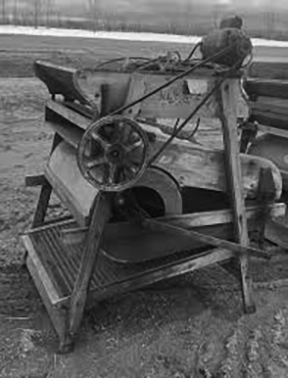 However, we had it on the ancients in one respect. When they came to clean their wheat they tossed it up in a stiff breeze and the wind blew the chaff and dirt away. We had the old-fashioned wind-mills to do what part and though we had to turn them by hand they did their work well. After thrashing machines came the wind-mills, which did not clean the wheat as well as our old hand-power windmills.
In most cases the wheat thrashed and nominally cleaned by the machines was run through the windmill (my father called them fanning-mills) before being taken to market. Among the things I loathed as a boy was to have to ride the horses trampling wheat and to turn the windmill when cleaning it. Thrashing machines run by steam came later and the modern double self-feeders, which devoured a whole field of wheat in a forenoon, without the bands being cut and almost without human help of any kind, are a welcome change from the flail.
Links to Earlier Articles
- Part one (Common Inconveniences) October 2018 newsletter.
- Part two (Land) June 2019 newsletter.
- Part three (Trees & Timber) November 2019 newsletter.
- Part four (The River) February 2020 newsletter.
Later editions are carried as separate posts.
- Part five (Public Roads)
- Part six (Schools)
- Part seven (Markets & Trading Points)
- Part eight (It’s Mills)
- Part nine (Wild Game)
- Part ten (Feathered Wild Game)
- Part eleven (Animal Pests & Birds of Prey)
- Part twelve (Fishing in the Early Days)
- Part thirteen (Wild Fruit)
- Part fourteen (Early Commerce on the Tippecanoe)
- Part fifteen (It’s Homes and Home Life)
- Part sixteen (House Raisings)
- Part seventeen (Clothing a Family)
- Part eighteen (Log Rollings)
- Part nineteenth (First Trip to Winamac)
- Part twenty (Grubbings and Wood Choppings)
- Part twenty-one (Apple Peelings)
- Part twenty-two (Sausage Makings)
- Part twenty-three (Parties and Amusements)