This is the twenty-third in a Series of Reminiscences by E. R. Brown. Brown was born in Pulaski County on August 9, 1845. His writings are abstracted from the “Pulaski County Democrat” on microfilm housed in the Pulaski County Public Library, Winamac, Indiana. Find links to earlier entries at the end of this article.
Published in “Pulaski County Democrat,” July 27, 1922
 Two kinds of parties or amusements often spoken of by older people as being popular where they had come from do not seem to have been tried here, namely, Sugar Makings and Corn Huskings. The scarcity of hard maple trees here (often called sugar trees) explains the absence of the former. Perhaps our corn fields were too large early to render the latter practicable. The corn husked at these parties was previously jerked from the stalks and piled in large round heaps. Then young people gathered about them, by moonlight or that of lanterns or bonfires and did the husking, with much fun and merrymaking.
But similar functions were common here, not called for now, and of which little is said. Others besides those already mentioned were connected with drying and preserving fruits or vegetables for future use. All recognized the urgent need for that. Parties not large but numerous devoted their individual attention to the common, plebeian pumpkin. Little else was considered more relishable than pumpkin butter, and much time was given to its preparation.
 Endless quantities of pumpkin were also dried to be made into sauce or toothsome pies when needed. It was common to carve pumpkins into rings, which, being peeled, were strung on poles and disposed about the cabin. For most available space overhead to be yellow with these suspended rings was a familiar sight.
Green corn was also cut off the cob extensively for drying or pickling, often engaging the help of neighbors. For drying it was frequently strung on strings, as were other vegetables and fruits, so that the one room of the cabin, or the attic, in case there was one, was freely festooned with these endless practical if not ornamental garlands.
It may be noted that I make no references to peaches in these connections, as I make none to other fruits and vegetables often calling for these parties. I have said in another connection that extra fine peaches were grown here early. The facts are that ready sale was made of most of them at tempting prices, but alas! In the early fifties after barely one good crop, the trees were all killed by a long severe winter and we had no more native peaches for several years.
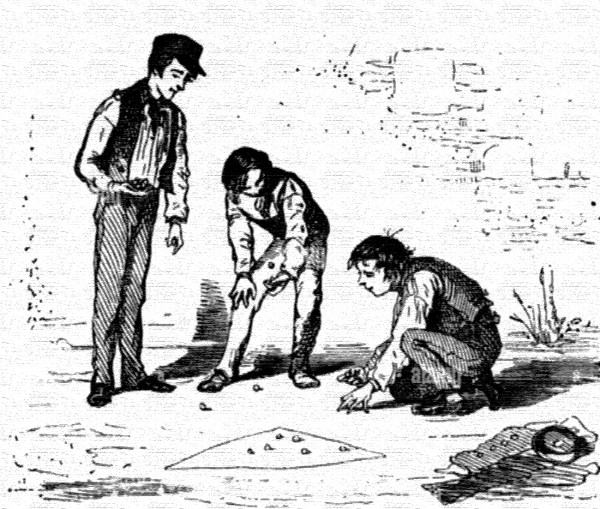 That we still had other gatherings, largely, if not wholly for amusement goes without saying. We played ball and marbles, pitched horseshoes, coasted, skated, (no roller skates) went sleigh riding, attended spelling schools, debating societies, goose and turkey roasts, shooting matches, dances and numerous other social functions.
A marked difference between all sports and pastimes then and now was in their plain, often rude equipment and their more simple character. For example, no balls or bats, skates, boys’ wagons or sleds or larger sleighs were on sale in the stores. All were made at home or at local shops. Many of them were really scarecrows, I think I see some of the youngsters I know using now what their dads or granddads were proud of then. Still, if improvements can be afforded and are properly used I do not begrudge them to any one, young or old.
I see boys and girls playing marbles now very much as long ago. Their marbles, though far more attractive, probably do not cost half as much as our plainer ones did. If my eyes are not at fault the old question as to ‘playing for keeps’ still remains unsettled.
 Town ball, formerly played everywhere, resembled baseball, which supplanted it in the sixties. The bases were not manned, runners being put out by passing the ball in front of them or hitting them with it. No special numbers were required to play the game. A bat or paddle was used by the striker.
“Rolly holly” played with a regular ball was a popular school recess game among boys. The fact that the loser had to step forward and allow himself to be hit with the ball where his pants were supposed to be the broadest made it very funny to all except him.
When there was snow, “jumpers” were frequently substituted for one horse-sleights. In these, two poles were made to serve as both runners and shafts. By boring holes in them to receive the legs, two stout trestles of the right length were placed crosswise from one to the other, near their large ends. With a rough bed in these trestles (often just a store box) and a horse between the smaller ends, all was ready. Generally it was better to flatten the poles in front of the trestles to facilitate their bending upward to play the part of shafts. Unnumbered proud young men and their equally proud best girls had the time of their young lives with these odd contraptions.
Shooting matches, while not often free from objectionable features, naturally went with rifles, then so common and useful. For a dozen young men to shoot at a mark–seventy-five yards with a rest or sixty off hand, as preferred – and everyone at least touch center, as I have seen done, was certainly not bad at all. Andrew Jackson’s squirrel hunters won worldwide fame by their deadly marksmanship at the battle of New Orleans, so these shooting matches and other experiences with rifles made Indiana and other western soldiers famous in the Civil War.
Of course, all of us ranged over whole townships and into those adjoining (frequently afoot), winter after winter, in attending schools. These are still regarded with approval and their discontinuance regretted. Reflecting on them, I would say that those in authority gave undue attention to developing a few prodigies so as to win matches and not enough to the raising of the common standard of spelling.
As to one matter I am entirely stumped. For the life of me I cannot recall a single thing about singing schools during the period of which I am writing. If I ever attended one or heard of one being held in the county during that time, my memory is as blank as a white sheet of paper.
More than this and worse: I cannot recall that I ever attended a meeting of any kind during that period: religious, political, social or what not, where there was singing of any kind by persons, young or old, except for the singing (it could hardly be termed congregational) then the rule at religious meetings, and the singing of a few verses of some hymn by the minister before or after the sermon, as was the custom. In short, I have to confess that my memory has entirely failed me to that extent, or that my experiences as to vocal music and all effort to cultivate or encourage it in this vicinity, while I was growing up was a case of total neglect.
Either of these conditions, if clearly established, would be humiliating to me. But I believe that first would be the least so. The efficient music instruction along all lines came later, with much popular encouragement and support is a matter of common knowledge.
That dances, as well as other social events, bore all the marks of their day would, I think, be assumed, if not stated. No musical instrument was heard at any of them except the violin, generally if not always called a ‘fiddle.’ Rarely two or more fiddles were played, but to have even one good one, with four strings, an uninjured bow and someone who could and would play fairly well, for an entire evening was exceptional With stores so meager as to stock, it was not unusual for the one fiddle to be short on strings, or the bow to be out of repair, while fiddlers were forever saying they were tired, sick or had other arrangements.
All the ladies wore heavy shoes and all the gentlemen heavy boots. As a rule, both wore heavy clothes, the same as they wore to church or on their trips to town. Pumps, slippers and light, dainty garments were as scarce as telephones or automobiles. No mosquito netting or goods of similar weave had appeared at doors or windows, particularly none made of silk and neither had anyone thought to make such into stockings or waists. Most attending dances walked, though a few rode and there was mention of riding bareback. But it was the animal and not the rider that was bare of back. The dances were all the square type, mostly single or double quadrilles or Virginian reels, with occasional jig dancing. In place of these, we have the waltz, tango and turkey trot. But it is not easy to see that this popular pastime has been reformed or improved to any degree in all the years.
Two other old English sports, horse racing and fox hunting with horses and hounds, were early introduced into parts of Indiana. From some acquaintance with them elsewhere, I am glad that Pulaski county has mostly been exempted from both of them. They were not known at all here in the early days.
Links to Earlier Articles
- Part one (Common Inconveniences) October 2018 newsletter.
- Part two (Land) June 2019 newsletter.
- Part three (Trees & Timber) November 2019 newsletter.
- Part four (The River) February 2020 newsletter.
Later editions are carried as separate posts.
- Part five (Public Roads)
- Part six (Schools)
- Part seven (Markets & Trading Points)
- Part eight (It’s Mills)
- Part nine (Wild Game)
- Part ten (Feathered Wild Game)
- Part eleven (Animal Pests & Birds of Prey)
- Part twelve (Fishing in the Early Days)
- Part thirteen (Wild Fruit)
- Part fourteen (Early Commerce on the Tippecanoe)
- Part fifteen (It’s Homes and Home Life)
- Part sixteen (House Raisings)
- Part seventeen (Clothing a Family)
- Part eighteen (Log Rollings)
- Part nineteenth (First Trip to Winamac)
- Part twenty (Grubbings and Wood Choppings)
- Part twenty-one (Apple Peelings)
- Part twenty-two (Sausage Makings)