We continue the celebration of the Semiquincentennial – the 250th anniversary of the signing of the Declaration of Independence – with a short look at the War of 1812. We find the beginning of that war right here in Indiana, in what is now Tippecanoe County.
Some would ask what the War of 1812 has to do with the signing of the Declaration. In 1776, this young nation declared its independence from Great Britian. In 1812, it seems we were still trying to wrest ourselves free.
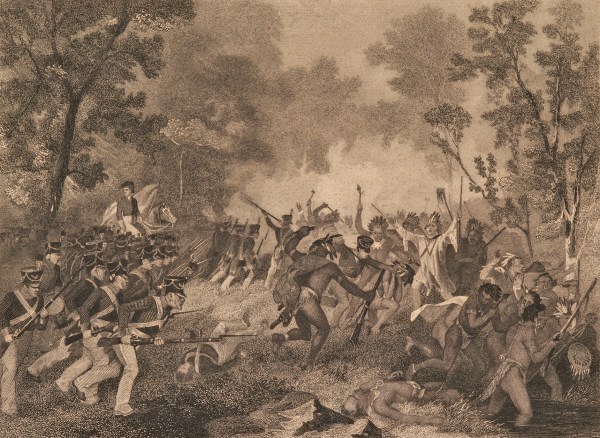
The Role Of Indiana In The War Of 1812
Until the end of the Revolutionary War, settlers had been forbidden from heading across the mountains – the Alleghenies and Appalachians – by King George. He had reserved those lands specifically for Native Americans. Once freed from the shackles of rule by the King, of course, U.S. citizens pushed west.
Natives pushed back.
The Northwest Territory was established in 1787; the Indiana Territory was carved out in 1800. The Governor of the Indiana Territory, William Henry Harrison, made it his life’s mission to rid the Territory of all Native Americans, which of course engendered hostility. He pushed through several treaties, taking possession of land that had belonged to Native Americans.
At the same time, a confederacy of Native American tribes was underway, under the leadership of Shawnee brothers Tecumseh and Tenskwatawa (The Prophet).
Tecumseh was a war chief; he advocated for a confederation of tribes to resist the Americans as they pushed west. Tenskwatawa provided spiritual leadership, advocating for a return to native values and practices. Together they established Prophetstown near present-day Lafayette, which became the center of their confederation.
The Battle of Tippecanoe was fought on November 7, 1811.
Governor Harrison marched a force of about 1,000 men toward Prophetstown. While Tecumseh was away gathering allies in the South, Tenskwatawa ordered a pre-dawn surprise attack on Harrison’s army. Harrison’s troops held their ground, forced the warriors to retreat, and subsequently burned Prophetstown to the ground.
Following the destruction of Prophetstown, Harrison’s men recovered British-manufactured weapons and ammunition from the battlefield. Harrison aggressively used this physical evidence to validate long-standing American suspicions that British authorities in Canada were actively arming Native American tribes to halt U.S. westward expansion. The U.S. declared war on Great Britian.
In response, Tecumseh solidified an alliance with the British, certain that they would help secure Native claims to the land.
The War of 1812 had begun.
Indiana Battles
The portion of Indiana Territory that eventually became Indiana was home to several battles during the War of 1812.

Pulaski County’s Involvement
Because Pulaski County was not officially organized until 1839 – nearly three decades after the war ended – no residents of the county served in the war. However, the area’s rich soil and the availability of federal bounty land warrants drew several aging veterans who chose to spend their final decades clearing land and establishing the county’s earliest communities. (Federal bounty land warrants acted as a form of alternative military currency used to purchase cheap, fertile tracts of land in the public domain.)
John Foos
From pension records, found by a simple AI search: John Foos was a veteran of War of 1812 who later filed for a federal pension while living in Indiana. He originally served as a soldier from Ohio. He migrated to the county during its pioneering era, settling down in Van Buren Township. He lived a remarkably long life, passing away in Pulaski County on August 10, 1876, at nearly 89 years old. He was buried in Marion County, Ohio. (https://www.findagrave.com/memorial/26316742/john-foos)
From FindAGrave: Married Mary Aye about 1811 Delaware Co, OH; Married Mary Falkinburg January 28, 1869 Pulaski Co, IN; Age 88 years, 8 months, 25 days
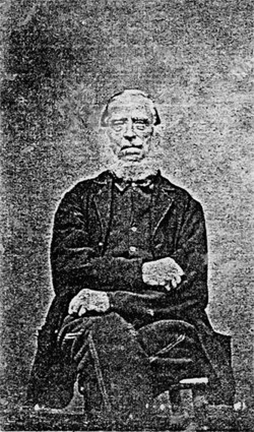
PCHS Research of Pulaski County Veterans
PCHS staff researched records onhand and found nearly 50 men who were old enough to have been in the War of 1812 that had connections to Pulaski County. The following veterans have been found to date. As more are identified, they will be added to this page. Photos and narratives, if any, are from FindAGrave.
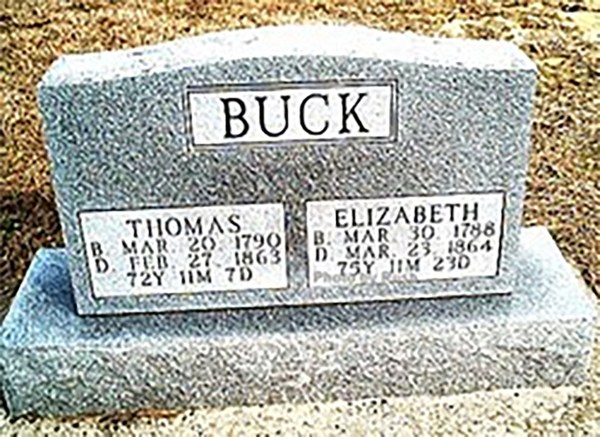
Buck Cemetery
Thomas Buck Jr.
(https://www.findagrave.com/memorial/18544167/thomas-buck)
Medaryville Cemetery
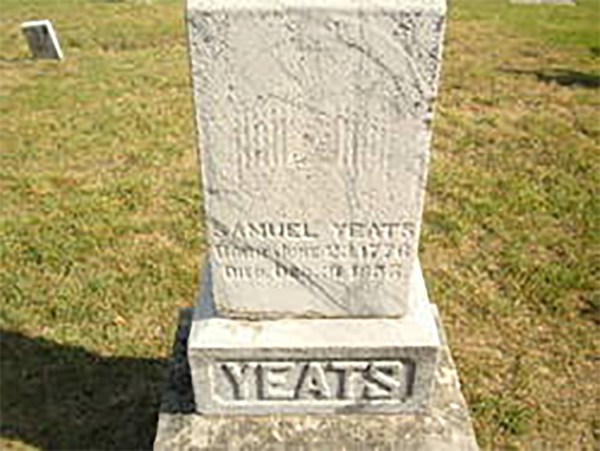
Samuel B. Yeats
(https://www.findagrave.com/memorial/30557204/samuel-yeats)

Nauvoo Cemetery
Micager Hancock
(https://www.findagrave.com/memorial/101637470/micager-hancock)


Pulaski Presbyterian Cemetery
John L. Widener
(https://www.findagrave.com/memorial/112090375/john-leonard-widener)
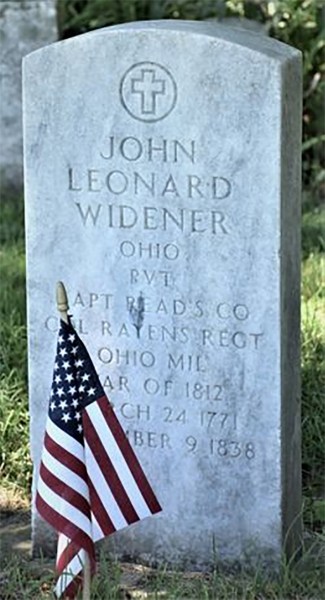
John Leonard Widner, son of John Widner and Mary Rouse Widner, both natives of England, was born 24 Mar 1771 during the voyage on the Atlantic Ocean. He died 09 Dec 1838 Pulaski County, Indiana. He married Jemima Benjamin 29 Nov 1818 Huron, OH. Known children: Rebecca Ellen Widner Fisher, Seth Widner, Jemima Jane Widner White, Kerrilla Widner Thayer, John Widner, Benoni Widner and Michael Widner.
John Lenard Widner was a Private in the War of 1812 serving in an Ohio company under Col. Rayen’s Regiment, Captain Read’s Company. He settled in Pulaski County, Indiana about 1835 and was thought to be the first death recorded in the county.
Riverbank Cemetery
Jacob Phipps
(https://www.findagrave.com/memorial/291705369/jacob-phipps)
Jacob Phipps was a soldier in the War of 1812. Pvt. 3 Regt. Ohio Militia. He was born in Morrow County, Ohio. He entered lands in section 32 of Tippecanoe Township in 1840 & 1841 near the Tippecanoe River. Supposedly he is buried on his farm in an unmarked grave.
Mr. Phipps’ son-in-law William Spangler gave the Evangelical Church of N. A. ground for church and burial purposes known as the O.K. Church and cemetery. Mr. Phipps was the grandfather of John M. Spangler, a prominent attorney whose mother was the youngest daughter of Mr. Phipps.
Roseland Cemetery, Francesville
Joel Pratt Wood
Mr. Wood has a cenotaph at Francesville, but he never lived in, nor is he buried in, Pulaski County (https://www.findagrave.com/memorial/171314657/joel-pratt-wood)

A Grave Stone Tells an Interesting Story. White County Democrat: Harry Boothroyd, the Monticello monument man, has completed a granite gravestone that will be placed at the grave of Joel Pratt Wood in the Francesville cemetery. The inscription tells an interesting story in the life of the deceased and proclaims him to be a patriotic American. The inscription reads: “Joel Pratt Wood, born 1804, died 1850. Drummer boy at the battle of Lundy’s Lane at age of 10, July 25, 1814. Fought with Texas in 1836 for her independence from Mexico.”
Nothing further is known here of the life history of Joel Pratt Wood or when he settled in Indiana. He was the grandfather of L. W. Hubbell, who lives at Francesville and who is known to many Monticello people. A niece of the drummer boy of Lundy’s Lane, who died in Cleveland, Ohio, provided in her will for the purchase of the gravestone and its erection in the Francesville Cemetery.
Star City Cemetery (now Old Star City Cemetery)
Elisha Freel
(https://www.findagrave.com/memorial/30244807/elisha-s-freel)
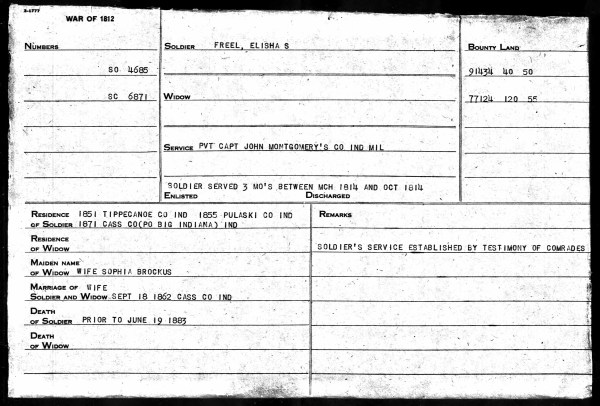
- Son of James Freel and Jean (Jane) Wood
- 1st wife: Elizabeth Tolover, married 15 Dec 1827, Tippecanoe, Indiana.
- 2nd wife: Maria A. Butler, married 1 Oct 1854, Tippecanoe, Indiana.
- 3rd wife: Sophia Brockus, married 18 Sept 1862, Cass, Indiana.Records on Ancestry.com show Elisha S. Freel served in the War of 1812 for 3 months, sometime between March and October 1814. He would have only been 11 years old, but a farm boy and probably large for his size. When the military found out he was only 11, they probably sent him packing home. We have attached his wife, Sophia’s application for pension.
U.S., Civil War Soldiers, 1861-1865:
- Name Elisha S. Freel
- Side Union
- Regiment State/Origin Indiana
- Regiment 20th Regiment, Indiana Infantry
- Rank In Private
- Rank Out Private
- Film Number M540 roll 25
Pulaski County Public Library believes he is buried in the Old Star City cemetery. This old cemetery is on the north edge of the town of Star City, IN. In the 1970’s the genealogy society read all the stones in this old cemetery and found one badly eroded stone: Freel. —
I [the writer on FindAGrave} suspect this is Elisha’s stone. His daughter Melvina Cadwaller is also in this Old Star City Cemetery. The I. O.O.F. cemetery, or as it is now known; Star City West, was not in existence until 1892.
Stump Cemetery
George Stump, Sr. – NOT FROM THE WAR OF 1812, BUT FROM THE BLACK HAWK WAR
(Black Hawk War) (https://www.findagrave.com/memorial/35047195/george-stump)

In 1811, when George Stump II, Sr., was twenty-three years old, he started to sell his land he inherited from his father. In 1815, he sold the last of his land. In 1820, he left Hardy County and settled in Wood County, VA, now WV. He was in Wood County in 1828. From there, he went to Fairfield County, Ohio, thence to Tippecanoe County, IN (1831-1835). The George Stump farm in Tippecanoe County was on Indian Creek, five miles northwest of Lafayette. While there he enlisted in the Black Hawk War. He arrived in Pulaski County, Indiana, in what was to be White Post Township in March of 1835, the third family to settle there. The first family was George S. Phillips and his wife, Mary Ann Stump, daughter of George Stump., Sr., (October of 1834). The second family was Silas Phillips Jr. and Charlotte Stump, also a daughter of George Stump, Sr., (February 1835). George Stump, Sr., settled on land one mile southwest of what is now Medaryville, Indiana. He entered land in White Post Township, Pulaski County, Indiana, in 1838 – the land on which he settled. In 1838 he built what was known as the Stump Bridge.
He was a public spirited man and in 1836 went to Monticello, Indiana, to vote in an election. From 1839 to 1843, he and his five sons voted in elections at Winamac, Indiana. In 1843, the first election in White Post Township was held at his home, as were elections several years later. April of 1840, he was a petit juror in Pulaski County. The second schoolhouse was built on his farm in 1847. (First was built on Phillips land.) He was a blacksmith by trade. His wife, Catherine, was the first white person to die in White Post Township.
Victor Chapel Cemetery
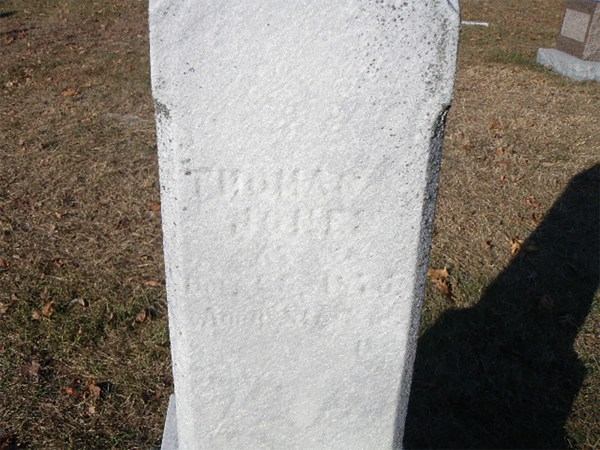
Thomas Jones
(https://www.findagrave.com/memorial/61711814/thomas-jones/photo#view-photo=35714133)
Winamac Cemetery
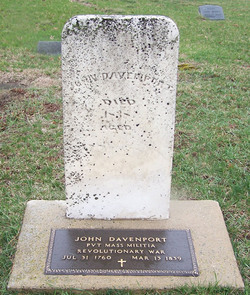
John Davenport, Sr.
(supposedly served in both the Revolutionary War and the War of 1812) (https://www.findagrave.com/memorial/26153461/john-davenport)
Asa P. Freeman
(https://www.findagrave.com/memorial/156210032/asa-putnam-freeman)
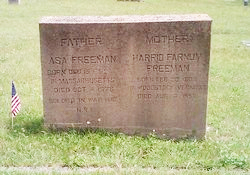
Father, Daniel Hampton Freeman
Mother, Sarah Horr
Burials of above persons: Attleboro, Bristol county Mass.
Wife #1, Lucy Bates (children Lucy, William, Frederick)
Wife #2, Harriet Silver Farnum (children Douglas Farnum, Daniel Ransom, Alvin Hannibal, Asa Horr, Harriet M, Findrich, Frederick G or C, Noah Robinson, Sarah L, Elisha Martin, male infant twin, Nancy E, Sylvia, Eleanor)
Wife #3, Alma P Graham (children Albertine, Minola)
Daniel Goble
(https://www.findagrave.com/memorial/60016654/daniel-goble)
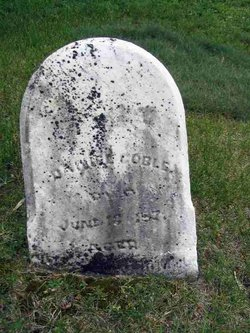
John E. Hiland
(https://www.findagrave.com/memorial/157513658/john-edward-hiland)

“Age 69y 26d”
Comfort Olds
(https://www.findagrave.com/memorial/26497304/comfort-olds)
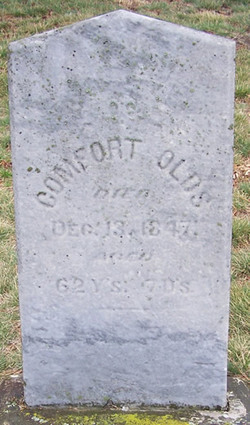
Aged 62 years 7 days
F.A. Battey Book
Tilman Hackett
From F.A. Battey and Co. Counties of White and Pulaski, Indiana. Historical and biographical: Tilman Hackett was a soldier in the war of 1812. He was married in Delaware, where he farmed for eight years. Returning to Maryland, he farmed until the summer of 1836, when he brought his family to this county, then a part of White County. He pre-empted 160 acres in what is now Monroe Township but did not receive his patent until 1841. He was the fourth settler within the present limits of Pulaski County, and here died in 1847. (No burial records were found.)
Sources used
https://visitindiana.in.gov/military/conflict/war-of-1812/; https://www.nps.gov/subjects/warof1812/indigenous-peoples.htm; https://www.newworldencyclopedia.org/entry/Potawatomi; https://www.FindAGrave.com, F.A. Battey and Co. Counties of White and Pulaski; several other sources while web-surfing.
The Series
- The Land, from the Ice Age to Europeans Coming Ashore
- The People, From Ice to Europeans Coming Ashore
- Europeans Arrive
- French Fur Trade & Beaver Wars
- Indian Wars Pre-Revolutionary War
- Indian Wars During Revolutionary War
- Indian Wars Post-Revolutionary War
- Indian Removals 1700 to 1840
- United States Takes Shape
- The Northwest and Indiana Territories
- The War of 1812
- Indiana Takes Shape
- Pulaski County Takes Shape
- Treaty of the Tippecanoe 1832
- Yellow River Treaty 1834
- Trail of Death
- Chief Winamac
- Keepers of the Fire
- The 7 Fires of the Anishinaabe