This is the thirty-third in a Series of Reminiscences by E. R. Brown. Brown was born in Pulaski County on August 9, 1845. His writings are abstracted from the “Pulaski County Democrat” on microfilm housed in the Pulaski County Public Library, Winamac, Indiana. Find links to earlier entries at the end of this article.
Published in “Pulaski County Democrat,” October 5, 1922
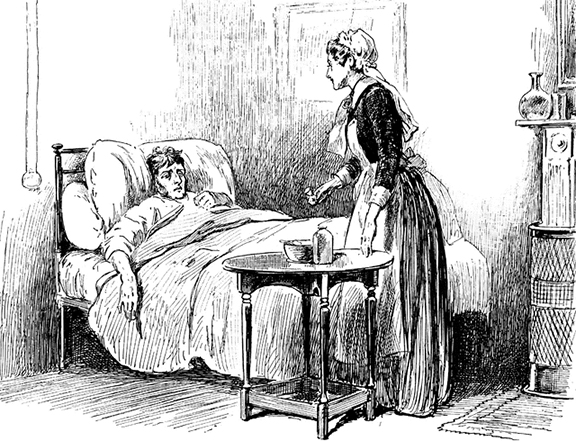 There was a large amount of sickness here in early years. Beautiful in most respects as the country was to look upon and delightful as Nature was in many of her aspects, our pioneers were terribly scourged by various diseases. Many pioneers were carried away at the time by acute or persistent attacks, while their constitutions were so weakened that they died before their time. For one to reach the age of seventy was unusual, while many fell by the wayside, apparently because they were just worn out, before they were sixty.
Malaria was Indiana’s worst physical trouble in the early days. Pulaski county was no worse than many others and not as bad as some. And though this state was given a worse name and wider publicity on account of it, I have long been convinced that other states, to borrow an old figure, were as deep in the mud as our state was in the mire. For example, I knew families who went from along the Tippecanoe in an early day to southern Illinois solely to escape malaria and after being there a few years they returned. I also knew one family that returned early to western Pennsylvania and after some short time returned here with the report that while they had lost in other respects they had gained nothing as to malaria. Their specific statement was that while the trouble had not been prominent there before they left, it had come to be as bad there as here, if not worse.
The most prevalent and pestilential form of malarial disease here was ague. In our Hoosier dialect of that elder day it was ‘ager’. Surely if there ever was a truly damnable human ailment, the old-fashioned Indiana ague was in that class. It has been almost forty years since I have seen a case of it. Can it be possible that there are those here who are almost that old and yet have never seen one? The way it used to search out people and grip them was memorable.
Its worst season was late Summer or early Fall and sometimes hardly anybody missed it. To say that some years all had it at the same time would not be missing it much. Or if some did not have it they were down with something else. The statement often heard that there were not enough well people to wait on the sick was literally true. And if the worst stages of the ague had not been intermittent with intervals between them when its victims could give some attention to others, the case would have been worse. Yet for all members of families to be on their backs at the same time, with no possibility of obtaining permanent outside help was just too common to excite surprise. For it to be known that those really sick themselves were in much distress, giving all the aid others worse off were receiving shocked no one.
I would take issue with those who say ague was (or is) a species of fits or convulsions. It did not come on suddenly and mostly unawares, a universal characteristic of those ailments, and beyond the shaking and chattering of teeth in the chill, which were not always present in attacks otherwise severe, there were no involuntary movements. Its premonitory symptoms were easily recognized and of considerable duration–a feeling of extreme lassitude, a disposition to yawn and stretch, pain and distress in the muscles and joints and chilly sensations running up the back.
Like a cruel animal of savage, it harried and tormented its victims plenty before proceeding to more drastic measures. The chill which followed likewise gradually and its freezing severity when at the worst was in no hurry to let up. All remedies availed nothing to alleviate it. Stimulants, hot applications or drinks and piles of covers, were all in vain. Some shook violently and their teeth fairly rattled, while the face, lips, nose, ears and fingernails turned blue, and there was a drawn, woe-begone aspect to the features that was hard to look at.
Like some other torturing processes, the fever was all the harder to bear because of the false hopes it held out. At first it seemed to afford relief but before it was through with its hapless victim he had reason to doubt whether his last estate was not worse than the first. It is the rule yet and perhaps always will be that many cases of sickness are preceded by a chill followed by a fever. But the fever following an ague chill must have been a little more proficient in its calling and knew of some ways of generating more torturing heat and creating more unbearable conditions, than most others known in this latitude.
The intermittent and periodical character of ague was a strange feature. A person afflicted with it had it every day, every second day or every third day. Curiously, too, the every day variety was the least serious and the easiest to break up, while the every third day cut its sufferer down more and held on tighter. In a measure people seemed to become immune to all varieties, the more recent comers often having it when those here longer did not. The way some families from certain sections of the east were pursued and scourged with it was simply awful. No wonder that a great many fled from it. If all the good people who came to the county had remained here our population would have increased much faster than it did.
No matter what was the cause of this ague and other malarial diseases and the opinions formed about it formerly held by those supposed to know, afford an illustration of how much dependence can be placed on mere human theories. At one time all who had studied the subject at all agreed that the trouble came from the air and water being contaminated in some way. Mostly by the ponds being dried up, this emitting poisonous vapors both from the impure water and the soil so long water-soaked, or by poisonous vegetable matter finding its way into springs and wells. Now the same authorities or their pupils and successors say that these had nothing whatever to do with it, but that it all came from the bite of a certain kind of mosquito. And there you have it.
There were other fevers in plenty, some of which prevailed along with the ague. One was known as intermittent fever. None of them were accompanied with chills, though most if not all were preceded by one. Often part of a family would be down with some fever while the rest had the ague. About the only fatalities from ague were cases enfeebled by it and then attacked by a fever. Pneumonia was very common in the winter and early spring. Houses that were too open or those not open enough, particularly after stoves came, as well as other exposures, are the lack of warm, stormproof clothing, were the causes of this.
A very large proportion of deaths are caused even yet by lung fever as it was formerly called. The poor children suffered of course with summer complaints and the various epidemics, chicken pox, measles, whooping cough and others. Infant paralysis, spinal meningitis, scarlet fever and diphtheria were never reported. One who had an opportunity to know has stated that typhoid was unknown here early, but I knew of some severe cases when I was quite young.
I readily recall my first experience of delirium. I was lying in the old sitting room, burning with fever, perhaps from ague. Near me sat my faithful mother sewing and keeping an eye on her sick boy. For some time the room seemed to be turning around and around and I was puzzled that my mother took no notice of it. Finally, I said, “Mother, why don’t you do something to keep this room from turning around?” She replied, “Don’ t worry, son, mother is right here and she’ll watch the room.” Then she came over where I was and looking down with grave tender eyes said, “Eddy, it’s the nasty fever. Can you stay alone while mother gets you a cool drink and a wet cloth to put on your head? Then maybe you’ll feel better?”
“O for the touch of a vanished hand. And the sound of a voice long stilled.”
Links to Earlier Articles
- Part one(Common Inconveniences) October 2018 newsletter.
- Part two (Land) June 2019 newsletter.
- Part three (Trees & Timber) November 2019 newsletter.
- Part four (The River) February 2020 newsletter.
Later editions are carried as separate posts.
- Part five (Public Roads)
- Part six (Schools)
- Part seven (Markets & Trading Points)
- Part eight (It’s Mills)
- Part nine (Wild Game)
- Part ten (Feathered Wild Game)
- Part eleven (Animal Pests & Birds of Prey)
- Part twelve (Fishing in the Early Days)
- Part thirteen (Wild Fruit)
- Part fourteen (Early Commerce on the Tippecanoe)
- Part fifteen (It’s Homes and Home Life)
- Part sixteen (House Raisings)
- Part seventeen(Clothing a Family)
- Part eighteen (Log Rollings)
- Part nineteenth (First Trip to Winamac)
- Part twenty (Grubbings and Wood Choppings)
- Part twenty-one (Apple Peelings)
- Part twenty-two (Sausage Makings)
- Part twenty-three (Parties and Amusements)
- Part twenty-four (Early Wheat Raisings)
- Part twenty-five (Quilting Parties)
- Part twenty-six (Early Religious Practices)
- Part twenty-seven (Early Church Buildings)
- Part twenty-eight (Early Clergymen)
- Part twenty-nine (Early Funerals)
- Part thirty (Cold Winters and Wet Summers)
- Part thirty-one (The Morals of Early Settlers)
- Part thirty-two (Its Wet Lands)