This is the thirty-fifth in a Series of Reminiscences by E. R. Brown. Brown was born in Pulaski County on August 9, 1845. His writings are abstracted from the “Pulaski County Democrat” on microfilm housed in the Pulaski County Public Library, Winamac, Indiana. Find links to earlier entries at the end of this article.
Published in “Pulaski County Democrat,” October 12, 1922
NOTE FROM THE EDITOR: If you are interested in doing further research to find these landmarks, follow THIS LINK for clues.
It is perhaps known generally that our State Historical Commission is urging that people in all the towns and townships locate with due care prominent historical points before it is too late and mark them in some way so that it may always be known where they are and where their significance is. A recent interview with its enthusiastic secretary has stirred me up on the subject, so I have given the matter some consideration locally. Hoping that it may furnish at least a starting point for more complete action I venture to state my conclusions here.
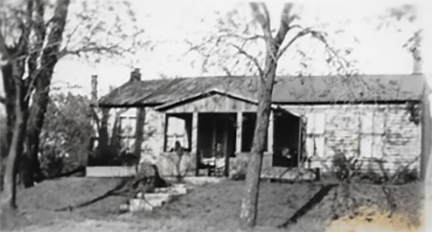
JOHN PEARSON CABIN
It is a matter of record that at least five important transactions, involving the beginnings of things here took place in this pioneer home in Winamac, to -wit: On May 5, 1839, the county was organized: on the same day Winamac was chosen as the county seat; eight days later May 13, 1839, the first election was held, that being the only place in the county where the polls were opened; the first meeting of the county commissioners was held May 27, 1839, at which the machine of the county was set going, being duly oiled up by a tax levy; then, finally, on April 24, 1840, the first term of the circuit court was opened there. “O yea, O yea, O yea! The Pulaski circuit is now in session.” All of these very interesting and immortal events took place in that one cabin. All but one over 82 years ago. As Mr. Pearson was one of the proprietors of that town and had assisted in laying off and platting it (really starting the town) it would seem highly probable that much of that was also done in his house. I would think that the exact location of that house should be hunted up and marked.
FIRST SCHOOL HOUSE in COUNTY
It is a matter of record that the first term of the circuit court after being opened in the home of John Pearson, adjourned to “the school house” and its remaining sessions were held there. It is of record, further, that what would seem to be the same school house served the purposes of a court house in other ways for several years and other public meetings were held there. If that house was built for school purposes, or being built was bought and devoted to that use, its location is worthy of being marked, as it was the first in the county. Or wherever the first school in the county stood, whether in Winamac or elsewhere, its exact location is worthy of being permanently known.
THE U.S. LAND OFFICE
The U.S. Land Office was located in Winamac from the late thirties until the fifties. All the land sold by the government during those years not only in this county but in all counties north and west of us in the state was sold here. All patents for land in those counties sold during those years, signed by the President of the United States, have the name of Winamac upon them. I would think the location of that Land Office should be marked.
THE GRAVE of CHIEF WINAMAC
It is generally known that the Indian chief after whom the town of Winamac was named (more commonly called Winnemac) was buried on the lot east of the Methodist church. If this can be satisfactorily verified that location is deserving of a tablet.
BURIAL PLACE of SQUIRE BOONE
I deem it beyond question that a man known as Squire Boone and who, with some si[ort from others, claimed to be the brother of Daniel Boone, is buried in a small cemetery, long since abandoned for interments, located in the timber on the right of the road to Star City (now State Road 15) between the Tippecanoe and Mill creek. That matter is being investigated and if the fact can be reasonably established that the man in question was the person he claimed to be, the place should be marked. The Squire Boone who was a brother and much of the time a companion of Daniel Boone, rendered distinguished public service.
Note from an editor: Daniel Boone & Squire Boone II are 2 of the 14 siblings born to Squire Boone Sr. & his wife Sarah. Squire II migrated to southern Indiana and is buried there. There is no evidence that any of these Boone siblings traveled as far north as Pulaski County. However, Jesse Hodges’s wife Sarah (Sally) is a descendant of George Ovid Boone, as is Elijah T. Oliver’s wife Catherine. Therefore, it is quite possible a distant relative of the numerous Boone families is buried at Wasson Cemetery.
STUMP’S BRIDGE
This was on the old LaFayette and Michigan City state road, evidently near where Medaryville was located some years later. It was built in 1838, by state funds, when the territory comprising this county was still under the jurisdiction of White county and was known as Stump’s bridge because George Stump built it rather than because it was near his house. It was unquestionably the first bridge of any size in the county and antedates any other bridge in the county of similar size by many years. I would judge that it spanned a stream of running water rather than a pond or slough. If its location can be determined and marked I would greatly appreciate seeing it, as indicating where the first step was taken towards bridging our streams.
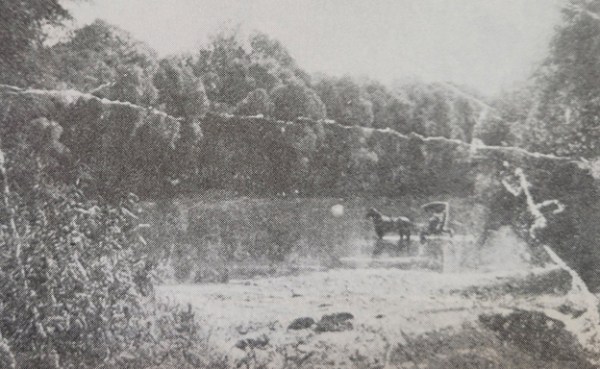
FERRY at WINAMAC
This was authorized and the projector was licensed to operate it at one of the first meetings of the county commissioner. Traces of the road leading down to it from North Main street are still visible. A few people are still living who crossed the river on it. It was a curiosity and a marker indicating its location would be a distinct landmark.
WHERE WINAMAC METHODIST CHURCH WAS ORGANIZED
This church the record says was organized in August 1838 and seems therefore to have been the first organized in the county. If the latter is true the site where it occurred deserves a marker.
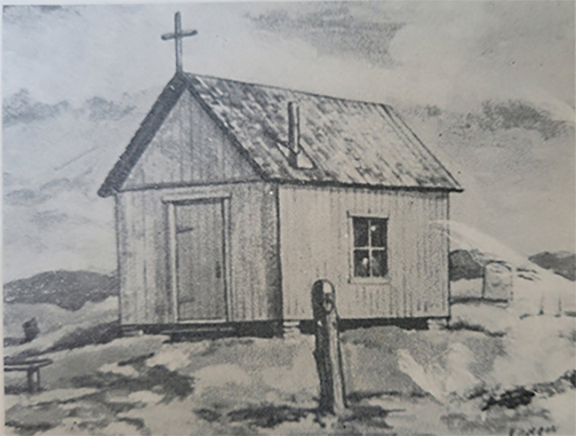
THE FIRST CHURCH BUILDING in the COUNTY
That site wherever it is I would say deserves to be marked. The sites of early churches in the various townships if marked would prove of unfailing interest through all coming time. Much of the sacred and treasured experiences of a neighborhood center in and around the churches. The very ground on which those early churches stood is consecrated ground.
THE SITE of the FIRST MILL and PERHAPS of ALL EARLY MILLS
It is almost impossible to understand or properly estimate the advantages brought to the doors of the early settlers by the erection of and successful operation of these pioneer mills. If the county outgrew them, they afforded most timely help when they first came. Well as I know the histories and often as I have seen most of them, I cannot be certain within a wide margin just where they stood, when I pass by. In many cases a stranger in passing would never dream he is on historic ground.
THE BARNETT HOUSE in WINAMAC
I have in mind the writing of an article at some future time on the distinguished men who at one time or other have visited our modest town, most of whom I have seen. While the old Barnett house was not the first or last hostelry here it was prominent for many years and its register, if one was kept, would show a lot of names known from ocean to ocean and some that will scarcely ever cease to be prominent in the annals of both State and Nation. What is said to be a part of the building removed to another lot still remains, but the hotel once so prominent and still remembered by many passed out of existence long years ago. Among other sites of interest in local history that it may be entitled to a place.
I will not enumerate further. The sites of early bridges on the Tippecanoe and Monon, of the first school houses, churches or cabin homes in the various townships, and probably other points of importance that will occur to others, should be considered. I have mentioned verbally on one or two occasions the surprising historical fact, recently dug out of the piles of musty records in Washington, that a regiment of cavalry visited the county in August 1791. This was when Washington was serving his first term as President and Indiana was a part of Virginia. Patrick Henry, as Governor of Virginia sent the cavalry to subdue the Indians. When the point has finally been determined, as I hope it soon will be, where they were obligated to halt and turn back, that will be a place for a very noted marker.
Links to Earlier Articles
- Part one(Common Inconveniences) October 2018 newsletter.
- Part two (Land) June 2019 newsletter.
- Part three (Trees & Timber) November 2019 newsletter.
- Part four (The River) February 2020 newsletter.
Later editions are carried as separate posts.
- Part five (Public Roads)
- Part six (Schools)
- Part seven (Markets & Trading Points)
- Part eight (It’s Mills)
- Part nine (Wild Game)
- Part ten (Feathered Wild Game)
- Part eleven (Animal Pests & Birds of Prey)
- Part twelve (Fishing in the Early Days)
- Part thirteen (Wild Fruit)
- Part fourteen (Early Commerce on the Tippecanoe)
- Part fifteen (It’s Homes and Home Life)
- Part sixteen (House Raisings)
- Part seventeen(Clothing a Family)
- Part eighteen (Log Rollings)
- Part nineteenth (First Trip to Winamac)
- Part twenty (Grubbings and Wood Choppings)
- Part twenty-one (Apple Peelings)
- Part twenty-two (Sausage Makings)
- Part twenty-three (Parties and Amusements)
- Part twenty-four (Early Wheat Raisings)
- Part twenty-five (Quilting Parties)
- Part twenty-six (Early Religious Practices)
- Part twenty-seven (Early Church Buildings)
- Part twenty-eight (Early Clergymen)
- Part twenty-nine (Early Funerals)
- Part thirty (Cold Winters and Wet Summers)
- Part thirty-one (The Morals of Early Settlers)
- Part thirty-two (Its Wet Lands)
- Part thirty-three (Early Sickness)
- Part thirty-four (Changes in People)