 The history of the Pearson, Huddleston, Kocher family was compiled by Roselyn (Huddleston) Kocher (great-great granddaughter of John and Edna Pearson) from conversations with descendants; letters, albums and other family records; history books and records in the Pulaski County Public Library; Pulaski County Courthouse records; shorthand notes; and cemetery markers. The history was given to the Pulaski County Historical Society by brothers John, Bill, and Doug Kocher, descendants. A copy of this history will be placed into the Semiquincentennial Time Capsule in early 2027.
We will start with brief notes on John Pearson, include some notes from Roselyn Kocher, then leave to you, the reader, to press further in the attached document.
Pearson Huddleston Kocher Family History
From Our Website
John Pearson built what is thought to be the first frame house in Winamac. Pearson, upon arrival to the area in 1838, moved into a vacated log cabin along the river. Later that year he built a larger log cabin to serve as a home for his wife Edna and their five children. The log cabin was also a trading post and tavern. This frame house was built in front of the log cabin in 1850.
Pearson was a prominent white settler and one of the founders of the town of Winamac, credited with naming the town. He is known as Winamac’s first entrepreneur. He owned the general store, tavern, and sawmill. He also held elected office as Clerk, Recorder, and Auditor.
He left Winamac for the gold fields of California. In 1850 on his return. He built what is thought to be the first frame house in Winamac. It was located in front of the log cabin he’d built for his family in 1839, just south of where the first sawmill was later established.

From Pulaski County Sesquicentennial, Volume I, 1989, “…in 1853, he severed relations with Pulaski County and moved to California where he was killed by Indians one year later.”
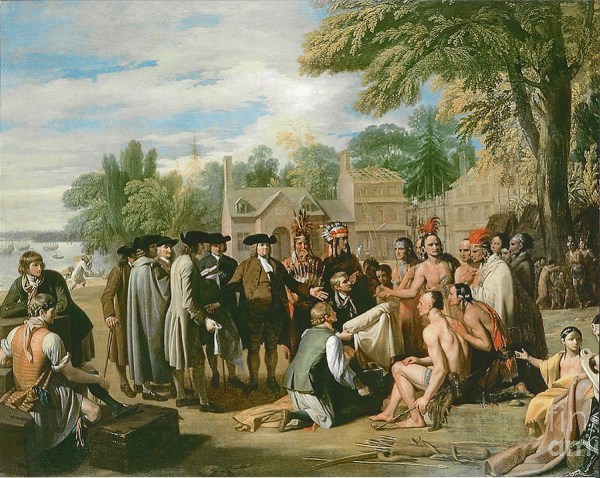
“Penn’s Treaty With the Indians”
Painted in 1771 by Benjamin West
In this iconic artwork, William Penn is shown standing under a massive elm tree in Shackamaxon (now Philadelphia), negotiating a peace treaty with the Lenape chiefs. Right next to William Penn stands a man holding a large, unfurled parchment. While many casual viewers assume it is the text of the treaty itself, historians and genealogy records note that the man is Thomas Pierson (Pearson), and the document he is unfurling is actually a survey map of the newly laid-out colony.
Thomas Pierson was the deeply trusted associate of William Penn and served as the Deputy Surveyor for the new colony of Pennsylvania and the surrounding territories (specifically Newcastle County).
Quaker Connection: Thomas Pierson was a devout Quaker who immigrated from England to escape religious persecution.
Why is he in the painting? The artist, Benjamin West, actually had a personal connection to this line; his own mother was Sarah Pearson. When West was commissioned to paint the famous treaty scene decades after it happened, he wanted to honor the prominent early settlers who built the colony, so he explicitly painted Thomas Pierson holding the survey map at William Perm’s right hand.
John Pearson
Some text from the attached PDF document will be reposted here, but for the full story, please see the original work from the family.
Early in 1838, John and Edna Pearson bought a covered wagon in Ohio, loaded their children in it (the youngest, an infant), and came to Winamac (before it was known as “Winamac”) in Pulaski County, Indiana. They moved into a vacant log cabin that was located at the east end of Spring Street, along the Tippecanoe River (now 220 and 222 North Riverside Drive in Winamac, Indiana).
The Spring Street log cabin did not have adequate space for their growing family and their future plans, so they set to work to build a much larger, more convenient cabin farther north, along the west bank of the river at the now 506 North Riverside Drive site in Winamac, Indiana. They moved into this cabin in late 1838.
Early in 1839, John Pearson established a trading center in his home. The community was happy about this as the nearest supply center for the earliest pioneers up to this time was Logansport. Pearson obtained about $200 worth of goods, notions, and other supplies when he first opened the trading center; the few settlers and the Potawatomi Indians traded cranberries, maple sugar, and venison for his merchandise.
John Pearson was known to be a peacemaker between the Indians and the settlers.
Pearson wanted to establish a large milling industry (with power slide) by the Tippecanoe River. In January 1839, he employed several workmen to dig a race, or canal, from Terry’s Creek. From that location (around the vicinity of the bridge north of Winamac on U.S. Highway 35), it proceeded across the present-day Phillips 66, A&P, and Winamac Power Plant sites to the Tippecanoe River. Then Person constructed the mill, but due to his election to county offices, and his interest in local government, he was unable to devote much time to the milling industry. Pearson sold an interest in the milling industry to Stephen and Abraham Bruce and Samuel Burson.
County Government & Town of Winamac
By the time the Pearson family moved to the area, Pulaski County had been platted and named by the State of Indiana, but it had not yet been formally designated. Pearson and four others, each pioneers to the new settlement, were very interested in locating the county seat in Winamac. The other main contender was a town closer to the middle of the county and some miles down the Tippecanoe River, the town of Pulaski.
To further their ends, the five promoters (Pearson, Jackson, Brown, Niles, and Polk) hired a surveyor, laid out, and platted the first 168 lots. Having no Recorder’s office, Recorder, or records of any type, the plat of the town was not recorded until later.
As an incentive to the Locating Commission, the promoters donated land for public uses and purposes. Lot 159 was set aside for a schoolhouse; the public square was donated for the courthouse; a tract of one acre north of Lots 121 and 168 (north of Madison Street) was donated for a seminary; and a tract of two acres west of town upon a part of the east half of the of the northeast quarter of Section 14 was donated for a cemetery. In addition, the use of the John Pearson log house on Lot 33 was granted for courthouse purposes for a period of four years, until a new courthouse could be built. The promoters also gave two notes to the town: a three-year note for $1,575.00, and a four-year note of a “like amount,” plus $125 in cash.
Many other town lots and tracts were given to the town by the promoters, which the town was authorized to sell and use the proceeds toward the erection of needed public buildings.
The Person log house was used to house county offices and the government land agent’s office from May 1839 until the first courthouse was completed on the public square. The Government Land Office was discontinued in Winamac in 1857.
By the Act of the Legislature, the Locating Commissioners met in the cabin of John Pearson (at the 506 N. Riverside Drive site), on May 6, 1839, and named the county seat Winnamack / Winnemack . (According to the Potawatomie Indians, the name means “catfish”.) The town was named after Chief Winnamack / Winnemack, who, with his tribe, had a village and lived in and about the vicinity of the town until after the War of 1812. The name of the town was shortened later (by the Post Office) to “Winamac.”
The first county election was held on May 13, 1839, at the place designated as the county seat, at the home of John Pearson. John Pearson became the first Clerk, Recorder and Auditor of Pulaski County. On May 27, the County Commissioners were sworn- in. They held their first meeting at the house of John Pearson in Winamac. The County was .laid out into three Commissioner districts. The County was then divided into four townships:
Likely the first marriage license issued in the county is recorded under date of June 3, 1839. It reads: “personally came before John Pearson, clerk of the Pulaski Circuit Court, the male parents of Robard White and Mary Ann Curtice, and made application for license for the purpose of binding their respective children in the bonds of matrimony, it being the desire of said Robard White and Mary Ann Curtice. I hereby authorize Abraham Sneathers to join the above named Robard White and Mary Ann Curtice according to law in marriage . (Signed) John Pearson, Clerk. There follows the certificate of Abraham Sneathers, minister of the gospel, showing that he performed the ceremony on June 6, 1839 .
John and Edna Pearson were among the first members of the Methodist Episcopal Church in Winamac; Edna became a member in 1839, and John in 1842 . The first church service was in the home of John Davis in 1839. John and Edna Pearson donated Lot 119 for a Methodist Church site, but for some reason the church members later bought Lot 104 (in 1859)·for $100, and in 1867 built a frame structure at that location. Church services were held in this building until it was torn down (in 1900) to make room for the brick structure which still stands. (Lot 119, donated by the Pearsons, was at the present 314 N. Market Street, Winamac, Indiana site.
The children of John and Edna Pearson attended the first school in Winamac (held in the summer or early fall of 1839, in a small log cabin which had been built and occupied by John Davis and family). The total enrollment was 10. John C. Waldo was the teaching master. The following year the cabin was again used as a residence and school was dismissed. Classes resumed in 1841 in the same location.
Since Lot 159 of the Original Plat had been donated by the Township Proprietors for school purposes, in 1843 — after a three-year construction period – a hewed log house was completed for educational purposes. It also served as a community center. It was used, too, for religious and political purposes.
In 1859, a frame schoolhouse was constructed, located on the same lot: 159. It was used as a school until 1871, and for business and professional establishments until 1926.
Family
John Pearson’s wife, Edna, died in 1847. The mother of several children; two only surviving: Martha Pearson and Shubel Pearson. After Edna Pearson’s death, John Pearson married Mrs. Lydia Chapin. To this union was born one son, John Pearson II.
John Pearson held the offices of Clerk, Recorder and Auditor of Pulaski County from 1839 to 1853. In the election of 1852, William Shipman Huddleston wanted to be Auditor of Pulaski County; so did John Pearson. The two men became involved in a lawsuit. The first case to go to the Appellate Court from Pulaski County was between Roselyn (Huddleston) Kocher’s great grandfather Huddleston and her great-great grandfather Pearson. The Court ruled in favor of the former, and great grandfather Huddleston became the second Auditor of Pulaski County, Indiana.
John Pearson made two trips to California during the “Gold Rush” era. He never returned from the second trip. Great-Grandfather Shubel Pearson told Roselyn that it was thought that his father was killed by the Indians – but not the Potawatomi; they were his friends.
John Pearson II lived in Kansas City, Missouri in the 1930s. During this period, he corresponded with Roselyn Huddleston and also with Judge John G. Reidelbach. Judge Reidelbach dictated the history of Pulaski County to Roselyn Huddleston. Portions of John Pearson ll’s letters are in the Reidelbach history of Pulaski County, Indiana.
The Rest of the Story
A sharp-eyed member of the Historical Society recognized a name in the Pearson Huddleston Kocher family history and did a little digging. What she found was a lovely headstone in Winamac Municipal Cemetery. The following information is from FindAGrave.com.
Fiana Dickey Burson (https://www.findagrave.com/memorial/120582880/fiana-burson)
- Birth: 13 Oct 1815, Elkton, Columbiana County, Ohio, USA
- Death: 27 Mar 1885 (aged 69), Winamac, Pulaski County, Indiana, USA
- Burial: Winamac Municipal Cemetery
Mrs. Fiana Burson died in Winamac, Ind., on Friday, March 27, 1885, in the 71st year of her age. Grandma Burson had been sick a long time with cancer, and during her last illness suffered great pain. The deceased was born in Columbiana County, Ohio, on the 13th of October 1814, and removed to Pulaski county in 1853. She leaves several children, Judge Burson, Mrs. S. Pearson, Mrs. Laura McGowan and W. B. Burson to our knowledge. She was a lady of many rare Christian virtues–a good, kind, charitable woman-whom to know was to love, honor and esteem. The families who are bereft by the removal of this dear old mother have the sympathy of all in the hour of their great sorrow, and we join in tendering our sincere condolence. Funeral services were held at the residence of Mr. Pearson, Eld. J. P. Barnett officiating.
Democratic Journal 04 Apr 1885
Excerpt from” Biographical History of Tippecanoe, White, Jasper, Newton, Benton, Warren & Pulaski Counties. Vol 2. pub. 1899. From an article about Judge George Burson. [Judge Burson served in the Civil War, beginning as the First Lieutenant of the first company raised in Pulaski County, joining the Forty-sixth Regiment. He mustered out as a Major.]
…James Burson married Fiana Dickey, who had been born October 13, 1815, in Pennsylvania, and in girlhood accompanied her father, James Dickey to Columbiana County, Ohio. The Dickeys were of Irish and German extraction. Mrs. Burson was an only daughter, and her two brothers were James and Moses. After the death of her first husband, she became the wife of his brother Silas. The children of the first marriage were George [the subject of this article]; Martin Luther, born January 5, 1846, now a successful physician of Streator, Illinois; Henry Gustavus, born in 1842, enlisted in the Ninety-ninth Illinois Infantry, was transferred to the artillery service, and was killed at the battle of Mission Ridge; Commodore Perry, born in 1844, enlisted in 1861, served in Company H, Forth-sixth Indiana Volunteer Infantry, and was killed at the Battle of Champion Hills, Mississippi, May 16, 1863; and Wellington Bonapart, born July 10, 1846, married Lucy Uptegraf, and has three children, being now the city engineer of Streator, Illinois. By the second marriage of our subject’s mother two daughters were born; Laura, who married Thomas McGown, and resides at Rensselaer, Indiana; and Ura who is the wife of Shubel Pearson, a merchant of Winamac.
With this updated information, two pages of the family history were updated and are ATTACHED.
Pearson Huddleston Kocher Family History PP 10 11