 This is the eighteenth in a Series of Reminiscences by E. R. Brown. Brown was born in Pulaski County on August 9, 1845. His writings are abstracted from the “Pulaski County Democrat” on microfilm housed in the Pulaski County Public Library, Winamac, Indiana. Find links to earlier entries at the end of this article.
Published in “Pulaski County Democrat,” June 15, 1922
It used to be common in the timbered sections of Indiana for people to come and assist a neighbor in rolling together, and piling in heaps, preparatory to burning, the refuse logs, limbs and brush on land he was clearing. This was gratuitous and such gatherings were called “log rollings.” But like other old ways of doing things, they began to wane about the time settlement here got started and our people, as we have seen before, were never slow in adopting improved methods. I have to confess that I did not before comprehend the progressive spirit of our pioneers as clearly as I have since beginning this series of sketches. They evidently lacked a whole lot of being moss-backs and happily their example is still being followed by their descendants and successors. No one need be surprised, therefore, when I say that while these log rollings were not unknown here, I have seen some myself, they were never numerous and were early discontinued.
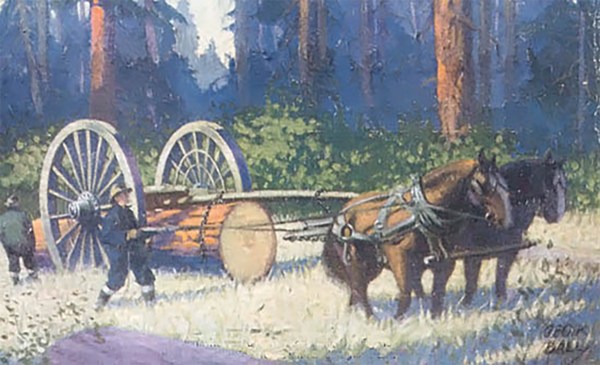
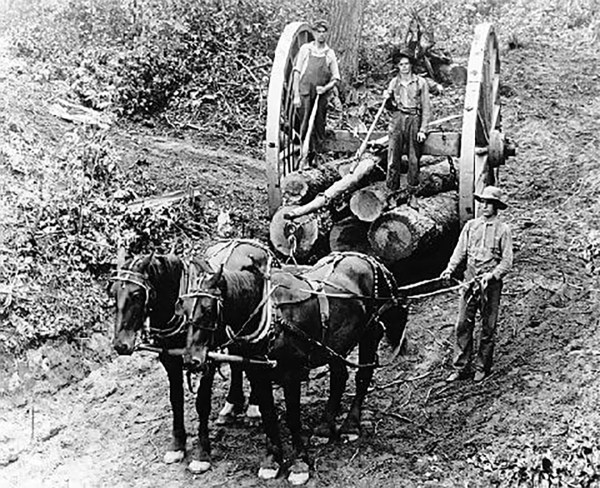
 There were two prominent reasons for the change. First, was the increase in the number and efficiency of sawmills, increasing the value of timber, so that not so many logs were burned, and secondly, was the decrease in the price of log chains and heavy ropes, making them more plentiful so that horses and oxen could be made to do as much as several men in a given time and with much less whoop and hurrah.
In part as a reproach, it was once said of the pioneers that they built good barns before they built good houses. In this connection it can be seen that in many cases they could not be blamed if they did. It was hardly possible to build barns having all necessary facilities out of logs alone. If, therefore, when sawed lumber became plentiful, a farmer did not have a barn at all equal to his needs who could say to him nay if he built one, even though the better house had to wait. Yet some built better houses first, while others built frame additions to their cabins or improved them otherwise, thus putting timber necessarily cut in clearing land to a better use than burning it in log heaps.
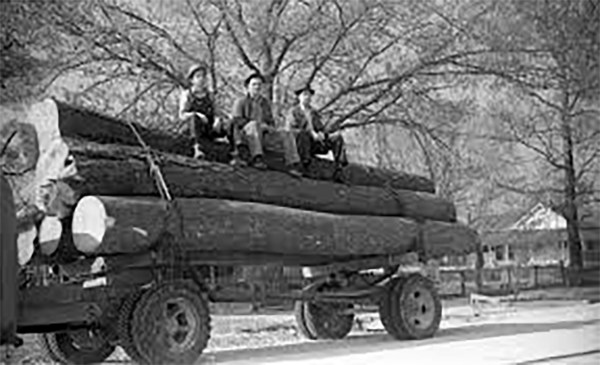 And, as to those logs regarded as of little or no value, I well remember my father’s first experience when, with the help of a hired hand (and of course a boy) he began using his horse team in this log rolling process. The result must have been something of a surprise to him and was evidently very gratifying. While no soil had then ever been turned in that field it would be called an old one now. Still, I believe I could almost go to it blindfolded, if I could not point out the exact location of some of the immense log heaps that were piled high that day and which later I saw go up in smoke. This was doubtless a typical experience and marked a new era in land clearing.
 I will mention in closing some features of these public gatherings, involving so much neighborly help in items of need and much hard unrequited toil most cheerfully rendered, which I have not known others to speak of, though I often heard them discussed in their day. One was the age-old matter of the loaves and fishes. Alas, too many came largely if not wholly for what they could eat or drink, only shirking and loafing where others were rendering diligent service. Another was the still pestiferous matter of strong drink. As is well known, whiskey was more often than not provided by the one being helped and was as free if not as plentiful as water, while it was always painfully in evidence that the shocking folly that in order to have a good time and enjoy some special occasion one must have some sort of stimulant, is not now a new evil. If liquor was not provided by the host, as it was not always, though it required some courage to disregard the custom, it was liable to be brought by others, so that drunkenness was the rue of such occasions, resulting in quarrels, sometimes in personal encounters and in the increase of hazards, if not in serious accidents. The latter, by the way, were of frequent occurrence, even when intoxicants were not their cause. Hence, all in all, the old gave way to the new because the new was better.
Links to Earlier Articles
- Part one (Common Inconveniences) October 2018 newsletter.
- Part two (Land) June 2019 newsletter.
- Part three (Trees & Timber) November 2019 newsletter.
- Part four (The River) February 2020 newsletter.
Later editions are carried as separate posts.
- Part five (Public Roads)
- Part six (Schools)
- Part seven (Markets & Trading Points)
- Part eight (It’s Mills)
- Part nine (Wild Game)
- Part ten (Feathered Wild Game)
- Part eleven (Animal Pests & Birds of Prey)
- Part twelve (Fishing in the Early Days)
- Part thirteen (Wild Fruit)
- Part fourteen (Early Commerce on the Tippecanoe)
- Part fifteen (It’s Homes and Home Life)
- Part sixteen (House Raisings)
- Part seventeen (Clothing a Family)