This is the thirty-seventh in a Series of Reminiscences by E. R. Brown. Brown was born in Pulaski County on August 9, 1845. His writings are abstracted from the “Pulaski County Democrat” on microfilm housed in the Pulaski County Public Library, Winamac, Indiana. Find links to earlier entries at the end of this article.
Published in “Pulaski County Democrat,” November 9, 1922
The improvement of the water power in the Tippecanoe at Pulaski and the building of the mills there had its inception very early – long before the village had an existence or a name. The suggestion seemed to come involuntarily to the first white people who came there, as well as to most who came later.
The stretch of the clear silvery river there for a mile or more must have been one of the most charming in its entire course. Flowing wide and strong, with innumerable giant oak trees lining its shapely banks and mirrored in its transparent depths, it at once won the admiration of all beholders. The two marked riffles, less than a half mile apart, the upper one having an unusually well-constructed Indian fish dam, furnished visible proof of the power available at that point.
Numerous reports of the predictions of enthusiastic travelers and visitors were in constant circulation, more than have ever come true so far, as to the prominence, commercially and otherwise, which was bound to take shape in that vicinity sooner or later. They were the common talk and were generally believed as far back as my recollection extends. In fact, deeds for real estate looking to that end seem to have been executed in 1839, six years before I was born.
I know of no reason why nothing was done at that time, but there was a circumstance which may have had something to do with the delay when in 1849, ten years later, other papers were executed. That was that none of the men behind the enterprise had at that time any money and were never known to have very much.
The movement which finally resulted in something being done took shape early in 1853. At that time Daniel Short, Samuel Good, Jonas Good Sr., John Decker, Ira Brown (my father) and John Stephens entered into a partnership to make the improvement. All of them farmers living nearby except Stephens who then lived at Lockport in Carroll County, and had previously had some experience with mills.
It was a part of the definite plan from the first that both a sawmill and grist mill should be built, both of them larger and more complete than any previously known here, and a woolen factory was to be added later on if conditions seemed favorable. I may say in this connection that my father always favored the latter addition or something else, even another saw mill on the east side of the river, in order to utilize the excess of power, his reason being that too much was invested in the dam and the expense of keeping it up was too high for what use was being made of it.
Daniel Short and Samuel Good soon saw that the financial burden was too heavy for their resources and were quietly permitted to withdraw. Jonas Good, Sr., was infirm before and he unfortunately died somewhat early in the enterprise. But his interest was mostly taken over by Decker and Brown.
Mr. Stephens soon moved to the neighborhood and the necessary ground on both sides of the river; together with water rights and other privileges having been acquired from former owners, it was these three men, particularly John Decker and Ira Brown, who pushed the much needed improvement which for so long was of such great benefit to a wide district of country to a successful issue.
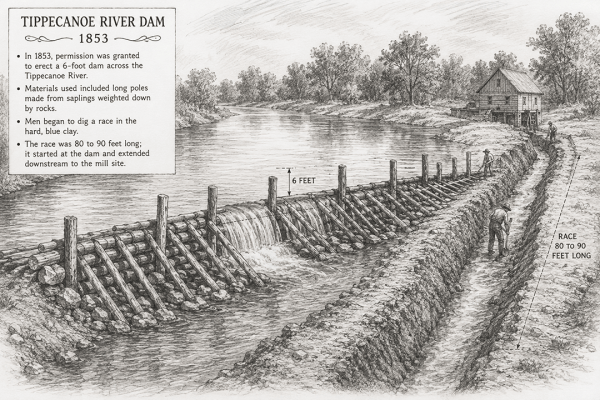
The statement in one history of the county that this dam was begun late in the summer of 1853 and finished the next year is erroneous. The work of getting out the timber for it was begun very early that spring, before the snow had all melted, the framing of it being started at once, while ground was broken for putting the dam in place just as soon as the stage of the water in the river would permit it and the last spike fastening the heavy plank in place which covered it, was driven before the first ice was frozen that fall.
This I know to be true beyond a preadventure. Not being able to get other help and not being willing to have the winter set in without the plank on, my father and Mr. Decker went into the cold water (perhaps in November) and spiked them on themselves. I saw them do it and have not forgotten what a shivering job it was, though it only required a day or two.
For that early day this dam was most creditable to its proprietors and owners. They absolutely spared nothing to make it as perfect as possible according to their lights. If the plans, about which they did not pretend to know anything, had not been at fault that original dam would be there today. The proprietors and owners did what enterprising progressive men always do, they employed the most expert professional men in that line available to draw their plans and supervise the work but as too often happens, that was the means of their undoing.
It was alleged in sworn statements afterwards that it cost $2000.00. The timber in it would alone cost four times that sum now – in fact, its cost would be prohibitive. Its abutments consisted of an oblong enclosure, perhaps 10X30 feet, composed of hewed timber one layer about another, well sunken in each bank and rising above ground perhaps 8 feet, the whole interior being filled with stone and gravel. Securely framed into these abutments and extending across the river from one side to the other were five layers of hewed timber at the lower side and two layers on the upper, those below resting on a foundation or apron of poles and brush, the two sides being well secured to each other by framed-in cross ties and the space between them being filled with stone.
Every stick of the timber used was either white oak or burr oak, wholly free from any suggestion of decay, while several groups of hands worked week in and week out in hauling, boating stone and gravel, taking infinite pains to place them properly and pack them thoroughly; then covering all, was the layer of plank mentioned above. All of the materials were obtained nearby, the plank being sawed at Hoover’s mill on Indian Creek.
But, alas, alack! There was a fatal defect which the sincere, well-meaning men thus putting their hard earned money into the enterprise could not know about at all until it was too late. The ‘apron’, so called, designed to receive the impact of the heavy weight of water pouring over the dam and prevent it from cutting into the bottom of the river, proved to be entirely inadequate for the purpose. In fact, as was known then to people of experience and should have been known to all pretending to be engineers, that in the absence of a very hard stone riverbed all other contrivances are and always have been inadequate with a square front dam as this one was.
A fact worthy of mention and of being remembered is that the only part of this apron which proved at all effective and which staved off disaster for a while, was contrived and put in place while the engineer (so-called) was absent, because the materials he had prescribed could no longer be obtained. If all the dam had been built like a small part of it (perhaps twenty feet) it would have been fine. That part was roof-shaped to facilitate the passage of lumber rafts, saw logs, etc. The gradually descending surface on the lower side at that point, which prevented the sudden drop of anything passing over the dam, at the same time carried the water away so that it could do no harm.
Links to Earlier Articles
- Part one(Common Inconveniences) October 2018 newsletter.
- Part two (Land) June 2019 newsletter.
- Part three (Trees & Timber) November 2019 newsletter.
- Part four (The River) February 2020 newsletter.
Later editions are carried as separate posts.
- Part five (Public Roads)
- Part six (Schools)
- Part seven (Markets & Trading Points)
- Part eight (It’s Mills)
- Part nine (Wild Game)
- Part ten (Feathered Wild Game)
- Part eleven (Animal Pests & Birds of Prey)
- Part twelve (Fishing in the Early Days)
- Part thirteen (Wild Fruit)
- Part fourteen (Early Commerce on the Tippecanoe)
- Part fifteen (It’s Homes and Home Life)
- Part sixteen (House Raisings)
- Part seventeen(Clothing a Family)
- Part eighteen (Log Rollings)
- Part nineteenth (First Trip to Winamac)
- Part twenty (Grubbings and Wood Choppings)
- Part twenty-one (Apple Peelings)
- Part twenty-two (Sausage Makings)
- Part twenty-three (Parties and Amusements)
- Part twenty-four (Early Wheat Raisings)
- Part twenty-five (Quilting Parties)
- Part twenty-six (Early Religious Practices)
- Part twenty-seven (Early Church Buildings)
- Part twenty-eight (Early Clergymen)
- Part twenty-nine (Early Funerals)
- Part thirty (Cold Winters and Wet Summers)
- Part thirty-one (The Morals of Early Settlers)
- Part thirty-two (Its Wet Lands)
- Part thirty-three (Early Sickness)
- Part thirty-four (Changes in People)
- Part thirty-five (Historical Markers)
- Part thirty-six (Early Operation of Pulaski Mills)