This is the twenty-ninth in a Series of Reminiscences by E. R. Brown. Brown was born in Pulaski County on August 9, 1845. His writings are abstracted from the “Pulaski County Democrat” on microfilm housed in the Pulaski County Public Library, Winamac, Indiana. Find links to earlier entries at the end of this article.
Published in “Pulaski County Democrat,” September 7, 1922
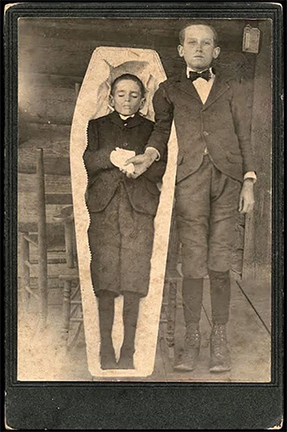
Naturally, our pioneers were not exempt from this common lot of all. In fact the divine edict “Unto dust shalt thou return” was enforced on them more ruthlessly and when younger than is often the case. It was not uncommon for children to be born into families while on the way from the east and members of families may have likewise died on the way here, though I do not know of such a case. I only know that death soon began to take a harsh toll after their arrival and I must say that as I write about those early funerals a sense of sadness and regret makes my heart ache.
I never knew or heard of a case here where the coffin was made by the family, though it may have been necessary at times. But I am sure few young people could witness those early funerals here as often as I did, frequently being required to take some part in them, without sharing my feelings about them.
The calling of funeral directors is, of course, a modern one. That of the undertaker is ancient, but no one was available for that here before a recent period, comparatively. It must be known too, that no ready-made coffins (much less caskets) were formerly kept in stock. Though it was known that certain men would make coffins to order, possibly a few taking some pains to have it known, no one was prepared to assume charge of dead bodies, or handle the situation in any way. I never saw a hearse in the county until some time after the Civil War.
The coffin was always made by hand after the person died, a measure of the body in length and across the shoulders was furnished. Sometimes the measurements were sent one day and the coffin sent for the next, and sometimes the one taking the measurements waited and brought it back with them. I myself have done it both ways. For various reasons too, I have been present when all the other simple primitive steps in burying the dead were being taken and have had some part in all of them. For this reason I know that there was a distressing poverty of materials and equipment and an unforgettable lack of experience and skill everywhere resulting often in rude or blundering preparations and in all subsequent details. Plain and cheap looking as everything was expected to be it was often impossible to get what was preferred. Black walnut was more in flavor than any other 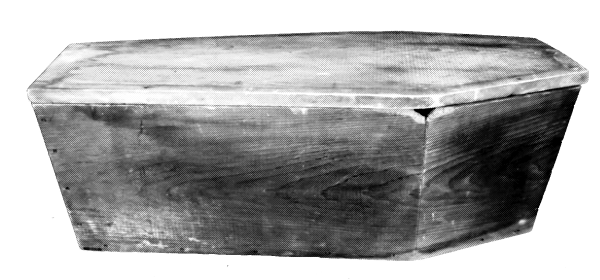 wood, but that could not always be obtained when wanted. So as to the making and timing, workmen not being able to do the job as desired or being obliged to substitute in many particulars. Delays as well as disappointments were common, sometimes with all the people waiting at the house. I have seen a few burials in unshaped oblong boxes, square at the corners, the same width from end to end and with flat lid. But the conventional shaped coffin was wider at the shoulders and tapering towards the ends, though wider at the head than at the foot and with a gable roof-shaped lid projecting over the sides and ends. There was hardly ever a total lack of finish, either of oil or shellac, or a total lack of lining, though in rare cases, both were lacking. For the coffin to be too large to look well or so small as to barely do, was not unusual.
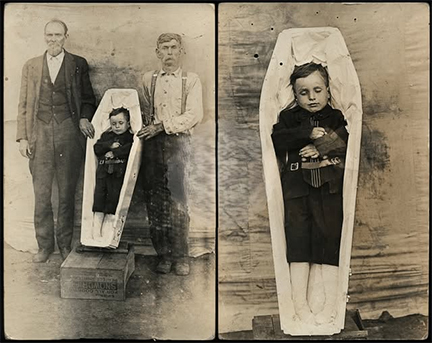
The ordinary farm wagon of that date filled the place of the modern funeral car and a white bed sheet commonly answered for a pall. If someone happened to have a new wagon or an attractive team of horses he was usually asked to render that service. I have often seen a quilt of many colors or a coverlet of some somber hue used instead of the white sheet. Graves were always dug by neighbors gratuitously, generally a light task, unless the ground was frozen deep or very dry and hard. Graves were wider and deeper then than now and often bore visible evidence of the rough, unskilled hands. The rule was to take the lines from the team hauling the coffin with which to lower it in the grave. The men present, not related to the family, took turns in using the shovels at hand to put the excavated dirt back in the grave, all standing by until a mound had been carefully rounded up. Before this, however, an opportunity was almost always given to view the remains. Two chairs were brought from a wagon (where they were commonly used for seats) to support the coffin while the lid was removed for that purpose. To this end it was for someone to see that a screw driver was brought along, and some carpenter or person accustomed to using one was asked to do the work. Plain, flatheaded screws continued to be used for many years. When those with round heads appeared they were noted as being an improvement and those more ornamented which were finished in imitation of silver and could be turned by hand, marked an era of progress.

In reflecting about these early funerals in more recent years, the extreme naked plainness of them, their sore distressing lack of those early funerals which are to express respect, honor and affection have impressed me very deeply. I know myself that more, if not all, of those long-departed ones deserved more. If all was done that was possible under the circumstances, as in all probability it was, it only serves to show the hard lot of our early settlers. The angels of God never brought into any homes more perfectly formed, sweeter or more charming children, than some who were buried in this way. So for bright promising boys and girls and young men and young women, those who were called so early and were laid away as I have tried to show, might be matched but they cannot be surpassed, either in looks or in character, by those of any other period. It seems to me to be a great pity. The thoughtful concern and deft touch of devoted women was anxiously added. It seems to me to be a great pity. The glorious resurrection will come and all minor things will be forgotten. So something of the same will come to these early friends and loved ones.
Links to Earlier Articles
- Part one(Common Inconveniences) October 2018 newsletter.
- Part two (Land) June 2019 newsletter.
- Part three (Trees & Timber) November 2019 newsletter.
- Part four (The River) February 2020 newsletter.
Later editions are carried as separate posts.
- Part five (Public Roads)
- Part six (Schools)
- Part seven (Markets & Trading Points)
- Part eight (It’s Mills)
- Part nine (Wild Game)
- Part ten (Feathered Wild Game)
- Part eleven (Animal Pests & Birds of Prey)
- Part twelve (Fishing in the Early Days)
- Part thirteen (Wild Fruit)
- Part fourteen (Early Commerce on the Tippecanoe)
- Part fifteen (It’s Homes and Home Life)
- Part sixteen (House Raisings)
- Part seventeen(Clothing a Family)
- Part eighteen (Log Rollings)
- Part nineteenth (First Trip to Winamac)
- Part twenty (Grubbings and Wood Choppings)
- Part twenty-one (Apple Peelings)
- Part twenty-two (Sausage Makings)
- Part twenty-three (Parties and Amusements)
- Part twenty-four (Early Wheat Raisings)
- Part twenty-five (Quilting Parties)
- Part twenty-six (Early Religious Practices)
- Part twenty-seven (Early Church Buildings)
- Part twenty-eight (Early Clergymen)