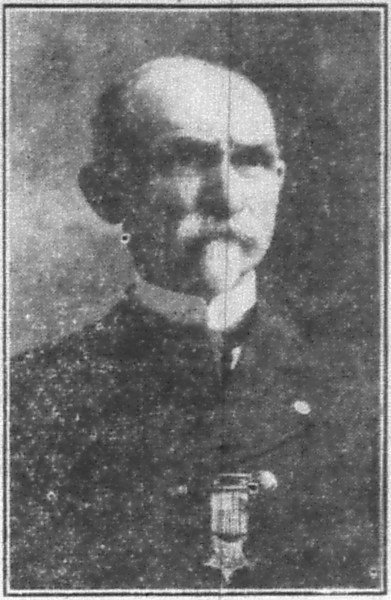
 This is the fortieth in a Series of Reminiscences by E. R. Brown. Brown was born in Pulaski County on August 9, 1845. His writings are abstracted from the “Pulaski County Democrat” on microfilm housed in the Pulaski County Public Library, Winamac, Indiana. Find links to earlier entries at the end of this article.
Published in “Pulaski County Democrat,” January 4, 2023
(Continued: see links to two previous articles at bottom of page)
This timber condition, however – “a chain of thin groves extending in the direction of the Wabash” – was exactly met, as were all other conditions, by the Mud Creek slough. This was none other than the well-remembered grove – always referred to as ‘the grove’ by the people of our neighborhood – which cut such a figure in my life from early childhood up.
My father owned a good part of this body of fine timber, though probably not the part concerned here. It became very dense later on and at the time under consideration was evidently not “a chain of thin groves.” With some allowance again for infelicity of expression, however, I can understand why the officers would say that.
In the absence of undergrowth, some trees also being much taller than others, to a person quite a distance away, with tall, thick grass and luxuriant cat-tails everywhere about him, the one grove might have seemed to be divided into a succession of groves.
There were plenty of trees there which had witnessed the coming and going of from 300 to 500 summers and winters. The majestic white oak I had previously mentioned stood not much over half a mile from where the officer must have come. An unusually fine black walnut, four feet in diameter, measuring 60 feet to the first limb and as sound as a dollar through and through, stood much nearer.
Plenty of trees of different species were 100 feet to their topmost branches. Later on, black walnuts, shell bark hickory nuts, butter nuts, grapes and many kinds of berries abounded. It was rare for the rays of the sun to touch the ground anywhere. Overcast and shadowy even on a bright day and always resonant with the reverberating calls of wild birds and animals, it always affected me peculiarly wandering around it.
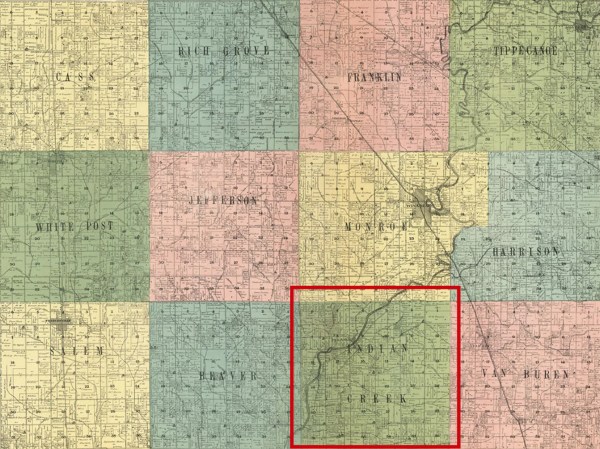
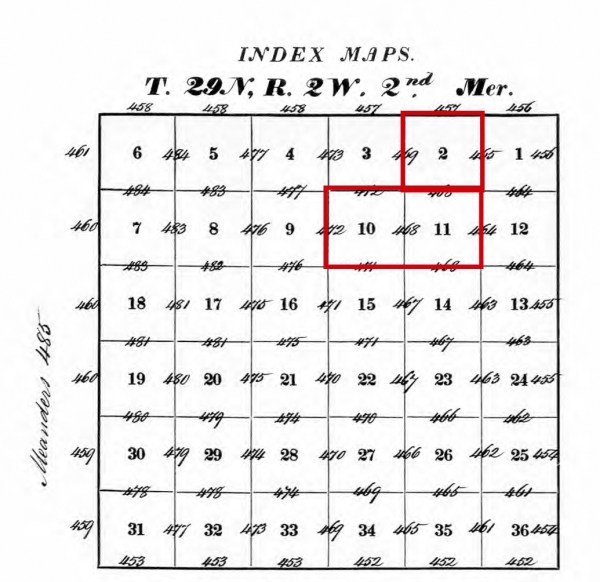
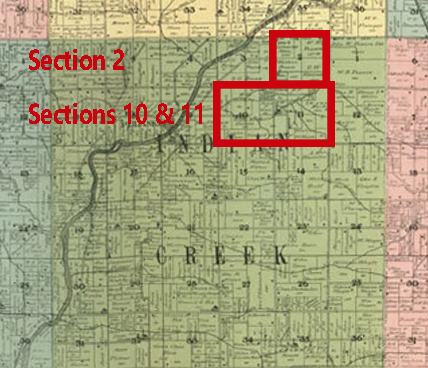
Without a recent visit, as I have contemplated with a view of locating these points of interest, my surmise would be that the place where the soldiers finally realized that they could not proceed further on their course was somewhere in section 2 not far from its south line, and that they found a refuge by reaching solid ground somewhere in section 10 or 11 near their north line.
From there, if they had only known it was easily possible for them to proceed northwest and within 24 hours, they might have found a way to search the offending Kickapoos. But fate often plays a curious hand in military projects and after giving a touch of romantic interest if not of glory to the history of our county, the expedition turned ‘south by west’, as the report says, and following the chain of ridges in that direction, without further incident was soon back on its former road.
It evidently re-crossed Mud Creek near where the George Green residence has more recently stood and where that of Hon. Samuel Decker was located on the opposite bank. There was a good ford there for many years after our first settlers came.
In thus going out of the county, they passed near where the homes of the Fisher’s, Washburn’s, Senn’s, Gaby’s, Lidgard’s, Pepper’s and many others of my time were to be, while in coming north they had passed near those of the Moyer’s, Korner’s, Kahler’s, Stagmeyer’s, Brown’s, Compton’s, May’s, Crist’s, Clapp’s, and others.
The Stone Prairie has always been a slightly attractive section. I confess that the thought of this large body of armed mounted men sweeping across in serried ranks, with their blue and gold guidons and streamers fluttering in the air and the polished brass and steel of their equipments glistening in the sunlight of that far-off day, impresses me with distinct fervor. And this fervor is increased when I recall how many brave boys from this splendid section afterwards took up arms and made fine records in a great war – some of them serving in the cavalry.
*** Thus ends this 3-part article.
Note: The fore-going three issues contain information having to do with a unit of cavalry soldiers venturing into the lower regions of Pulaski County Indiana. Keep in mind, E. R. Brown is talking about an expedition led by Col. James Wilsonson in August of 1791.
Links to Earlier Articles
- Part one (Common Inconveniences) October 2018 newsletter.
- Part two (Land) June 2019 newsletter.
- Part three (Trees & Timber) November 2019 newsletter.
- Part four (The River) February 2020 newsletter.
Later editions are carried as separate posts.
- Part five (Public Roads)
- Part six (Schools)
- Part seven (Markets & Trading Points)
- Part eight (It’s Mills)
- Part nine (Wild Game)
- Part ten (Feathered Wild Game)
- Part eleven (Animal Pests & Birds of Prey)
- Part twelve (Fishing in the Early Days)
- Part thirteen (Wild Fruit)
- Part fourteen (Early Commerce on the Tippecanoe)
- Part fifteen (It’s Homes and Home Life)
- Part sixteen (House Raisings)
- Part seventeen(Clothing a Family)
- Part eighteen (Log Rollings)
- Part nineteenth (First Trip to Winamac)
- Part twenty (Grubbings and Wood Choppings)
- Part twenty-one (Apple Peelings)
- Part twenty-two (Sausage Makings)
- Part twenty-three (Parties and Amusements)
- Part twenty-four (Early Wheat Raisings)
- Part twenty-five (Quilting Parties)
- Part twenty-six (Early Religious Practices)
- Part twenty-seven (Early Church Buildings)
- Part twenty-eight (Early Clergymen)
- Part twenty-nine (Early Funerals)
- Part thirty (Cold Winters and Wet Summers)
- Part thirty-one (The Morals of Early Settlers)
- Part thirty-two (Its Wet Lands)
- Part thirty-three (Early Sickness)
- Part thirty-four (Changes in People)
- Part thirty-five (Historical Markers)
- Part thirty-six (Early Operation of Pulaski Mills)
- Part thirty-seven (The Pulaski Dam)
- Part thirty-eight (A Matter Of Long Ago, Indeed, Part 1)
- Part thirty-nine (A Matter of Long Ago, Indeed, Part 2)