 We’re not telling a story so much as relaying information gleaned from a variety of sources.
Some items regarding the Civil War were gleaned from the Commissioners’ notes.
Keep an eye out for the name J.W. Selder. You can follow his path a little in these writings.
Commissioners Court Special Term July 3rd, 1862
Whereas to enable men having families to support, to volunteer in the Army under the call for 300,000 volunteers. It is ordered by the Board that there is allowed to the family of each volunteer from Pulaski County in the company now forming in said county the sum of Twenty Five Dollars, any volunteer leaving a widowed mother dependent on him for her support is hereby considered a man with a family, such amount to be paid when said volunteers are mustered into the service of the United States Upon the certificate of the Captain of such company to be paid to the wife of such volunteer leaving or such widowed mother of the volunteer, and none shall receive the benefits of this order unless he shall have volunteered by the 15th day of August 1862, nor shall the benefits of this order apply to the family of any person who may volunteer in any company out of Pulaski County. Which amount to be paid out of any money belonging to the County, not otherwise appropriated by the Treasurer upon the order of the Auditor of said County.
- T. Wickersham, Auditor P. C.
Commissioners Court Special Term August 6th, 1862
A list of Volunteers entitled to Bounty from Pulaski County, under the order of the Board of Commissioners made at their Special term on the 6th day of August, 1862.
Capt. J. W. Selder, Wm. W. Agnew, Wm. Poole, John J. Murphy, John May, Christopher Doremus, Luther Williams, Jacob Lemaster, G. R. Allen, Wm. Bridgman, Robert W. Budd, David N. Barnes, David Bube, Andrew Burch, Frederick Bourn, Louis Crimm, John G. Crist, Cornelius Doremus, Cyrus Ernsperger, Samuel B. Glover, Joseph G. Goble, Tillman Davis, John Helm, George W. Hight, Isaac Hoback, Jeremiah Hinkle, John Hodges, Edward Kirkham, Charles N. Meeker, Ruben McDaniel, John McCarty, Jacob McCarty, Joseph McCoy, George Parrott, Noah Penny, John Stamm, John B. Sickman, Ithamar M. Vanscoyk, Andrew P. Williams, Manliff Williamson, W. N. Waterhouse, Spencer Boyles, John Cappis, Henry Griffith.
I, James W. Selder, Captain of Company B 87th Regt. Indiana Volunteers do certify that the foregoing named men have all been mustered into the United States service and are members of my Company and further that each one of them leave wives or are sons of widows and that they volunteered before the 18th day of August 1862 from Pulaski County, Indiana.
Given under my hand at Camp Rose, Ind. this 22 day of August 1862.
(signed) J. W. Selder, Capt., Com. B 87th Reg Ind. Vol.
Filed and recorded Aug 26th 1862
- T. Wickersham
From Findagrave.com
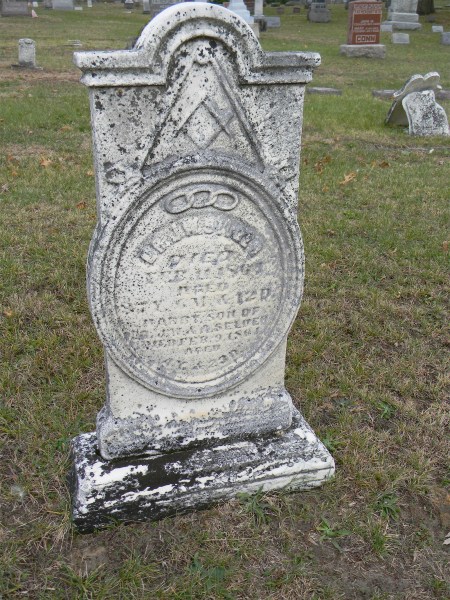
James W. Selder is buried in the Winamac Cemetery.
Birth: 31 Jul 1824, Westmoreland County, Pennsylvania, USA
Death: 11 Feb 1864 (aged 39), Winamac, Pulaski County, Indiana, USA
James W. Selder md. Lovina E. Lockwood 4 Mar 1851, Jones Co., IA. License issued 28 Feb 1851. [died 1954], Harvey Taylor minister. James W. Selder md. Augusta Noyes 20 Dec 1855 Dearborn Co., IN
From An Additional Resource
These items were copy/pasted from Counties of White and Pulaski, Indiana, 1883, Chicago, F.A. Battey & Co.. Kindle Edition. Because this was the Kindle edition, I cannot reference page numbers of the hard copy version.
The Rebellion
During the latter part of 1860 and the early part of 1861, the warmest interest of the citizens of the county was centered upon the important political changes that were overshadowing the country. Some felt the coming storm and accurately predicted the prolonged and dreadful results. Others had no fear that the American people would have the courage and hardihood to spring upon the country a gigantic civil war in the support of any principle likely to be involved.
As State after State in the South passed ordinances of secession, all the better citizens of each party were united upon the question of supporting the administration of Mr. Lincoln and upholding the constitution and the laws. As yet the all-important question of slavery had not been seriously considered as to its partial suppression or total obliteration, and all those bitter sentiments and controversies which were to array one section of the North against the other, almost to the extent of open war, were yet unknown, and the county, as a whole, was united and hopefully tranquil.
The Fall of Sumter
When the news of the fall of Fort Sumter swept over the country like a flame of fire, the most intense excitement in all places prevailed. The suspense in Pulaski County was bewildering. The first reports depopulated the rural districts, suspended all agricultural and other pursuits, and flooded the towns, telegraph offices and news stations with vast crowds of excited, indignant and determined citizens.
All former political antagonisms were speedily relinquished. Men everywhere forgot their daily employment and gathered at crossroads and villages to discuss the political situation, denounce the rebellion and encourage one another with hopeful and loyal words. Every heart was disturbed with direful misgivings.
Old men who had passed through the political storms of half a century, who had learned to put their faith in the nobility of the American character, who had seen the Government rise like Neptune from the sea, serene and sublime, until its broad dome shed its protection upon the lowest of God’s creatures, turned away in tears, sick at heart, from the dark, desperate and forbidding aspect. Many were palsied with sickening fear at the vision of the horrors of civil war, and, regardless of the safety of the Government, turned first to the protection of their loved ones.
Still others flew to the doubtful consolation that no sacrifice of life and property could be too great to quell the rebellion at all hazard and maintain intact the Union of the States. But public sentiment soon recovered from the shock. Men by the thousand, with Spartan hardihood, signified their anxiety to go out to their country’s battles. Mothers tendered their sons ; wives their husbands ; maidens their lovers; children their parents; parents their children; sisters their brothers – all were intensely eager to show their devotion to their beloved country. And the opportunity was not wanting.
An Incident
A short time before the news was received that Lincoln had been assassinated, a man named Myers living at Winamac, announced that through some spiritual manifestation he had learned that such a calamity was to occur, and told to his friends many of the scenes surrounding that lamented incident. No attention was paid to his story until the county was electrified with the news of the attack on the principal heads of the Executive department, and then the story was suddenly brought to public attention and publicity, and at last Myers was arrested.
It was thought at the time that the assassination was the result of the machinations of treasonable secret societies, and while arrests were being made in the East, it was thought probable at Winamac that Myers might have been connected with such societies. His deposition was taken, published and circulated, attracting no little attention from all parts of the Union. Quite a disturbance occurred at the time of his arrest, but he was soon released.
Excitement at Winamac.
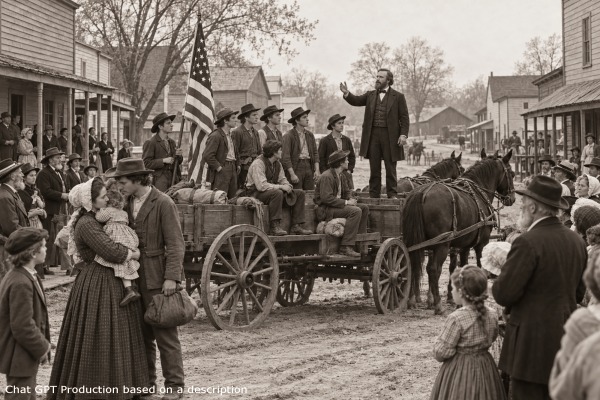
Within a week after the news was received that Sumter had been surrendered to the rebels, a notice was circulated in Winamac and vicinity that a public meeting would be held at the court house, to consider the state of the country, and to take some action in response to the call of the President for 75,000 militia. Some 400 persons assembled, quite a bevy of ladies being among the number, and the meeting was addressed, first by the Chairman, who, in a brief speech, announced that the object of the call was to arrange matters so that any volunteers asked for could be quickly and easily secured and dispatched with promptness to the field.
Dr. F. B. Thomas was then called out. He spoke at length upon the political issues of the day, declaring that while he had not cast his ballot for the Republican ticket, still he was heartily in favor of supporting the administration of Mr. Lincoln in the “vigorous prosecution” of the war and the immediate crushing of the rebellion. He was loudly cheered at the conclusion of his remarks, and then other speakers followed in rapid succession, amid great excitement and intense loyalty.
Almost all the leading citizens of Winamac were called out, and all were greeted with tumultuous applause. James W. Eldridge delivered an eloquent speech. He was followed by Byron T. Lane, W. C. Barnett, H. P. Rowan, A. I. Gould, W. S. Huddleston, Stephen Bruce and others.
The burden of every speech was, that it was the duty of all loyal citizens of any party to cast aside political prejudice, and rally as one man to the support of the Constitution and the Union. It is stated, however, that there were men present, and quite a number throughout the county, who were conscientious in the belief that the Southern States had the right to leave the Union if they saw proper to do so, and that the constituted authorities had no right to coerce them to remain.
They were champions of the doctrine of State Rights – a doctrine that has done more to imbitter the North and the South against each other during the preceding half a century than any other cause except slavery. They believed that the administration was violating the Constitution in levying war to prevent States from leaving the Union.
The effect of former Congressional legislation on this question was felt not only in the South, but in all the North. Men who had been bred as far north as the Canada line, believed not only in the sovereignty of the States, but in the “divine institution” of slavery as well. This was the inevitable result of Congressional teaching, where the knee had constantly been bent in abject servility to both doctrines on the floor of the highest law-making power.
It was then no wonder that humble citizens in Pulaski County had been so impressed with the horrid heresy that they sincerely believed as John C. Calhoun and Jefferson Davis believed. At the outset of the war, when it was yet thought that the question of slavery would not be seriously considered, several citizens of the county, believing that the Southern States had the right to leave the Union, quietly opposed a continuation of the struggle.
Later, when it was seen that slavery, as well as secession, was doomed, they were outspoken and bitterly energetic in opposing the course of Mr. Lincoln.
At this first meeting above mentioned, no sentiment save loyalty was publicly expressed, but here and there could be seen an ominous shake of the head, and a prophetic warning quietly uttered. J. W. Eldridge, W. J. Gridley and G. T. Wickersham were appointed a committee to prepare resolutions expressive of the sense of the meeting. The resolutions, about ten in number, were adopted after some comment. They embodied, in substance, the burden of the speeches that had been delivered that afternoon and were thoroughly loyal and determined.
Three Months’ Men
Within two weeks after the fall of Sumter, about fifteen men left the county, going to Logansport, and joining the Ninth Regiment, destined for the three months’ service. A squad of about ten of these boys assembled at Winamac, to be taken to Logansport in wagons. Quite a crowd gathered on the street as the time for their departure drew near.
Just before they left, Stephen Bruce addressed them in a short speech, praising them for their loyalty and bravery, adjuring them never to allow the flag to trail in the dust, and promising that they who left families behind need borrow no trouble, as no one would be permitted to starve as long as he continued operating his grist mill.
Away the boys went amid the cheers of their fellow-citizens, and the tears and lingering farewells of loving friends. It was but a short time after this that other men began to leave the county for the three months’ service. It has thus been estimated that under the call for 75,000 volunteers, about thirty men entered the service from Pulaski County.
The First Company
As it was thought that the rebellion would be brought to a speedy close by the three months’ men, the further enlistment of volunteers in Pulaski County languished until fall, when Dr. F. B. Thomas was commissioned to raise a company for the three years’ service. The enlistment of men was begun and continued during the months of September and October 1861.
As there was no newspaper at Winamac when this meeting was held, and as no record was kept of the proceedings, the statements above are made from the recollection of those who participated, and who could be induced to impart the desired information. The account must be taken with some grains of allowance. A citizen, who was relied on for matters embraced in this chapter, although asked four different times for items, said on each occasion, “I have no time to talk with you.”
This will, in a measure, illustrate the obstacles which the historian has had to encounter, and will account for the dearth of important matter in the military history of Pulaski County contained in the above stimulus of a big war meeting, where loyal and fiery speeches were made, patriotic airs were sung, and beautiful ladies with bewitching smiles passed round the fatal enlistment roll.
The company was quickly raised, and the election of officers resulted as follows: F. B. Thomas, Captain; George Burson, First Lieutenant; James Brown, Second Lieutenant.
The company was mustered in on the 5th of November, and soon afterward was ordered with its regiment, the Forty-sixth, to the front. There was much excitement in the county while this company was being enlisted. Col. G. M. Fitch, of the Forty-sixth, came and spoke at Winamac and other places.
Capt. Thomas held meetings at Winamac, Pulaski, Monterey, Francesville, Medaryville and other places, securing at each place a few volunteers for his company. Mr. Burson was also active in all these meetings.
A Splendid Dinner
At last, when the company was ready to depart, a splendid dinner was spread out for the boys in Lane’s Hall. Every provision which bountiful stores could supply, and every luxury and convenience which love could suggest, was placed upon the board, and the heavy tables groaned under the weight as if in protest.
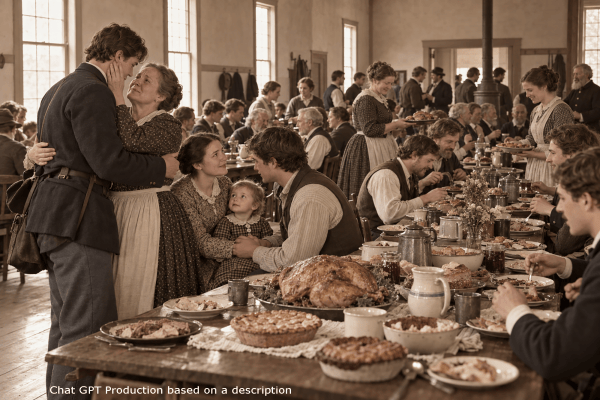
Ah, it was a feast the boys remembered long afterward, when “hard-tack” and “sowbelly ” were ravenously devoured, or when the fare was little better than nothing in the gloomy prison hells which Southern cruelty had devised.
How they gorged themselves, as if a forecast of the future was shadowed before them! Whole turkeys disappeared as if by magic. Pies, cakes, jams, jellies, without limit or number, were speedily put where they would do the most good. At last, the feast was over, good-byes were spoken with pale lips and streaming eyes, but brave hearts; warm kisses and embraces were passionately exchanged for the last time, and all hearts were rent with unspeakable anguish.
Slowly the long train pulled out with its human sacrifice. They were gone. Quite a number of three years’ men, however, had left the county for the war before the departure of the company of Capt. Thomas. These men left the county to enlist and were credited to where the companies to which they belonged were raised.
Additional Regiments
When the Ninth Regiment was re-organized in August 1861 and mustered into the service for three years in September, about one-half of Company D was taken from Pulaski County.
Besides these there were a few in other companies, notably G, of the same regiment; and there were in the whole regiment not less than about seventy men from the county. There were also a few men from Pulaski in the Thirteenth, Fifteenth, Seventeenth and Twentieth Regiments.
There were but a few from Pulaski in the last-mentioned regiment when it first took the field; but during the progress of the war many others joined it as recruits. Owing to the fact that the county was comparatively small, and could not furnish many full companies, her men went in small detachments to various regiments, were often credited to other counties where such regiments were raised, and, as no proper record was kept, the facts cannot now be traced.
About one-third of Company A, of the Twenty-sixth Regiment, was from Pulaski. The men were mustered August 30, 1861. One-half of Company C, of the Twenty-ninth, was from Pulaski, the men being mustered in during the months of August, September and October. Besides the company of Capt. Thomas in the Forty-sixth, two other companies had a few men from the county. During the winter of 1861-62, scarcely anything was done to raise men for the war.
This was not due to a lack of proper interest in the struggle, but was because of the cold weather. Early in the spring, volunteering was revived, and received a fresh impetus, from the fact that the citizens had begun to realize the stupendous character of the war, and were fully determined to do their share in ending it.
Men began to leave the county, entering the Forty-eighth, Sixty-third and other regiments. Several recruiting officers from other counties appeared, and steadily drained Pulaski of her best men.
Dr. James W. Selder
In July and August 1862, war meetings began to be held in all parts of the county. Schoolhouses, churches and other public buildings were thus used. It was announced that unless the county’s quota was full by the middle of September, a draft would surely take place. This was sufficient to rouse the citizens to their best efforts. Dr. James W. Selder was authorized to raise a company, and was commissioned Captain. Meetings were held all over the county, and soon his company was full.
About twenty-five men joined Company E, organized in Fulton County, and commanded by Capt. Troutman. There were also a few Pulaski men in Company A, and others. All these men entered the Eighty-seventh Regiment.
Disloyalty
About this time a sentiment in opposition to the war began to be manifested. The editor of the Pulaski County Democrat, a young attorney named Rufus Magee, adopted ultra measures in espousing the cause of his party. His paper had much to do with the feeling in the county hostile to the war.
The Knights of the Golden Circle also made their appearance and added their influence to the general ill-will. It was nothing unusual to hear men publicly state that they would not assist, by a solitary dollar, a continuance of the most unjust war.
The names “Copperhead” and “Abolitionist” began to have a sting, and more than one black eye and bloody nose resulted from an injudicious use of them.
Butternut breastpins became fashionable. The “nigger” and all his sympathizers were made the objects of suggestive ridicule. “Secessionist” was the word that was flaunted in the face of many, but nothing good was thereby accomplished. It only served to array, unnecessarily, neighbor against neighbor.
To Be Continued….