If you are interested in locating the historic places named by E. R. Brown, here are a few clues.
Pearson Cabin
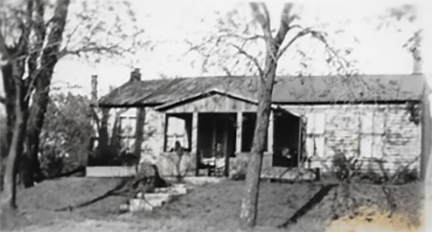
Upon arrival in 1838, John Pearson moved into a vacated log cabin along the river. Later that year he built a larger log cabin to serve as a home for his family. It was also a trading post and tavern. The frame house was built in front of the log cabin in 1850. Pearson was one of the founders of the town of Winamac. He is credited with giving the town its name. In this 1936 picture of the Pearson-Agnew house, the first water tower can be seen beyond the north (left) end of the house. The structure was nearly 90 years old but looked very much as it had when first built.
First School House in County
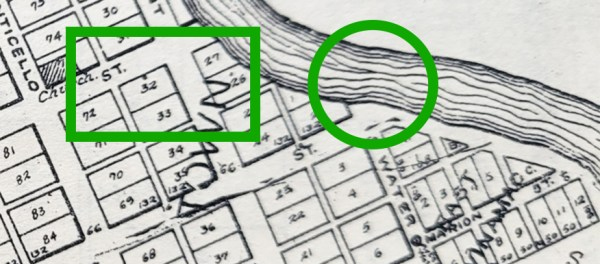
First schoolhouse in Winamac: The original Courthouse was on Lot 33, which held a “good hewed-log house.” It held both the first circuit court and a school. Lot 33 faces Front Street and is located six lots north of the first survey marker at Front and Main Streets. It is also very close to what then was “downtown,” with most of the town’s residences and several small businesses.
Two things happened in 1843. First, the construction of the first log schoolhouse was completed on Lot 159 (on Logan Street, just south of Pearl Street). This moved the school away from the good-hewed log house. That same year, construction began on the first courthouse to be located on the courthouse square, a two-story frame building.
U.S. Land Office
The LaPorte-Winamac Land Office was also located on Lot 33. The Commissioners met there until a new courthouse was built in the 1840s.
Grave of Chief Winamac
No, he is not buried under the United Methodist church. There are a few possibilities as to who this man actually was, how he lived, and where he died. For a review of the possibilities, visit our webpage: https://pulaskihistory.net/historical-museum/pulaski-countys-native-american-history/chief-winamac/
Burial Place of Squire Boone
It is not in Pulaski County! Squire Boone died of congestive heart failure, at age 70, on August 5, 1815, and was buried per his request in the cave on his property in Harrison County, Indiana. The cave was sealed by his sons and his remains were left undisturbed for many years; but in the mid-20th century, relic hunters began taking parts of his coffin and even some of his bones. The cave eventually was brought under local guardianship and became a commercial attraction (Squire Boone Caverns) with guided tours. In 1973, his remains were removed from the cave and placed into a new coffin built by employees of the cave and reburied in a recessed part of the cave, where it resides today, at the end of the tour of Squire Boone Caverns.
Stump’s Bridge
The Editor is stumped.
Ferry at Winamac
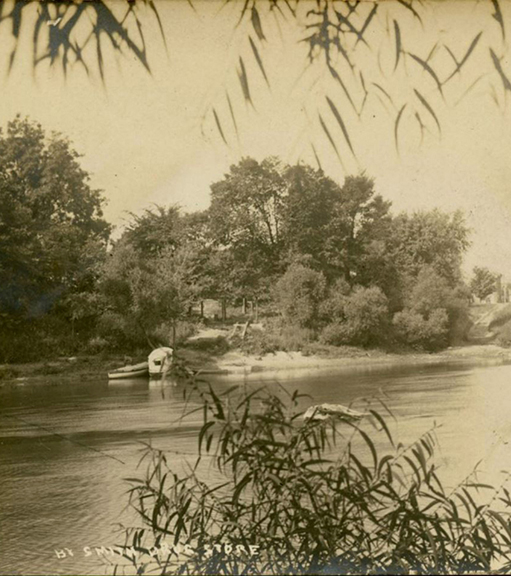
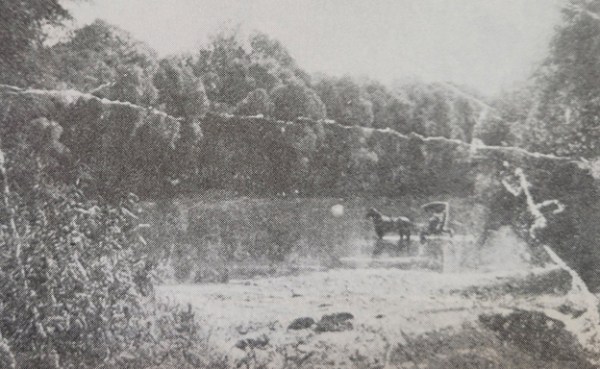
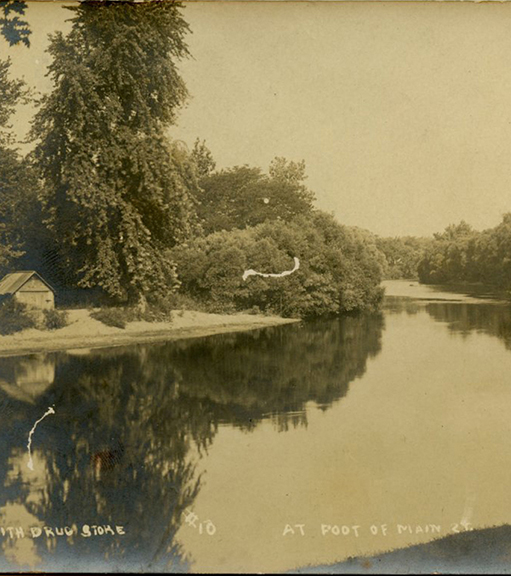
There were two fords. They were at the end of Main Street and the end of Pearl Street. Their locations can be easily found on the west side of the Winamac Town Park (on the west side of the Memorial Swinging Bridge).
Where Winamac United Methodist Church was Organized
This Editor does not know if the church was organized on the current site, but the Church has a Historian!! That person should know!
The First Church Building in the County
This information is from a previous E. R. Brown article, which can be found at https://pulaskihistory.net/the-county-of-long-ago-by-e-r-brown-part-27-early-church-buildings/
“In the summer of 1850, some of us kids went, at the noon hour, from the log school house nearby to the Catholic cemetery west of Pulaski, then unfenced and containing but a few graves. Among the tall weeds or low bushes, perhaps some of both, then covering most of the ground we saw a pile of rough lumber, possibly a wagon load for that period. As showing how a young mind will seize upon and hold fast certain facts, I recall that part of it consisted of 4X4 studding ten or twelve feet long.
The teacher being with us was asked about it and he replied that a church was to be built there. That was the first suggestion I remember personally about providing a house of worship in the county. The lumber was probably hauled there by some of the Weaver or Ruff families and whoever did it deserves worthy distinction. If it was not the first act of the kind in the county it was among the first.”
The Site of the First Mill
From an earlier ER Brown article: “… as early as 1841, a saw mill seems to have been in operation at the north end of Winamac, run by water, obtained not from the Tippecanoe, but from ‘Quigley’s Branch’, and carried by a race which is still plainly visible. If this saw mill was not the first in the county no other one had long preceded it. Yet others were built around the same time and crude ‘corn crackers’, as they were called, soon followed, usually operated in connection with the saw mill. This does not mean that they could not or did not grind wheat, rye or buckwheat, but only that they were not equipped to make flour. It was more important in those early times to have facilities for converting corn into food than for wheat. Corn could be more quickly raised and was much more generally raised than wheat and was far cheaper when people had to buy it. Newcomers had to buy what they lived on until they could clear fields and until crops could mature, and for various reasons–floods, droughts, forest fires, trespass of stocks, sickness, etc., others had to buy it also.
The Barnett House in Winamac
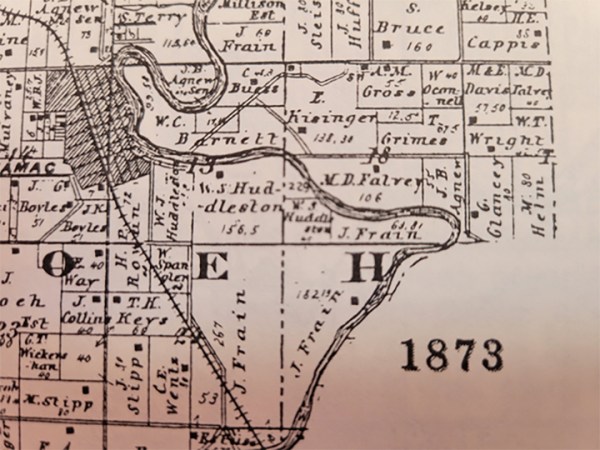
A member of the Historical Society believes a Barnett house was in the 200 block of North Market. Early in Winamac’s history, Barnett owned all of the property now encompassing the Winamac Town Park.
Regiment of Cavalry
George Washington was involved in what is commonly called Lord Dunmore’s War, the effort to rid the territory of Native Americans. The military expeditions of 1791 were most notably those of General Arthur St. Clair and Lieutenant Colonel James Wilkinson. Their cavalry and militia forces penetrated the Northwest Territory to suppress Native American resistance, mapping and laying the groundwork for the future settlement of Indiana.
In May and August of 1791, Lt. Col. James Wilkinson led mounted cavalry and militia raids from Kentucky (then still part of Virginia) into what is now central and western Indiana. His troops destroyed Wea and Miami villages, including Kenapacomaqua (near present-day Logansport, Indiana).