Revolutionary War Musket
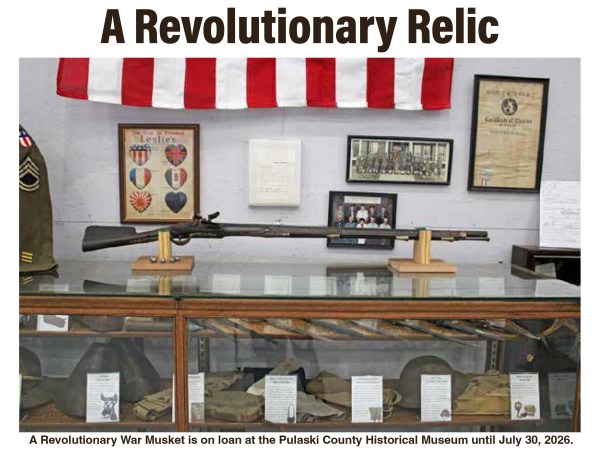
German-Dutch / Used by Hessian Soldiers
75 Cal / 42” Barrel / 11 pounds / On loan until July 30, 2026
 The military conflict that erupted in the spring of 1775 at Lexington and Concord, Massachusetts was not only a war for independence by rebellious British colonies. It was a nasty civil war pitting neighbors against neighbors and breaking families apart. It was also the central feature of a world war which embroiled the American colonies as pawns in long-standing European geo-political and military intrigue. With upwards of 30% of the American population claiming Loyalist sympathies, it was natural for the conflict to extend to the civilian population. On both sides, the ransacking, destruction and confiscation of personal property were common; the practice known as tarring and feathering was rarer. As colonists drew lines between ‘us’ and ‘them’, remaining neutral was impossible.
As France, Spain, the Netherlands and others lined up with the Patriots against the British, the King went looking for allies. With the Royal Family’s German connections, naturally central Europe was an obvious choice when looking for soldiers-for-hire.
The Hessians were one of Europe’s most feared fighting forces – rough, fearless and with a reputation for cruelty. The Hessian regiments were primarily made up of the poor and criminals whose only pay was often their food and shelter. At one point during the war, Hessian troops made up one quarter of the British fighting force. Following the war, many deserted and stayed in the United States and Canada.
https://queenscountyheritage.wordpress.com/2011/08/16/loyalist-of-the-day-2/
Germans in the American Revolutionary War
Taken from Wikipedia
Great Britain maintained a relatively small standing army, so it found itself in great need of troops at the outset of the American Revolutionary War. Several German princes saw an opportunity to earn extra income by hiring out their regular army units for service in America. Their troops entered the British service not as individuals, but in entire units, with their usual uniforms, flags, equipment, and officers.
 A total of 29,875 German troops fought alongside British troops in the Revolutionary War, of which 16,992 came from Hesse-Kassel and 2,422 from Hesse-Hanau. Other contingents came from Brunswick (4,300), Ansbach-Bayreuth (2,353), Anhalt-Zerbst (1,119), and Waldeck (1,225). As the majority of the German troops came from Hesse, Americans use the term “Hessians” to refer to all German troops fighting on the British side.
Deployment
Hessian troops included Jägers, hussars, three artillery companies, and four battalions of grenadiers. Most infantrymen were chasseurs, including sharpshooters, musketeers, and fusiliers. Line infantry was armed with muskets, while the Hessian artillery used the three-pound cannon. The elite Jäger battalions used the Büchse, a short, large-caliber rifle well-suited to woodland combat. Initially, the typical regiment was made up of 500 to 600 men. Later in the war, due to death in battle, death by disease, and general desertion to settle in the Colonies, the regiments may have been reduced to only around 300 to 400 men.
The first Hessian troops to arrive in British America landed at Staten Island on August 15, 1776, and their first engagement was less than two weeks later in the Battle of Long Island. Hessians proved decisive to the British victory, and they subsequently fought in almost every battle that year.
By 1777, the British used them mainly as garrison and patrol troops. Hessians fought at the Battle of Bennington, the turning point of the Saratoga campaign. At Saratoga, approximately 1,000 Hessians were defeated; being killed or captured by a raw, untrained militia force from Vermont, New Hampshire, and Massachusetts. General John Burgoyne lost 1,000 of his 8,000 soldiers at Bennington, and the loss of so many Hessians doomed his army later. An assortment of Hessians fought in the battles and campaigns in the southern states during 1778–1780, including at the Guilford Court House, and two regiments fought at the Siege of Yorktown in 1781. Hessians also served in Nova Scotia for five years (1778–1783), where they protected the colony from American privateers, such as during the 1782 Raid on Lunenburg.
Notwithstanding their reputation as skilled and disciplined fighters, many British soldiers shared the American distrust of Hessians, who often spoke little or no English and were perceived as crude and barbaric.
American attitudes
Americans, both Revolutionaries and Loyalists, often feared the Hessians, believing them to be rapacious and brutal mercenaries. The American Declaration of Independence, written roughly a year after hostilities broke out, condemned King George III for “transporting large Armies of foreign Mercenaries to [complete] the works of death, desolation and tyranny, already begun with circumstances of Cruelty & perfidy scarcely paralleled in the most barbarous ages, and totally unworthy the Head of a civilized nation.” Throughout the war, reports of plundering by Hessians were said to have galvanized neutral colonists to join the Revolutionary side.
General Washington’s Continental Army had crossed the Delaware River to make a surprise attack on the Hessians in the early morning of December 26, 1776. In the Battle of Trenton, the Hessian force of 1,400 was quickly overwhelmed by the Continentals, with only about 20 killed and 100 wounded, but 1,000 captured.
Hessians captured in the Battle of Trenton were paraded through the streets of Philadelphia to raise American morale; anger at their presence helped the Continental Army recruit new soldiers. Most of the prisoners were sent to work as farmhands.
Throughout the Revolutionary War, Americans tried to entice Hessians to desert the British, emphasizing the large and prosperous German-American community in the Colonies. The Continental Congress authorized the offer of land of up to 50 acres (roughly 20 hectares) to individual Hessian soldiers who switched sides. British soldiers were offered 50 to 800 acres, depending on rank.
Many Hessian prisoners were held in camps at the interior city of Lancaster, Pennsylvania, home to a large German community known as the Pennsylvania Dutch. A large Hessian prison camp was also located at the nearby city of Reading. German prisoners were treated well, with some volunteering for extra work assignments, helping to replace local men serving in the Continental Army. After the Revolutionary War, many Hessian prisoners of war never returned to Germany and instead chose to accept American offers of religious freedom and free land, becoming permanent settlers. By contrast, British prisoners were also held in Lancaster, but these men did not respond favorably to good treatment and often tried to escape.
After the war ended in 1783, some 17,313 German soldiers returned to their homelands. Of the 12,526 who did not return, about 7,700 were killed in action or died; some 1,200 were killed in action, and 6,354 died from illnesses or accidents, mostly the former. About 5,000 German troops, most of whom had been press-ganged or conscripted, opted to settle in either the United States or Canada.