This is the thirtieth in a Series of Reminiscences by E. R. Brown. Brown was born in Pulaski County on August 9, 1845. His writings are abstracted from the “Pulaski County Democrat” on microfilm housed in the Pulaski County Public Library, Winamac, Indiana. Find links to earlier entries at the end of this article.
Published in “Pulaski County Democrat,” November 2, 1922
 Most people have probably observed that there is not only a difference between seasons from year to year, but that sometimes there is a swing to one extreme or the other that lasts several years after which the swing may be to the other extreme again. A long time ago I spent four successive winters in Iowa. All of them were exceptionally cold and long, with terrific blizzards and very deep snows. Then the following winter was as exceptionally mild as the other had been severe and on my recent visit to Iowa I was told that they did not have such cold winters and deep snows anymore. Yet that does not necessarily mean that there may not be a swing back again at almost any time with those former conditions restored for a while.
When settlement here first began the state elections were held on the first Monday in August and for a number of years it was an invariable rule to find roasting ears on the field corn at that time. The lack of variety in table supplies, if not their limited quantity, made this a welcome event, while the prominence of the election served to fix the date so it would be remembered. But later on I often heard my father say in times of lament if not discouragement that the season had changed for the worst and the fact was cited that field corn no longer yielded roasting ears the first Monday in August. It must be true that about the time he said this there was a series of years when the winters were notably cold and they may have been longer than usual also. The report that Major Gardner had ridden horseback on the ice on the river April 4th, 1844, was in general circulation in my boyhood. It afterwards found its way into print as part of the history of the county. I had it personally confirmed to me by Mr. Jacob Shoup, one of our prominent pioneers, who for many years lived in Tippecanoe township, but finally spent his last years here in Winamac. He said he had that same day, April 4th, 1844, crossed the Wabash on the ice at Logansport. He added however that the ice there went out the next day as the result of a rain the night he made the crossing. We know that as a general thing farmers are well-started on their spring plowing, if not their oats sowing, by April 4th.

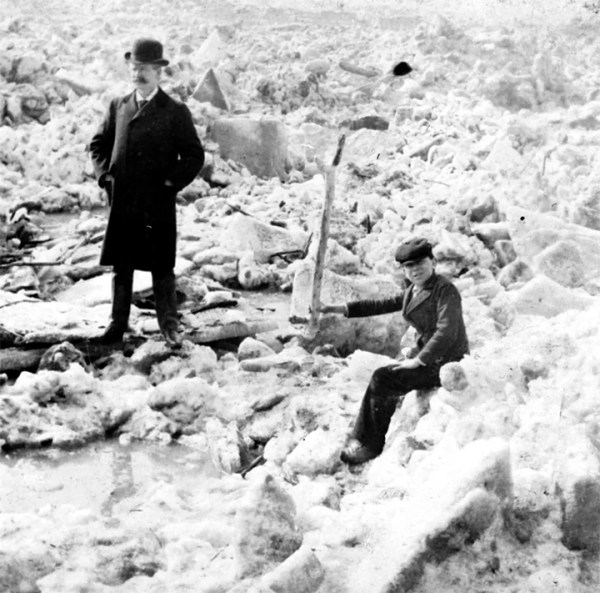
It must be true also that in the early fifties there were a lot of very cold winters with deep snows. I know that we had a large orchard of fine bearing peach trees killed in what must have been the winter of fifty-two and three and that all peach trees on our farm were killed every winter after that for several years. Further than this, we lived directly overlooking the Tippecanoe River, as many know, and I slept for the most part during those years in one of the front rooms upstairs. No childhood recollection of that period comes back to me more often or with more vividness than the roaring and rumbling of the ice on the river, as it does only when it is very heavy. The rising or falling of the water causes it to crack with a loud report and these cracks frequently run long distances, extending the sound into long reverberations. It really resembled the fierce cannonading which many of us were to become familiar with a few years later. I recall also that one spring when the ice went out huge cakes were pushed up on the lower land between our house and the river. All of it was blue and hard as if it had just been frozen. One cake on top of most of the others was half as large as an ordinary town lot and father, on measuring it with his square, reported that it was two feet thick-exactly the same as the length of his square. It surely required some cold to freeze such ice. The recollection seems likewise to pursue me forever of going through deep snow to school in winter. Often we had to break a path for ourselves, or rebreak it, after fresh snow fell. After the path was broken I have a mental picture of the snow rising up high on either side. While crossing downhill, snowball fights, rolling huge snow balls or building immense snow men, resembling more a Chinese idol than anything human, would seem to have been a part of our amusement at recesses or noon hours. Many winters later than these narratives refer to, must also have been colder than any we have had for some years. I knew of no thermometers in that earlier period and as the government kept no record of the weather until long afterwards, neither did it seem to have any standard for such instruments. But when thermometers came into general use here it was nothing unusual for them to register as much as thirty-three degrees below zero in a cold winter.
Many of those years were evidently very wet too. “The wet summer of 1844” was often referred to in my childhood. I think very little was raised that year. A person or family having a leaky roof notices excessive rains more than those situated differently and the fact that so much of the land was wet anyway may have caused us to think it rained more then than it really did relatively. It seems to me that the river was high there much more of the time and that there were far more things floating upon its turbid current than has been true latterly-parts of bridges carried out of the smaller streams, milk houses, pig pens, hewed timber, sawed timber, etc. I once saw several rods of rail fence carried by in quite perfect condition.
Links to Earlier Articles
- Part one(Common Inconveniences) October 2018 newsletter.
- Part two (Land) June 2019 newsletter.
- Part three (Trees & Timber) November 2019 newsletter.
- Part four (The River) February 2020 newsletter.
Later editions are carried as separate posts.
- Part five (Public Roads)
- Part six (Schools)
- Part seven (Markets & Trading Points)
- Part eight (It’s Mills)
- Part nine (Wild Game)
- Part ten (Feathered Wild Game)
- Part eleven (Animal Pests & Birds of Prey)
- Part twelve (Fishing in the Early Days)
- Part thirteen (Wild Fruit)
- Part fourteen (Early Commerce on the Tippecanoe)
- Part fifteen (It’s Homes and Home Life)
- Part sixteen (House Raisings)
- Part seventeen(Clothing a Family)
- Part eighteen (Log Rollings)
- Part nineteenth (First Trip to Winamac)
- Part twenty (Grubbings and Wood Choppings)
- Part twenty-one (Apple Peelings)
- Part twenty-two (Sausage Makings)
- Part twenty-three (Parties and Amusements)
- Part twenty-four (Early Wheat Raisings)
- Part twenty-five (Quilting Parties)
- Part twenty-six (Early Religious Practices)
- Part twenty-seven (Early Church Buildings)
- Part twenty-eight (Early Clergymen)
- Part twenty-nine (Early Funerals)