This is the twenty-seventh in a Series of Reminiscences by E. R. Brown. Brown was born in Pulaski County on August 9, 1845. His writings are abstracted from the “Pulaski County Democrat” on microfilm housed in the Pulaski County Public Library, Winamac, Indiana. Find links to earlier entries at the end of this article.
Published in “Pulaski County Democrat,” August 24, 1922

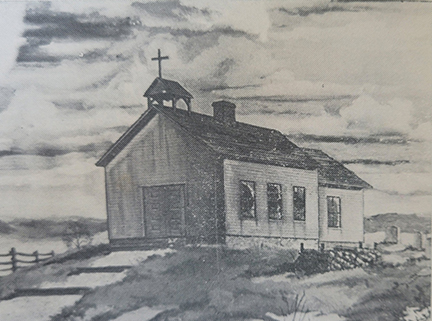
In the summer of 1850, some of us kids went, at the noon hour, from the log school house nearby to the Catholic cemetery west of Pulaski, then unfenced and containing but a few graves. Among the tall weeds or low bushes, perhaps some of both, then covering most of the ground we saw a pile of rough lumber, possibly a wagon load for that period. As showing how a young mind will seize upon and hold fast certain facts, I recall that part of it consisted of 4X4 studding ten or twelve feet long.
The teacher being with us was asked about it and he replied that a church was to be built there. That was the first suggestion I remember personally about providing a house of worship in the county. The lumber was probably hauled there by some of the Weaver or Ruff families and whoever did it deserves worthy distinction. If it was not the first act of the kind in the county it was among the first.
Frederick Weaver, father of John H. Weaver of Winamac and Henry Weaver, living near the cemetery, was a carpenter as well as a farmer. He came that same summer and measured the school house and later installed the wide shelves used for writing exercises. He may have hauled the lumber or sent one of his boys to do so.
Jacob Ruff also lived near. He then had three sons old enough to do the hauling – Jacob Jr., who gave his life for his country in the Civil War; Lawrence, whose honored remains were recently brought back from the West to rest finally in that cemetery; and Michael, the prosperous farmer of Stoney Prairie. Any one of these may be entitled to the credit for this early step. Anthony Ruff of Pulaski is a younger son of Jacob Ruff.
The only other cases where steps toward building churches might have been taken earlier than this were the Olive Branch church and the one on the Winamac and Logansport road beyond Mill Creek. Both were Methodist and both in Harrison township. Both were also begun early though not finished at once.
It was not unusual in those days for a farmer to be several years in building a new dwelling. The frame would frequently stand over winter and perhaps longer before being enclosed. And the structure would stand still longer before being painted, if ever. Almost without exception churches shared in this common experience.
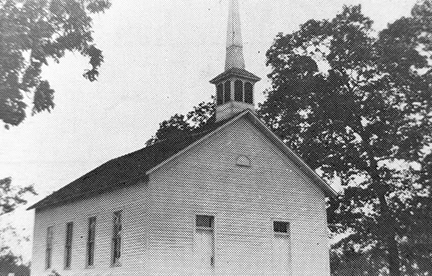
My recollection is that the small Catholic church in question was not ready for use for three or four years after that first lumber was delivered. In the meantime a hewed log church was begun and eventually finished at the cemetery across the river below Pulaski, mainly by people who were then Lutherans. Slightly later a second Catholic church was built a mile west of the Prough cemetery, near the White county line and a small frame Presbyterian church in the north-east corner of Van Buren township.
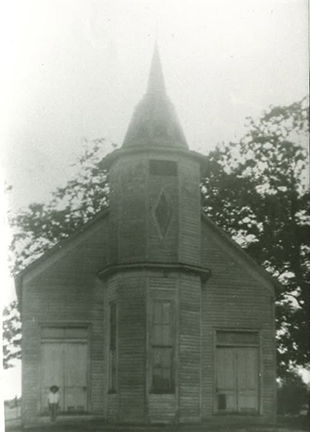
It seems that a few other small churches, some log and some frame, were built in different parts of the county about the same time, though I do not recall the facts, if I ever knew them. It is clearly true that the year 1850, which I recall very distinctly, was allowed to come to its close, and possibly one or two succeeding years were allowed to do the same without a church building of any kind ready for use in the county. But movements toward building took their rise about that time and by 1854 or 1855 several modest structures were doing God’s service in various townships.
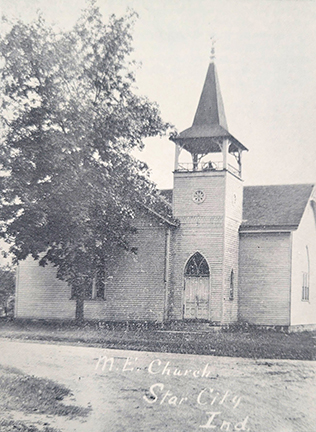
Soon afterwards the church near the mouth of Mill Creek was moved bodily with ox teams to a point a half mile northwest of Star City (not there then) and after that if not before was known far and wide as Mount Zion. I frequently attended services in it.
There were doubtless extenuating circumstances, but it must be confessed that it does not look well in retrospect that no Catholic Church was ready for use in Winamac until after 1859 and no Protestant church until 1866 – the former more than twenty years after the county seat has been located here and the later equally that long after the town had begun to put on airs in other respects.
When all is said and done, it is not easy to excuse any community of any pretensions for not having a church building of some kind. Medaryville, much smaller at the time than the county seat, had a church building ready for use in 1854, less than two years after being laid out. Happily, Winamac is now fairly well supplied with church buildings, though some of them are no longer up-to-date.
Many changes for the better all over the county began to take shape at the close of the Civil War. That was the beginning of the end of the dearth and poverty of many pioneer conditions. While some of the more sparsely settled townships still had their problems to solve, the lack of church buildings and other facilities for public worship was not marked after that.
I recall clearly many of the facts pertaining to the first Sunday school I ever attended and for want of a better place will tack on a brief account of it here. It was held in the log church, referred to above, near Pulaski. It was about the first one I had ever heard of and must have been the first in the
township, if not the first in the county. I cannot give the date of it but the church had not been chinked or daubed and that would show that it was early in the fifties. A striking feature about that matter was that not only all religious denominations in the neighborhood were represented among the promoters but several citizens of some prominence, not members of the church, also took part.
Daniel Short, a man of some education and reading, who lived opposite the dam on the west side and who with John Stevens laid out the town of Pulaski, was called to the chair, to effect an organization. Some Englishman has said (perhaps because of envy) that not the least thing can be done at a public meeting in the United States without first having a president and a secretary.
The first thing Mr. Short did after reaching his position was to draw his coat together very deliberately and button it around him. Then instead of using the chair for a seat he carefully placed it in front of him and leaned upon its back somewhat ungainly with both hands, shifting his weight from one foot to the other. These preliminaries over, and after clearing his throat with two or three ahems, he proceeded to give the history of the first Sunday school, started by Robert Raikes in London.
That was not inappropriate, as I remember he said the first school started by Raikes was not so much to teach religion as to keep children out of mischief and the teaching at first was largely of a secular character. Both of those conditions applied here. The school as organized continued to be maintained. Though officers and teachers were changed from time to time my impression is that the Sunday school never ceased to exist in some form or other until it was finally moved to the new church in town. Yet about all I remember of the work of that first school is that my lessons were in the First Reader.
Links to Earlier Articles
-
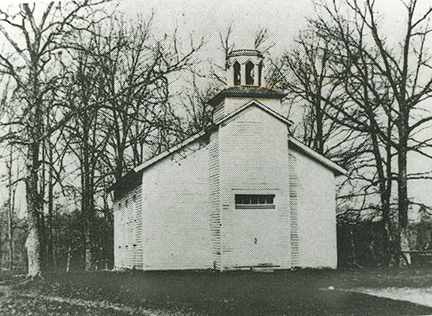
Indian Creek Presbyterian, 1867 (Pulaski County Public Library Facebook page) Part one (Common Inconveniences) October 2018 newsletter.
- Part two (Land) June 2019 newsletter.
- Part three (Trees & Timber) November 2019 newsletter.
- Part four (The River) February 2020 newsletter.
Later editions are carried as separate posts.
- Part five (Public Roads)
- Part six (Schools)
- Part seven (Markets & Trading Points)
- Part eight (It’s Mills)
- Part nine (Wild Game)
- Part ten (Feathered Wild Game)
- Part eleven (Animal Pests & Birds of Prey)
- Part twelve (Fishing in the Early Days)
- Part thirteen (Wild Fruit)
- Part fourteen (Early Commerce on the Tippecanoe)
- Part fifteen (It’s Homes and Home Life)
- Part sixteen (House Raisings)
-
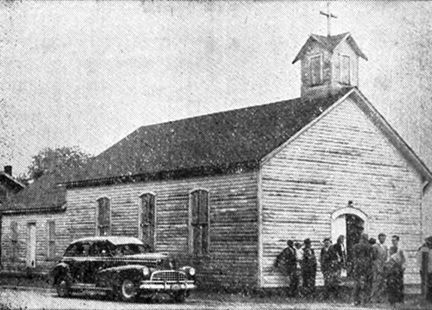
St. Henry’s Church, Medaryville, erected 1868 (Pulaski County Public Library Facebook page) – pretty sure the car is not from the 1800s! Part seventeen (Clothing a Family)
- Part eighteen (Log Rollings)
- Part nineteenth (First Trip to Winamac)
- Part twenty (Grubbings and Wood Choppings)
- Part twenty-one (Apple Peelings)
- Part twenty-two (Sausage Makings)
- Part twenty-three (Parties and Amusements)
- Part twenty-four (Early Wheat Raisings)
- Part twenty-five (Quilting Parties)
- Part twenty-six (Early Religious Practices)