The Story of Taylor’s ‘Liberty Tree,’ a Guitar Made From Historical Landmark | Ultimate Guitar
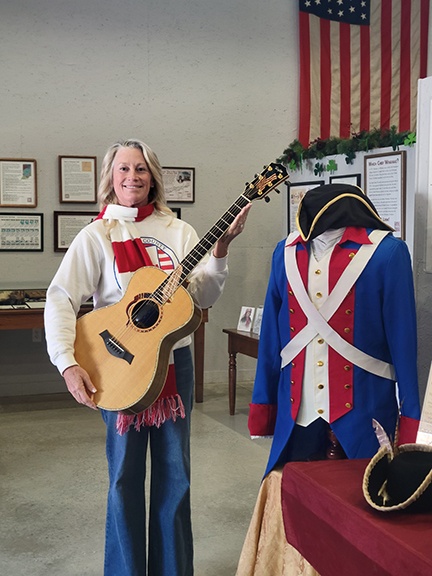
The tree in Annapolis was the last known Liberty Tree. It had been damaged over the years by lightning and previous hurricanes and was being held together by cables and concrete. After its felling, Taylor Guitars preserved its legacy in the form of the Liberty Tree Guitars. You can still find these guitars on the used market—the last one I found was priced at $10,000. Students at St. John’s College took some cuttings from the tree to create new ones. A 100-year-old offspring of the tree stands a few hundred feet away from the original.
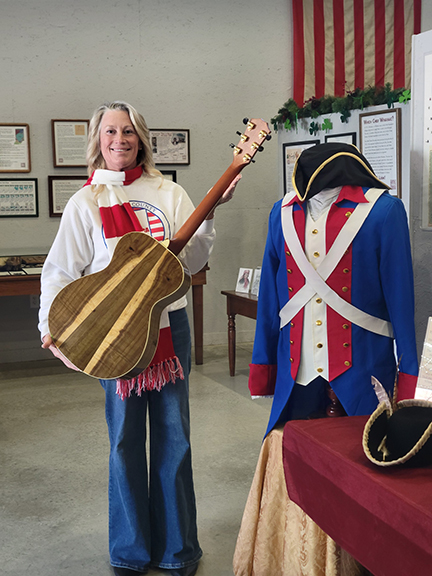
While poplar is a common wood used in electric guitars, it is far less common in acoustics as it is quite soft. But I believe that for most people who bought these guitars, the focus was less on tonal properties and more on owning a literal piece of American history. That being said, it is not unheard of for poplar to be used – it’s a unique choice that some builders use, especially roasted poplar. The grain pattern of the tree seems to be well-figured based on the photos I’ve seen of the guitars, and having worked with reclaimed or uniquely sourced wood, I do believe they take on a bit more reverence than any old production model.
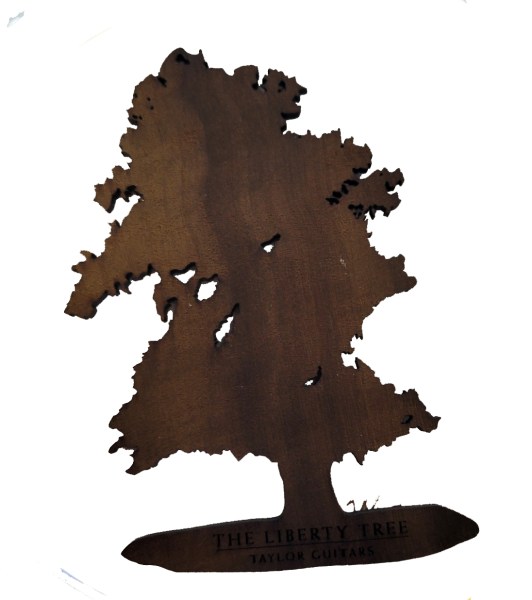
In 2002, Taylor Guitars added a limited lineup to their Gallery Series of guitars built from wood harvested from a famous tree known as “The Liberty Tree,” a 400-year-old tulip poplar that stood in Annapolis, Maryland, until 1999, when it was felled after Hurricane Floyd caused irreparable damage to it. Taylor Guitars purchased the historic tree and ended up making 850 guitars out of it, dubbed the Liberty Tree Guitars. That series consisted of 400 Grand Concert, 400 Baby, and 50 T-4 guitars.
Who or What is Taylor Guitars
The story of Taylor Guitars began in 1974 in El Cajon, California, when Bob Taylor and Kurt Listug pooled their resources and expertise to establish what would become a world-renowned guitar company. Bob Taylor, known for his visionary designs and commitment to quality, paired perfectly with Kurt Listug’s business acumen. Together, they transformed a struggling guitar shop into a powerhouse of innovation.
The early days were anything but easy. With limited capital and fierce competition, Taylor and Listug relied on their shared dedication to craftsmanship and creativity. Bob Taylor’s approach to building guitars was revolutionary. At a time when many manufacturers adhered strictly to tradition, Taylor embraced modern tools and techniques, introducing precision machinery to enhance consistency and quality.
To highlight some famous customers of Taylor Guitars, consider the following notable musicians:
- Taylor Swift – Pop and country music superstar known for her songwriting.
- Dave Matthews – Frontman of the Dave Matthews Band, known for his acoustic guitar work.
- Jason Mraz – Singer-songwriter famous for his hit “I’m Yours” and acoustic style.
- Sheryl Crow – Grammy-winning artist known for her blend of rock, pop, and country.
- Kurt Cobain – Iconic frontman of Nirvana, known for his influence on rock music.
- John Mayer – Renowned guitarist and singer-songwriter with a distinct style.
- Phil Collins – Legendary musician and former Genesis frontman, known for his solo work.
- Bob Dylan – Influential singer-songwriter and Nobel laureate in literature.
- Ben Harper – Multi-instrumentalist known for his unique blend of music genres.
- Taylor Hicks – American Idol winner and soulful singer known for his performances.
From A Taylor Guitars Quarterly Publication, Volume 31, Winter 2002: Wood & Steel
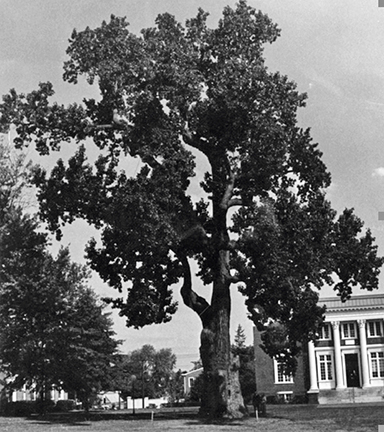
The Liberty Tree Guitar: Historical photos from the Maryland State Archives
Liberty Tree Guitar Photography by Robert Sanders/AGT
In our industry, luthiers and guitar manufacturers regularly create instruments to honor legendary or popular musicians, folk heroes, celebrities, events, or cultural icons. Even if the materials used to produce these guitars have little or no direct relation to the subject of the homage, one’s imagination can fill in the gaps.
You get closer to something more meaningful with special edition guitars designed to replicate a player’s favorite old axe, or, as in the case of our own Signature Models, to coalesce specific materials and design elements that reflect an artist’s tastes, values, personality, preference, and playing style. Even then, we rely on familiar sources for the materials, which have no intrinsic “meaning” beyond the aesthetic and tonal characteristics that make them appropriate.
Then, there is the Liberty Tree Guitar, whose materials alone make it the most significant instrument we’ve ever created.
In the 27-plus years of our company’s existence, through tens of thousands of instruments made from some of the most incredible tonewoods nature has produced, we’ve never made a guitar from wood that inspired actual reverence. Awe, perhaps, but not reverence. It could be argued that never have American history, craftsmanship, a special wood, the concepts of democracy and freedom, and the promise of a lasting legacy converged as completely, to convey a time and an ideal as powerfully, as in the Liberty Tree Guitars being unveiled this winter by Taylor Guitars.
The Tree Stood Sentinel
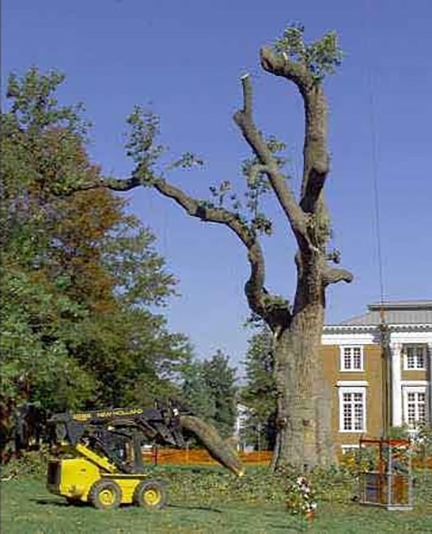
What distinguishes this wood from all others is that it is the flesh of a tree that stood sentinel over the difficult birth of our nation, then did its part to embrace and nurture the evolution of the United States of America for another 233 years.
Each of the original American Colonies had Liberty Trees (or, in some cases, Liberty Poles) under which the Colonists rallied to seek solidarity in their quest for independence from Great Britain. Taylor’s Liberty Tree Guitars are being made from the wood of the last surviving Liberty Tree, which stood on the grounds of St. John’s College in Annapolis, Maryland until 1999, when it sustained fatal injuries from Hurricane Floyd.
All trees of a certain vintage have an expanse of “time” encoded in their growth rings and configurations, in their scars, in their grain figure and coloration. But every cell of the Liberty Tree was imbued with the spirit of the early Americans and their quest for freedom and self-determination.
That’s why the Liberty Tree Guitars, which were 18 months in the wood-processing, designing, and building, are so much more than a “commemorative product.” In fact, Bob Taylor, who purchased this wood with a vengeance when he realized that it was available, won’t even discuss the LTG in “marketing” terms.
“This isn’t about selling guitars,” he admonished a group of excited staffers just days before buying the wood in June 2000. “This is about this tree and what it means to me and what it should mean to all Americans. I understand that you all have jobs to do, but this is personal. Now that the tree is gone, this wood needs to become something that will live for another 100 or 200 years and tell future generations the story of our country’s founding.”
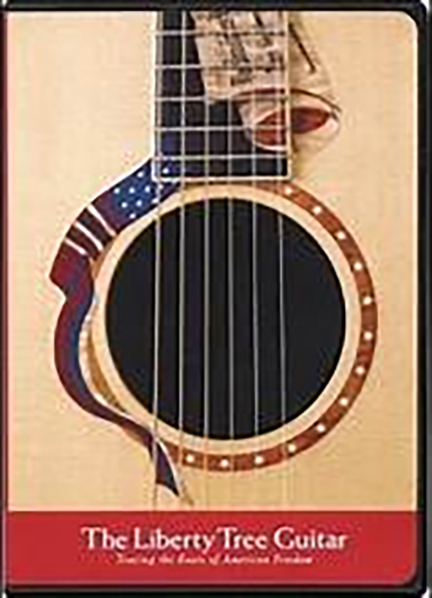 Even a year later, when he was in full guitar-making mode, Taylor couldn’t keep his emotions completely in check. Staffers John D’Agostino and Larry Clark have been working for months to produce a full-length docu-video about the Liberty Tree and the Liberty Tree Guitar, with historical content, making-of footage, rare photos, and some great music, for release in early 2002. In one scene, Bob is showing the first LTG prototype to members of the Product Development team and is momentarily swept away by it all.
“The thought just occurs to me while I’m holding it, that this is the Liberty Tree,” Bob says, quietly. “You can get a chill from it. That’s happening to me now.”
The Remarkable Age of the Tree
In addition to its place in American history, what makes the Maryland Liberty Tree remarkable is that it survived long enough to be made into state-of-the-art guitars. The human impulses and physical forces employed by 18th-century England in an effort to quash the American Revolution and destroy the Colonists’ spirit succeeded only in killing off several of the highly symbolic Liberty Trees. Natural forces, including weather and time, took care of the others. Only the Libert Tree in Annapolis carried on.
 The very first Liberty Tree was the largest among some graceful elms in Boston, Massachusetts, on the corner of what today are Essex and Washington streets. That tree’s role dramatically changed in August 1765. Colonists, already restive over a succession of taxes levied by Britain, were enraged when Parliament sought to impose the Stamp Act, which would force Americans to pay extra for a wide variety of legal documents, licenses, deeds, newspapers, and permits.
Although the tax itself amounted to only pennies per stamp, what infuriated the Colonists was that it was imposed directly on the Colonies with no American representatives involved in the decision-making. To make matters worse, the British levied the tax to pay off debts leftover from the French and Indian War and to underwrite the continuing cost of stationing British troops in the Colonies – financial burdens the Americans felt were not theirs to bear.
The Tree Inspired Others
Inspired by Samuel Adams and other notable figures in Boston, a revolution-minded group of shopkeepers, artisans, tradesmen, and workers who called themselves the Sons of Liberty (after a similar group in New York City) gathered at the Liberty Tree under cover of night and hung two figures in effigy. One was local merchant and politician Andrew Oliver, who’d been appointed by the Crown to distribute the tax stamp, by which he would have made a handsome profit. The other showed the Devil peering out of a large boot, a play on the name of the Earl of Bute, who was believed to have advised King George III to raise funds by taxing Americans.
 Aroused by this brazen defiance of Parliament’s authority and by speeches subsequently delivered under the Liberty Tree, Bostonians went on a rampage that came to be known as the Stamp Act Riots. They ransacked Oliver’s home, trashed and looted the home of Oliver’s brother-in-law, Chief Justice Thomas Hutchinson, circulated ani-British petitions, and tarred-and-feathered anyone deemed loyal to the British Crown. The flames of that uprising sent sparks throughout the Colonies.
Before long, Liberty Trees and Poles were serving as gathering places for budding patriots up and down the Atlantic Coast. A year after the Stamp Act Riots, Maryland dedicated its own Liberty Tree – a lovely tulip poplar – on the Annapolis grounds of what was then King William’s School. There, such impassioned orator-patriots as Samuel Chase gave speeches and led rebels in singing protest songs. As patriotic fervor grew, the Liberty Tree became the staging area for the Annapolitans’ pro-independence activities.
Historical Notes
On October 15, 1774, the Liberty Tree prominently figured in the town’s variation on the “Boston Tea Party.” When a ship named the Peggy Stewart sailed into Annapolis harbor with a cargo of more than 2,300 pounds of tea, its owner, Andrew Stewart, hoped to unload it and quietly pay the much-hated Tea Tax. Hearing this, an angry mob met under the Liberty Tree, then marched to Stewart’s house with an ultimatum: he could burn the ship and its cargo or be hanged right there at his front door. Stewart ran his ship aground and set it ablaze with his own torch.
A year later, Annapolitans were awakened by the sounds of beating drums and told to meet under the Liberty Tree. Once assembled, they voted on a resolution that would banish from the city all those who did not support the patriots’ cause. (The resolution, deemed too severe, was defeated.)
 Before, during, and after the American Revolution, the Annapolis Liberty Tree provided a focal point for numerous patriotic demonstrations, shade for various important ceremonies, and friendly shelter for soldiers who were either creating or preserving the Union.
In September 1781, 4,000 French soldiers under the command of Marquis de Lafayette and Comte de Rochambeau camped under the Liberty Tree on their way to Yorktown, Virginia. There, they would provide invaluable assistance to George Washington and his troops for the pivotal battle that would win America its freedom.
On a sentimental return to America in December 1824, Lafayette was feted on the grounds of what by then had become the state-chartered St. John’s College. At one point during two days of festivities honoring his role in the American Revolution, Lafayette stood in the shadow of the Liberty Tree and announced that in the aftermath of the successful revolution in his own country, more than 60,000 Liberty Trees had been planted in France. The Liberty Tree, it seemed, was becoming a widely recognized symbol of freedom.
Through much of the 19th century, the Liberty Tree would be a favorite touchstone for various statesmen, dignitaries, and Presidents, and a popular site for Fourth of July picnics and other civic events. The tree also would withstand a number of near-disasters, including fire, lightning strikes, and other acts of nature that would fell lesser trees.
One day in the 1840s, schoolboys stuffed gunpowder into a hollow in the Liberty Tree’s trunk and ignited it, blasting off all the tree’s leaves. Heartbroken Annapolitans believed their beloved tree was destroyed, but the following spring it burst forth with lush, new growth. Apparently, the force of the explosion had killed worms and fungus that were consuming the tree from the inside. It was flourishing two decades later, when Union soldiers took their respite under its limbs during the Civil War.
The Tree Suffered Decay and Worse
 By the early 20th century, the Liberty Tree was suffering from decay that had reduced its trunk to a hollow shell only 13 inches thick, with the cavity taking up 56 vertical feet of the interior. In 1907, landscape architect and forester John T. Withers was hired to restore it to health. Using an antiseptic wash, Withers cleaned out the tree’s decayed interior to a depth several feet below ground level, then filled the cavity with 55 tons of concrete reinforced with steel and iron. At the time, the repair was believed to be the greatest successful major tree surgery ever undertaken. It would not be the last time a landscaper would rescue the tree from an ignominious fate.
For 400 years, neither natural nor man-made assaults on the Liberty Tree could topple it, and even Father Time was stared down by the sturdy and resolute tree, which would outlive the average lifespan of a tulip poplar by almost a century. By 1961, the tree’s resilience was so noteworthy that “Ripley’s Believe It or Not” featured it in a cartoon strip captioned, “The Poplar that would not die!”
Almost 40 years later, however, the Liberty Tree could not emerge unscathed from the destructive force of Hurricane Floyd, which pounded the central and south Atlantic states in September 1999. At its peak, Floyd was almost 600 miles wide, its winds reaching an unfathomable 155 miles-per-hour. By the time it moved away from shore to die at sea, the hurricane had claimed 20 lives and billions of dollars in damage.
In the storm’s wake, vast stretches of flatland were flooded, homes were destroyed, trees were uprooted, and devastation stretched from New Jersey to Florida. the Liberty Tree sustained a crack in its trunk and another in one major limb, and the threat of partial collapse was deemed serious enough to pose a hazard for the nearest student dormitory. Several rooms in the dorm were evacuated, and a fence was erected about 100 feet from the tree.
To assess the damage, St. John’s called in a host of experts from the Maryland Department of Natural Resources and the National Arboretum, as well as two professional arborists. The consensus was that such traditional repair methods as bracing, bolting, and wiring would not save the Liberty Tree, which was at great risk of massive structural failure. The living symbol of American freedom, which had survived so much for so long, would have to be cut down. Over four centuries, it had grown to a height of 96 feet and had a spread of 60 feet. Its diameter, measured four and a half feet from the ground, was 102 inches.
The Tree Comes Down
On October 25, 1999, St. John’s hosted a special ceremony to honor the tree while it was still standing. Hundreds of spectators heard speeches by the Governor of Maryland and other dignitaries. A St. John’s professor sang the “Star Spangled Banner,” which had been written almost 200 year earlier by a former St. John’s student, Francis Scott Key. A bell atop McDowell Hall rang 13 times in tribute to the original Colonies. A wreath was placed on the tree’s mammoth trunk. People snapped pictures, shot video footage, shared trivia and memories, and explained the significance of it all to their children.
Once the chainsaws started, however, the crowd fell silent. As limbs dropped, people took the smaller branches for souvenirs, and volunteers from the college handed out clusters of leaves. Observers interviewed by local media fought back tears.
Perhaps fittingly, the tree did not easily surrender. Unable to cut through the concrete that John Withers had used to stabilize the tree in 1907, workers struggled to remove the final 50 feet of trunk. They elected to topple the stubborn tower by force, and when it hit the ground, the tree’s bark splintered off in a five-inch layer of wood that surrounded several inches of black, decayed material. Prolonged decay had robbed the tree of as much as 85 percent of its volume. For years, the trunk wood had been completely separated from the concrete inside, prompting experts to wonder how the tree could still be standing.
Because the concrete lining extended several feet below ground level, workers had to dig down to excavate it, and that precluded any chance of preserving the tree’s stump as a memorial. The decayed wood and concrete were hauled away, and the lawn where the tree had stood was smoothed over. St. John’s saved parts of the tree for posterity; the trunk and large sections of branches were hauled away to three different destinations – two recycling plants in Northern Virginia (120 miles away) and a landfill in Millersville, Maryland.
The Wood is Saved
When Taylor dealer Emory Knode at the Appalachian Bluegrass Shoppe in Baltimore, Maryland read about the Liberty Tree coming down, he faxed an article from the local paper to Bob Taylor. Bob was intrigued but not confident of his chances of seeing the wood, let alone obtaining any.
“I would’ve given anything to get my hands on the wood from the Liberty Tree,” Taylor explains. “As a lover of American history, I was fascinated and moved by this tree’s story and I wanted that wood. Only a few years before, I had visited many of the key historical places in the Virginia-DC-Maryland area and had come away more amazed than ever by what our forefathers had accomplished. So, this tree had real significance for me. I was grateful to Emory for telling me about this, but I figured, “The Liberty Tree has been there for hundreds of years, everyone back there knows about it, and there are far more important people than me trying to get that wood, so what chance would this guy out in Southern California have?”
A few months later, Bob had his answer.
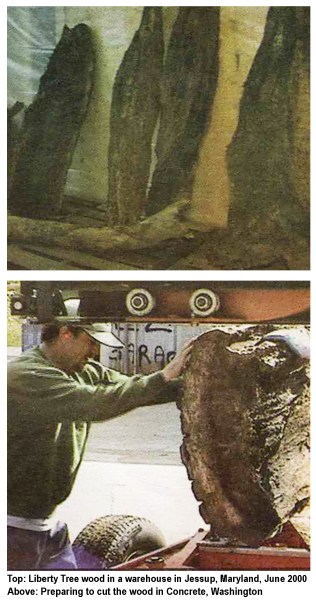 “In May 2000, I get this frantic voice-mail message from a guy named Mark Mehnert, who says he’s the landscaper in Annapolis who had ‘rescued’ the Liberty Tree wood from the dump. He was keeping the wood in a climate-controlled section of a warehouse at his own expense. He wondered if I was interested in buying it, but he needed my answer right away because he was going broke and needed a quick infusion of cash to pay off creditors. I called him back and said, “Yeah, I’m definitely interested.”
The following month, Bob and Cindy Taylor, company videographer Larry Clark, and Taylor Vice President of Public Relations John D’Agostino flew to Maryland to document the acquisition of the wood. They hosted a press conference at the warehouse in Jessup, Maryland, surrounded by huge hunks of the Liberty Tree arranged Stonehenge-like around the room. Regional print media and Washington, DC’s NBC-TV affiliate were on hand to record the proceedings.
After everyone had left, Bob quietly wrote a check to Mehnert for about 30,000 pounds of wood, telling the landscaper that he considered him a “hero” for salvaging the remains of the Liberty Tree. Before leaving Maryland, the Taylor crew shepherded the wood onto a large truck that would transport it to Pacific Rim Tonewoods, in Concrete, Washington. The wood was cut on July 17-18, 2000, then sawn and dried. In August, sets of Liberty Tree wood began arriving at our factory in El Cajon, California.
The Guitars are Designed
On March 22, 2001, Bob and members of our design team brought the preliminary “mock-up” of the LTG to our interdepartmental Product Development meeting for comment and discussion. During that months-long phase of the process, paper renderings of the eventual inlay designs were applied to the guitars to allow for further finessing without creating waste. At the third such LTG design meeting on April 18, Bob showed the final design.
The sight of this amazing wood in the finished form of the Liberty Tree Guitar ratcheted the reverence up several notches. After those present quietly voiced their unanimous approval, there was a heavy silence.
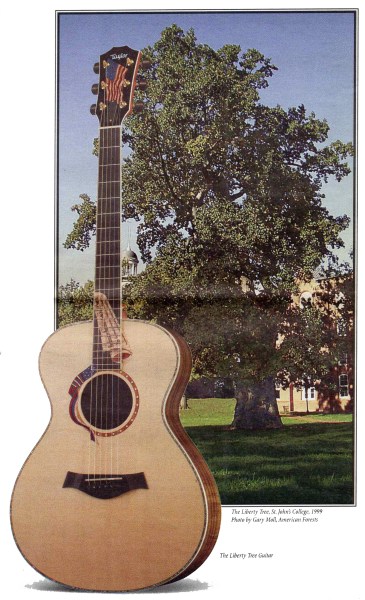
The Liberty Tree Guitar is a stunner that speaks volumes more about itself than can be conveyed with the printed word. It is a Grand Concert body with back and sides of gloriously figured, chocolate-and-vanilla-colored tulip poplar, with an abalone-edged top of Sitka spruce.
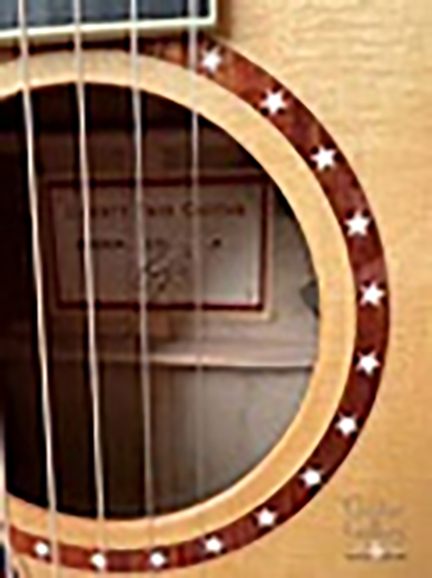
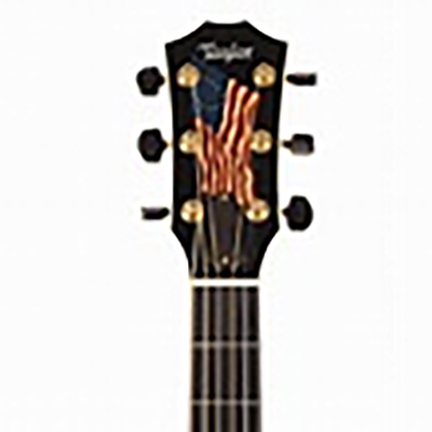
A laser-etched, burly maple inlay of a scrolled Declaration of Independence extends from the fingerboard onto the guitar top. The rosette combines a crescent of 13 stars (one for each of the original Colonies) around one half of the soundhole, opposite an early battle pennant that flew during the Revolution, rendered in bloodwood and dyed maple. A depiction of the first post-Revolution American flag is inlaid in dyed maple on the peghead.
Happily, the LTG also is a phenomenal musical instrument. When Bob examined the wood in that Maryland warehouse, he knew it would make great guitars. Now we know that it makes great-sounding guitars.
“Tulip poplar has about the same weight and texture as walnut, so to me they sound like our walnut guitars,” Bob Taylor says. “It’s probably a little softer, so these guitars have a fullness that is really nice. If you think of combining mahogany and walnut, you’d be on the right track.”
The Magazine’s Final Line
“We will make a Limited Edition run of about 400 LTG guitars.”
Charitable Contributions
A portion of the proceeds from the sale of each Liberty Tree Guitar was donated to the American Forests Tree Nursery Project, known for its innovative program of propagating offspring from hundreds of trees of historical significance. American Forests was established in 1875, making it the nation’s oldest non-profit citizens’ organization.
Since 1917, it has also been the organization of record for trees that have been “Living Witnesses” to historical events. For information about American Forests, visit https://www.americanforests.org.
Photo Gallery
Taylor Liberty Tree Limited Edition Guitar – Guitar Gallery
- The back & sides are this rare, figured Tulip Poplar wood from the Liberty Tree in Annapolis, MD.
- Hand picked Sitka Spruce top with an antique stain
- The guitar has pre and post Revolutionary War flag inlays- one on the headstock and the other forms part of the patriotic rosette
- Also, a laser-cut Decoration of Independence scroll decorates the Ebony fretboard
- 13 stars for the original colonies, partially circle the sound hole
- Ebony bridge with Ebony pins/pearl dots
- Abalone top trim
- Gold Grover tuning machines
- Special interior label signed by Bob Taylor