As a follow-up piece to last month’s post on the Ford Pinto trial, we offer a short bio of Judge Staffeldt, who catapulted to international fame during this crucial trial.
U.S. Army Service Profile
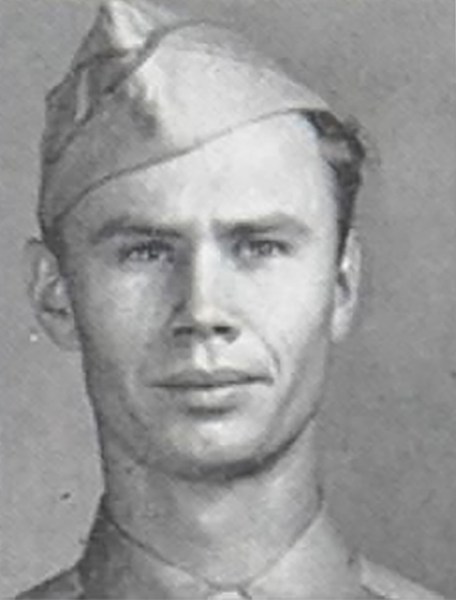 Jim Phillips, a Star City native, manages a Facebook group: World War II – Tell Me About My Boy. In it, it profiles Pulaski County veterans of World War II by combing through the archives of local newspapers. Jim was gracious enough to share his profile of Judge Staffeldt as a follow-up piece to last month’s post: Ford Pinto Trial 45 Years Later (https://pulaskihistory.net/ford-pinto-trial-45-years-later/)
Jim’s group is described as follows: This Facebook group is dedicated to the World War II veterans connected to one community.
Thousands of men and women with some connection to this community left their homes to “do their duty” in military service. Nobody knew for how long. Most of these individuals were in their early twenties. They were the sons, and daughters, cousins, and classmates.
Along with their parents, siblings, friends, and neighbors, they had been struggling with the Great Depression for the past ten years – now a World War! They were the Greatest Generation!
Find it here: https://www.facebook.com/groups/tell.me.about.my.boy
Harold Robert Staffeldt
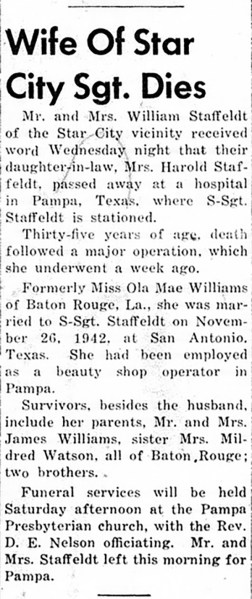
On a furlough back home, Harold was called back to his base, because his wife was ill, but sadly she died soon after.
After Harold’s discharge, he rose to be Pulaski County prosecutor, then Circuit Court judge. He presided over the Ford Pinto trial. Three girls had died when their Ford Pinto exploded after being hit from the rear. It was the first time that an automaker faced criminal rather than civil charges in deaths resulting from a car crash. (Ford was acquitted of reckless homicide.)
- Born: 3/6/1919
- Entered: 6/29/1941
- Branch, ID, Rank: USAAC, 35163178, SSGT
- Discharged: 11/17/1945
- Died: 8/30/1981
Parents: William Carl Friedrich and Ida Christina Tack Staffeldt
Staffeldt’s Thoughts on the Ford Pinto Trial
For additional information on the trial, see last month’s post about the trial here: https://pulaskihistory.net/ford-pinto-trial-45-years-later/.
Per an article in the Logansport (IN) Pharos-Tribune 16 Mar 1980 (reprinted from the Detroit Free Press), Judge Staffeldt said he “probably would have acquitted Ford Motor Co. of reckless homicide charges had the jury been unable to reach a verdict in the case.” He stated he “had the power to enter an acquittal” since he deferred a decision on a Ford motion for acquittal before the case went to the Pulaski County jury.
He said he had become a “better judge” because of the Pinto trial. “I like to work and I work hard. I’ve been learning every day of this trial.”
Staffeldt was known for his humor, especially when jury deliberations dragged on for 25 hours. “I’d like to get home early tonight,” Staffeld said one evening. “I was hoping to watch ‘Sheriff Lobo’ on TV.”
Some of Judge Staffeldt’s thoughts on the trial follow, taken from the Logansport (IN) Pharos-Tribune 30 Mar 1980.
The indictment handed down by the Elkhart County grand jury in late 1978 was badly written from the state’s side, Staffeldt said, because it was generally unclear and it specified one particular car of the several million Pintos made. Because of the limited nature of the indictment, Staffeldt said he was forced to limit evidence introduced by the Prosecutor Michael Cosentino to the 1973 Pinto model. If the charges had stated the Ulrich Pinto was only one of the several million Pintos made between 1971-76, it would have allowed him to expand the scope of the trial, the judge said.
He added he was forced to block the prosecution from showing crash test films it had acquired for two main reasons. First, the state did not produce a witness to the crash tests who could have testified as to how the films were made and second, the state did not show the tests were conducted with the specific intention of studying fuel system integrity.
The judge said he was concerned at the time the state rested its case that it had not produced its own accident reconstruction specialist. A statistical expert would have been allowed to testify in rebuttal, the judge said, but Cosentino chose not to have the man take the stand.
Staffeldt Passes Away 17 Months After the Trial
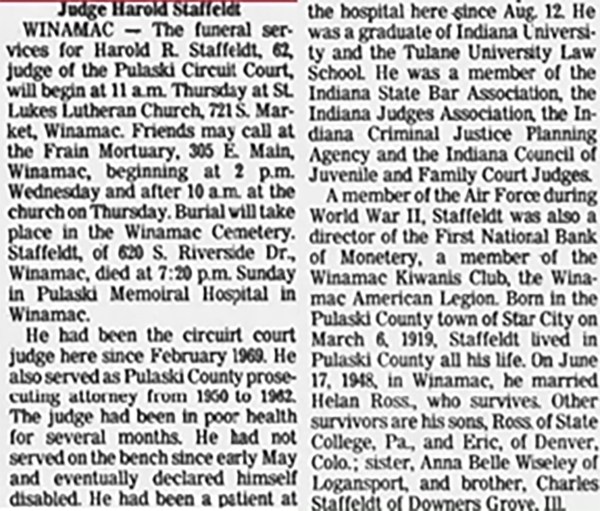
According to news accounts, Judge Staffeldt had been in failing health for “several months” before succumbing to cancer in August 1981, a mere 17 months following the trial. Harold R. Staffeldt, born March 6, 1919, died at the age of 62 on August 30, 1981.
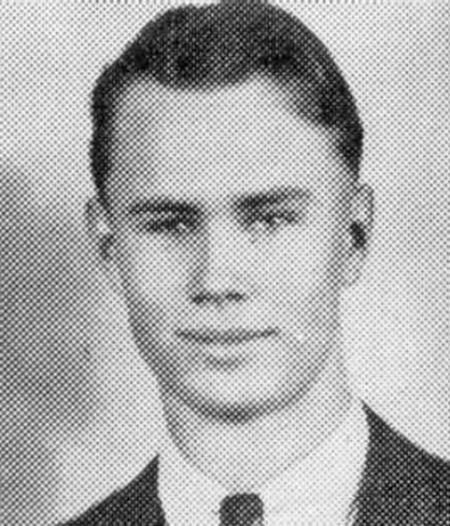
Staffeldt was born in Star City; he was a member of the Class of 1937 of Star City High School. After high school, he attended and graduated from Indiana University and the Tulane University School of Law (New Orleans).
He joined the Army Air Corps on June 29, 1941, well before the bombing of Pearl Harbor. He served at Pampa Army Airfield, a training airfield in Texas. After World War II, he returned to Pulaski County to practice law. He was elected to the position of Pulaski County Prosecutor in 1950, serving for 12 years, until 1969, when he was appointed to fill an unexpired term as Circuit Court Judge. He was elected to the position the following year.
During his tenure, he was a member of the Indiana Criminal Justice Planning Agency and the Indiana Council of Juvenile and Family Court Judges. This editor remembers, as a young probation officer in central Indiana, receiving a call from Judge Staffeldt asking for any information I could provide as he established procedures for the local probation department.
Following the Pinto trial, Judge Staffeldt continued to serve for little over a year more, leaving the bench in early May the following year. He passed away after an extended stay in the local hospital.
A Local Journalist Remembers
Karen Fritz covered the trial for two media outlets, WTRC radio in Elkhart and the Washington Post. She offers memories of Judge Staffeldt during that time.
Judge Staffeldt was a trooper during the trial. I was surprised to discover, looking back, that he was only 62 when he died. He seemed older to me when I was only 27!
I remember that his wife Helen seemed to be very protective of him. The judge was quiet, soft-spoken, not given to any theatrics or raised voice. He was thorough, dignified, did his homework. Respectful to both sides; little or no hint of favoritism.
His quiet personality could perhaps be interpreted as a hint of frailty, but I recall no speculation during the trial as to the status of his health. The trial was, however, intense for all involved. Much was riding on it. We were all tired. (The trial ran Mondays-Thursdays so the court could conduct regular business on Fridays.)
It most certainly took physical and even emotional tolls on the judge, his staff, the jury, lawyers, advisors, researchers and journalists. Also to the local residents who hosted and fed (restaurants and cafes) the trial participants and otherwise accommodated the influx of out-of-towners.
Revisiting the Ford Pinto Trial, a Panel Discussion
Karen Fritz, who, as stated above, covered the trial, publishes a local online news site, PulaskiPost.com. This article was published 36 years after the fact. Link to PulaskiPost article HERE.
Historical Society revisits Pinto Trial
Pulaski Post: Friday, 11 March 2016 21:58
The Pulaski County Historical Society revisited the 1980 Ford Pinto Trial, held at the courthouse in Winamac, at its annual meeting Thursday evening (March 10), at the Vurpillat Opera House, Winamac.
The featured program included a panel discussion with several participants from the historic trial, including jurors, lawyers and journalists. About 50 people attended the dessert and coffee bar program.
Special guest for the panel discussion was Elkhart County Circuit Court Judge Terry Shewmaker who served on the prosecution team for the trial. He was joined on the panel by jurors Jay Chamness and Janet Olson, attorney Dan Tankersley who also served on the prosecution team and journalist Karen Fritz who covered the trial for WTRC-Radio in Elkhart and the Washington Post.
Also present were jurors Charlotte Berger and Carolyn Redlin; along with court administrator Phyllis Crist, and Jeanette Podell, who as secretary for local attorney Lester Wilson who assisted the Ford defense team, came to know the defense attorneys and staff very well.
The Historical Society’s curator, Dr. Natalie Daily Federer, led the panel discussion.
Thirty-six years after the trial, Shewmaker and Tankersley still smarted a little from the sting of the prosecution’s inability to get some of their vital evidence and testimony admitted before the jury. But both had high praise for Judge Staffeldt and the jury and the difficult task they faced in charting new territory in corporate and legal responsibility.
Both Chamness and Olson admitted they were reluctant jurors. Mrs. Olson, particularly disliked the long periods of separation from her young children. As they deliberated the verdict, she said most of the jury could not get past the “reasonable doubt” aspect required to return guilty verdicts.
The panel answered questions about the publicity surrounding the trial, Winamac and its townspeople, the accommodations for the prosecution and defense teams, and their staffs and witnesses, the media and other participants. They also covered legal questions regarding the trial and its impact on corporate responsibility.
For 10 weeks in 1980, the landmark Ford Pinto Reckless Homicide Trial caught the national spotlight as news datelines from the Winamac courthouse flashed across the country. The charges stemmed from the fiery deaths of three teenage girls, sisters Judy and Lyn Ulrich and their cousin Donna Ulrich, after their 1973 Pinto was struck from behind and burst into flames on U.S. 33 in Elkhart. Elkhart County Prosecutor Michael Cosentino took the unprecedented step of filing criminal charges against a corporation, and renowned attorney James Neal of Nashville, Tenn. was hired to defend automaker Ford. Neal had previously prosecuted labor leader Jimmy Hoffa, as well as top officials of the Nixon administration in the Watergate scandal.
In April 1979 it was announced the Pinto Trial would be venued to Pulaski County, and it began with jury selection on Jan. 7, 1980, and ended with not-guilty verdicts on March 13, following 25 hours of deliberation over four days.
At the Historical Society’s annual meeting Thursday evening, trial evidence and memorabilia were on display, including the crumpled and fire-scarred gas tank from the Ulrich Pinto.
Trial judge was the late Harold Staffeldt, and court administrator was Phyllis Crist. Trial jurors were foreman Arthur Selmer, Roger Tanner, Edgar Adams, Carol Redlin, James Yurgilas, Jay Chamness, Charlotte Berger, Janet Olson, Mark Feece, Barbara Asel, Raymond Schramm and Mary Lea Sass, along with alternates Mike McFarland, Chris Dust and Herman Braun. Caretaker of the jury was a popular local figure, the late court bailiff Mike Garrigan.
Winamac attorneys Lester Wilson and John Richert assisted Neal’s defense team, while Dan Tankersley helped with the prosecution team.
We’re A Small Community
Probably everyone in this small community is connected to Judge Staffeldt, the local attorneys, the members of the jury. Two jury members were from this editor’s own graduating class; the mother of another classmate also served. As a Star City native, my connections run to Staffeldt’s childhood. He was a member of my aunt’s graduating class. He would have attended that school from grade one; my aunt would have entered in junior high, after grade school at Thornhope. My father was two years behind.
As Staffeldt joined the Army Air Corps during WWII, so did my father. He, however, failed an eye-hand coordination test and ended up in the Army itself, while Staffeldt continued with the Air Corps. Both served honorably.
My sister and I attended Winamac High School with the two Staffeldt boys, Ross and Eric, while Staffeldt was Judge of the Circuit Court. Certainly, some of my classmates were brought before him on a variety of highjinks.
This means nothing, except to show that in a community such as this, the bonds grow deep and strong.
The community was in the middle of an international firestorm. Opinions were high throughout the legal community and throughout our own. You can hear positive and negative thoughts about how the Judge handled the case, but these things are clear. He was a steady hand through the process and the experience was probably much harder on him than anyone could have ever known.