For a couple of years, we have shared the Reminiscences of E.R. Brown, a man born in Pulaski County in 1845. It is due to his writings that we know much about our past as a young community, moving toward the future. Today, we’re going to tell you a little about the man, from a variety of sources. In the future, we will bring you stories of his service during the Civil War.
Selected Notes From 1883
F.A. Battey and Co. Counties of White and Pulaski, Indiana. Historical and biographical. Chicago, F.A. Battey & Co., 1883. Kindle Edition.
This book is (1) great source material for post-Civil War Pulaski County, and (2) not always completely reliable. For our purposes in telling a story of E.R. Brown, it is probably accurate.
Re-union of 1881.
A soldiers’ re-union was held at Monticello on the 28th, 29th and 30th of September 1881, on which occasion not less than 10,000 persons were present. Ex-soldiers were there from all the neighboring counties, and even from quite distant points. E. R. Brown, of Winamac, addressed the meeting on the first day, and Gen. Manson on the second day. During the first two days, the time was passed much after the fashion while in actual service, camps being formed, and the boys passing the hours in recounting their varied experiences. The last day was the day of the re-union. Military evolutions were enjoyed in the forenoon, and in the afternoon the sham battle took place. The Union forces were defeated. It was one of the most enjoyable times ever passed in Monticello.
Detectives.
The Star City Horse Thief Detective Association was organized in 1880, with the following first members, who filed articles of association in the Recorder’s office, at the county seat, according to law : V. S. Buston, Charles Ledgert, C. A. Compton, John Senn, Jr., Peter Skillen, E. P. Washburn, I. L. Washburn, James Billaker, Michael Ruff, M. L. Washburn, Levi Tomlinson, J. A. Humes, E. R. Brown, John L. Burton, James Osborn, William Korner, George Clause, John Buck and William F. Venard. The formation of the association was due to the popular indignation over several aggravated cases of horse-stealing in the southeastern part of the county. The object is to unite means and efforts to run down and capture those rascals who, in new countries, are usually consigned to an ignominious death from a rope hung over the limb of a friendly tree.
Biography.
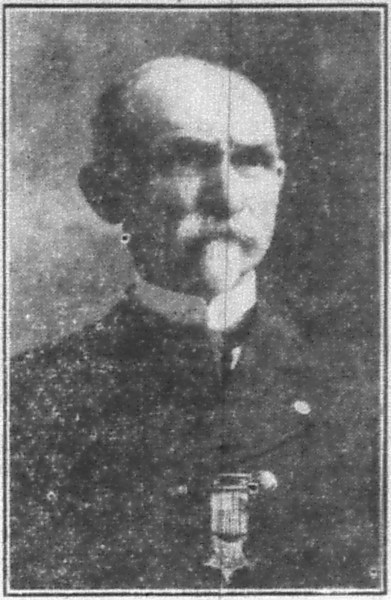
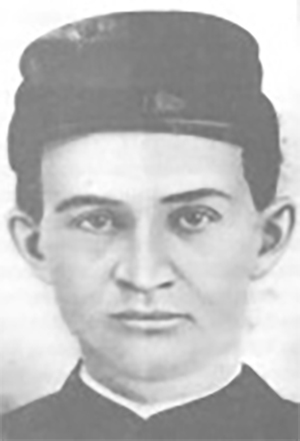
E.R. Brown, son of the oldest settlers of this county, was born in Indian Creek Township, August 9, 1845, and is one of the eight children, seven still living, born to Ira and Sophia (Blew) Brown, a sketch of whom will be found under the head of Indian Creek Township. E. R. Brown was reared on the old homestead until sixteen years of age.
August 12,1861, he enlisted in Company C, Twenty-seventh Indiana Volunteer Infantry; was sent to the front, and for the first two years was in the Army of the Potomac, under Gen. Banks, and afterward in the Twelfth Army Corps. He took part in the battles of Winchester, Newtown, Cedar Mountain, Antietam, Chancellorsville and Gettysburg. Soon after the last-named battle, he was transferred to the Army of the West, under Gen. Joe Hooker, and was detailed to the office of the Provost Marshal at Tullahoma, Tenn.
He was mustered out September 22, 1864, when he returned to Pulaski County, resumed his studies at school, for a time attended the old Male and Female College at Valparaiso, and in January 1865, entered Wabash College at Crawfordsville, graduating in 1868 with the degree of B. S. The fall of 1868, he entered Lane Theological Seminary, graduating in 1871.
The summer of 1871, he went to Mechanicsville, Iowa, and was ordained minister and appointed pastor of the Presbyterian Church at that place, where he was engaged in active ministerial labors until the spring of 1875, when ill health compelled him to relinquish his charge.
The fall of the same year he purchased an interest in a store at Pulaski, remained there until 1879, then moved to Star City, and thence, in 1880, to Winamac, where he is still engaged in business.
He was married, March 1, 1879, to Miss Emma March, and is by her the father of one son, Arthur H.
Selected Writings from the Book.
Much like E.R. Brown’s writings, submitted in the 1920s to the local newspaper, these musing added a bit of color to the reference book: Counties of White and Pulaski. The following items were contributed to the Indian Creek Township section.
The First School.
One of the first schools was taught by William Wall – ‘Old Billy Wall,’ as he was familiarly called – at the house of Jonas Good, Sr., as early as 1842, and possibly 1841; he was paid entirely by subscription, but how much is not known. His pupils were the older children of Jonas Good, Sr., John March, and a few of the children of persons living farther away, whose names cannot be ascertained.
The First Birth and Death.
The first death was that of Amanda Long, wife of Thomas Long, and daughter of Elisha Hall. She died in the summer of 1838, in a cabin on the north side of Hall’s Branch, near where the bridge now is. She died in childbirth. The child lived a few weeks and also died, and both mother and child were buried at Winamac, among the first there, if not the, first.
The First Cooking Stove.
The first cooking stove in the township was brought by Elisha Hall early in the ’40s. He paid $50 for it. It was a small stove of the old-fashioned raised oven, or ‘ step’ pattern. A man could easily carry it. He bought it on credit, giving his note. When the note fell due, he traded four nice large milch cows for it.
The German Reformed Church.
The German Reformed Church was organized out of material that was mostly, if not all, Old-School Lutheran, though in very early times both Lutheran and German Reformed ministers visited the neighborhood and labored temporarily among the Protestant Germans. The first is thought to have been Rev. Reuben Good, D.D., now connected with the German Reformed College at Tiffin, Ohio. After him, probably came a Mr. Bossier, a Lutheran. His ministry extended over a considerable period, and it was probably under him that a Lutheran class was organized. It was about this time, also, that the log church was built.
After Mr. Bossier came a Mr. Chappais, generally known in the community as ‘Cabus.’ He came with the design of remaining permanently. He settled on a new piece of land on the east side of the river, in the lower side of Monroe Township, south of the Shelhart or Neff place. But his ministrations were not acceptable to the members of the church, they claiming that he rebuked them too sharply for their manner of living. He consequently had to give up his preaching. He was a highly educated man; had gone to school twenty-five consecutive years in Germany, and knew nothing about making a living.
He first tried peddling books. And ‘Mr. Cabus,’ or the ‘Dutch Preacher,’ with a leather trunk filled with books on his back (load enough for a pack mule) was a frequent visitor at the houses of the neighborhood. But the people in general were too poor to buy books, and that failed to yield him a living. He came down to absolute want, and but for the hand of charity, his family must have suffered greatly. No one came to take his place as minister to the church until Rev. Jonas Michael, a German Reformed minister, came and organized a church of that denomination.
Methodist Episcopal Class in Indian Creek.
The history of the Methodist Episcopal class in Indian Creek, if well written up, would make an interesting chapter not unlike romance. It was organized very early in the history of that community. A Rev. Mr. Munson was preaching at John Reeder’s, and had organized a class as early as May, 1839. After Washburn’s Schoolhouse was built, the meeting place was located there until the town of Pulaski began building, when it was permanently located there. Its history furnishes ample proof that the church is in the world if not of it.
Some of the best men and women who have ever lived in that township were members of that class. Two very able ministers, leading men in their sections, one of them in Kansas and the other in Iowa, were brought up as members of that class. Two men who were pastors of the class, after going to other points, were sent to the penitentiary, one for horse-stealing and the other for adultery. Another’s wife, after they had moved to Illinois, shot a neighbor woman dead, because she suspected her of criminal relations with her husband.
The meetings were often interrupted by rowdies. It was nothing unusual to have horses turned loose, harness and saddles cut, etc., etc. One time, during protracted meeting at Washburn’s Schoolhouse, some rowdies got into the loft with a fiddle, and when the congregation sang, they sawed on the fiddle.
Some of the early preachers were famous for lung power. One in particular could be heard distinctly in his ordinary preaching over a quarter of a mile. The people also, if occasion required, did not hesitate to make a little noise. At their protracted camp-meetings, they were often heard praying and shouting a distance of more than a mile.
FindAGrave
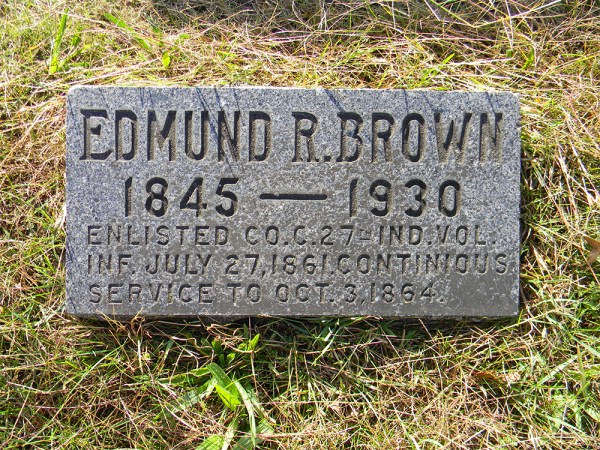 E.R. Brown is buried in the Winamac Cemetery. The following inscription on his gravestone:
EDMUND R. BROWN
1845-1930
ENLISTED CO. C. 27 – IND. VOL.
INF. JULY 27, 1861 CONTINUOUS
SERVICE TO OCT. 3, 1864.
From the site comes this notation:
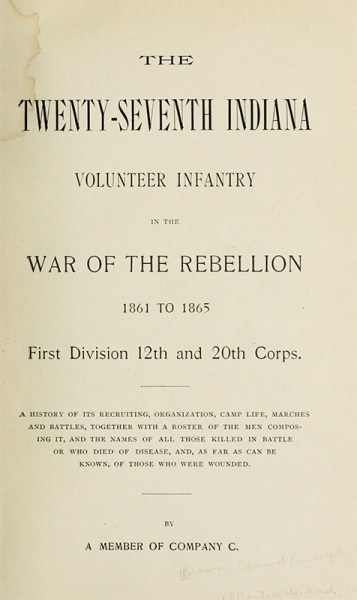
Civil War Veteran Promoted from Private. Wounded at Antietam – left of navel. Declined promotion to Sergeant over those absent wounded; detached service as clerk for post Provost Marshall office Tullahoma Tennessee 11-1-1863 to 8-1864. Mustered out 10-1-1864. Regimental Historian – wrote The Twenty-Seventh Indiana Volunteer Infantry in the War of the Rebellion, (1899). Died Winamac Indiana 3-14-1930.
Federal Records Regarding Antietam.
https://antietam.aotw.org/officers.php?officer_id=15382
From a Google AI Search: “The Battle of Antietam, also known as the Battle of Sharpsburg, was fought on September 17, 1862, near Sharpsburg, Maryland. It was the bloodiest single-day battle in American history, with over 23,000 casualties. The battle ended the Confederate Army of Northern Virginia’s first invasion of the North and provided President Abraham Lincoln the opportunity to issue the Preliminary Emancipation Proclamation five days later.”
Per the federal records regarding the battle at Antietam, Edmund Randolph Brown reached the rank of Corporal, serving in Company C of the Twenty-Seventh Indiana Infantry. A farmer, he enlisted at the age of 16 on September 12, 1861. The federal records record this remembrance from Brown.: “It is alleged that certain of the boys who were under the minimum age put the figures 18 in their shoes, and, when asked how old they were, answered innocently, “I am over eighteen.” The writer [Brown] was not smart enough to think of such a clever expedient. When he was mustered Major Wood stopped in front of him, and, laying one of his hands on each of the writer’s shoulders, asked kindly, “Bub, how old are you?” Of course, the answer had to be “eighteen,” even if it was “stretching the blanket.”
Brown was promoted to the rank of Corporal (date unknown). He was wounded in the belly one year into his service, on September 17, 1862, at Antietam. From November 1, 1863, until August of 1864 he was detached from his unit as a clerk at Tullahoma, Tennessee. Brown mustered out with his Company on October 1, 1864.
On the Antietam Campaign.
The 27th Indiana was part of the Federal 12th Corps advance through the Miller Cornfield on the morning of 17 September. They were heavily engaged there, and nearly half the men of the Regiment were casualties.
After the War.
He graduated from Wabash College in 1868, and then from Lane Seminary (Cincinnati, OH) in 1871. He was a Presbyterian minister in Iowa for 3 years and was a storekeeper in Monticello, IN for 27 years. He completed his history The Twenty-Seventh Indiana Volunteer Infantry in the War of the Rebellion in September 1899. …. He was once commander of the Grand Army of the Republic (GAR) of Indiana.
Taps Sound For Veteran Business Man
Edmund R. Brown Dies at Home in Winamac
Pulaski County Democrat 03/18/1930
After an active life of more than eighty-four years, the greater part of which was spent here in his native county, Edmund R. Brown passed away early last Saturday morning at his home on East Main street, where he had been gradually failing for several weeks from frailties incident to his age.
A veteran of the Civil war, a former minister, businessman and banker, his passing marked the close of many years of busy activity, although his recent years, since retiring as president of the Citizens National Bank, had been spent more leisurely.
A son of two of the earlier settlers of the county, Ira and Sophia Brown, Mr. Brown was born in Indian Creek township on August 9, 1845, on the farm just across the river from Pulaski which is still known as the Brown homestead. He was the third of eight children born in the pioneer home and was the last of all his brothers and sisters to pass away.
In August of 1861, when he was a few days past sixteen years of age, he enlisted in Company C, twenty-seventh Indiana Volunteer Infantry, and served during three years of the conflict, or until the expiration of his enlistment n September of 1864. His regiment was engaged in many of the more important battles, including Antietam, Chancellorsville and Gettysburg.
Four Years in the Ministry.
Returning from the war he attended Valparaiso university for a short time, then entered Wabash college and graduated with the class of 1868. From there he went to the Lane Theological Seminary at Cincinnati, completing the course and entering the Presbyterian ministry in 1871. For four years he served as pastor at Mechanicsburg, Iowa, but because of his health was compelled to relinquish his charge.
Entering the mercantile business, he spent the succeeding years as a merchant in Pulaski, Star City and Winamac, moving from here to Monticello in the late 80s. After a long career there in the furniture business he changed to banking and was located at Akron for a time. In 1917 he purchased a large interest in the Citizens National Bank of Winamac and became its president, remaining in that capacity until the consolidation of that institution with the First Trust & Savings Bank in the fall of 1920, when he retired from active work.
Fifty-one years ago March 1 he was married to Miss Emma March of Pulaski, who has been his constant companion throughout more than half a century and his faithful caretaker during his declining days. Surviving also are the two children born to them, Halleck Brown, an attorney of Billings, Mont., and Miss Genevieve Brown of Indianapolis, now clerk of the Indiana Supreme and Appellate courts.
Regimental Historian.
Mr. Brown was for many years active in the G.A.R., taking part in its reunions and other affairs and during the year 1906 served as commander of the Department of Indiana. He was also made regimental historian and devoted a great deal of attention to the compilation of a 500-page volume which contains an interesting and authoritative record of the Twenty-seventh.
Among his other writings, Mr. Brown prepared a few years ago a series of sketches covering the early days of Pulaski County, which appeared in The Democrat at that time as a popular historical resume.
In keeping with his own wishes, a military funeral was held Monday afternoon, under the auspices of the G.A.R. and American Legion. Several veterans from the post at Logansport came here to take part in the service.
The Winamac American Legion post, with most of those present in uniform, also turned out and bore the flag-draped remains to their resting place in the new Southlawn addition to the Winamac cemetery. Services were conducted at the Presbyterian church by Rev. M.H. Rice, formerly Presbyterian pastor at Monticello but now of Condit, Ohio. He was assisted by Rev. H.R. Martin of Gary and Rev. J.E. McCloud of this city. The service also included a talk by Capt. William Guthrie of Monticello and a vocal solo by Mrs. Faye Stephens of Star City. A salute of guns and the blowing of taps, just as the sun sank in the western horizon, reverberated as the departing comrade lay down for his well-earned rest.
Closing
You will continue to receive the Remembrances of E.R. Brown monthly, and we hope to give some sense of his service in the 27th Indiana in future articles.
Contributing: Malissa Poor
Links to the Series of Reminiscences by E. R. Brown. These articles are posted monthly. It’s most likely this list will not be kept up to date, but you need only search for them. This list, ending in Part Twenty-Four, is accurate to July 2025.
Links to Earlier Articles
- Part one (Common Inconveniences) October 2018 newsletter.
- Part two (Land) June 2019 newsletter.
- Part three (Trees & Timber) November 2019 newsletter.
- Part four (The River) February 2020 newsletter.
Later editions are carried as separate posts.
- Part five (Public Roads)
- Part six (Schools)
- Part seven (Markets & Trading Points)
- Part eight (It’s Mills)
- Part nine (Wild Game)
- Part ten (Feathered Wild Game)
- Part eleven (Animal Pests & Birds of Prey)
- Part twelve (Fishing in the Early Days)
- Part thirteen (Wild Fruit)
- Part fourteen (Early Commerce on the Tippecanoe)
- Part fifteen (It’s Homes and Home Life)
- Part sixteen (House Raisings)
- Part seventeen (Clothing a Family)
- Part eighteen (Log Rollings)
- Part nineteenth (First Trip to Winamac)
- Part twenty (Grubbings and Wood Choppings)
- Part twenty-one (Apple Peelings)
- Part twenty-two (Sausage Makings)
- Part twenty-three (Parties and Amusements)
- Part twenty-four (Early Wheat Raisings)