This is the twenty-second in a Series of Reminiscences by E. R. Brown. Brown was born in Pulaski County on August 9, 1845. His writings are abstracted from the “Pulaski County Democrat” on microfilm housed in the Pulaski County Public Library, Winamac, Indiana. Find links to earlier entries at the end of this article.
Published in “Pulaski County Democrat,” July 13, 1922
Other parties where gratuitous neighborly help was combined with social enjoyments, formerly popular here, were generally referred to as sausage makings, though it was always understood that any work necessary in taking care of by-products after the farm butchering of hogs was liable to be done. I presume that fewer hogs now being killed at one time, with improved devices for doing things, are responsible for the discontinuance of these notable experiences.
The statement may seem strange, but no live hogs were then marketed in this region. At an earlier period than the one being considered and probably at this time, large droves of hogs were driven to Cincinnati and perhaps other Ohio river ports from as far north as Indianapolis. But if there was any demand for such hogs within reach of the people in this section they did not choose to avail themselves of it. The invariable rule here then was to kill and dress them at home. Then if any were to be sold, their carcasses, after cooling overnight (often frozen) were hauled, with heads and feet still on, to Logansport or Lafayette. Frequently all were cut up and salted away, a portion to be sold later as salt meat or smoked and sold as bacon. Both of these latter methods, by the way, were often found relatively profitable and I have often wondered why they were discontinued so largely.
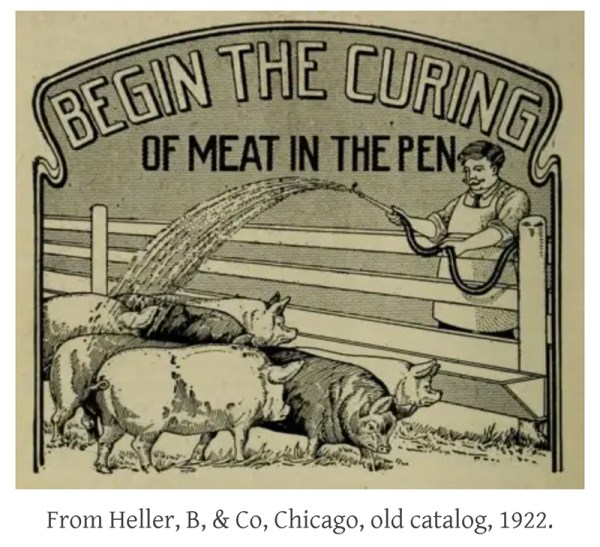 The large amount of byproducts resulting from such a course was largely increased by another rule of the hog-raising or pork-producing game as played early, which may seem even more strange to those playing it now. No hogs were considered ready for market until at least one year old, while even farrows were often kept until two years old. This was because only large hogs were wanted for slaughter. I may add further that few fed stock hogs grain except in winter. In summer, they were largely expected to shift for themselves. Sometimes they were provided with pasture, a clover field being a favorite with my father, but more frequently they were turned out on the commons.
Then the rule was to select such as were deemed ready for it, put them in close pens or small enclosures and begin feeding them corn about the time it was ripe, which brought butchering time in early winter, near the holidays. It has been many a day since I have seen a farm butchering. My impression is that while fewer hogs are now killed at one time, the average size being also much smaller, methods have really changed but little. I would hope that more of the work can now be done indoors, with less heavy lifting and carrying.
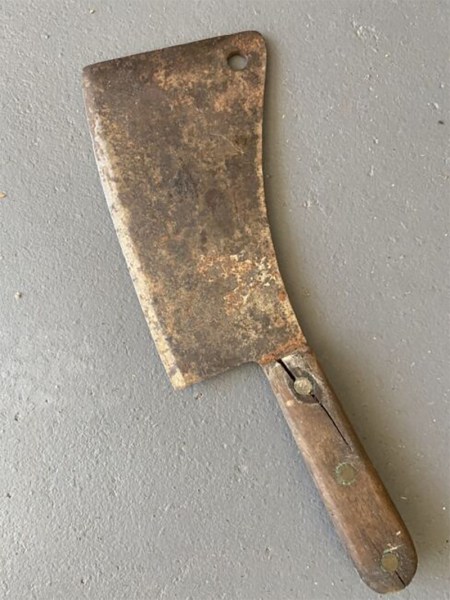
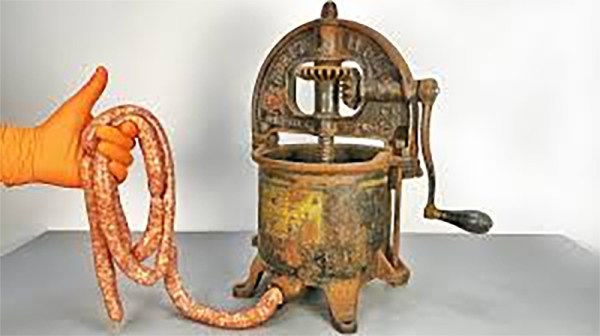
The assemblages in question were always at night, which at that season are at their longest, while farm work was then slack so that no one was in any hurry to go home. Perhaps the attendance was more limited to intimate friends or relatives than on some other occasions. While all were there for business, the spirit of good cheer and revelry was spoiling for expression. Earlier there were no grinders or other machines to do any part of the work of reducing meat to pulp. All had to be done by hand with sharp knives of some sort. Later a tool was contrived and made by local blacksmiths, resembling a butcher’s cleaver, but smaller, by which when handled dexterously, a fine lot of meat could be beautifully chopped in a short time. It was curiously true also that certain other local blacksmiths eventually contrived and made wholly by hand in their own shop, a machine which ground the meat quite like the more modern machines do and which soon supplanted all hand work, wherever introduced. The tool for stuffing the sausage consisted of a tin tube with one small end and a wooden plunger by which the meat whether chopped or ground, on being put in the larger end was forced out at the smaller end into whatever has been made to hold it, either the intestines of the animal or of cloth. The power for operating this device was simply ‘main strength and awkwardness’. The men mostly took turns in keeping all special tools in constant use, while all others lent a hand in cutting, trimming, rendering, cooking, mixing, fetching and carrying. It was a hustling, hilarious, happy time for all.

It should come as no surprise when stated that an invariable feature of these parties was that near their close at midnight or after, all sat down at the groaning table and ate a prolonged hearty meal in which among much else, the sausage and other rich preparations of the evening were liberally sampled. The surprise may come in when it is stated that no sudden deaths resulted. The more definite social program varied with the wishes of families where the party was held, also with the hour when the work was finished and feasting was over.
N.B. I meant to say in the proper connection that hogs running half wild in the woods, were often well fatted on acorns, as is perhaps generally known, and by hook or crook generally did better than might be imagined. In some counties, beech nuts fatted the hogs, but as previously stated, beech trees were scarce here. Sometimes however, when hogs were hunted up, some were found to be very poor, while many died, largely of starvation. A neighbor, a recent new-comer, once made himself the laughing stock of our community by blandly expressing the wish in public and with evident sincerity that a breed of hogs might be found which would fatten on prairie hay.
Additional Information
For added fun, please take a look at this PDF document, “Hoosier Hogs,” published by the Indiana Historical Bureau in 1994. Link: https://www.in.gov/history/files/7027.pdf. It covers agriculture, specifically hog farming, in the mid-1800s.
Links to Earlier Articles
- Part one (Common Inconveniences) October 2018 newsletter.
- Part two (Land) June 2019 newsletter.
- Part three (Trees & Timber) November 2019 newsletter.
- Part four (The River) February 2020 newsletter.
Later editions are carried as separate posts.
- Part five (Public Roads)
- Part six (Schools)
- Part seven (Markets & Trading Points)
- Part eight (It’s Mills)
- Part nine (Wild Game)
- Part ten (Feathered Wild Game)
- Part eleven (Animal Pests & Birds of Prey)
- Part twelve (Fishing in the Early Days)
- Part thirteen (Wild Fruit)
- Part fourteen (Early Commerce on the Tippecanoe)
- Part fifteen (It’s Homes and Home Life)
- Part sixteen (House Raisings)
- Part seventeen (Clothing a Family)
- Part eighteen (Log Rollings)
- Part nineteenth (First Trip to Winamac)
- Part twenty (Grubbings and Wood Choppings)
- Part twenty-one (Apple Peelings)