This is the twenty-first in a Series of Reminiscences by E. R. Brown. Brown was born in Pulaski County on August 9, 1845. His writings are abstracted from the “Pulaski County Democrat” on microfilm housed in the Pulaski County Public Library, Winamac, Indiana. Find links to earlier entries at the end of this article.
Published in “Pulaski County Democrat,” June 29, 1922
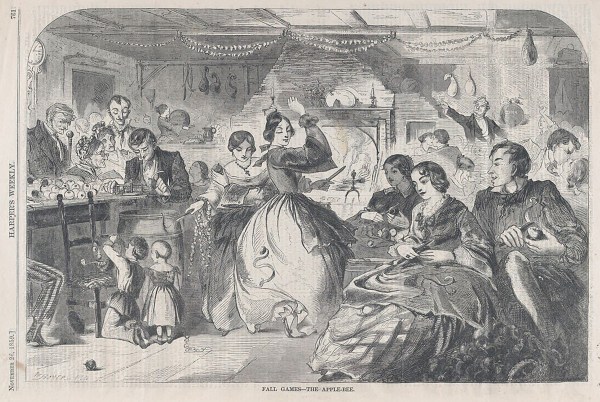
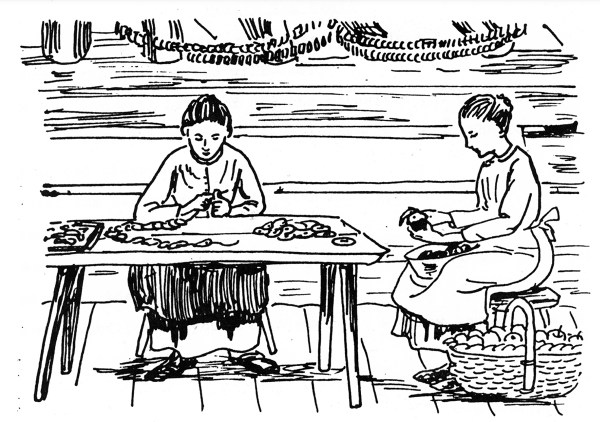
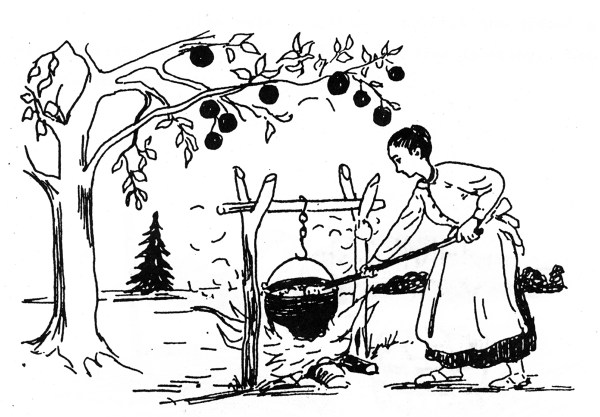
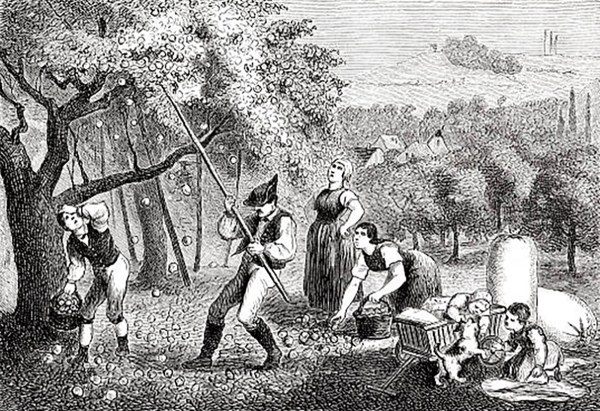
As previously stated, apples, peaches and kindred fruits did extra well here at the first. For various reasons it was not easy to get trees started, but that accomplished, with scant attention afterwards, there were soon bending if not breaking, under a burden of choice fruit. And many modern ways of keeping fruits being unknown or impracticable, particularly that of canning, the resort was mainly drying. Therefore apple peelings, also called ‘peeling bees’, were numerous and popular. They have not seemed in vogue lately, so were peculiar to earlier times.
Unlike other gatherings for neighborly help, including amusement for those rendering it, these were always evening functions and distinctively if not exclusively for young people. For that reason it was natural that my impressions concerning them should be more deep and lasting than could be true of some others. I have tried to have it understood all along that I was not an adult at the time covered by any of these articles. As I ponder over these gatherings therefore, I am glad that so much that was creditable to those of that period and so little of a contrary nature is recalled. Youngsters of the county at that time must have averaged well along some lines, if not along many. If this is handing a bouquet to myself it will have to go at that.
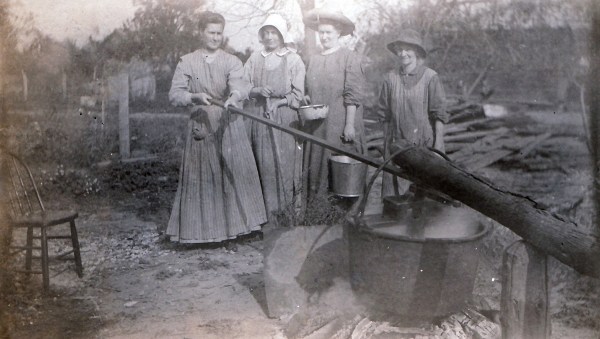
Of course they were dressed plainly. Every garment on every mother’s son or daughter had been made at home, wholly without fashion-plate, printed directions or late patterns to go by. Of course they were in no sense ‘dolled up’. Without doubt some who have since reared fine families lived worthy lives along other lines and are now living in comfort and honor or enjoying a rich reward in heaven, belonged to homes where if there was a mirror it was less than six by eight inches in size, certainly without a hair brush while if there was a comb it was a cheap affair. Of course, if there was some refinement, there was little polish or veneer. No one present had had a chance to go as far as what is not the eighth grade in school. Few had attended a school where the teacher had gone that far. No one present had traveled to speak of and many had not visited outside of the county. All that anyone knew of etiquette had been learned from word of mouth or example. Yet I do not scruple to say that all might have gone further and done worse. Of course, there was some rudeness at these gatherings: some loud talking and boisterous demonstrations, coarse remarks, cutting rejoiners, etc. Since when have these ceased to be true of other similar functions?
I recall that the maxim, “Business before pleasure” was invariably observed. If the fruit previously gathered was somewhat excessive, revealing a spirit of selfishness somewhere, no matter. Without other contrivances in the earlier years than cheap pocket knives (often barlows), or common case or butcher knives, the large supple was resolutely attacked and there was no let up until the last apple had been neatly peeled, cut and cored, with all litter sedulously cleaned up. I also recall the strong sentiment always in evidence that, whether in minor competitions in the work or in the games and amusements following, all must be on the square and all must learn to be good losers. No one given to cheating, deceit or ‘figs’ was popular.
After the hard work in hand, plain refreshments were the rule, pies “like mother used to make,” gingerbread and the like, but no angel’s food cake or ice cream: plenty of rich, fresh milk or buttermilk , possibly some kind of tea, but never coffee. My people were among the well-to-do, yet I never tasted much coffee or any ice-cream until after I became a soldier.
The amusement features were kept for the last. They consisted wholly of plays and games. I have no recollections of dancing following an apple peeling. In most homes where they were held, dancing was strictly prohibited. Just why the square dances of that period were more objectionable than the plays and games I have never heard explained. I refrain from any attempt to enumerate or describe the latter. I would say that most of those reported elsewhere were; first and last, tried out here. The people here had come from many sections, with others constantly arriving. As a rule, a newcomer is seldom backward about speaking well of things “where I come from”, commonly insisting that they surpass what he finds here. “Heavy hangs over your head” and “Button, button, who’s got the button” were always stand bys. Perhaps I recall the miller “who lived in the mill”, “London Bridge is falling down” and others which were sung, more vividly, as well as more tenderly, than the others.
As to the kissing between the sexes, always imposed as a penalty in all games and plays, some good people questioned its propriety at the time as others would have a duck fit over it now. By certain well-understood manipulations it was largely between those who, according to the rules of good society, have the right to kiss each other and, though in public, could hardly be considered as immodest. Still, it must be admitted that more or less of it was promiscuous, and like some other things not common now, it was plentiful at one time. And whether good or bad like short skirts, peek-a-boo waists, bare knees and bare backs, they were characteristics of a period. Dear knows, the young people of those primitive times saw little enough of the brighter side of life.
Links to Earlier Articles
- Part one (Common Inconveniences) October 2018 newsletter.
- Part two (Land) June 2019 newsletter.
- Part three (Trees & Timber) November 2019 newsletter.
- Part four (The River) February 2020 newsletter.
Later editions are carried as separate posts.
- Part five (Public Roads)
- Part six (Schools)
- Part seven (Markets & Trading Points)
- Part eight (It’s Mills)
- Part nine (Wild Game)
- Part ten (Feathered Wild Game)
- Part eleven (Animal Pests & Birds of Prey)
- Part twelve (Fishing in the Early Days)
- Part thirteen (Wild Fruit)
- Part fourteen (Early Commerce on the Tippecanoe)
- Part fifteen (It’s Homes and Home Life)
- Part sixteen (House Raisings)
- Part seventeen (Clothing a Family)
- Part eighteen (Log Rollings)
- Part nineteenth (First Trip to Winamac)
- Part twenty (Grubbings and Wood Choppings)