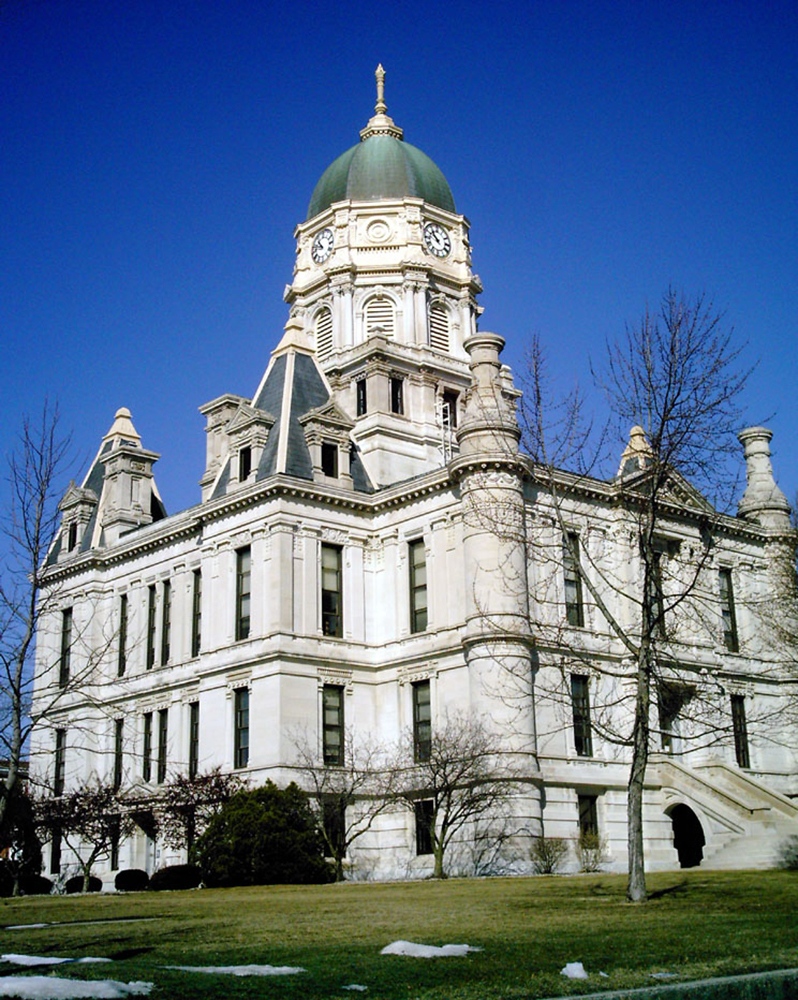
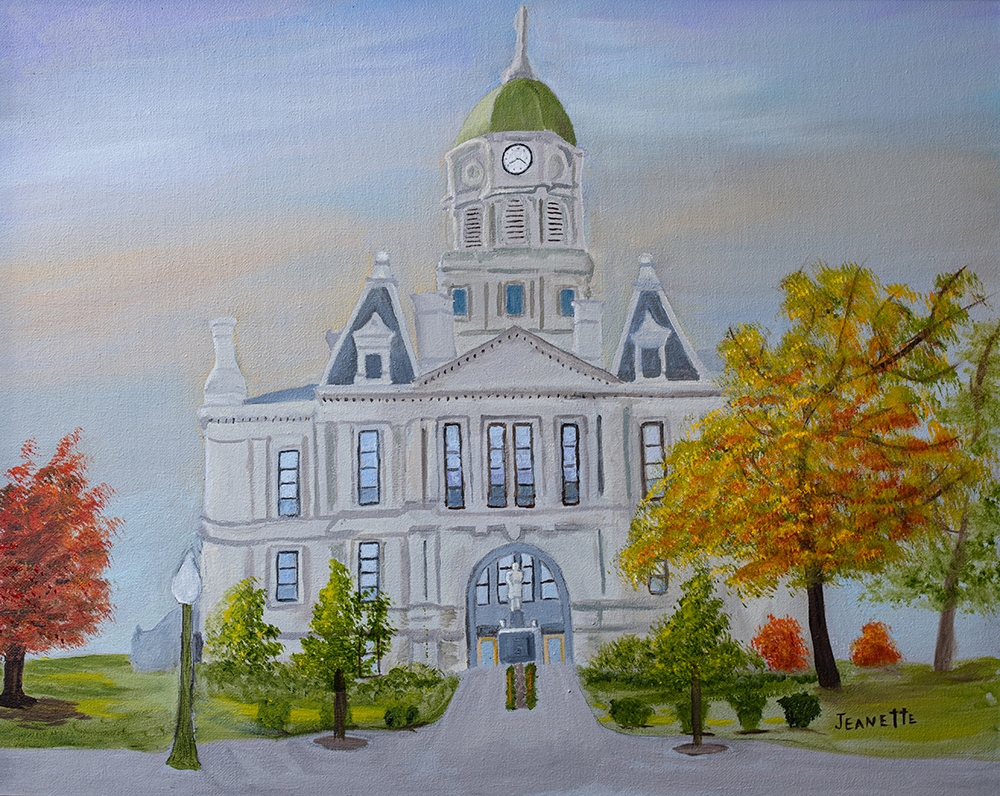
The content of this post was developed with the permission of Indiana Landmarks and the photographer who digitized the art, Cydney Huntzinger.
Indiana’s Historic County Courthouses
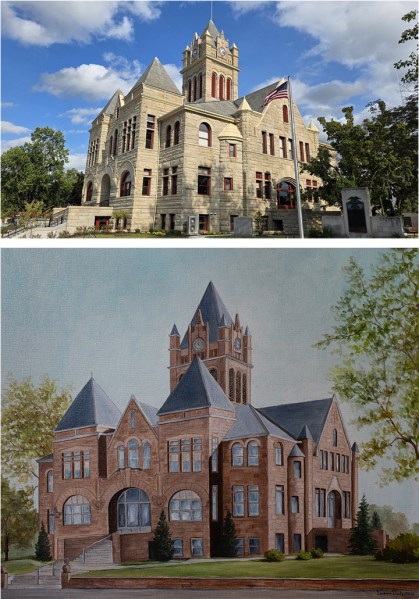
The “Icons of Community: Indiana’s Historic County Courthouses” project features artwork of all 92 Indiana county courthouses, collected by attorney Douglas Church from 2007 to 2025 and recently displayed at the Indiana Landmarks Center. The exhibit showcases a wide variety of art, including oil paintings, watercolor, pastels, and fiber art, and is a collaborative effort involving Indiana Landmarks, the Indiana State Bar Association, and the Indiana Bar Foundation. After the exhibit’s run, the collection’s ultimate goal is to find a permanent home in a public building to honor the enduring role of courthouses as symbols of community and the rule of law.
The collection includes a mix of pieces depicting current courthouses, historic ones, and some that are both. It features diverse artistic styles, such as realism and impressionism, and different mediums, including oil, watercolor, pastels, pen-and-ink drawings, woodcuts, and fiber-art.
The long-term goal is for the complete collection of 92 works to be displayed in a public place, such as a state judicial building.
Notes:
 We provided a recent photograph of each courthouse, supplied by Wikipedia and Google AI searches. Sorry, the editor didn’t have the time to travel around the state!
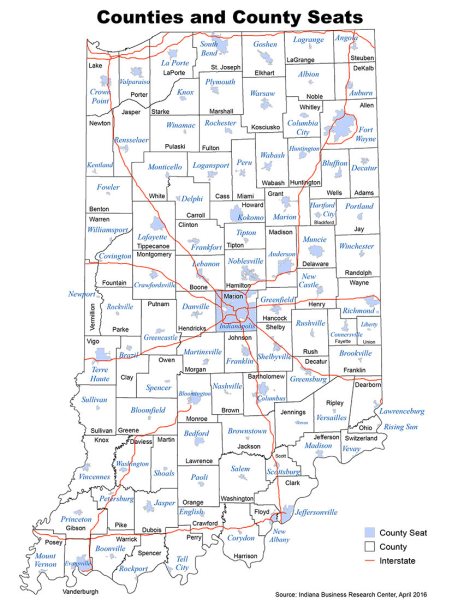
This small photo of Indiana’s counties is replicated on a PDF (Map of Counties). Should you want to see where you are in the state, open the PDF and keep it handy while you read through the counties.
To view a full size photo, click on the one you would like to see in the inserted “gallery.”
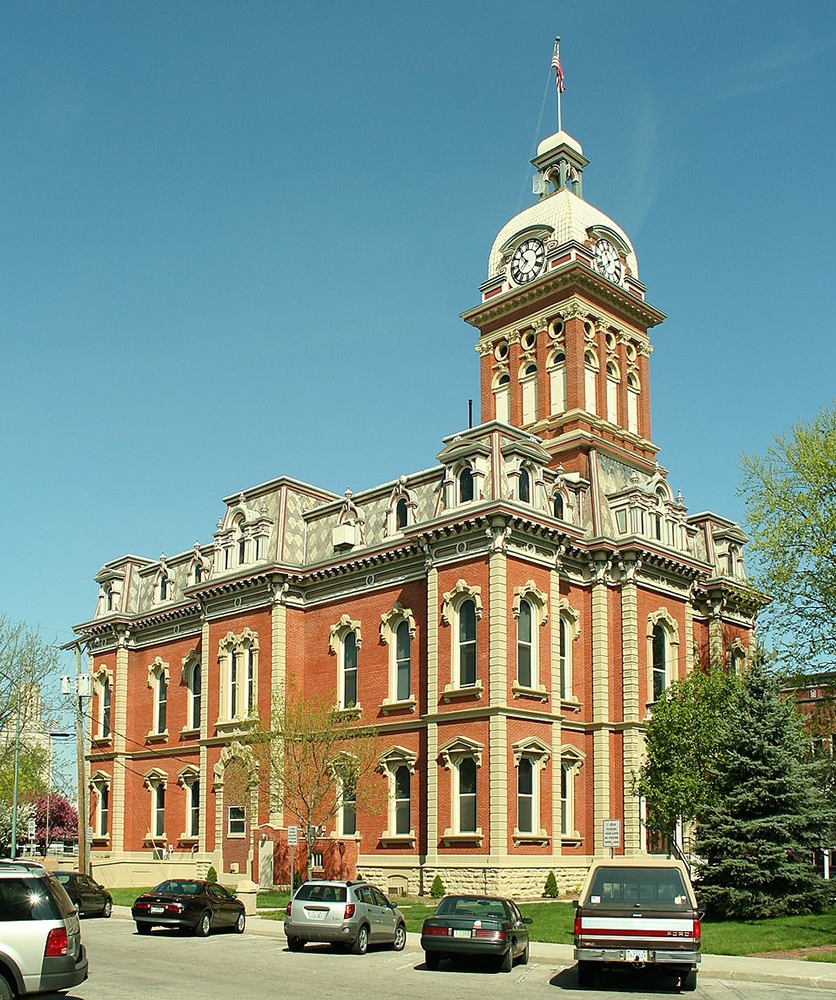
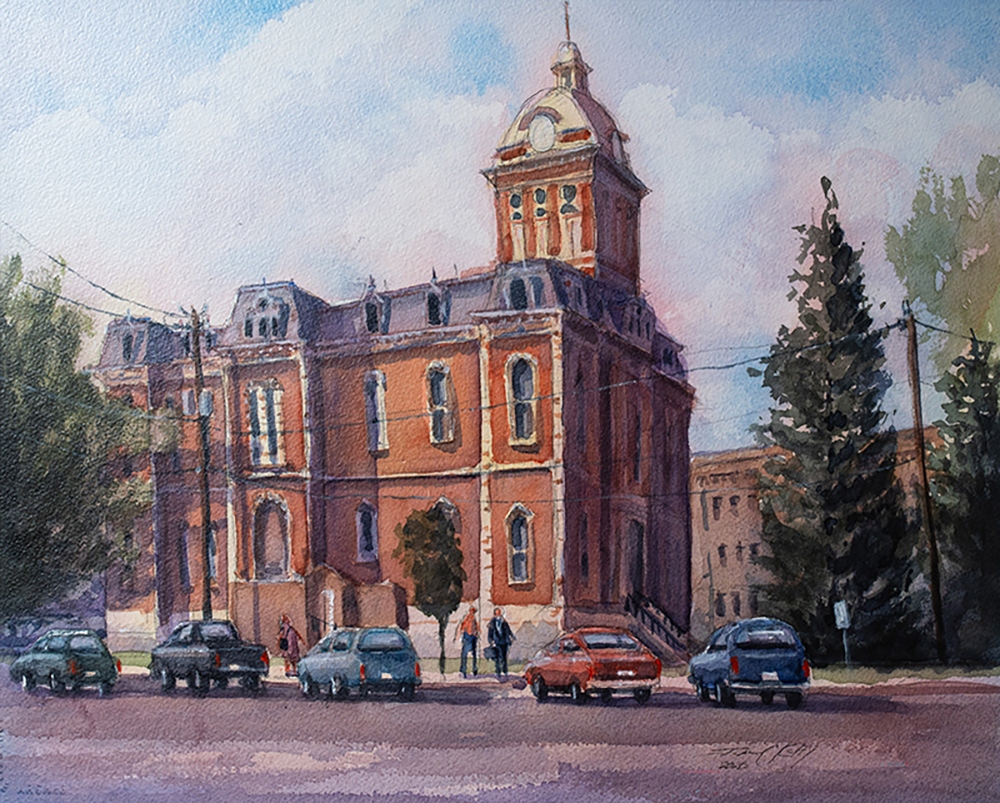
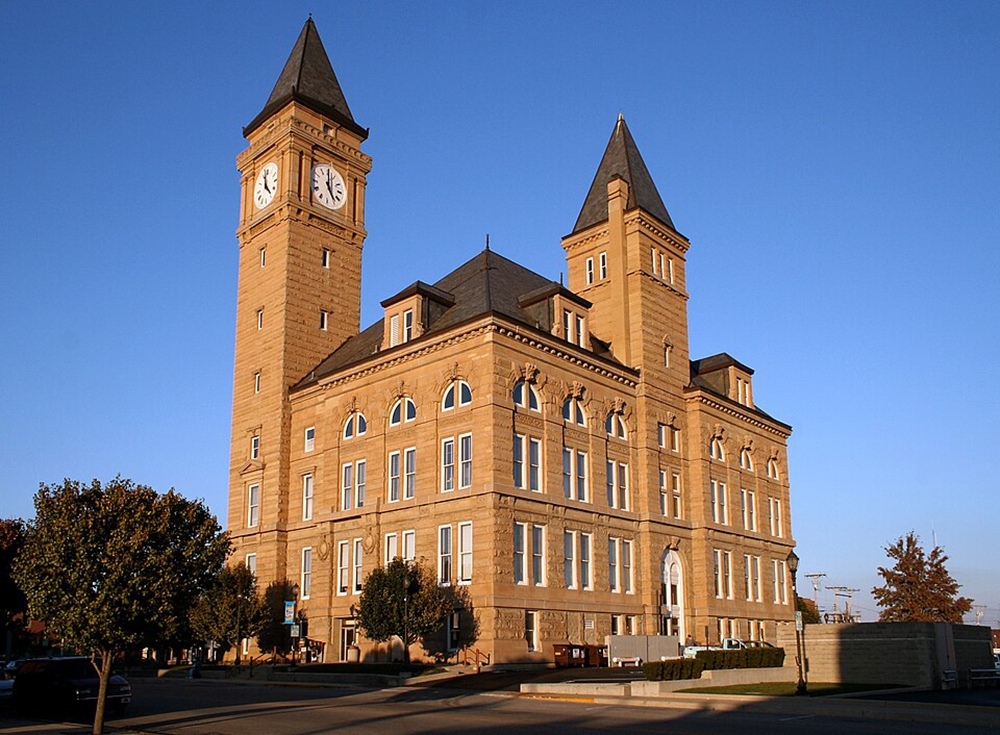
In general, the “real” photo will be on the left and the artist’s rendering on the right.
Adams County
- Artist: John Kelly
- Donor: Hon. Samuel Conrad & Hon. Chad Kukelhan
- Medium: Watercolor
The Adams County Courthouse is located in the city of Decatur. It was built in 1872–1873 at a cost of $78,979. The designer was J. C. Johnson, who had been trained as a carpenter and joiner and became a self-taught architect; he won second place in the Indiana State Capitol design competition.
Allen County
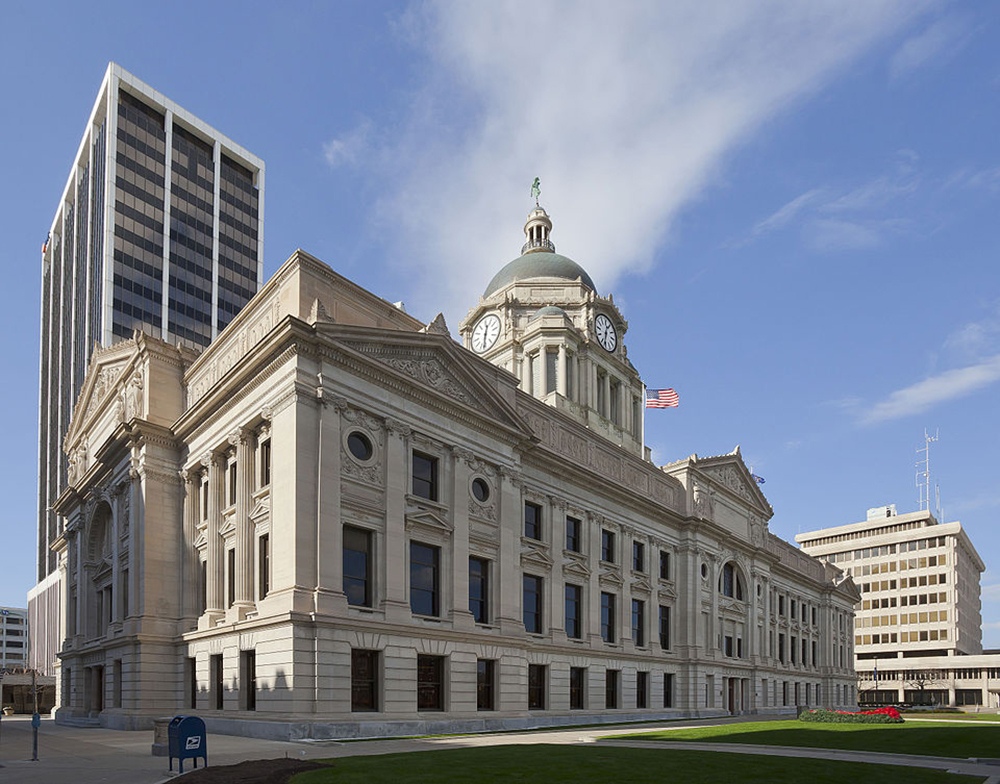
- Artist: Roger Hulquist
- Donor: Allen County Bar Association
- Medium: Oil on Paper
The Allen County Courthouse is located in downtown Fort Wayne. Built between 1897 and 1902, it is a nationally significant example of Beaux-Arts architecture. It was listed on the National Register of Historic Places in 1976 and was designated a National Historic Landmark on July 31, 2003. Designed by Brentwood S. Tolan, construction began in 1897; the cornerstone was laid November 17, 1897. The building was dedicated September 23, 1902, with a final cost of $817,553.59 ($250 million today).

Bartholomew County
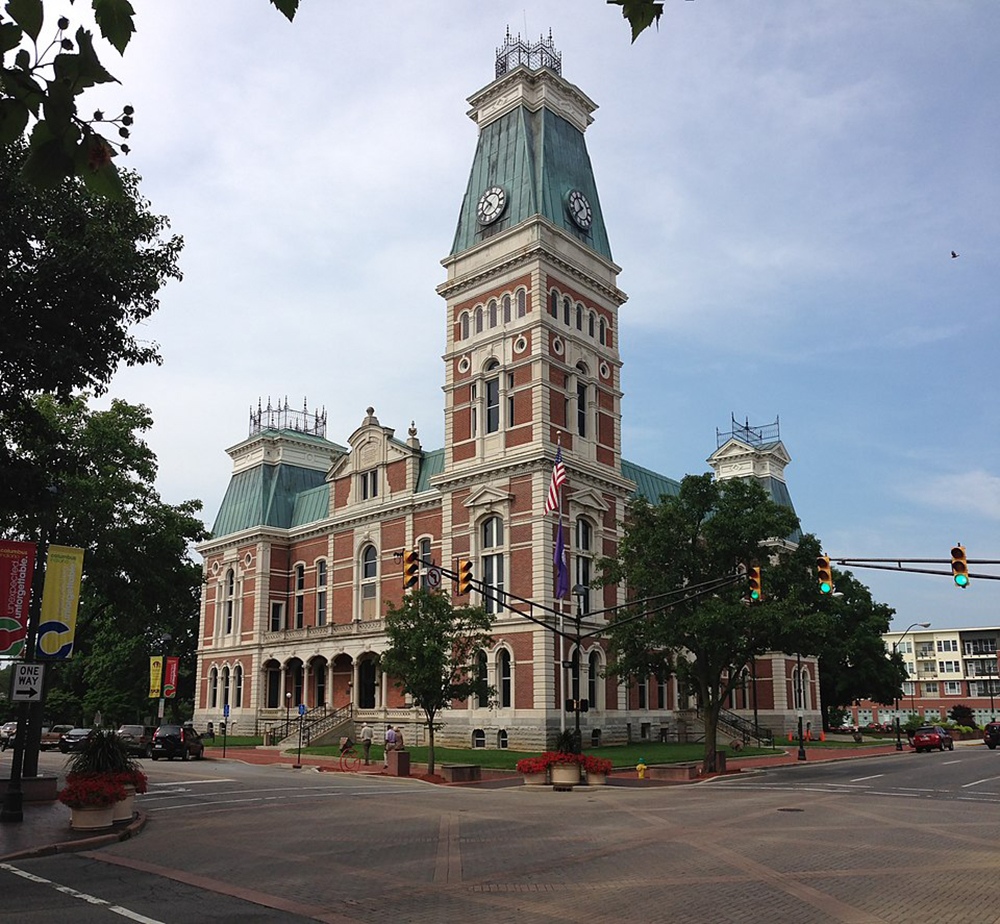
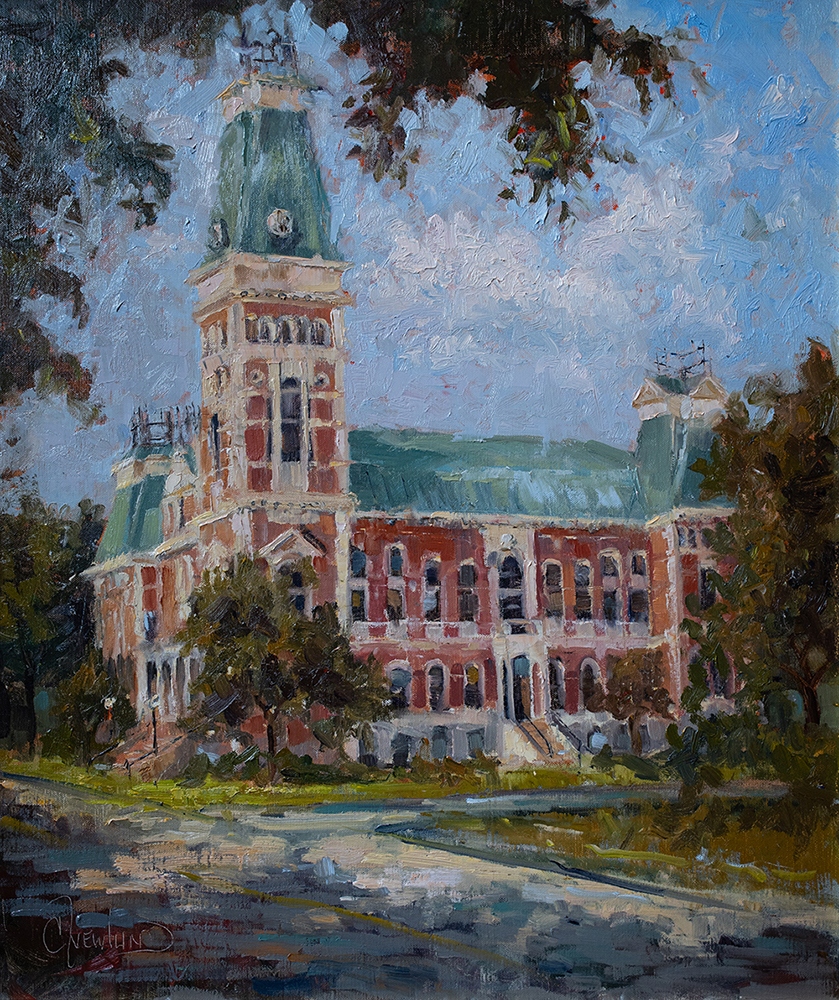
- Artist: C. Newlund
- Donor: Bartholomew County Bar Association
- Medium: Oil on Canvas
The Bartholomew County Courthouse is in Columbus. It was designed by noted Indiana architect Isaac Hodgson, built in 1871–1874 at the cost of $250,000, and dedicated in 1874. Construction was by McCormack and Sweeny. The building was hailed as “the finest in the West” upon its completion.
Benton County
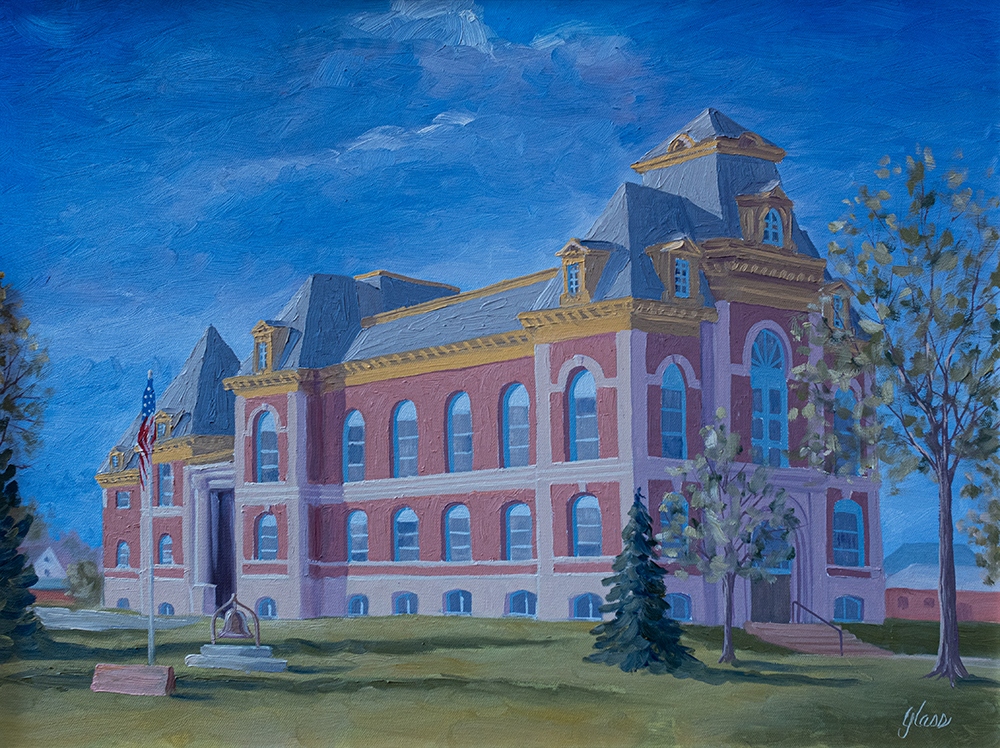
- Artist: Robert J. Glass
- Donor: Judge Rex W. Kepner; Benton Circuit Court; Benton County Historical
- Medium: Oil on Canvas
The Benton County Courthouse is a Second Empire style building in Fowler that was built in 1874. It was nominated for listing on the National Register of Historic Places in 2008, and it was listed on the National Register on August 1 of that year. There was a previous Benton County Courthouse, built in 1855 but torn down in 1873. The current courthouse was designed by Gurdon P. Randall of Chicago and built by Levi L. Leach at a cost of $62,257. The new courthouse was an impressive building from an architectural standpoint, but also provided much-needed improvements in security, including large fire-proof vaults.

Blackford County
- Artist: Angel Mercado
- Donor: Angel Mercado; Blackford County Bicentennial Committee
- Medium: Screenprint
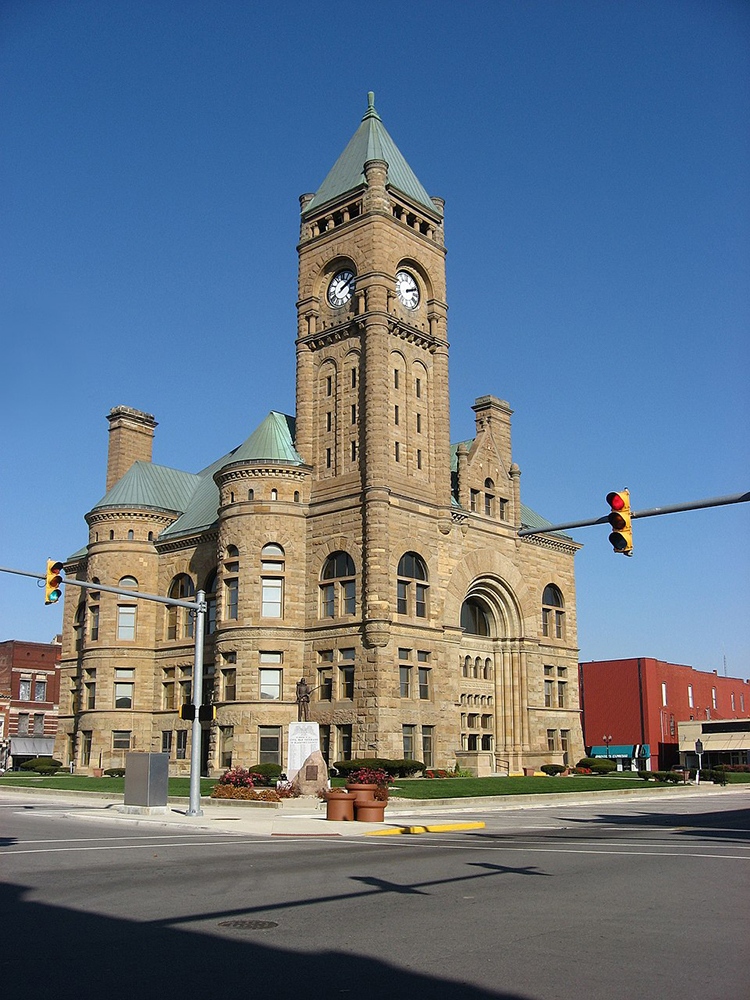
The Blackford County Courthouse is in Hartford City. Built during the Indiana Gas Boom, most of the construction work was completed in 1894. The current courthouse was preceded by another courthouse building on the same site, which was declared inadequate by a judge in 1893 and torn down. The current courthouse was designed by architects Arthur LaBelle and Burt L. French, who were from nearby Marion, Indiana. The building’s architectural style is Richardsonian Romanesque, which was popular during the second half of the 19th century. The large corner tower of the building is the tallest structure in the downtown commercial district. Considered “the county’s most outstanding landmark”, the structure is often pictured on web sites associated with the area, and continues to house local government over 100 years after its construction.

Boone County
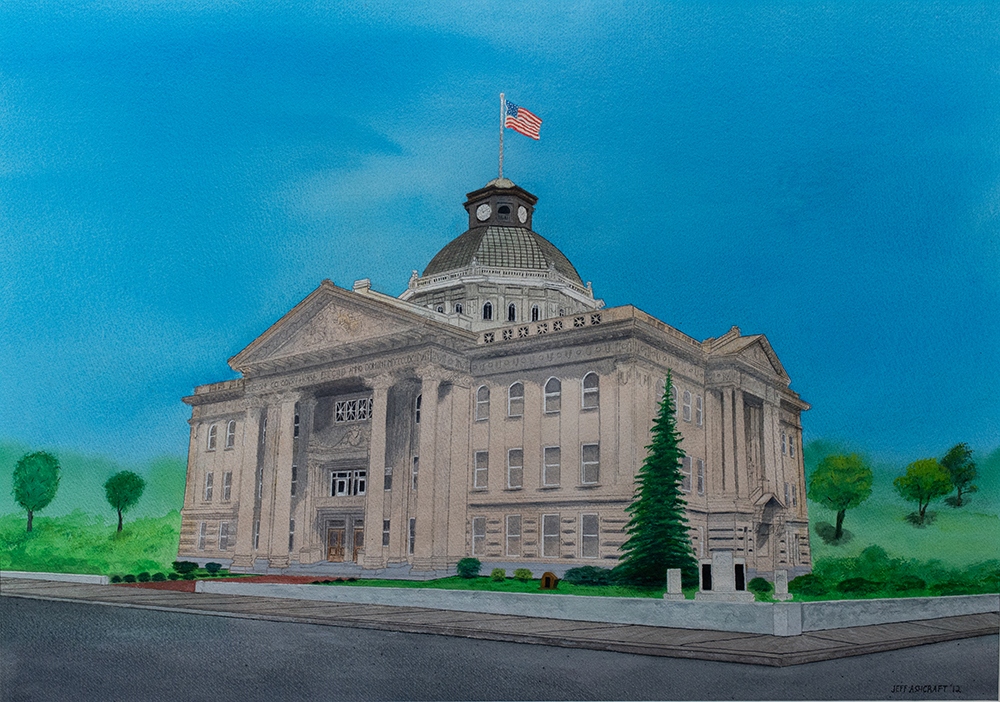
- Artist: Jeff Ashcraft
- Donor: Boone County Bar Association
- Medium: Watercolor
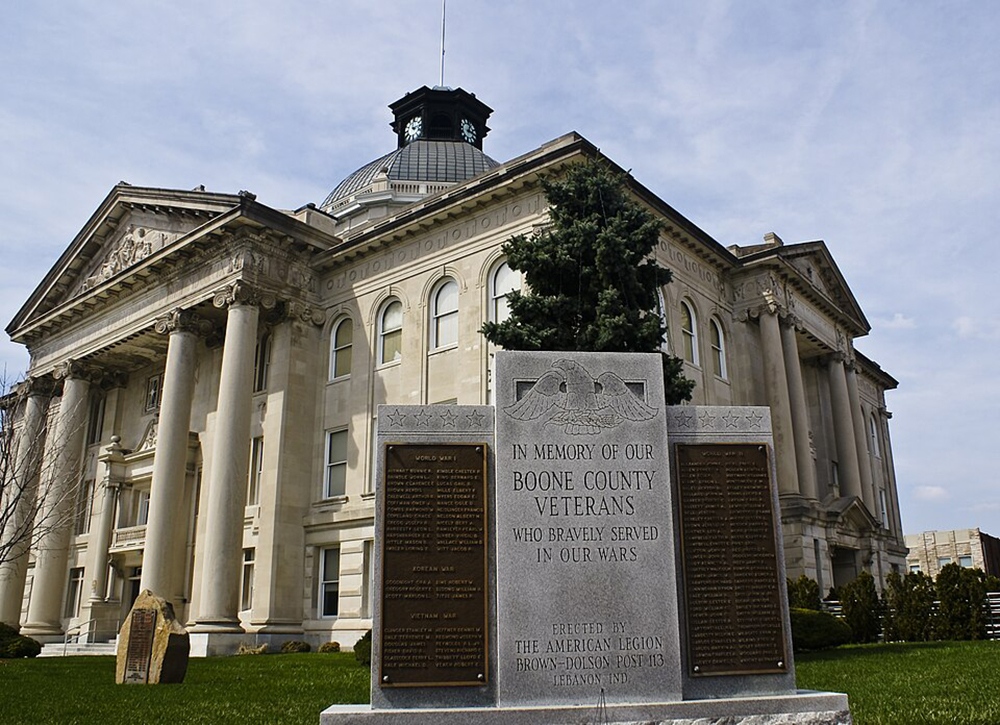
The Boone County Courthouse is in Lebanon. It was built between 1909 and 1911, and is a three-story, rectangular Classical Revival building constructed of granite and Bedford limestone. It features an art glass dome surmounted by a clock tower and pedimented porticoes supported by four Ionic order columns. The columns, measuring 35 feet 3 inches tall, were at the time at their construction among the tallest solid columns in the U.S. It was listed on the National Register of Historic Places in 1986.
Brown County
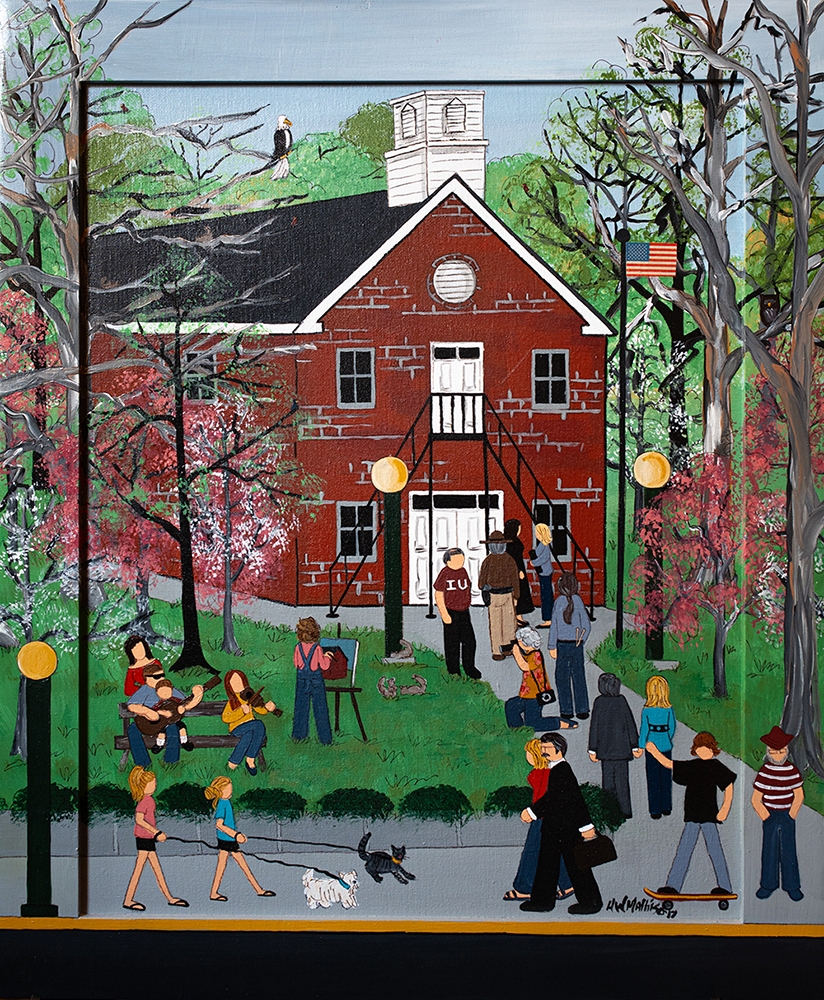
- Artist: A.W. Mathis
- Donor: Jim & Carol Roberts; Brown County Bar Association
- Medium: Oil on Board
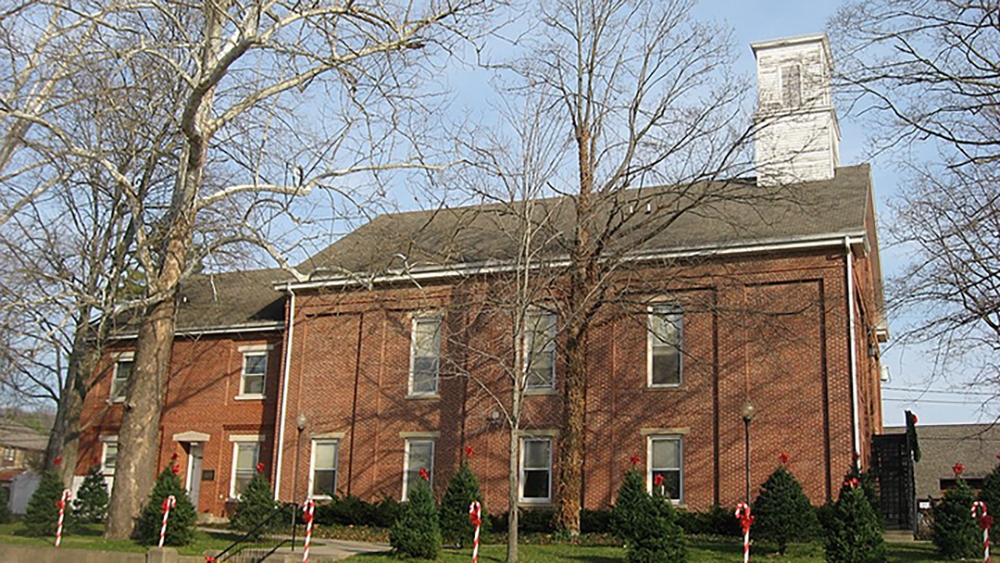
The Brown County Courthouse Historic District is a historic courthouse and national historic district in Nashville. It encompasses three contributing buildings: the courthouse, Old Log Jail, and the Historical Society Museum Building. The Brown County Courthouse was built in 1873–1874, and is a two-story, Greek Revival style brick building. It has a gable roof and two-tiered, flat-roofed frame tower. The Old Log Jail was built in 1879 and is a small two-story log building. It measures 12 feet by 20 feet and was used as a jail until 1922. The Historical Society Museum Building, or Brown County Community Building, is a two-story, rectangular log building. It was moved to its present location in 1936–1937. The Works Progress Administration funded the reconstruction and remodeling of the building. It was listed on the National Register of Historic Places in 1983.
Carroll County
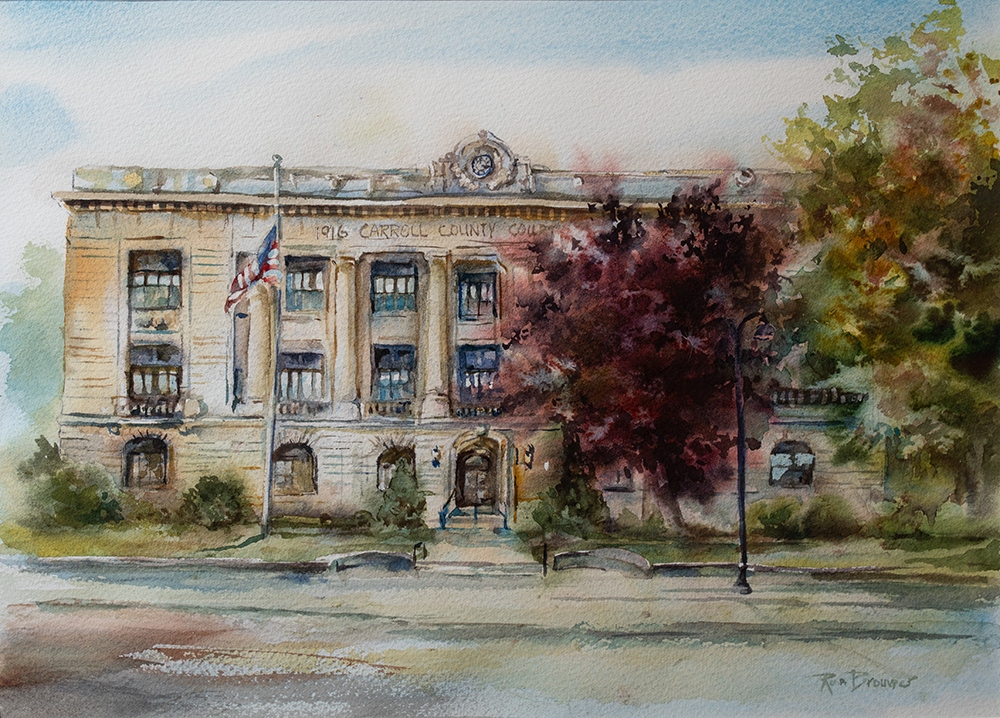
- Artist: Rena Brouwer
- Donor: Carroll County Bar Association
- Medium: Watercolor
The Carroll County Courthouse is in Delphi. It was designed by architect Elmer E. Dunlap and built in 1916. It is a three-story Classical Revival style rectangular building of Indiana limestone. It features a three-story projecting pavilion. The property has two prominent works of public art in its collection: the Murphy Memorial Drinking Fountain (1918) and the Soldiers and Sailors Monument (1888); they are considered contributing objects along with a World War II artillery gun. It was listed on the National Register of Historic Places in 2003. It is in the Delphi Courthouse Square Historic District.

Cass County
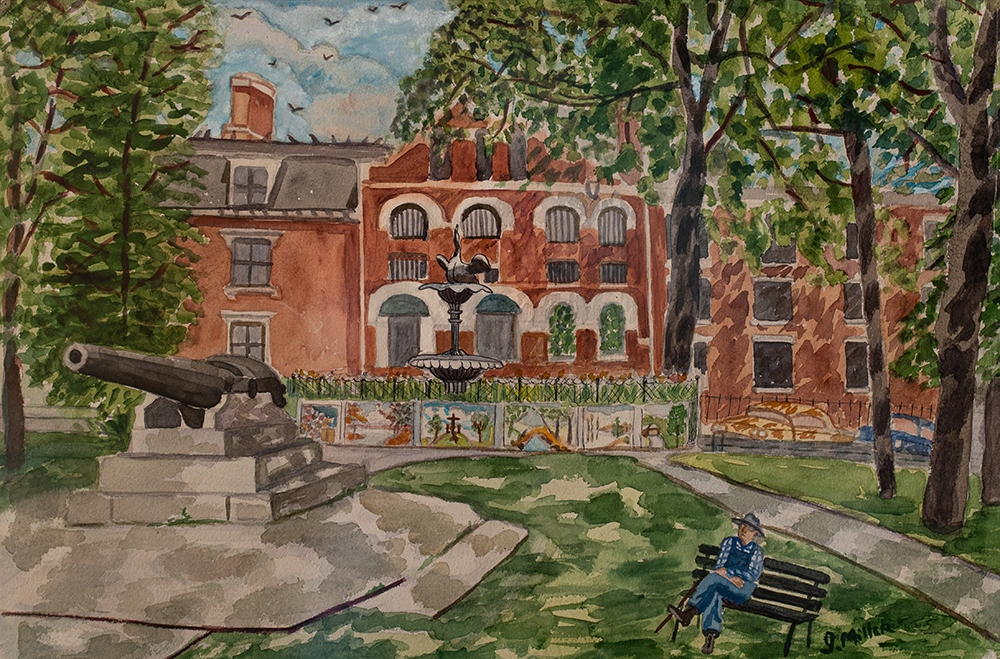
- Artist: Helen Irene Miller Murphy
- Donor: Logansport Art Association
- Medium: Watercolor
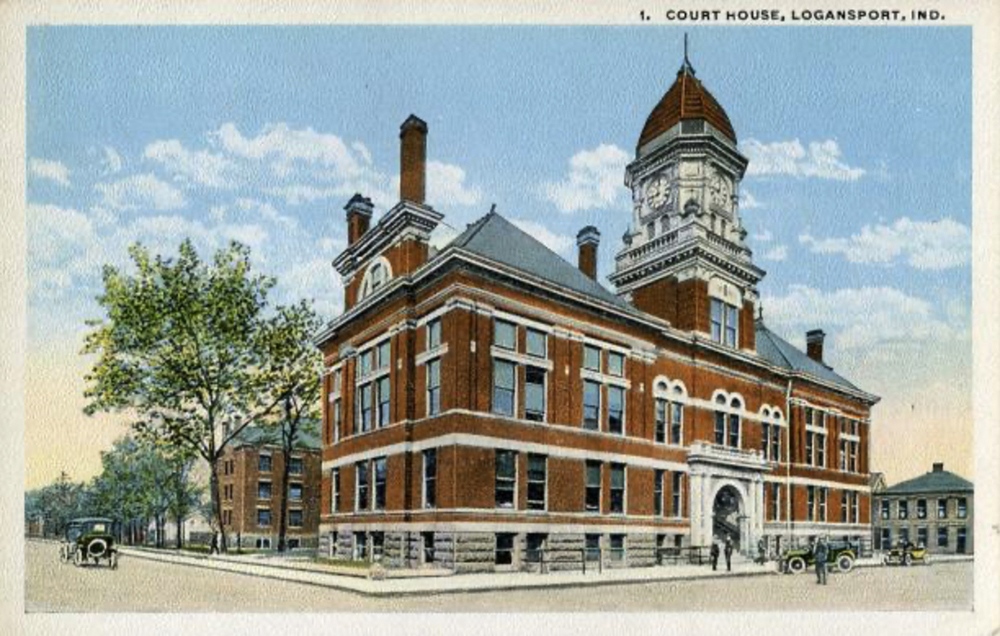
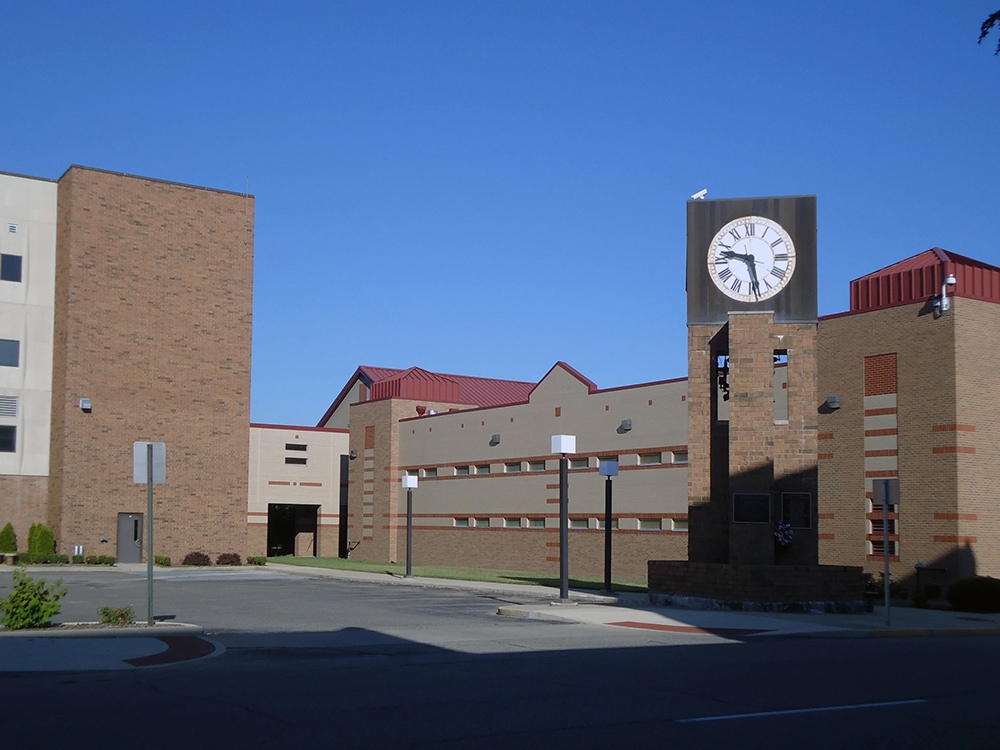
The Cass County Government Center is in Logansport. The first court and county meetings were held in the Mansion House, a hotel on the southwest corner of Fourth Street and Market Street. The first courthouse was a two-story stone structure designed by Joseph Willis and built in 1844 at a cost of $16,393. The second courthouse was an addition to the previous courthouse in 1888 at a cost of $40,000. The architect was John S McKean, and the contractors were John Medland and John E Barnes. When the 1888 courthouse was built, the 1844 courthouse was kept as the courtroom had outstanding acoustics, The 1888 courthouse was built in front of the 1844 courthouse. Both courthouses were demolished in 1976 to make way for the present courthouse. The third and present courthouse was constructed in 1977 to 1979. It was not intended to augment its elderly predecessor. Instead, it was built nineteen feet west of it, next to a parking lot planned for where the old building stood. The new building – known officially as the Cass County Government Building – was dedicated on November 11, 1979. At that time, the structure was heralded as a modern office that offered an enormous improvement over its “timeworn” predecessor. Contemporary accounts noted how much more “badly needed” space it provided over the old building. “The spic and span public restrooms in the building are a delight to use,” said the Logansport Pharos-Tribune, “far different from the shamefully dirty outdoor toilets that used to stand next to the old courthouse. It is one of Indiana’s seven “modern” courthouses.
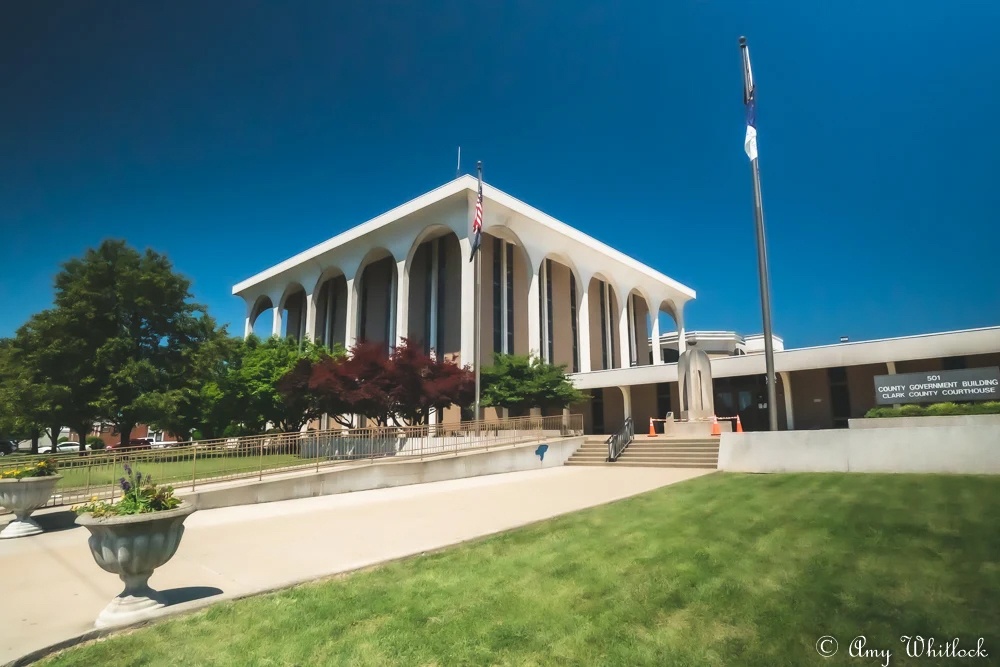
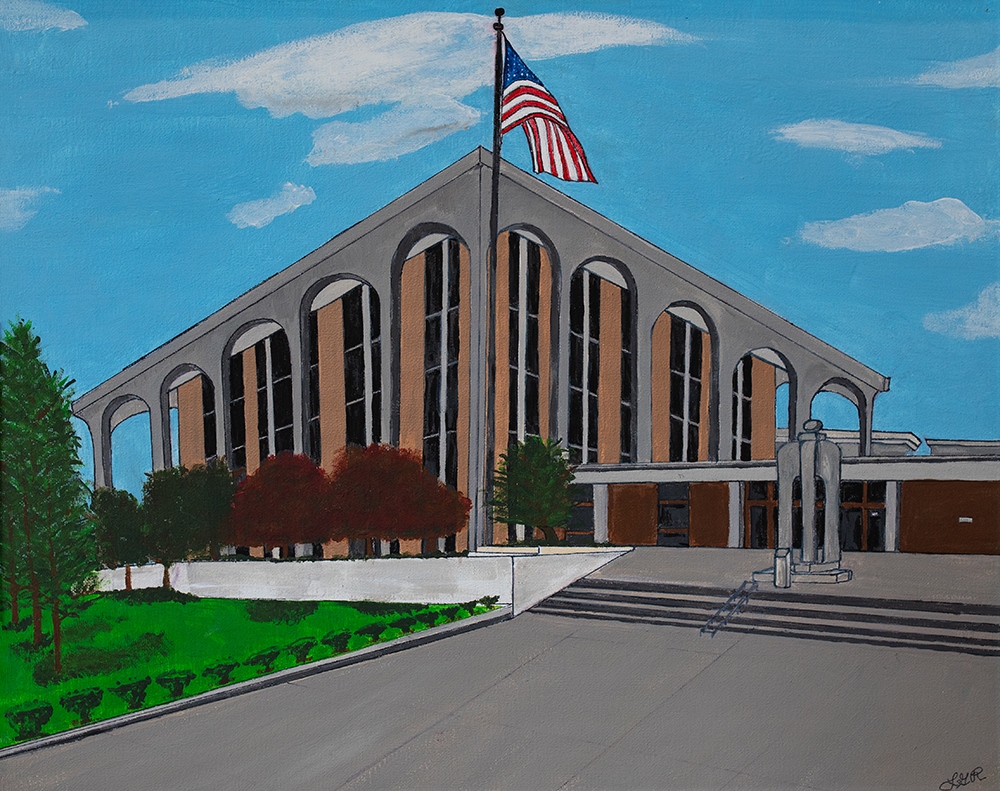
Clark County
- Artist: Lisa Reger
- Donor: Lisa Reger
- Medium: Oil on Canvas
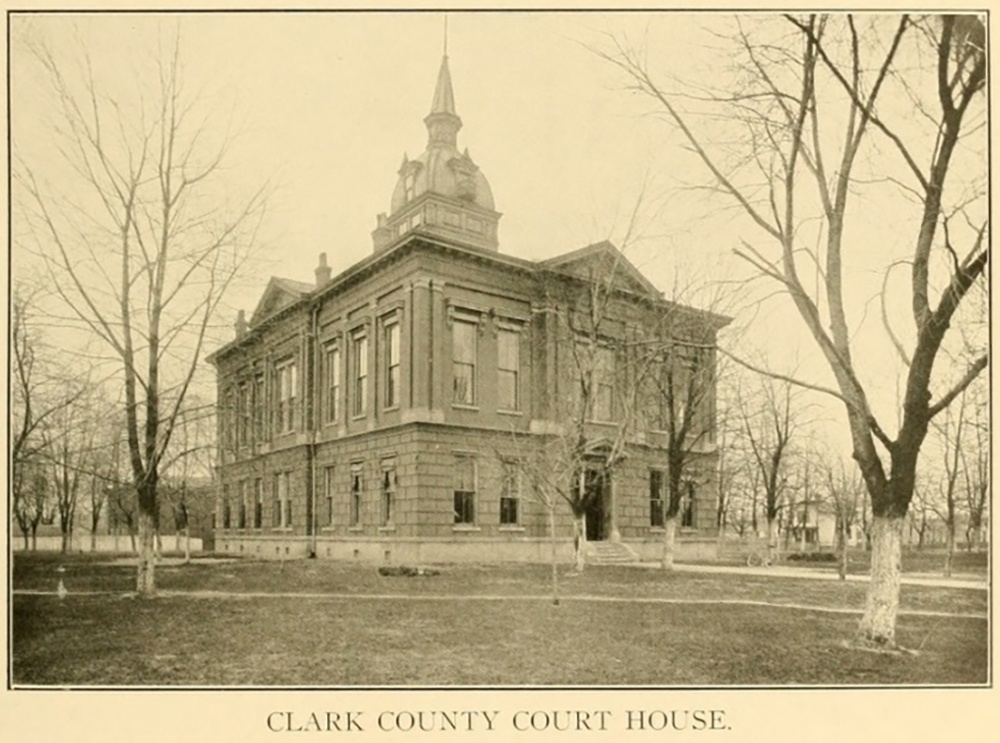
The history of the Clark County Courthouse in Jeffersonville involves several buildings, with a significant courthouse being built in 1878. The county seat was moved from Jeffersonville to Charlestown in 1811, but it was moved back to Jeffersonville in 1878. The brick and limestone structure with a central tower was a prominent landmark serving county purposes. It was eventually replaced in 1970 by a modern facility, which remains today and combines city and county functions.
Clay County
- Artist: Linda White
- Donor: Hon. Blaine Akers
- Medium: Watercolor
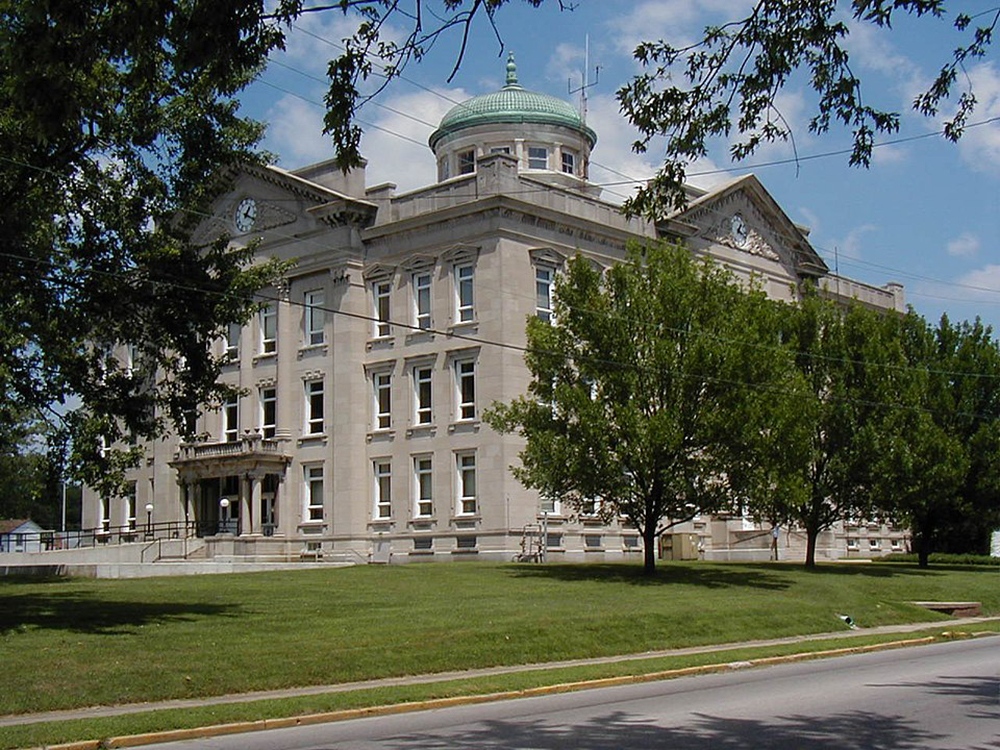
The Clay County Courthouse is in Brazil. It was designed by noted Indiana architect John W. Gaddis and built in 1914 in the Classical Revival style. It is a three-story, limestone building over a raised basement. It features a multi-tiered parapet with clock faces within a decorative tympanum and a two-story dome atop the flat roof. The interior has a rotunda with stained glass octahedral dome. It was added to the National Register of Historic Places in 1999.

Clinton County
- Artist: Linda Trowbridge
- Donor: Linda Trowbridge, Watercolor Society of Indiana
- Medium: Watercolor
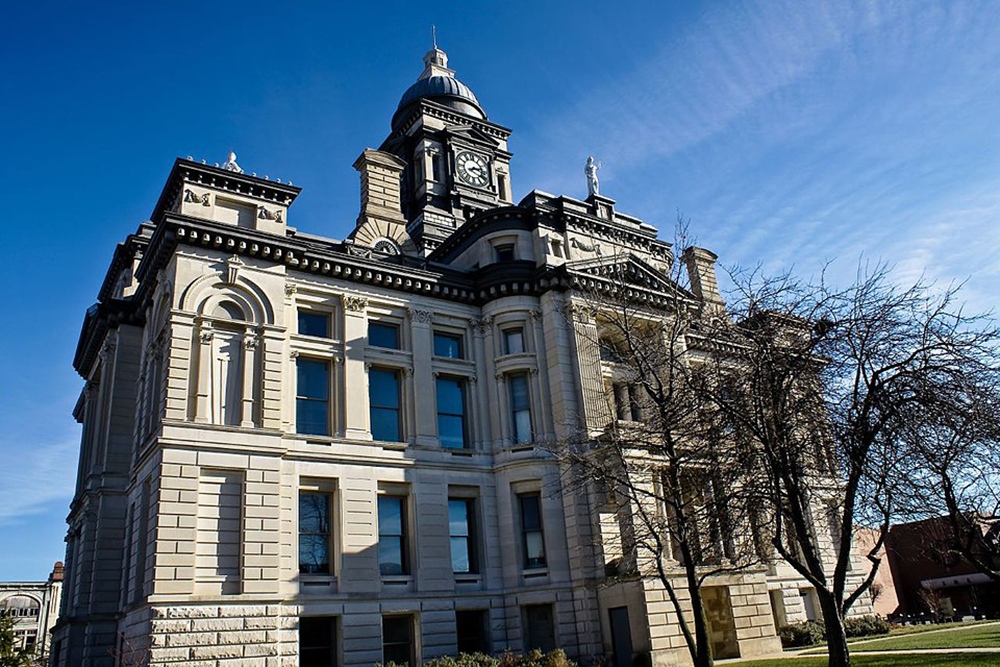
The Clinton County Courthouse is in Frankfort. Built in 1882–1884, the courthouse was designed by George W. Bunting, who also designed courthouses in Anderson (Madison County) and Franklin (Johnson County). The Clinton County Courthouse is a three-story, Second Empire style limestone building adorned with statuary and a 165-foot domed central tower with a clock. The courthouse cost $170,450 to build in 1882. The courthouse is still in use as the county courthouse. It was added to the National Register of Historic Places in 1978. It is located in the Frankfort Commercial Historic District.

Crawford County
- Artist: Lisa Reger
- Donor: Lisa Reger
- Medium: Watercolor
The courthouses in Crawford County tell quite a story.
First seat of government: 1816: Court initially met at the private home of Edward N. Cullom.
First courthouse: 1818: The first permanent county seat was established in Mount Sterling (or Palestine in other records). A brick courthouse was built here around 1819, but it was made of poor material and later abandoned.
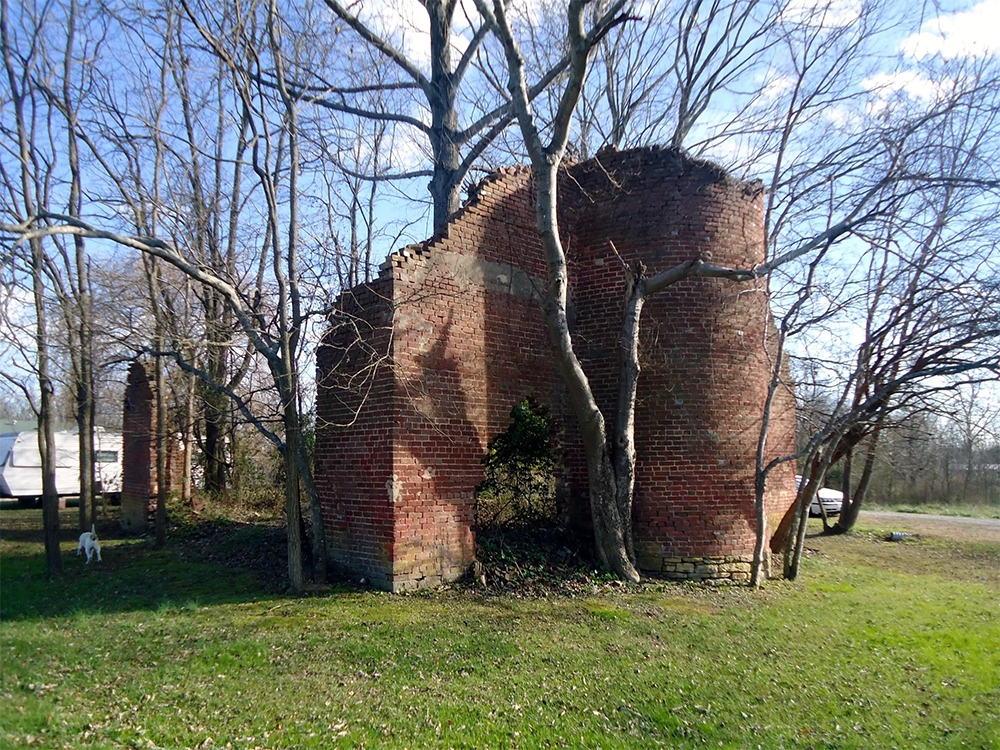
Second courthouse: 1822: The county seat relocated to Fredonia due to a lack of safe water in Mount Sterling. A new courthouse was built in Fredonia in 1822 (or 1821). This building was later converted into a church and burned down in 1972; only ruins remain today.
Third courthouse: 1843: The county seat moved again, this time to Leavenworth. A brick courthouse was constructed here in 1844. Research turned up nothing regarding the construction of this building.
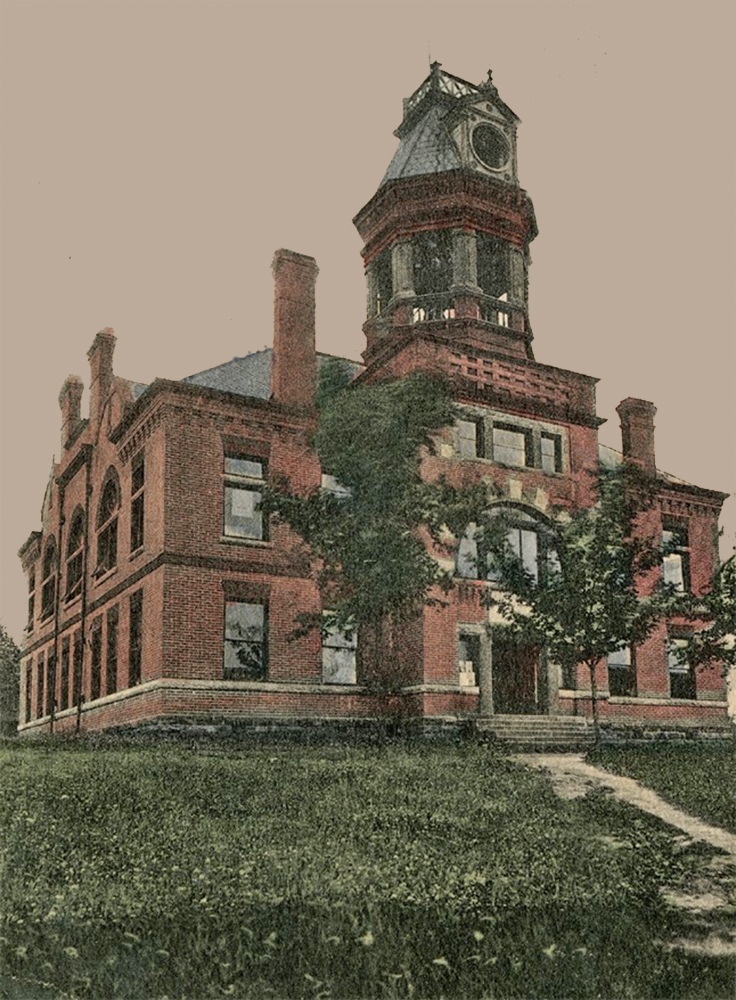
Fourth courthouse: 1895: The county seat was moved to English after a prolonged “county seat war”. A new courthouse was built in English that year, a substantial brick structure which, remarkably, lacked running water, plumbing, or central heating. It was condemned in 1939.
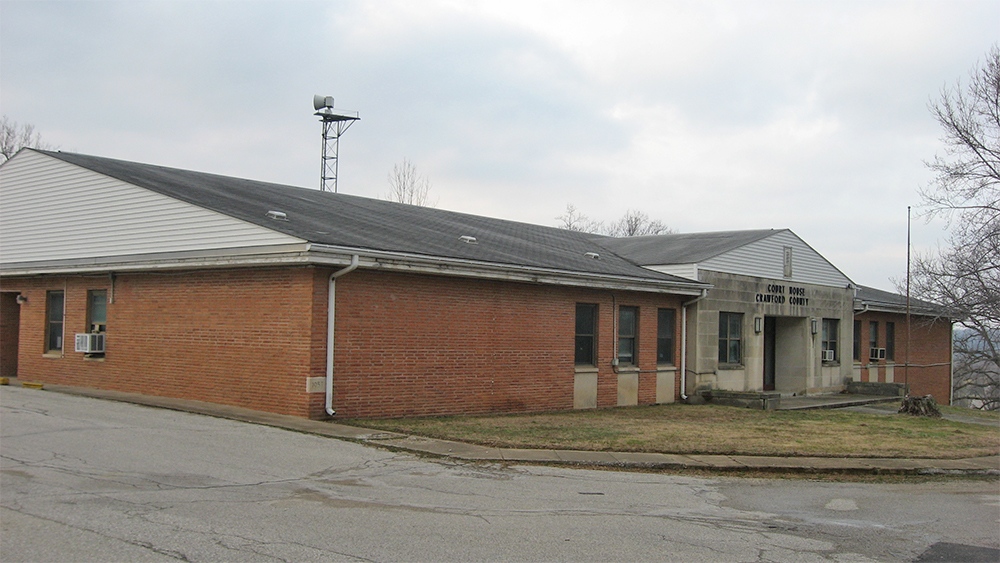
Fifth courthouse: 1958: The town of English, situated at the confluence of several creeks, was highly susceptible to severe flooding, leading to further building and relocation efforts. A new, more modest courthouse was erected in English, a single-story structure built into a hill.
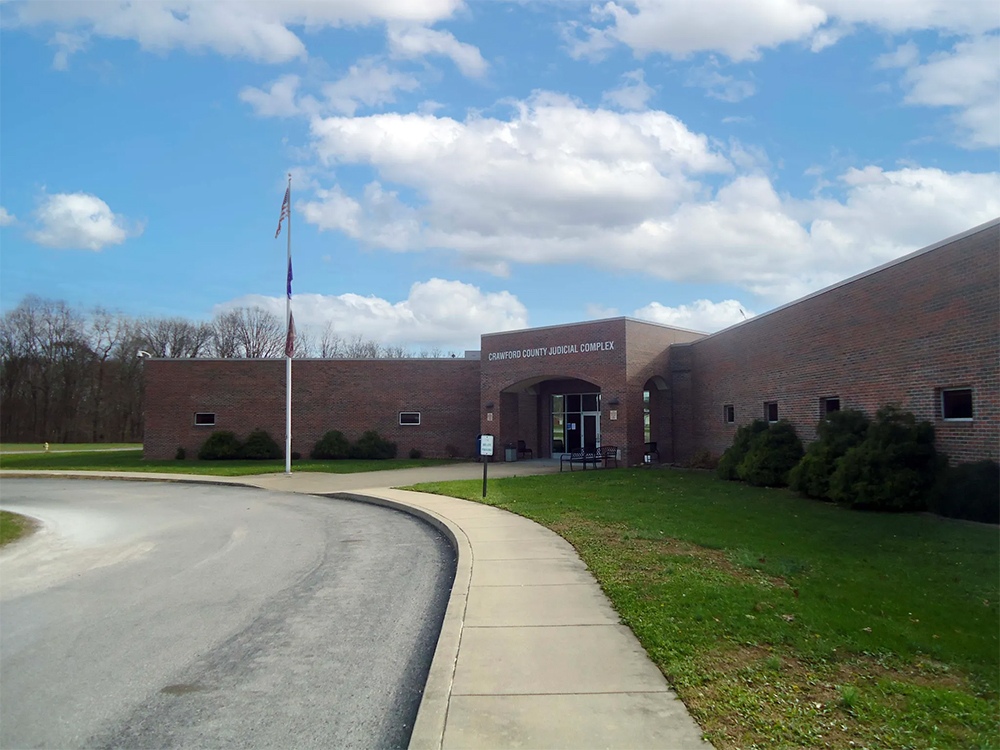
Sixth courthouse: 2004 (Present): Due to repeated, catastrophic flooding (notably in 1959, 1964, 1979, and 1990), a decision was made to relocate most of “Old English” to higher ground, creating “New English”. The new Crawford County Judicial Complex, designed by ShenckelShultz architects, was completed in 2004 (officially the 2003 building) in the new location on State Road 64. This single-story, V-shaped complex houses both county offices and a 74-bed jail facility.
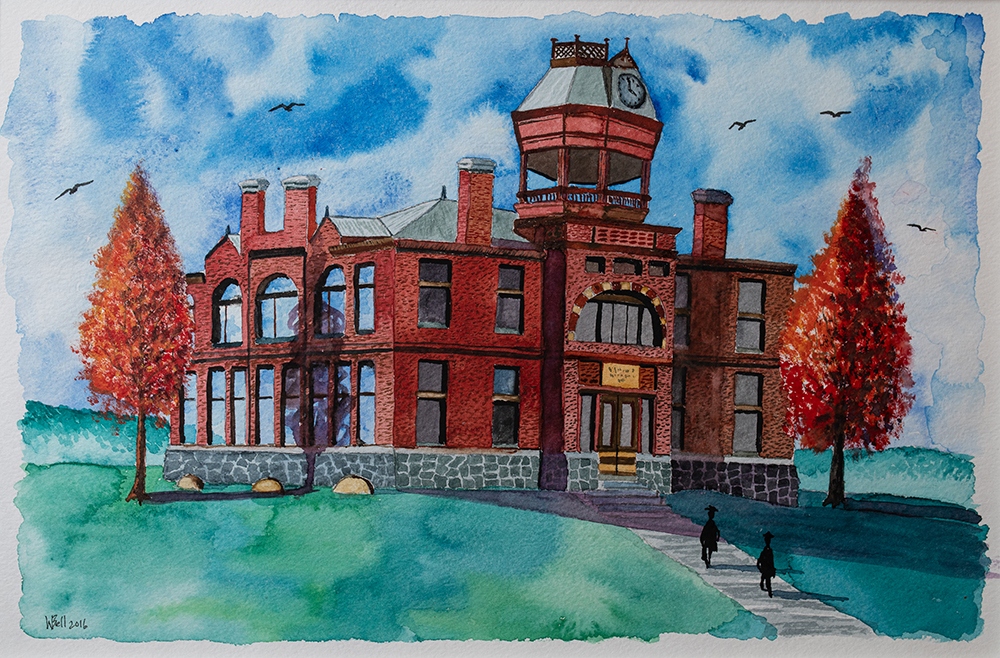
Daviess County
- Artist: Ervin R. Clark
- Donor: Daviess County Bar Association
- Medium: Pastel
The Daviess County Courthouse is in Washington. Constructed in 1927–1928, it exemplifies the Classical Revival style. This two-story rectangular structure is constructed primarily of brick and adorned with Bedford limestone. Measuring approximately 80 feet by 124 feet, it features a flat roof and slightly protruding colonnaded pavilions. One of these pavilions boasts six freestanding Ionic order columns. Unfortunately, the original second floor courtroom was damaged by fire in 1985. Also on the property are the contributing Union Soldier monument on the southwest corner of the lawn (1900) and flagpole (1929). It was added to the National Register of Historic Places in 2008.


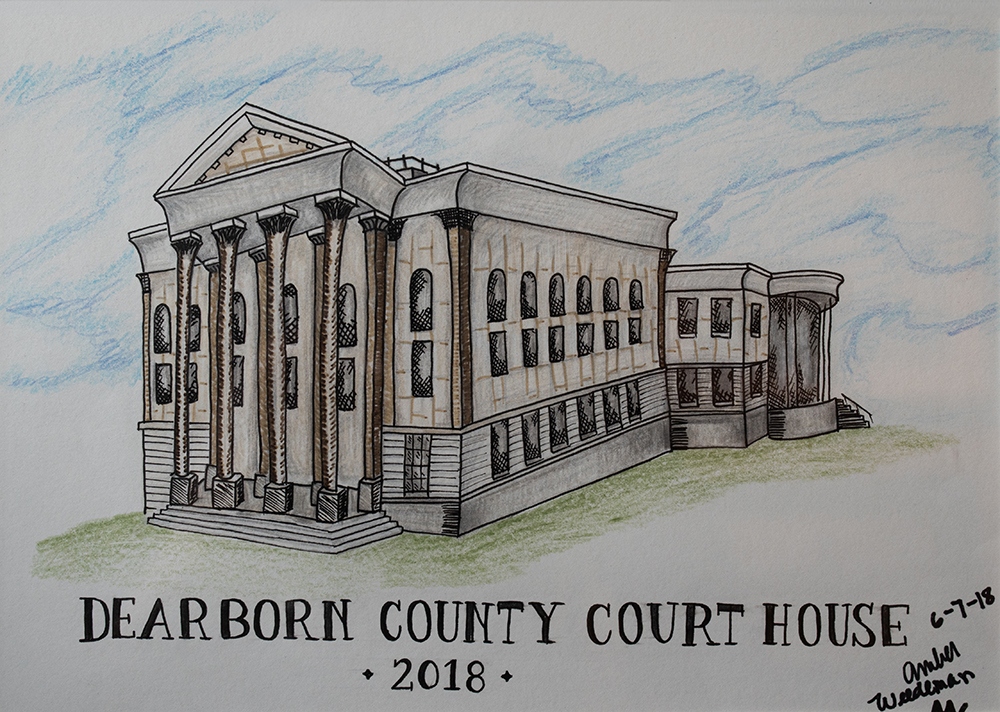
Dearborn County
- Artist: Amber Weederman
- Donor: Dearborn County Bar Association
- Medium: Pen & Ink, Pencil
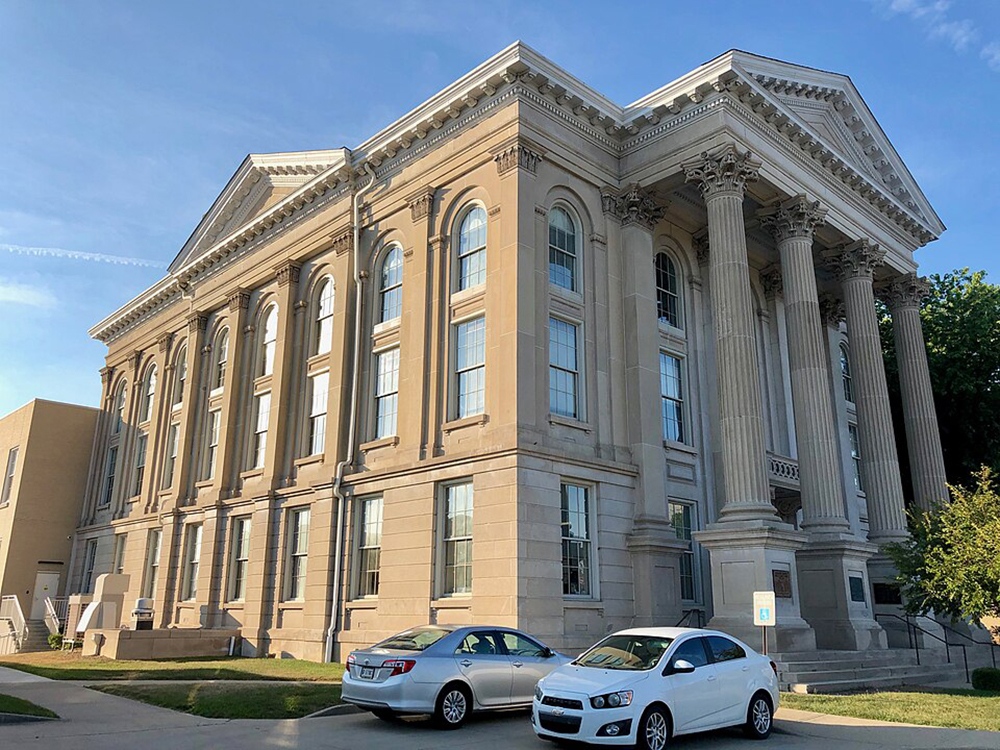
The Dearborn County Courthouse is in Lawrenceburg. It was built in 1870–71 and is a three-story, five-bay, Greek Revival style building constructed of limestone. It features a three-bay pedimented portico with four fluted columns with Corinthian order capitals. It was added to the National Register of Historic Places in 1981. It is located in the Downtown Lawrenceburg Historic District.
Decatur County
- Artist: Judy Glore
- Donor: Decatur Bar Association and Drew Young
- Medium: Watercolor
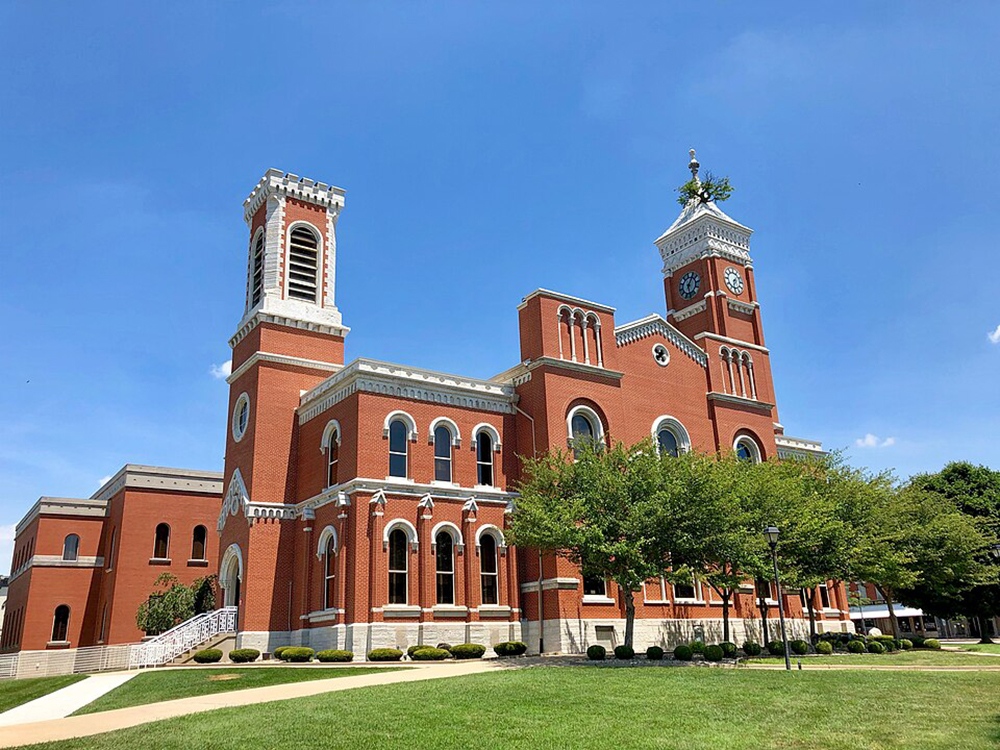
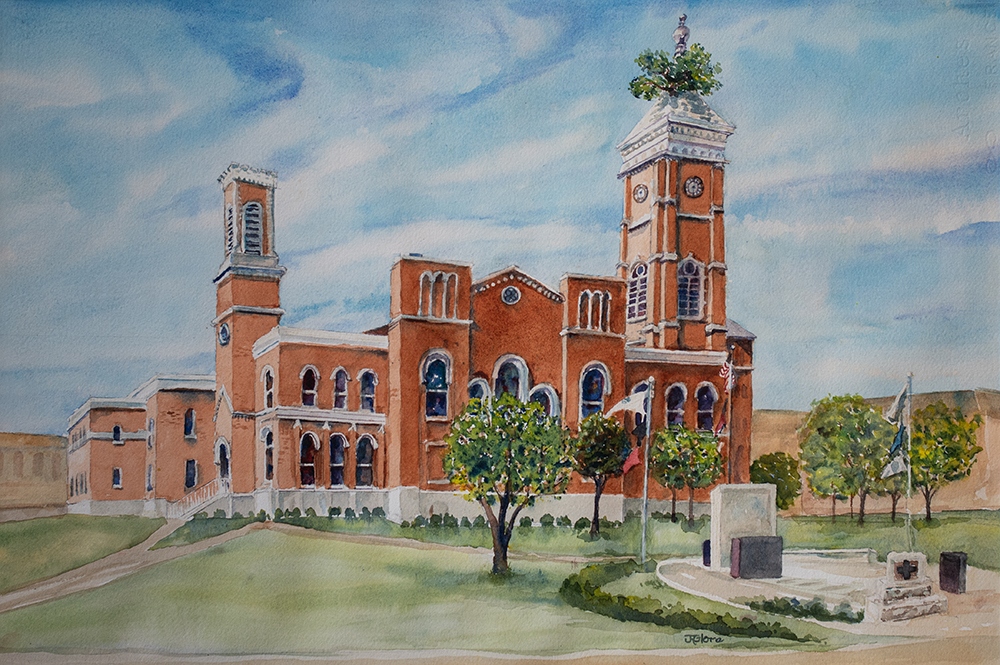
The Decatur County Courthouse is in Greensburg. It was listed on the National Register of Historic Places in 1973. It is best known for having a growing tree on its roof. Building of the present structure commenced in 1850; it was completed in 1861, at a cost of $100,000. At the time, it was called the finest courthouse in the state.
In the early 1870s, it was noticed that a tree was growing on the roof. Soon four more trees were counted on the roof of the one-hundred-and-ten-foot steeple. In 1888, a steeplejack was hired to help workers scale the building and remove a few of the shrubs. Of the two trees left, one eventually reached a height of fifteen feet, with a base diameter of five inches. At some point, another tree began to grow on the southeast corner of the tower and reached a large height within a few years. As this tree was growing, another tree sprung up on the southwest corner.
In 1994, a renovation and expansion of the courthouse took place on the north end of the building. The floorspace of the building was more than doubled. At that time, the stucco that covered the building was removed and the original brick facing was revealed.
DeKalb County
- Artist: Jeanne Gehring
- Donor: DeKalb County Bar Association
- Medium: Oil on Canvas
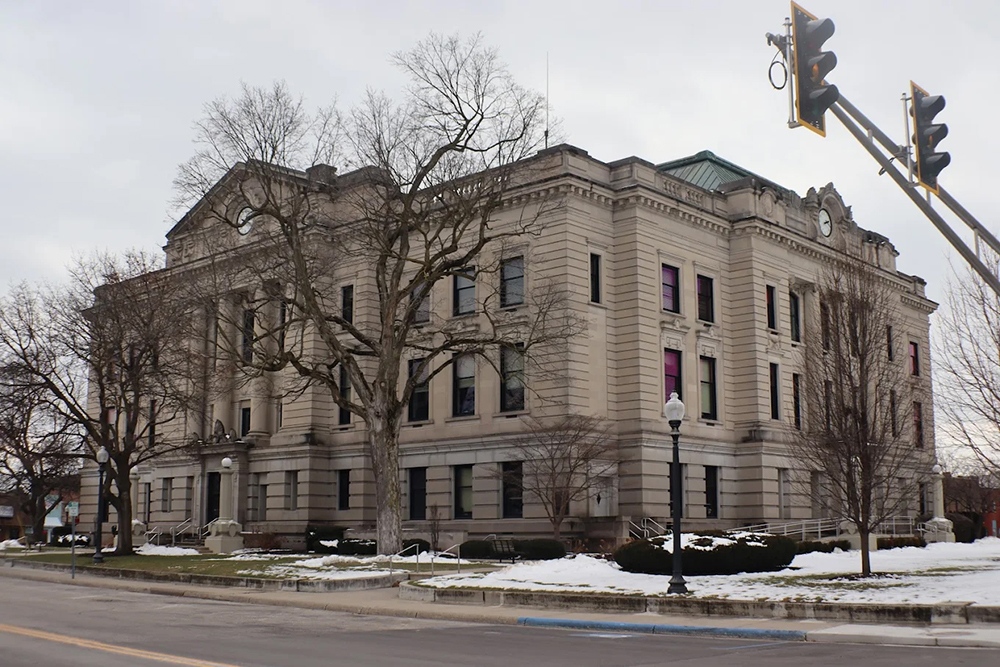
The DeKalb County Courthouse is in Auburn and is a notable historical building. The Neoclassical-style courthouse was constructed between 1911 and 1914 and is listed on the National Register of Historic Places.

Delaware County
- Artist: Kathleen Crawley
- Donor: Delaware County Bar Association
- Medium: Oil on Canvas
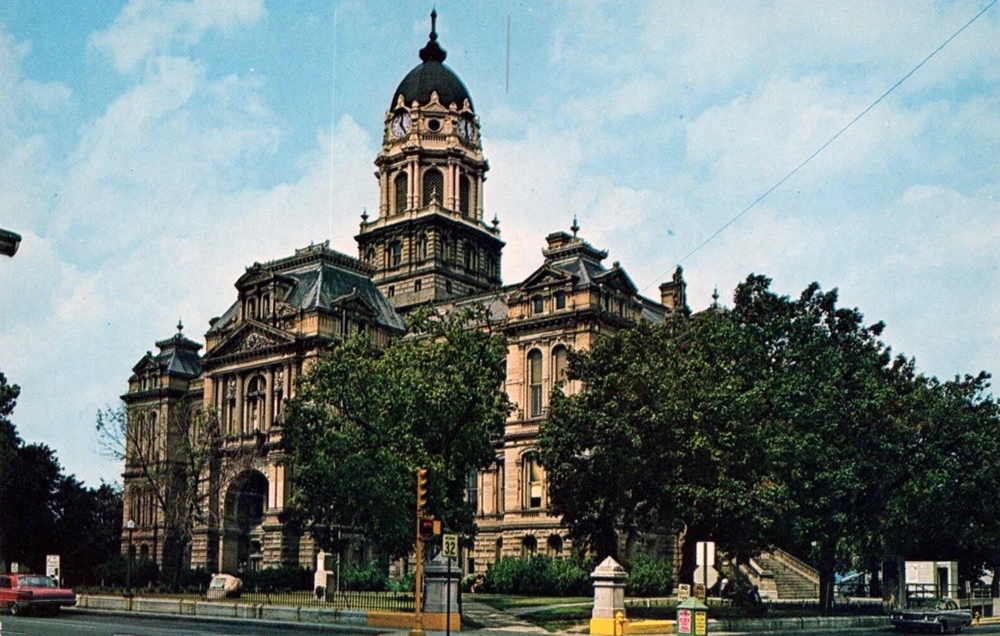
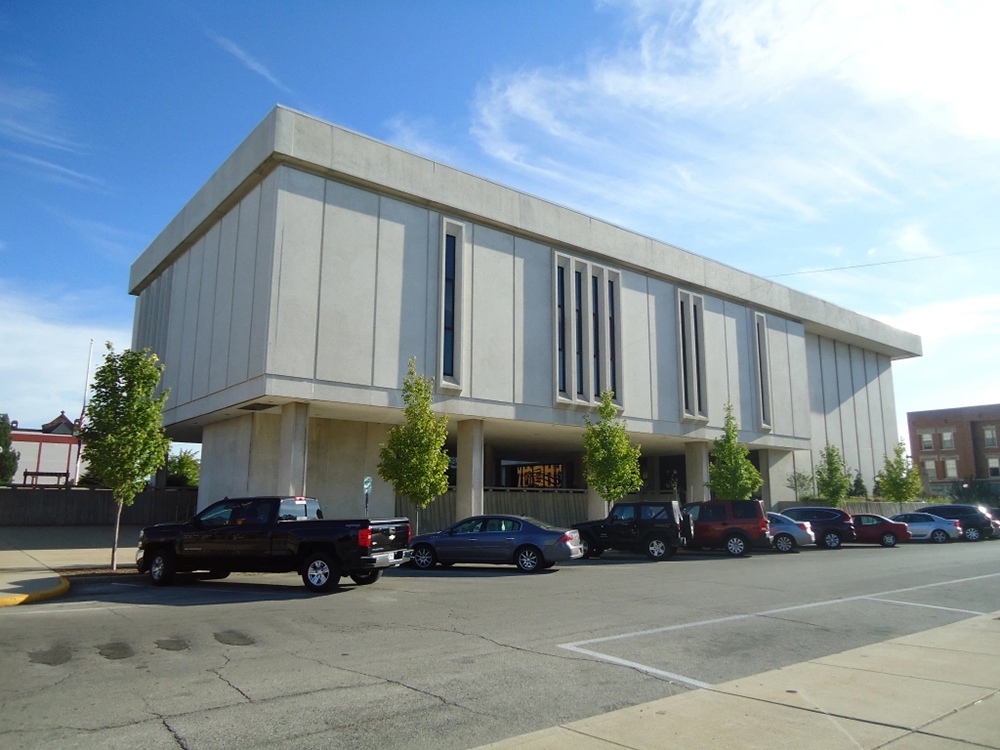
Delaware County has seen four courthouses in Muncie since 1829: a timber building (1829), a two-story square building with a cupola (1837), a Second Empire-style building demolished in 1966 for the current structure, and the modern-day Delaware County Courthouse completed in the early 1970s. The 1887 building was designed by Brentwood Tolan. It was a prominent structure that hosted President Theodore Roosevelt in 1902 and John F. Kennedy in 1960. Demolition began in 1966 to make way for the current building. There was a period of discussion and debate about the fate of the old courthouse, with some advocating for renovation and others for demolition.

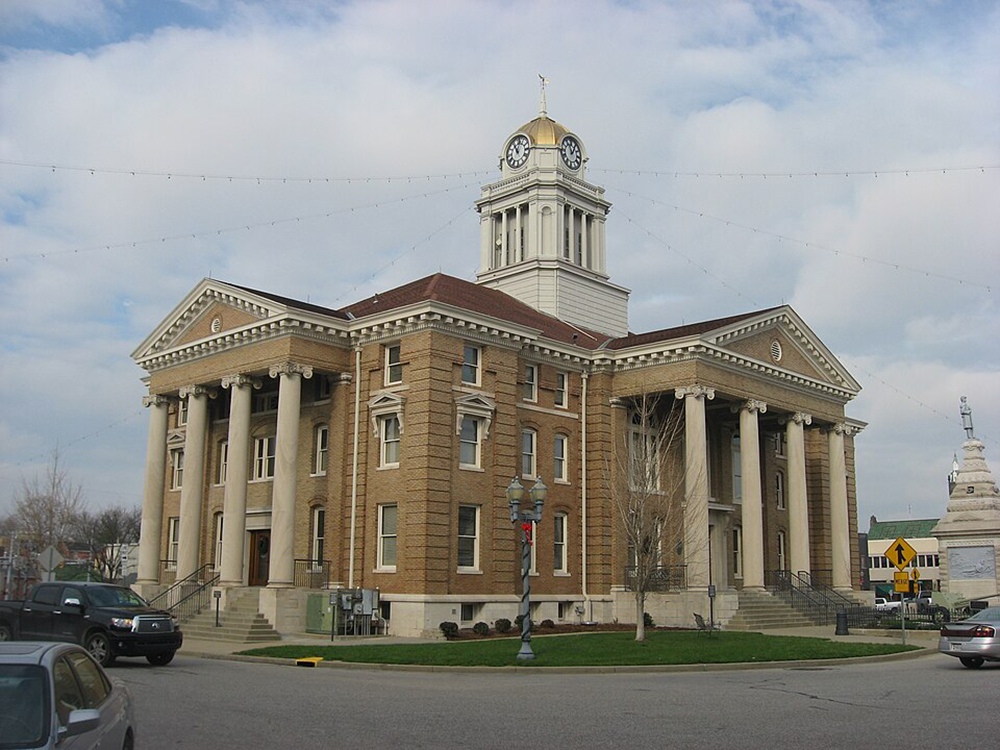
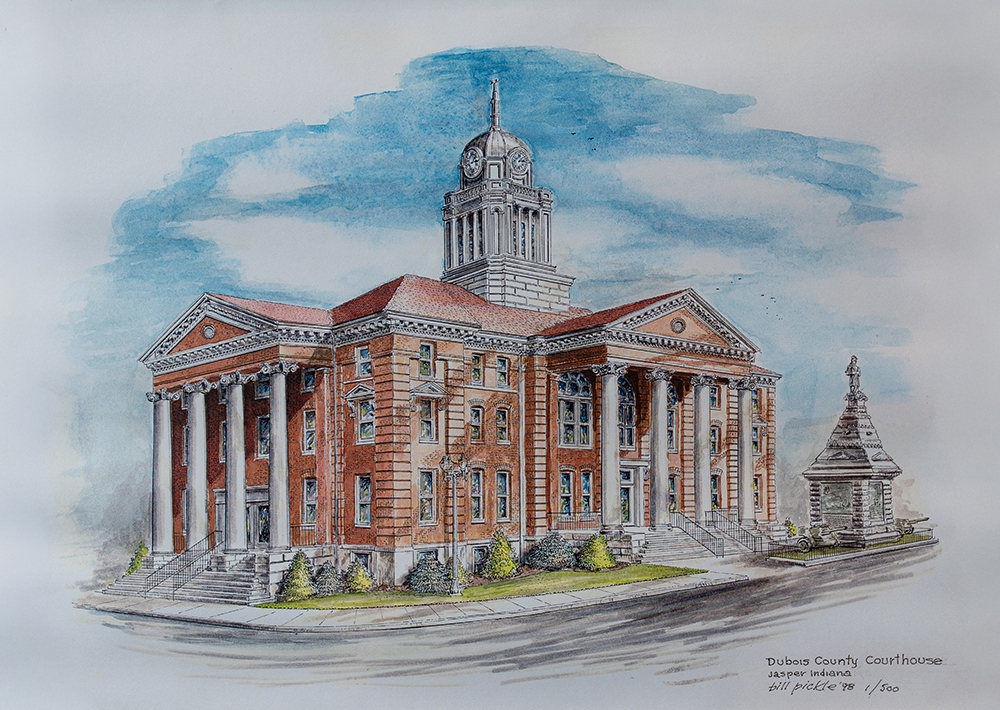
Dubois County
- Artist: Bill Pickle
- Donor: Dubois County Bar Association
- Medium: Watercolor, Pen & Ink
The Dubois County Courthouse is in Jasper. It was designed by the architectural firm Milburn & Heister and built between 1909 and 1911. It is a three-story, Classical Revival style reinforced concrete and masonry building. It features a cupola that rises 100 feet high and pedimented porticos with Ionic order columns. Also on the property is the contributing Soldiers and Sailors Monument erected in 1894. It was added to the National Register of Historic Places in 1996.
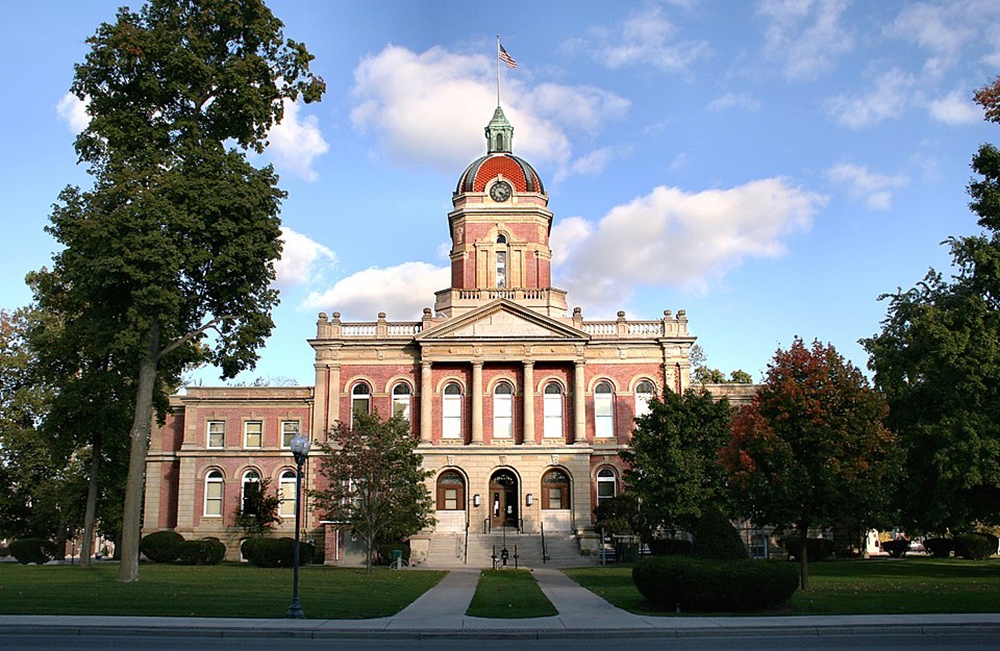
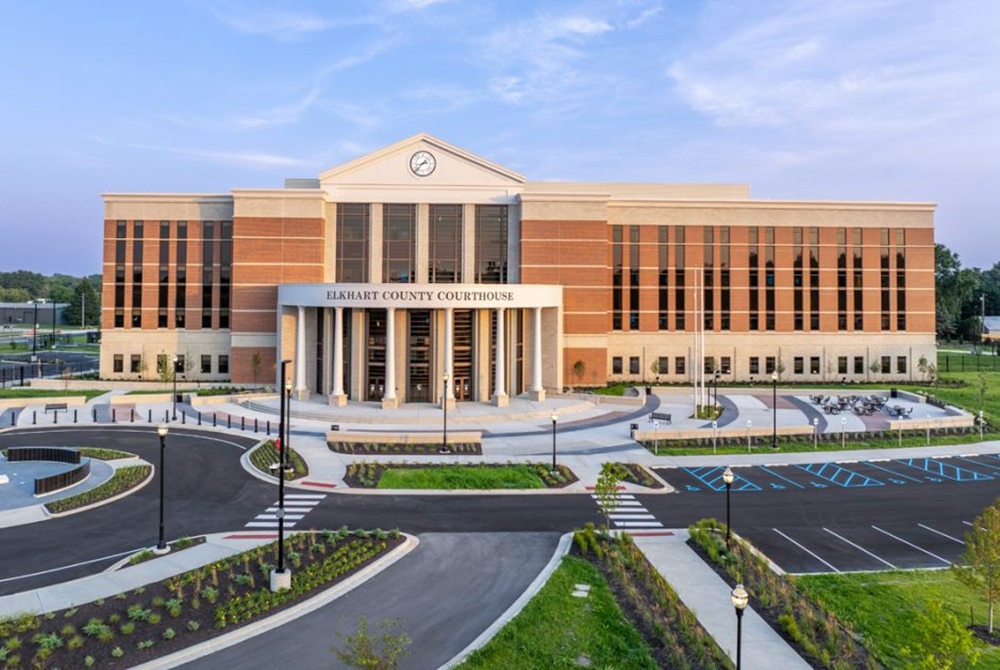
Elkhart County
- Artist: Jan Appenzeller
- Donor: Jan Appenzeller
- Medium: Ink Print
The Elkhart County Courthouse is in Goshen. It was originally built in 1868–1870 and renovated between 1905 and 1908 in the Renaissance Revival style. It is a three-story brick building with a clay tile dome tower. It features a portico with four freestanding Doric order columns, with stylized triglyphs, set on a rusticated podium. It was added to the National Register of Historic Places in 1980. In September 2025, a new Elkhart County courthouse opened in Goshen. The historic courthouse remains in use for other purposes including meetings of the county commissioners.

Fayette County
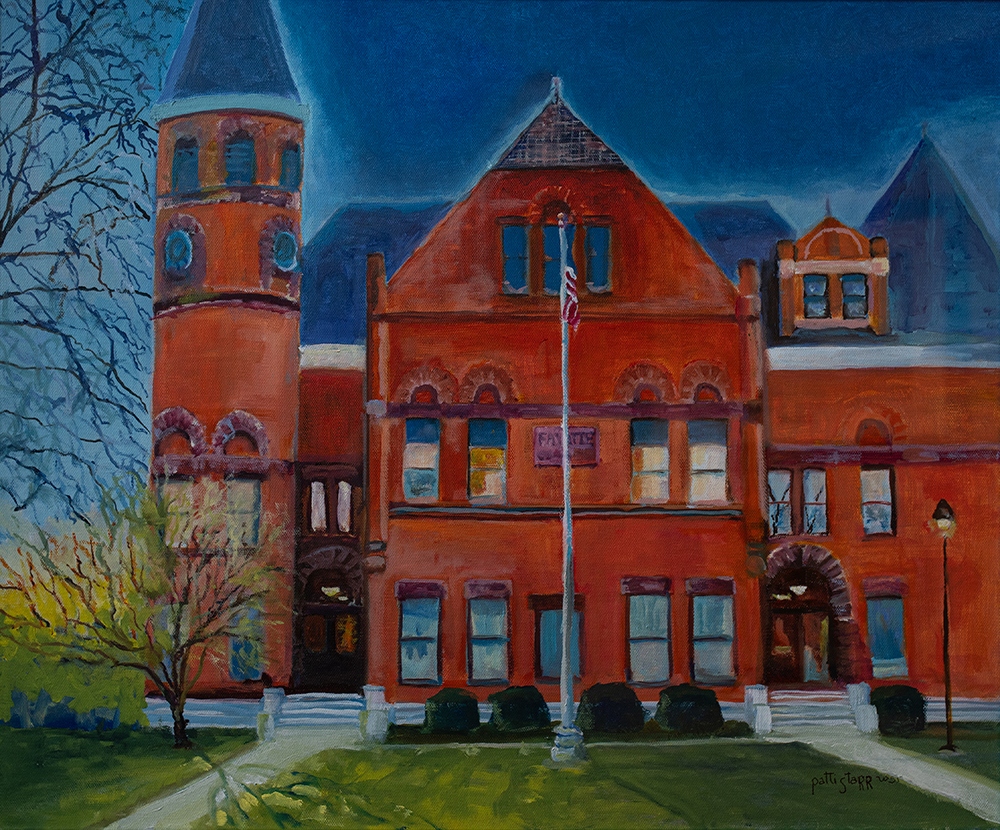
- Artist: Patti Starr
- Donor: Patti Starr, Watercolor Society of Indiana
- Medium: Watercolor
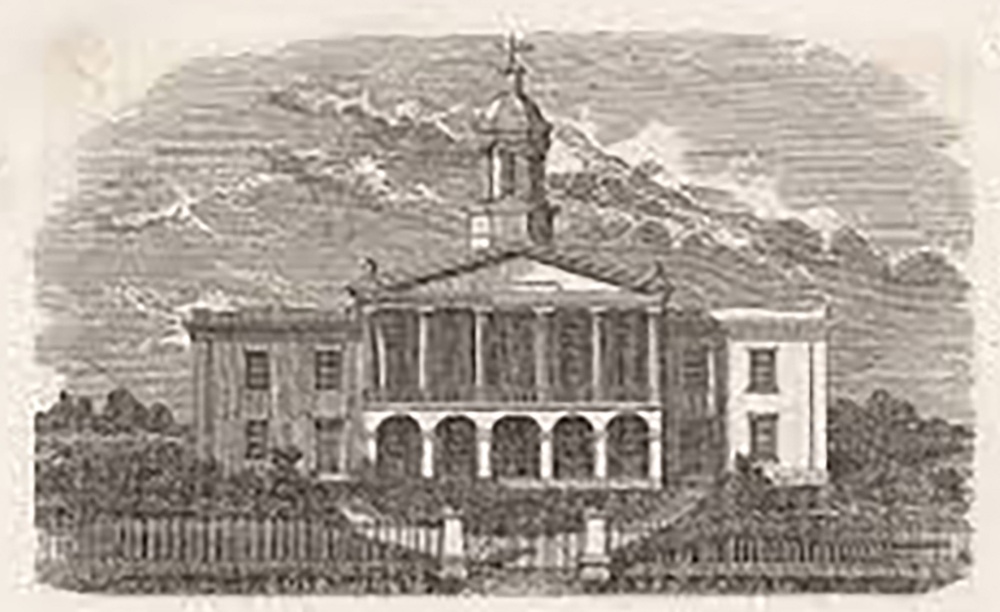
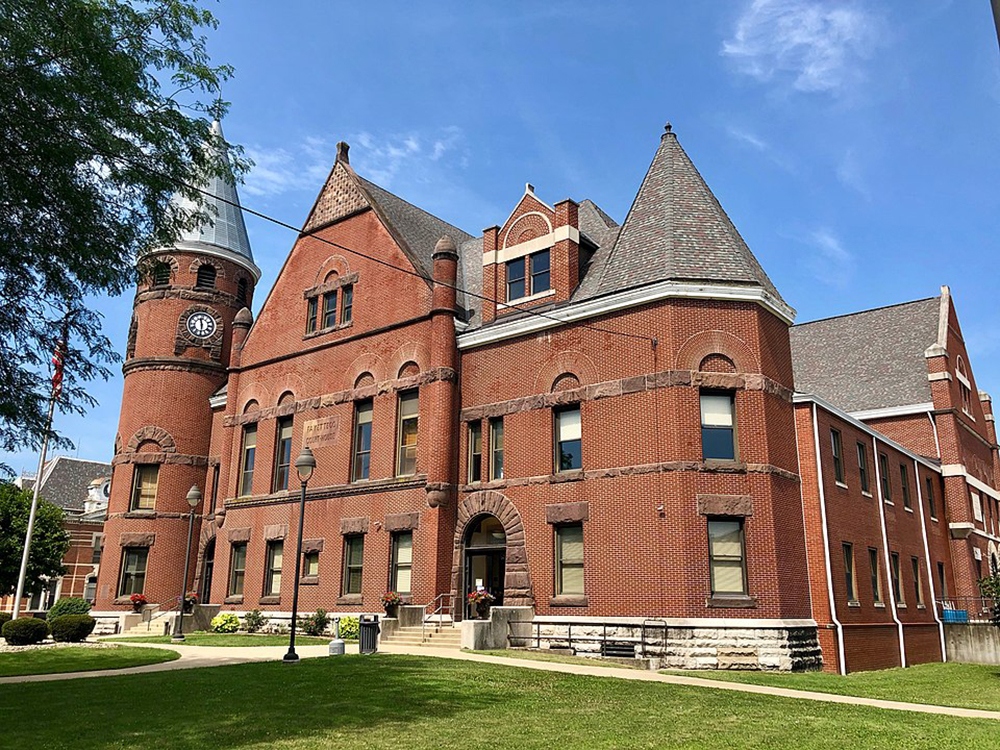
The Fayette County Courthouse is in Connersville. The first building to be formally known as the Fayette County Courthouse was completed in 1849. It was a Greek Revival-style structure made of red brick and designed by architect John Elder. In 1890, the courthouse was radically altered. The original portico was removed, and contractors added large additions. They then covered the entire building with new running-bond brick, converting its appearance to the Romanesque style. The 1849 structure is contained within the walls of the later renovations.
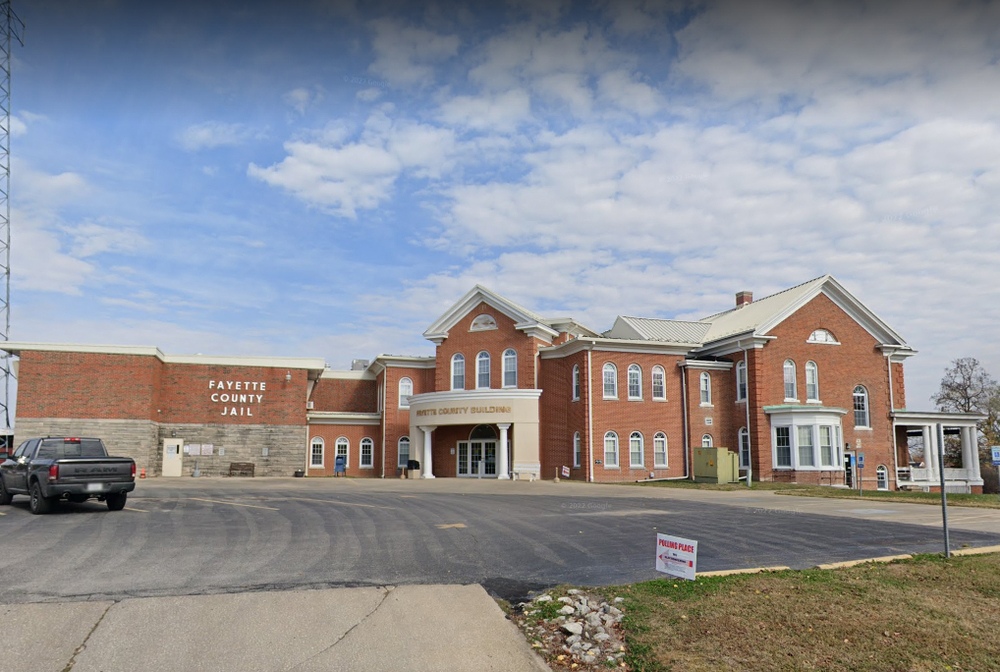
The building that now serves as the Fayette County Courthouse was constructed in 1839 as a residential home. In 1932, Fayette County purchased the property to serve as its courthouse. A county jail was added to the complex in 1968 and was later expanded to 70 beds, but the support spaces were never increased. Decades of additions and renovations created a confusing and inefficient 44,400-square-foot layout.
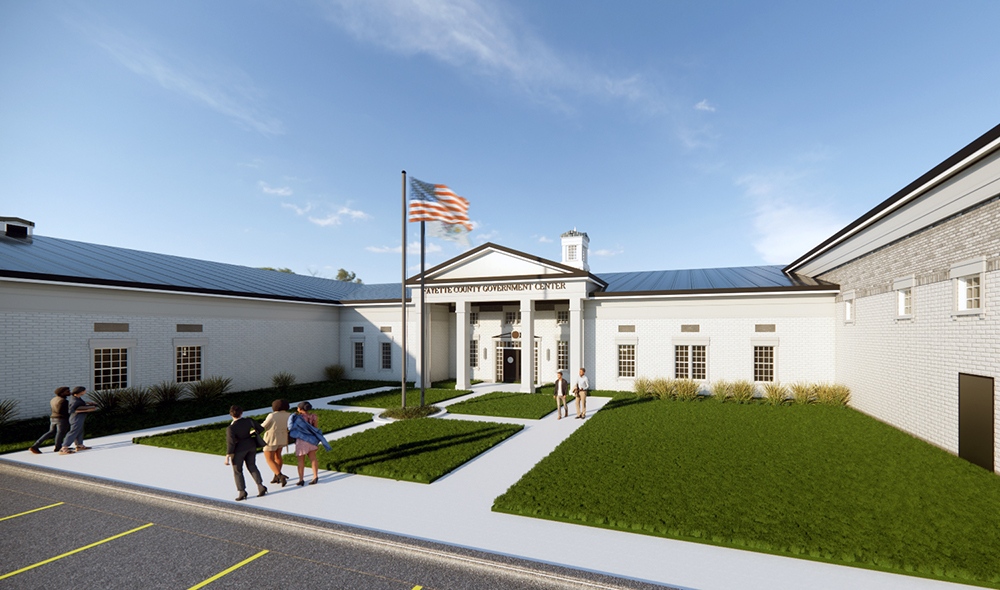
In early 2024, the Public Building Commission evaluated the building and determined that renovation was not practical due to severe deficiencies. These issues include outdated wiring, regular plumbing leaks, mold, and a basement that floods during heavy rain. County officials have determined that building a new government center is a more cost-effective solution than renovating the current structure.
Floyd County
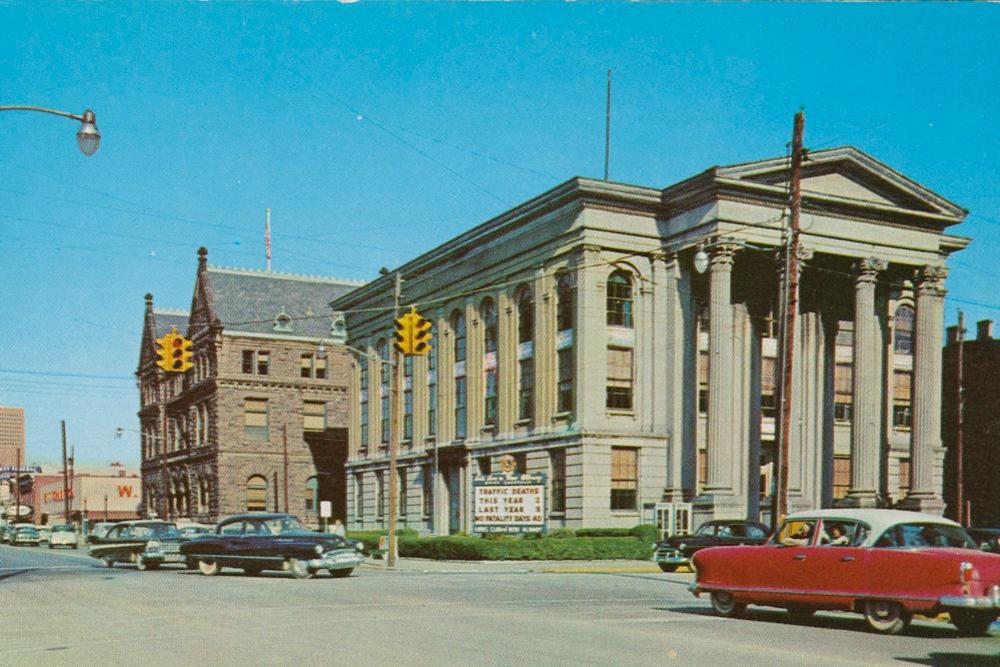
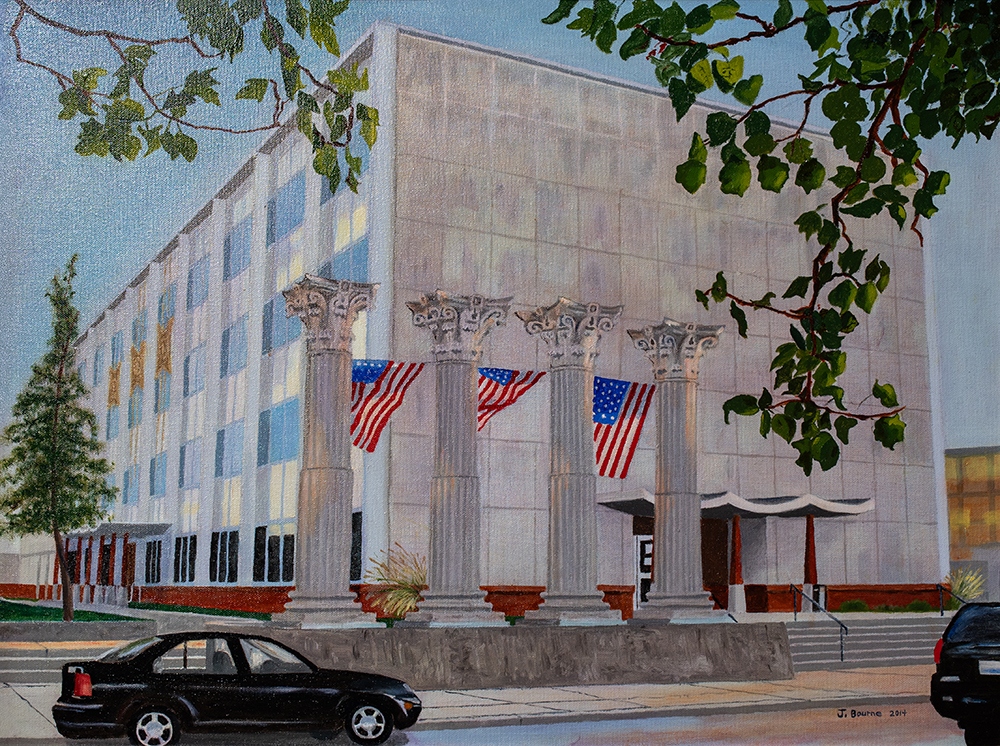
- Artist: James E. Bourne
- Donor: James E. Bourne
- Medium: Oil on Canvas
The Floyd County courthouse is in New Albany. It was constructed between 1959 and 1961 as Indiana’s first City-County Building. It was built after the demolition of the previous Neoclassical-style courthouse, a structure that had been a fixture in New Albany for years. Following the demolition of the older building, some of its columns were preserved and now stand as a monument on Spring Street, next to the current courthouse. The current courthouse building was designed by the architectural firm of Walker, Applegate, Oakes & Ritz.

Fountain County
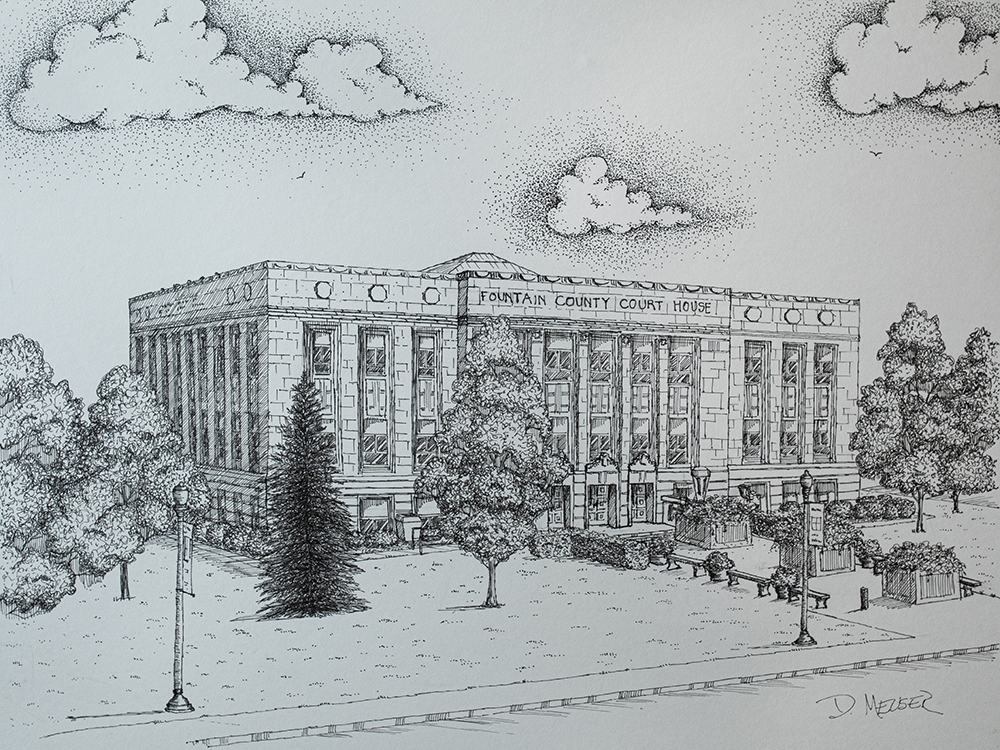
- Artist: Debbie Meuser
- Donor: Fountain County Bar Association
- Medium: Pen & Ink
The Fountain County Courthouse is in Covington. It was built in 1937 as a Public Works Administration project. The courthouse was designed by Louis Johnson, and cost $228,822. It is a three-story, Art Deco style, flat roofed building faced with Indiana limestone. It measures 116 feet by 89 feet and incorporates a 32 foot-square wired-glass skylight. It was built to replace three previous courthouses that were built in 1827, 1833, and 1859. It was listed on the National Register of Historic Places in 2007.
The interior features a collection of murals, totaling 2,500 square foot, painted by Eugene Savage. The murals reflect the history of Fountain County. In 1983, the murals underwent conservation, using sealant which caused the paint to begin to peel from the walls.

Franklin County
- Artist: Hon. Steve Cox
- Donor: Franklin County Bar Association
- Medium: Oil on Canvas
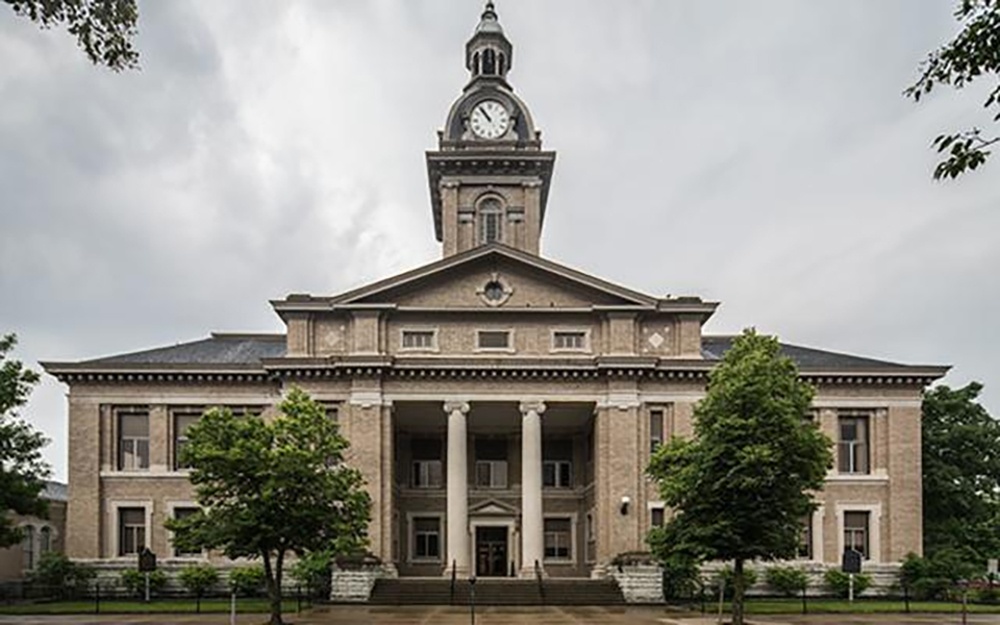
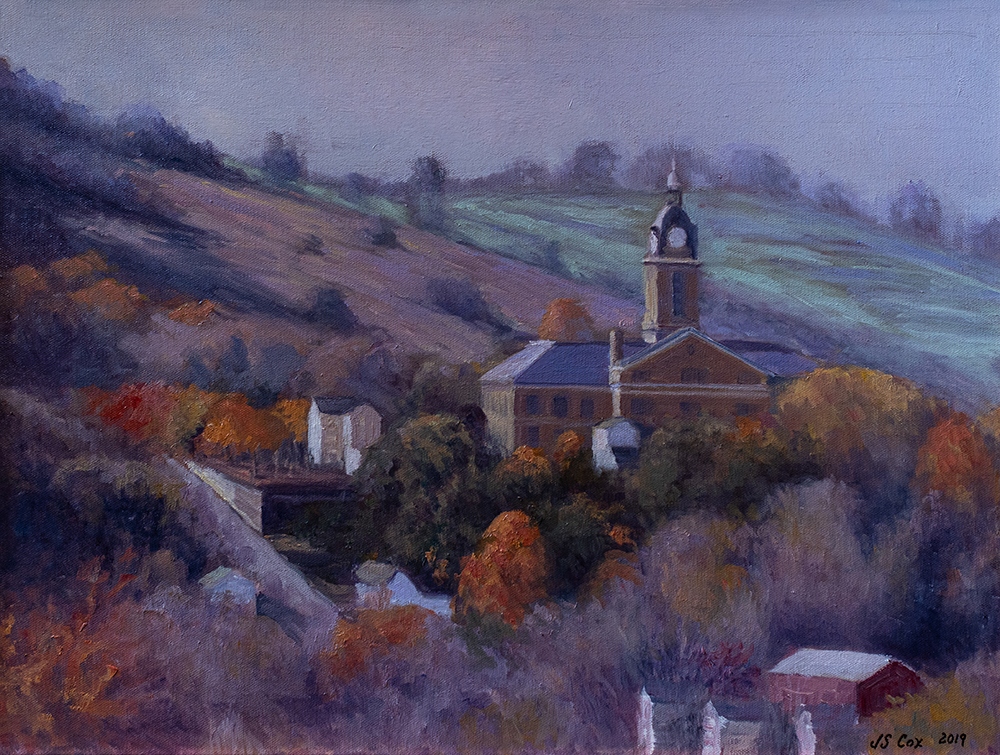
The Franklin County Courthouse is in Brookville. It has been through several significant renovations since it was originally constructed in 1852. The designer, Edwin May, also designed the Indiana Statehouse. In 1877, the roof collapsed after heavy construction materials were piled on it during a renovation attempt. Though a trial was in session, no one was killed. The building was later repaired. In 1912, the courthouse underwent a major remodeling designed by architect Elmer Dunlap. He added north and south wings, reconfigured the windows, and replaced the original tower. As the county outgrew the courthouse, many offices were moved to the new Franklin County Government Center, located in the former Brookville High School. The courthouse was listed on the National Register of Historic Places as part of the Brookville Historic District.
Fulton County
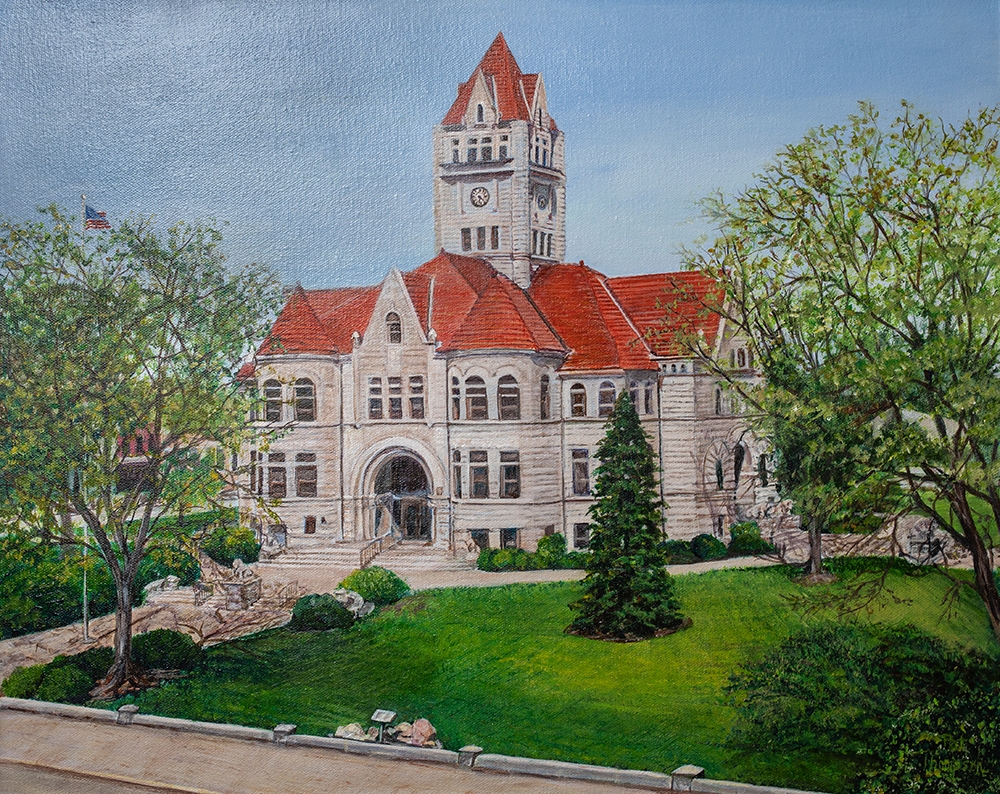
- Artist: Pat Thompson
- Donor: Fulton County Bar Association
- Medium: Oil on Canvas
The Fulton County Courthouse is in Rochester. It was built in 1895–1896 and is a four-story, Richardsonian Romanesque style limestone building. It has a cross-hall plan and features a central bell and clock tower with a pyramidal roof. In addition to the courthouse, the grounds have four memorials: one for the Potawatomi Trail of Death, a cornerstone for Rochester College, and two war memorials. The current structure is the third Fulton County courthouse, preceded by an 1837 log cabin and an 1846 structure. It was listed on the National Register of Historic Places in 2000 and is in the Rochester Downtown Historic District.

Gibson County
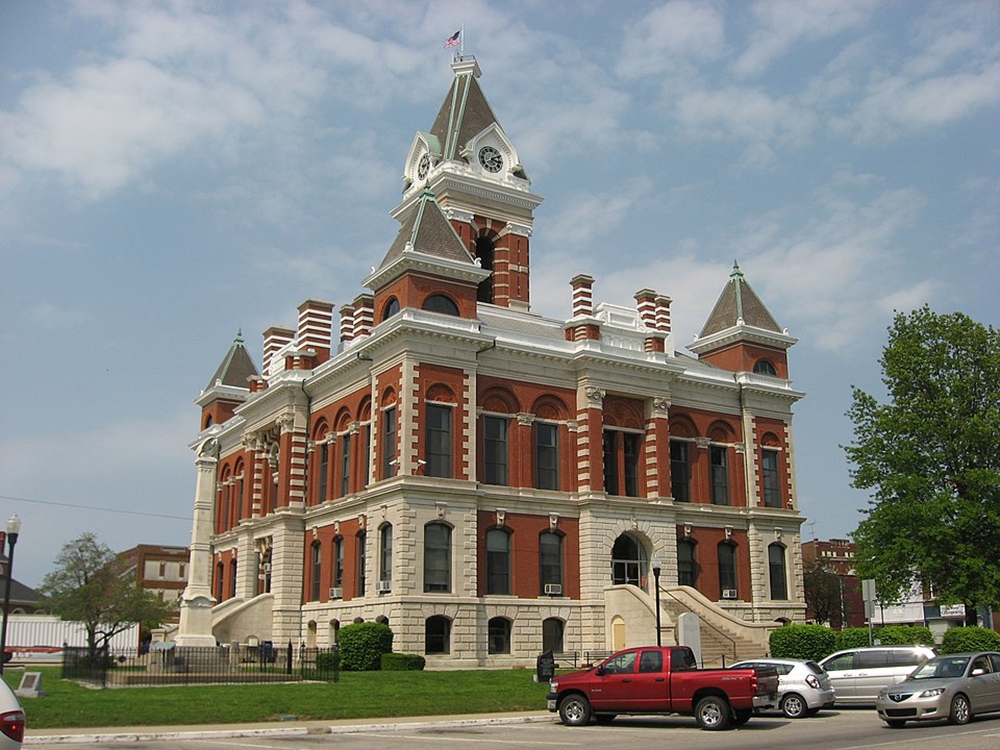
- Artist: Krista August
- Donor: Krista August, Watercolor Society of Indiana
- Medium: Watercolor
Since 1815, three separate buildings have served as the Gibson County Courthouse in Princeton. The current building was constructed in 1884 and is an example of Romanesque Revival architecture. The structure is of very similar design to the Johnson County Courthouse. The residence of Judge William Harrington was first used to conduct court business. Work on the first courthouse began on September 1, 1814. The brick building had two floors and measured 33 feet by 40 feet. It was first occupied in June 1815. The second courthouse was also made of brick and was completed in 1843 at a cost of about $9,000. The third (and current) courthouse was built on the site of the previous building. The cornerstone was laid on June 17, 1884. The McDonald Brothers of Louisville, Kentucky designed the building, which was constructed by local contractor Joseph Miller at a cost of $188,661. The two-story building has a full basement and is made of red brick trimmed with stone; the interior is trimmed with black walnut and oak, and has mosaic tile floors. In 2006 and 2007, an aesthetic renovation project began. The exterior walls and corner towers as well as the central bell tower were repainted, and a gazebo donated by Toyota Motor Manufacturing Indiana was placed on the courthouse lawn.

Grant County
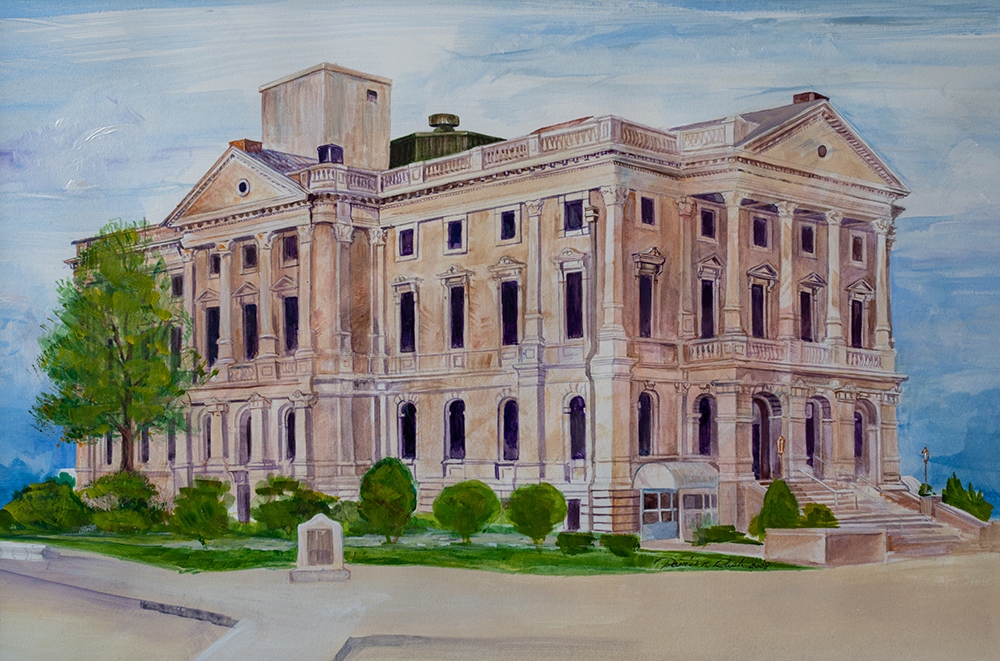
- Artist: David M. Rush
- Donor: Grant County Bar Associaiton
- Medium: Watercolor
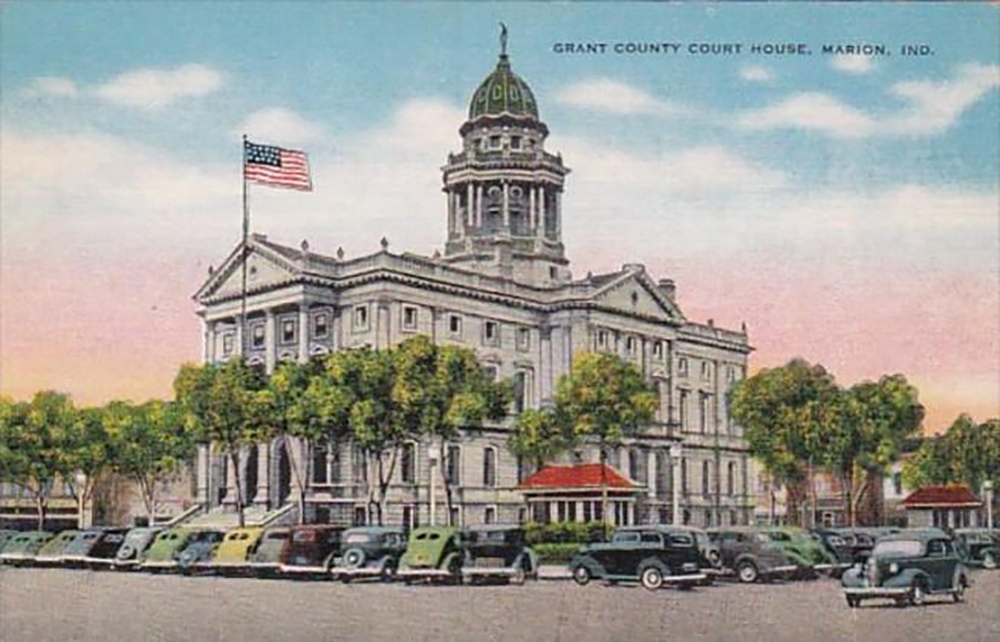
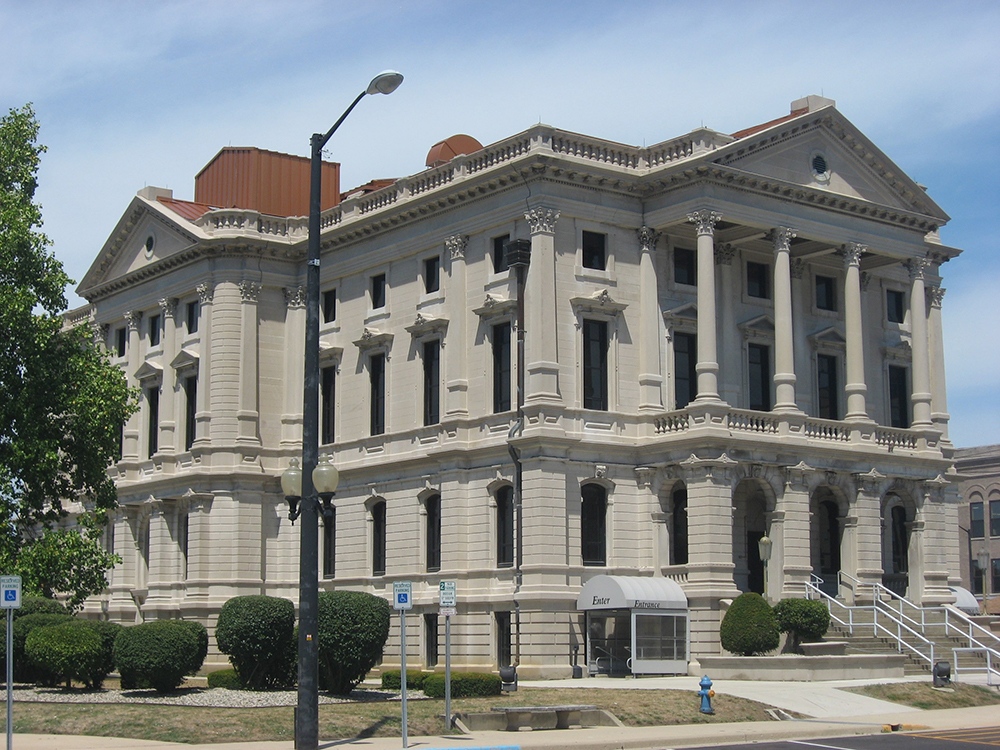
The Grant County Courthouse is in Marion. Built in 1880, the current building is the third courthouse constructed for the county. It was designed by Detroit architect Elijah E. Myers and is a three-story gray stone structure in the Neo-Classical style. When first constructed, it featured a 40-foot dome topped with a statue of Lady Justice. The dome was removed in 1943 due to safety concerns, and the statue was later sold for scrap. The building is now part of the Marion Downtown Commercial Historic District, which is listed on the National Register of Historic Places. The interior of the courthouse has undergone several changes over the years. The original circuit courtroom was split in half in the 1950s, and extensive renovations in the 1990s and 2011 updated the courtrooms with modern technology.
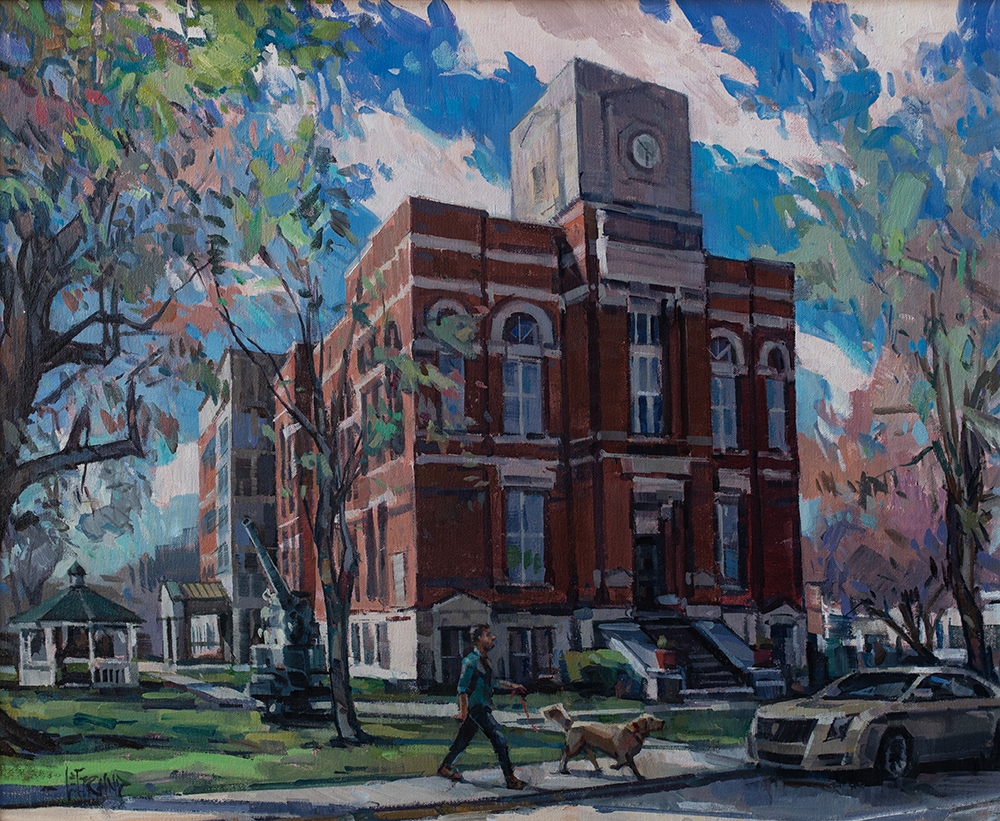
Greene County
- Artist: Wyatt LeGrand
- Donor: Greene County Bar Association-Judge Erik “Chip” Allen and John Rowe
- Medium: (not listed)
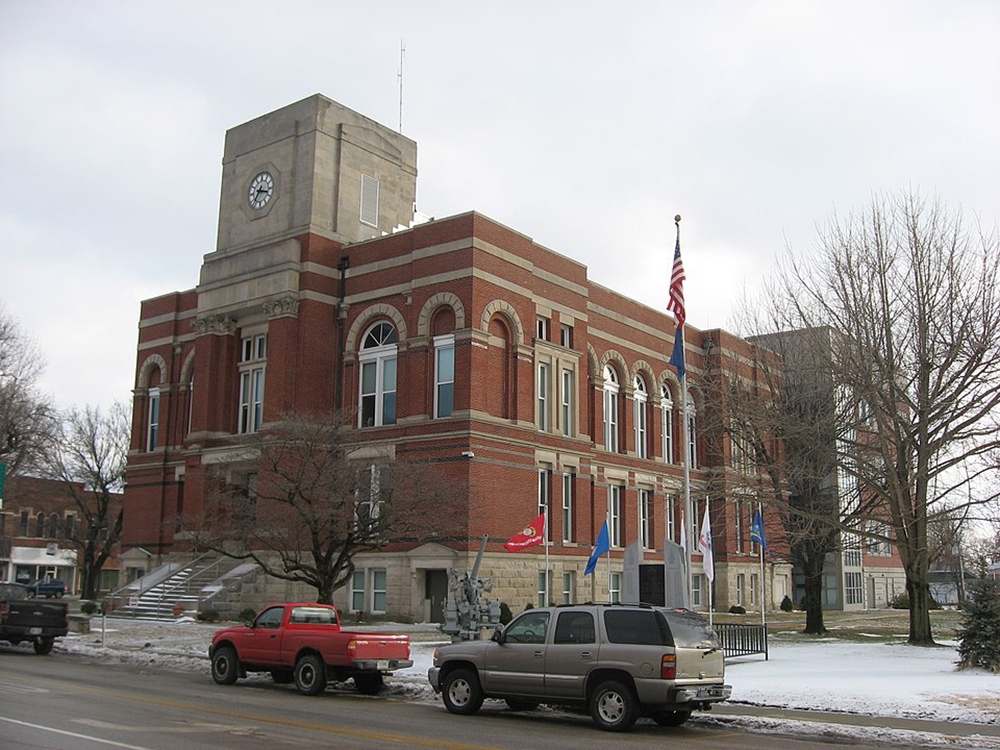
The Greene County Courthouse is in Bloomfield. It was designed by noted Indianapolis architect George W. Bunting and built in 1885–1886. It is a three-story, rectangular, Classical Revival style brick and stone building. It measures approximately 112 feet by 77 feet. The building has lost its original tower and corner turrets. It was listed on the National Register of Historic Places in 2008.
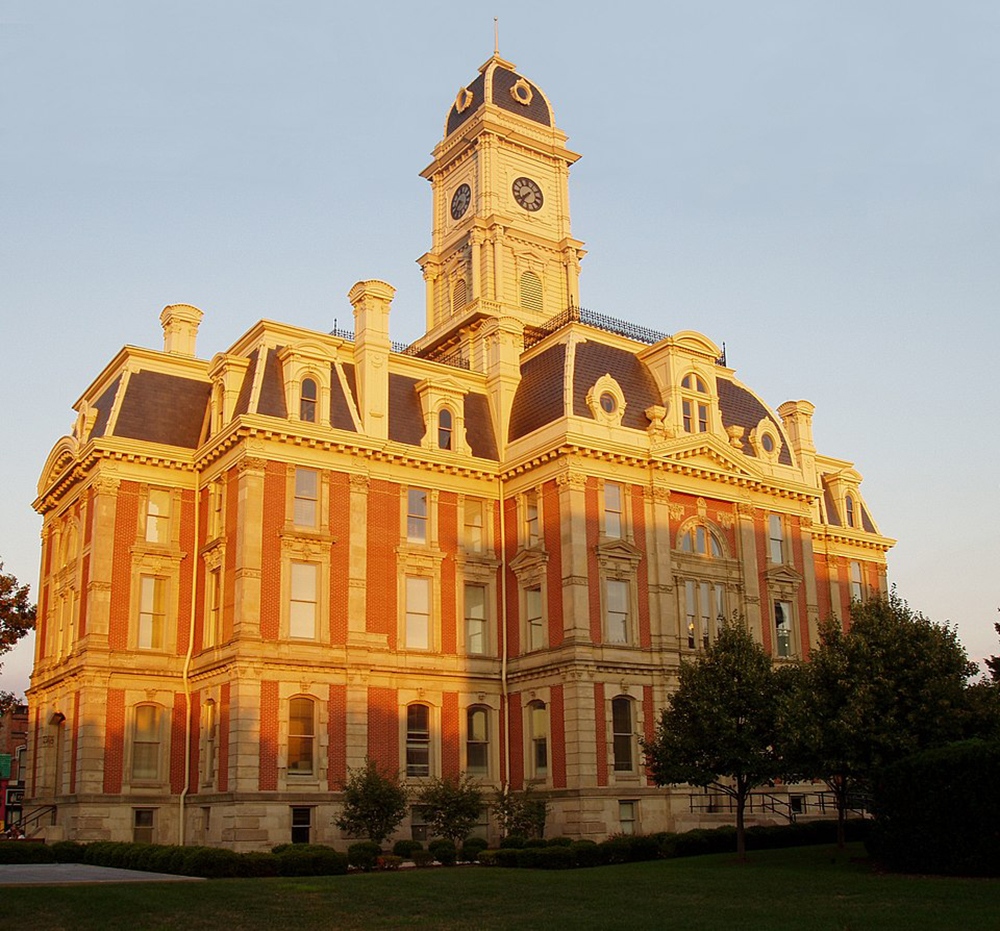
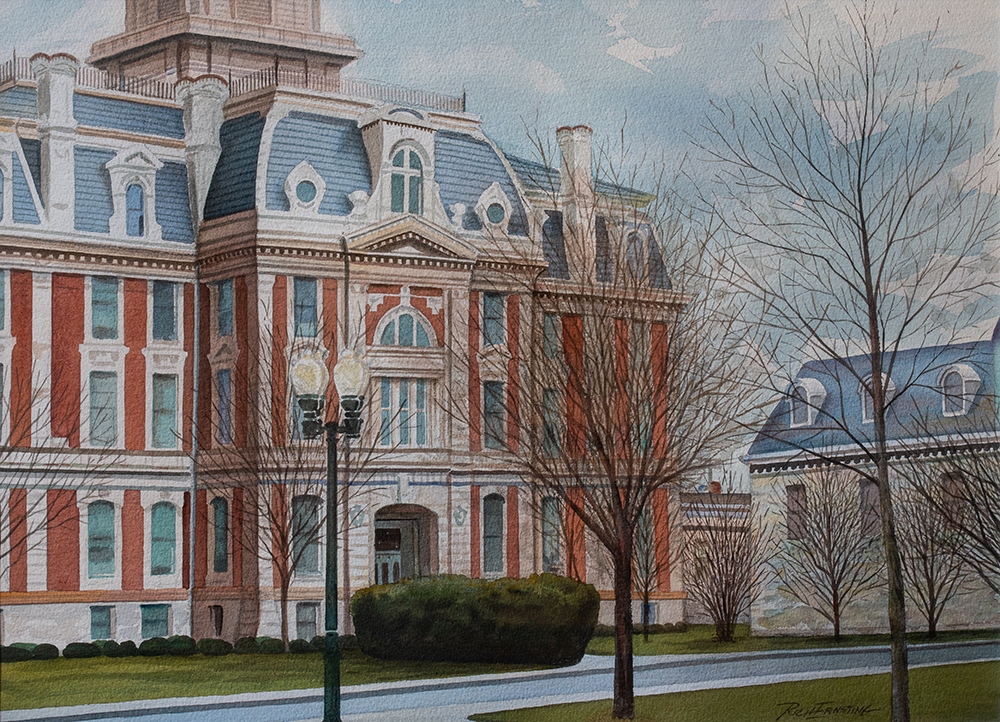
Hamilton County
- Artist: Rich Ernsting
- Donor: Hamilton County Bar Association
- Medium: Watercolor
The Hamilton County Courthouse Square contains the courthouse and jail and is in Noblesville. The jail was built in 1875–1876, and is a Second Empire style brick and limestone building. It consists of the two-story, ell-shaped jailer’s residence, with a cellblock attached at the rear. It features a three-story square tower that once had a mansard roof. The courthouse was built between 1877 and 1879, and is a three-story, Second Empire style, rectangular brick building. It has a clock tower atop the mansard roof and limestone Corinthian order pilasters. The Courthouse was listed on the National Register of Historic Places in 1978. The buildings are also included as contributing buildings in the Noblesville Commercial Historic District, which was NRHP-listed in 1991. The courtroom is where Ku Klux Klan Grand Dragon D. C. Stephenson was tried and convicted of murder on Nov 14, 1925.
Hancock County
- Artist: Deborah Smith
- Donor: Hancock County Bar Association; C. Dean Dobbins
- Medium: Watercolor
The Greenfield Courthouse Square Historic District encompasses 72 contributing buildings and 1 contributing object in the central business district of Greenfield that developed between about 1835 and 1935. The focal point of the district is the Romanesque Revival style Hancock County Courthouse (1896–1897) and Second Empire style jail. It was listed on the National Register of Historic Places in 1985.

Harrison County
- Artist: Lisa Reger
- Donor: Lisa Reger
- Medium: Oil on Canvas
The history of the Harrison County Courthouse in Corydon is intertwined with the town’s role as the first state capital of Indiana. The current structure is the third permanent courthouse to serve the county.
The first courthouse (1809): Harrison County was organized in 1808, and the first courthouse was built in Corydon the following year. At this time, Indiana was a territory, and Corydon would later serve as its capital. The original courthouse was a temporary frame structure, as was common for new counties.
The second courthouse and state capitol (1816–1825): The second courthouse, a two-story limestone building, was constructed in 1816. That same year, Corydon was made the official state capital. From 1816 to 1825, this building served as both the Harrison County Courthouse and the Indiana State Capitol. The Indiana Constitution was signed under a nearby elm tree because the building was not yet finished. Corydon served as the state capital until 1825, when it was moved to Indianapolis. The old capitol building still stands and is a state historic site.
Third courthouse (1882): After Indiana’s government moved, the limestone building reverted solely to county use. It was later replaced by a new brick courthouse in 1882.
Current courthouse (1928): The third courthouse was razed and replaced with the current Neoclassical-style courthouse, which was completed in 1928. The building is notable for its prominent domed rotunda and large clock tower. It features a limestone exterior that honors the architectural heritage of the earlier statehouse. The courthouse was built in a period of economic expansion in Corydon and reflects the early 20th-century trend of constructing impressive, permanent public buildings. A historical marker for Harrison County is installed on the grounds.


Hendricks County
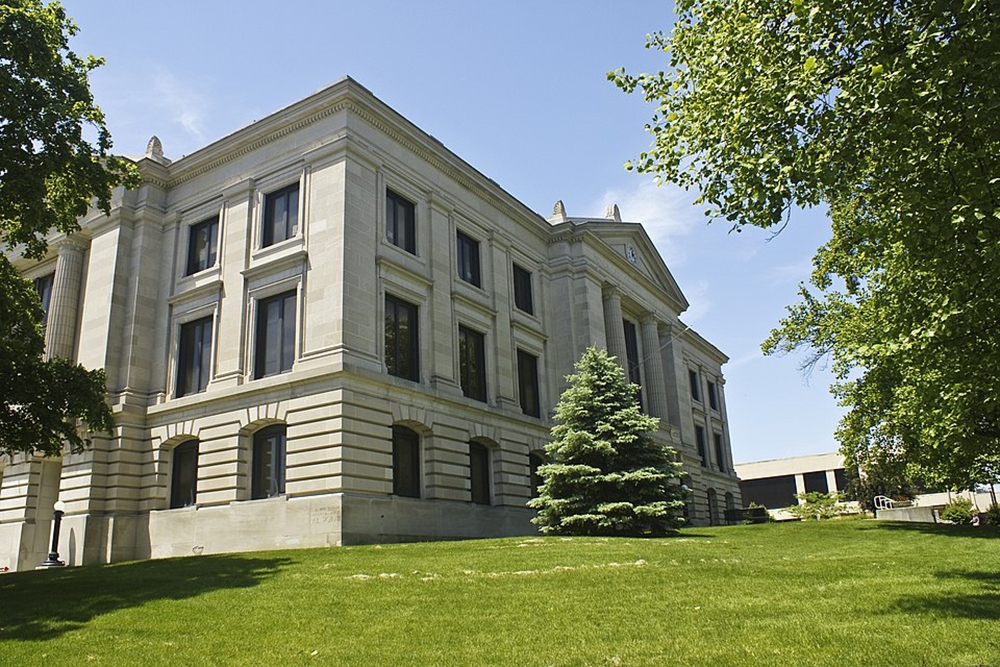
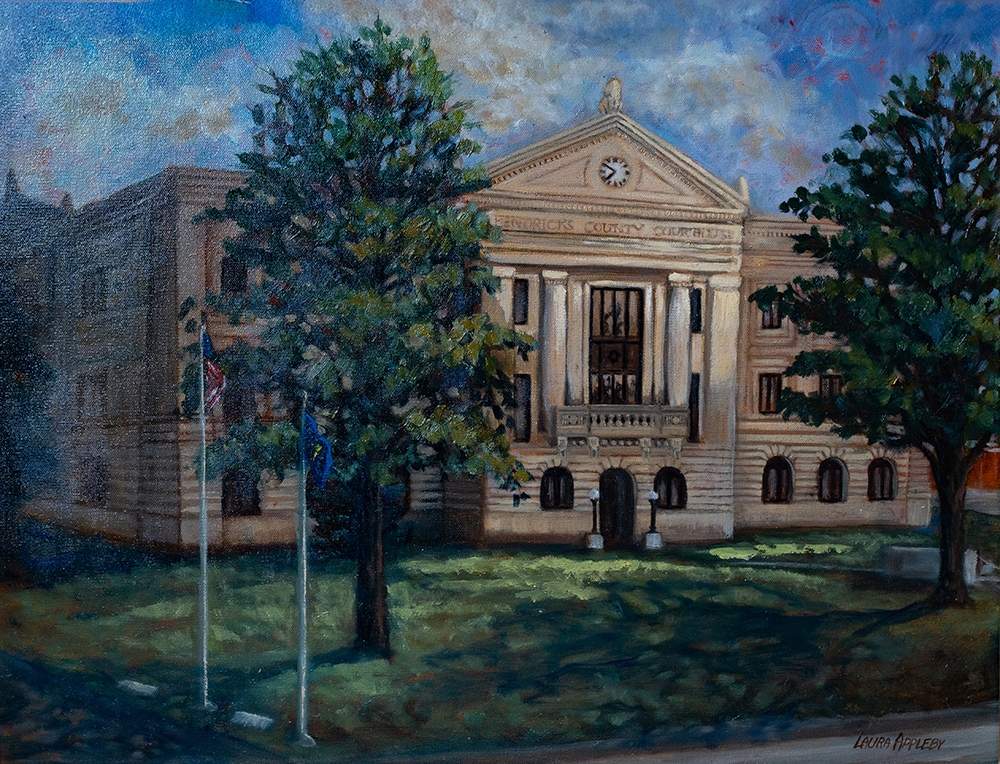
- Artist: Laura Appleby
- Donor: Hendricks County Bar Association
- Medium: Oil on Canvas
The Danville Main Street Historic District encompasses 42 contributing buildings and two contributing structures in the central business district of Danville. The district developed between about 1865 and 1960 and includes notable examples of Italianate, Classical Revival, Beaux-Arts, and Tudor Revival style architecture. Located in the district is the separately listed Hendricks County Jail and Sheriff’s Residence. Other notable buildings include the Hall Block (c. 1900), Danville Public Library (1902–1903), Hendricks County Courthouse (1915), and Danville Post Office (1936). It was added to the National Register of Historic Places in 2010.
The county’s first courthouse was opened in Danville in 1826, when the county was organized. A more permanent structure was built between 1841 and 1842. This building was replaced by a newer courthouse in 1856. The current courthouse was completed in 1914 and is noted for its Renaissance Revival architecture, limestone construction, and clock tower. In recent years, public areas of the interior have been restored to their original appearance, including plaster and marble repair, and the original light fixtures and stained-glass skylight have been restored.
Henry County
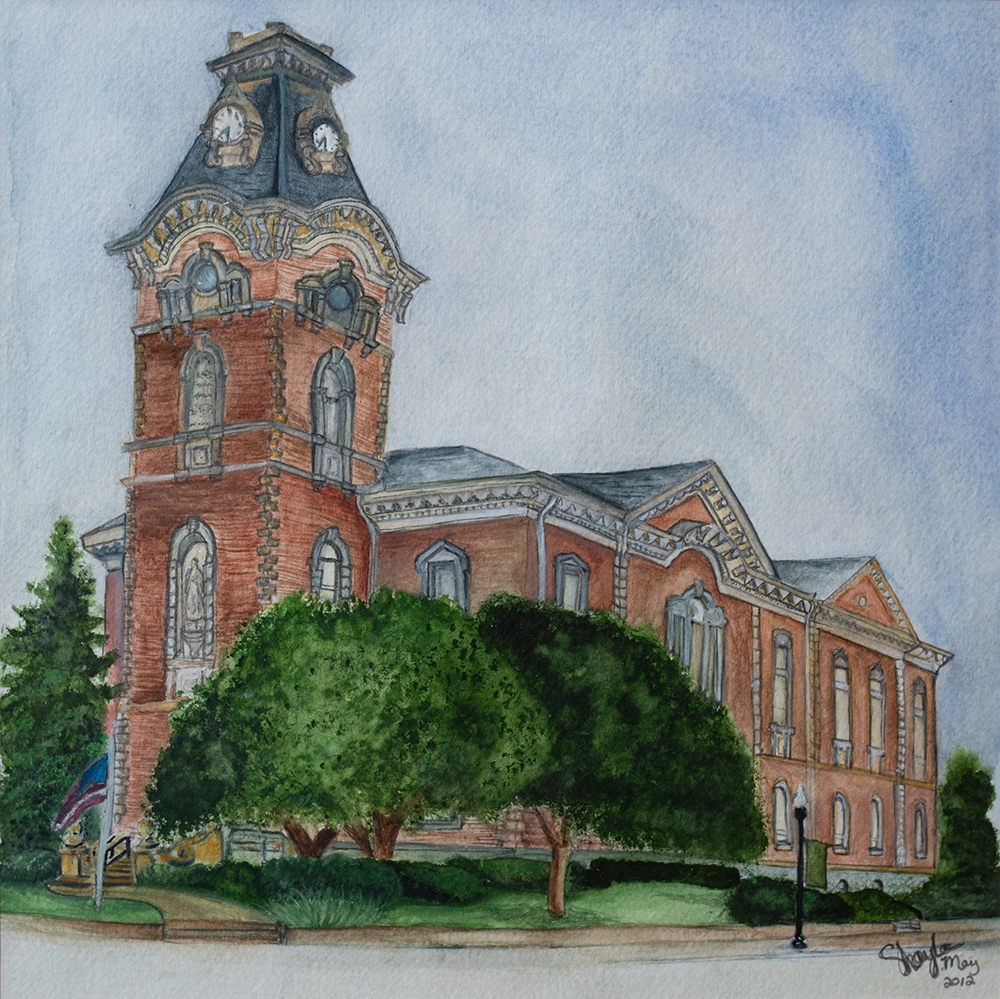
- Artist: Shayle Major
- Donor: District 6 Access to Justice; Henry County Pro Bono Attorneys
- Medium: Watercolor
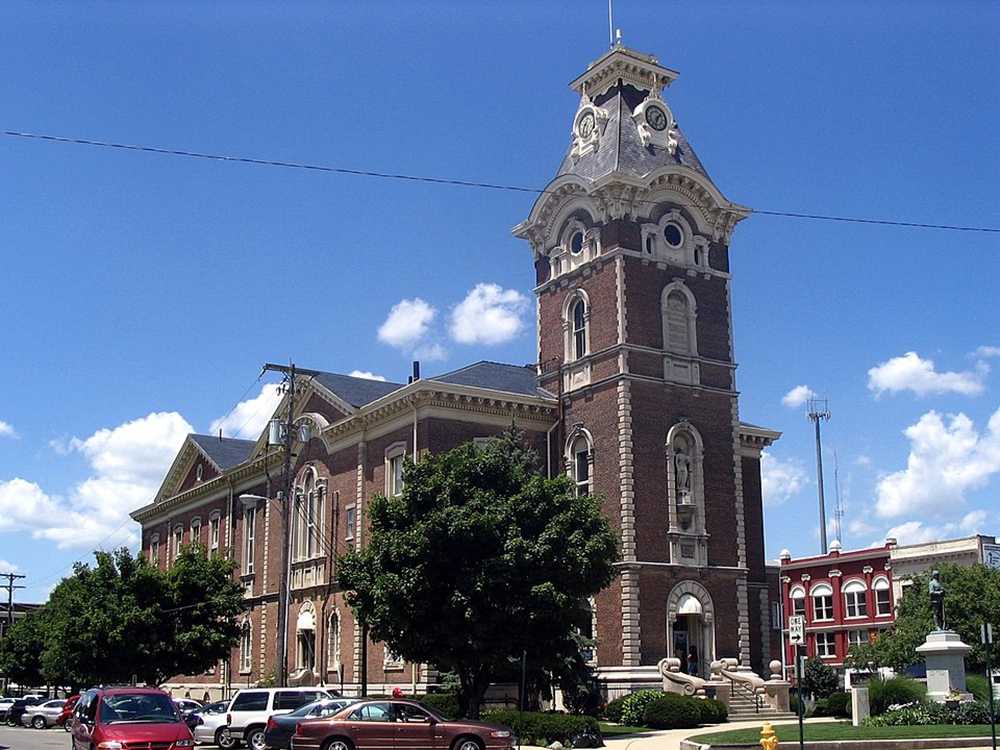
The Henry County Courthouse is in New Castle on the land designated as courthouse square by the Henry County Commissioners. The Court House was built between 1865 and 1869 at a cost of $120,000. An annex was added in 1905 at a cost of $44,000. When it was built the commissioners wanted a fireproof courthouse. They did not want to see the courthouse burn again as it had in 1865. Architect Isaac Hodgson provided them with what they wanted, but with a mansard roof and a 110-foot clock tower. The mansard roof was unusual for a midwestern public building in the 1860s. It became popular later, but the Henry County Court House was probably the earliest example of the style for public buildings in the Midwest.
Henry County claims the distinction of being the Raintree County described in Ross Lockridge Jr.’s book Raintree County in part because the Henry County Court House is pictured inside the front cover of the book and the book includes references to places in Henry County. It was added to the National Register of Historic Places in 1981. It is located in the New Castle Commercial Historic District.
Howard County
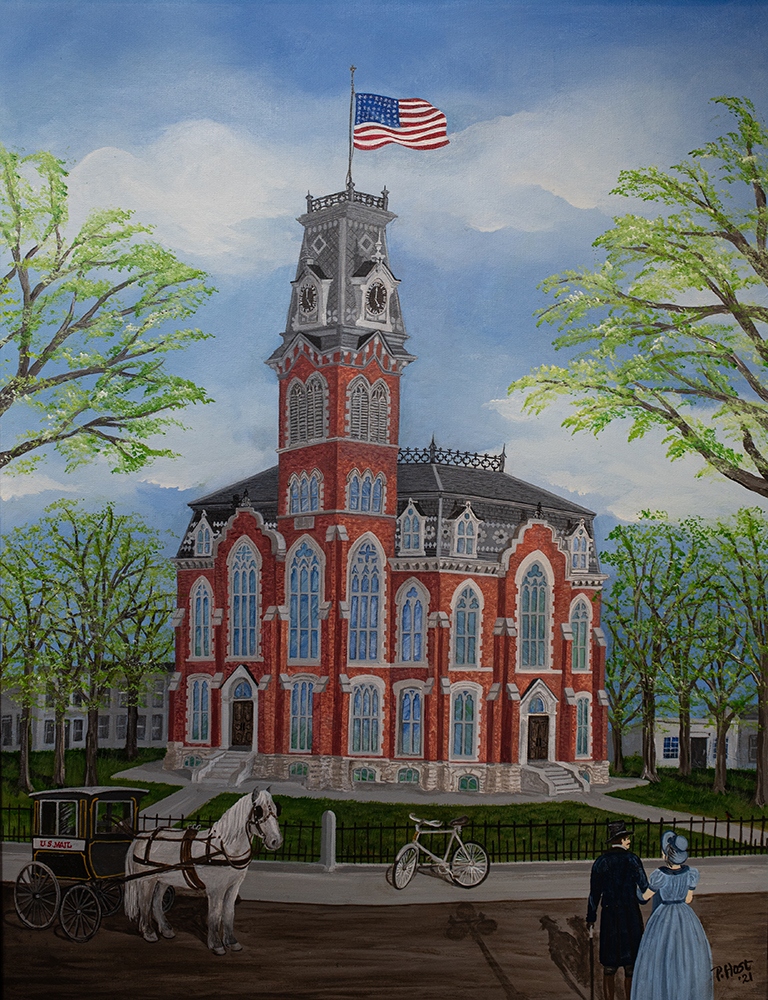
- Artist: Patti Host
- Donor: Howard County Bar Association
- Medium: Oil on Canvas
- NOTE: Two artists’ renderings were featured at the Indiana Landmarks showing; only one was listed in the database.
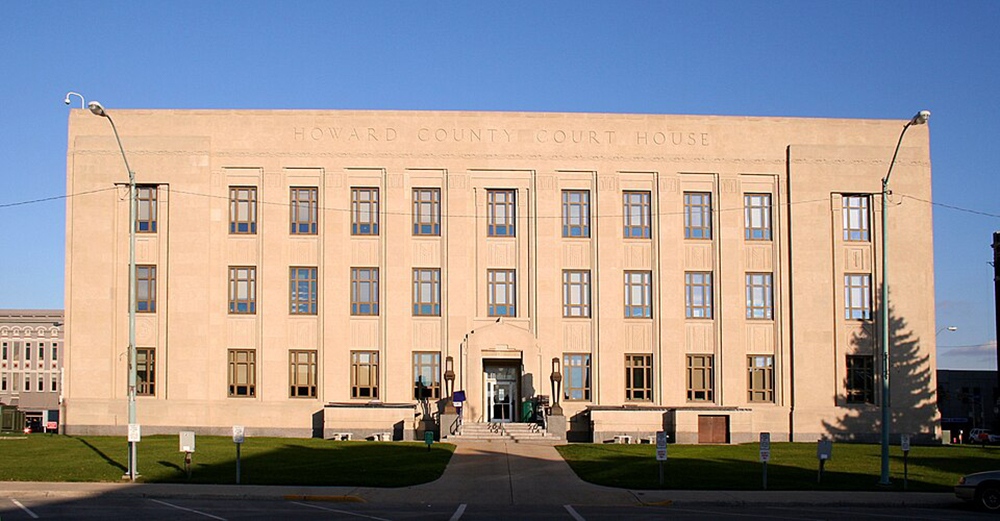
Howard County’s original Second Empire style courthouse was built in 1868 and once stood at the location of the current structure. An unfortunate and devastating fire led to its demolition in 1927, scattering county offices throughout downtown Kokomo. The current Art Deco style Howard County Courthouse was dedicated on October 20, 1937 and was designed by Kokomo architect Oscar F. Cook. The building now features a stylized limestone entry with bronze doors decorated with the likeness of Kokomo founder David Foster and famous local inventor / industrialist, Elwood Haynes. The structure is part of the Kokomo Courthouse Square Historic District and was listed on the National Register of Historic Places in 2008.


Huntington County
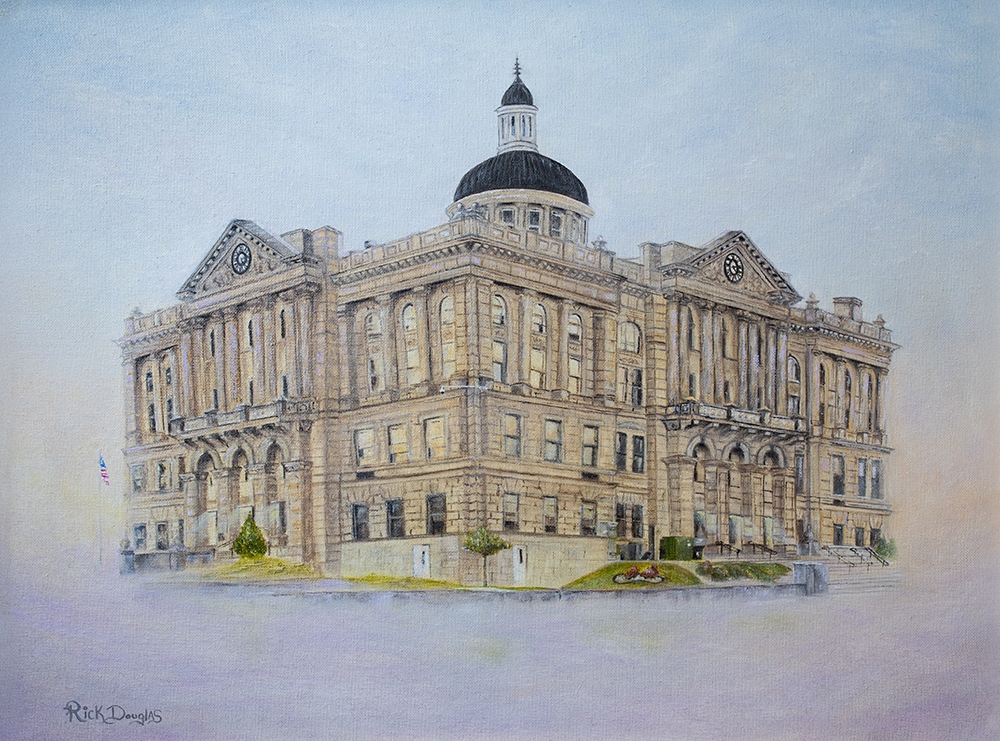
- Artist: Rick Douglas
- Donor: Huntington County Bar Association; Huntington County Historical Society
- Medium: Oil on Canvas
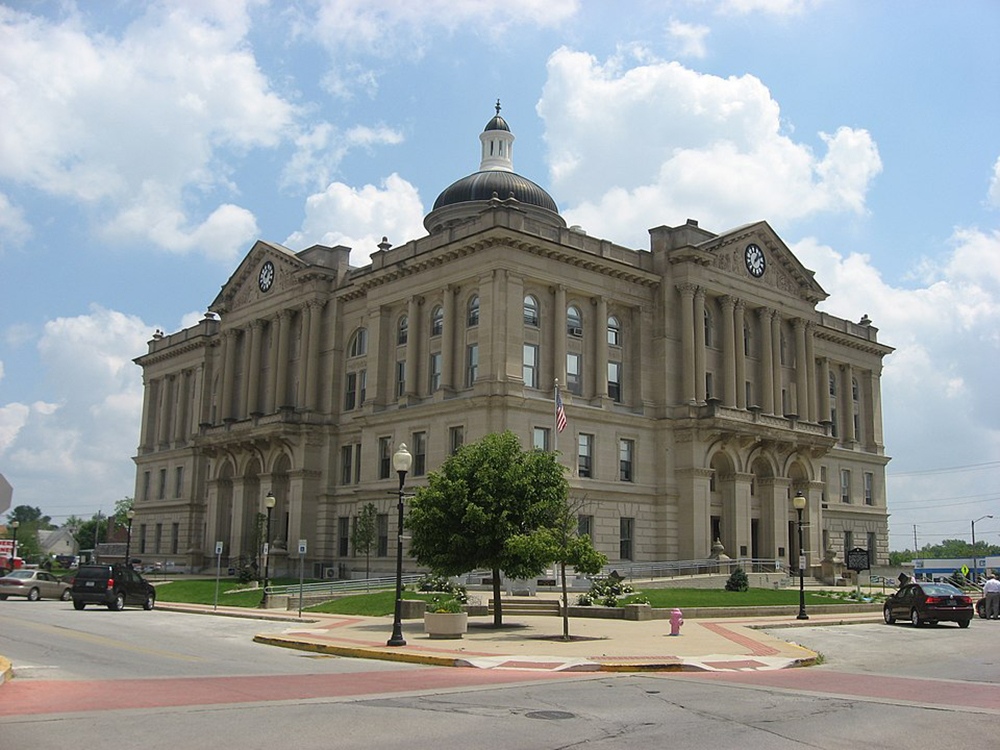
The current Huntington County Courthouse was constructed between 1904 and 1906, designed by architect J.W. Gaddis in the Grecian style. It replaced two earlier courthouses: a wooden structure built in 1840 and a two-story brick building constructed in 1858. The current building, known for its use of Bedford Limestone and Ionic and Corinthian styles, was added to the National Register of Historic Places in 1992 as part of the Huntington Courthouse Square Historic District.
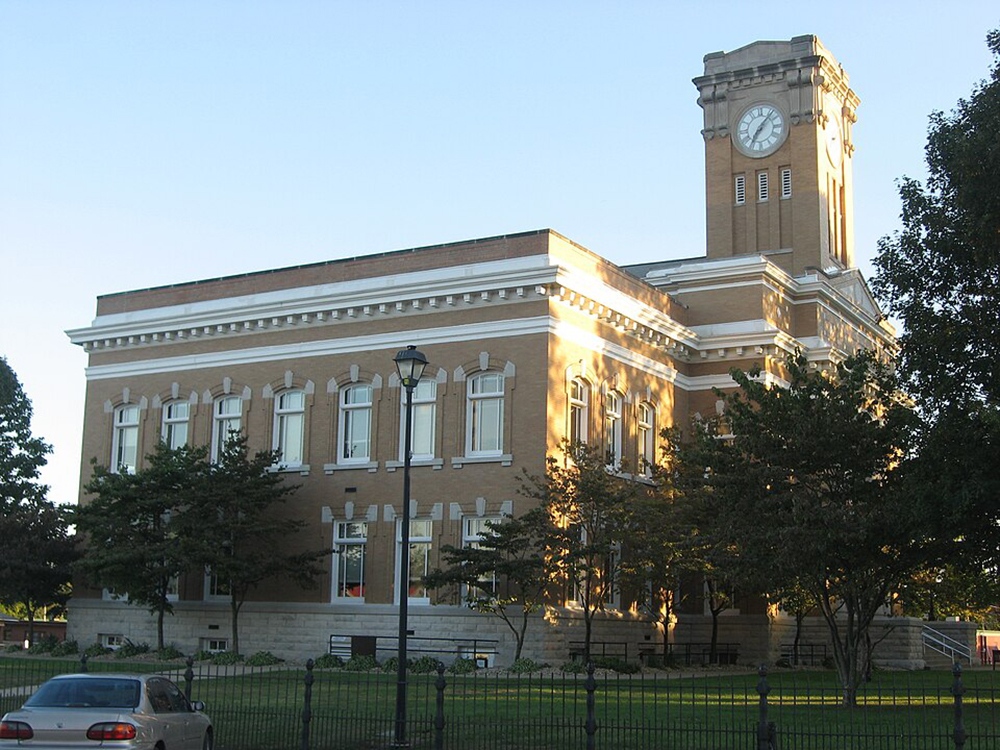
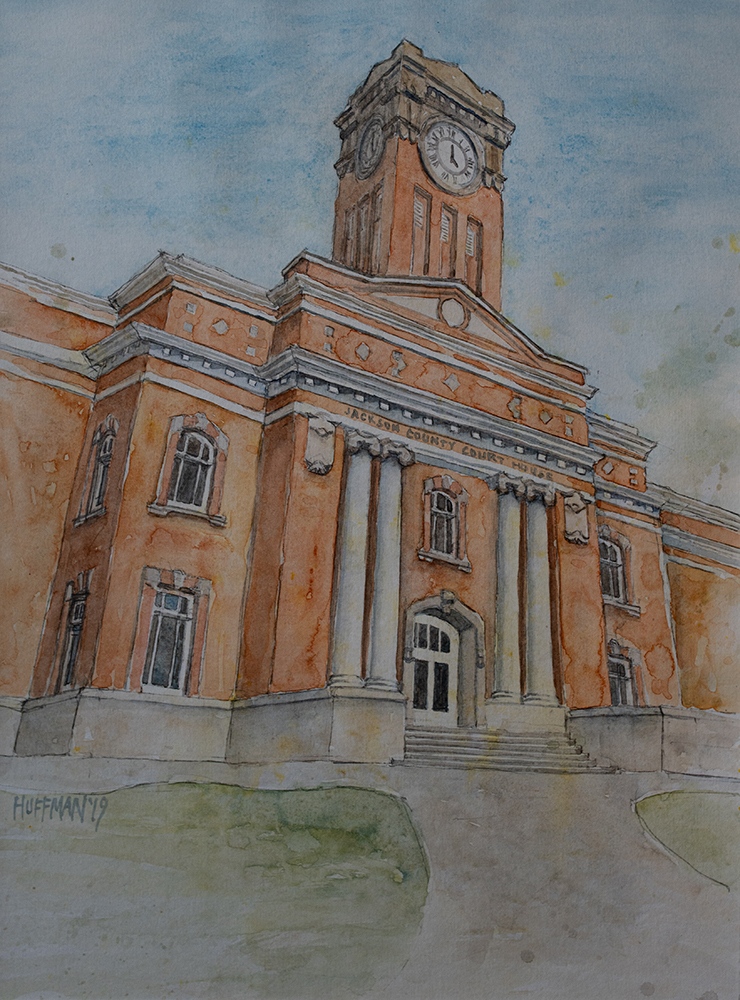
Jackson County
- Artist: Cathleen Huffman
- Donor: Mary Ann & Roger Pardeick
- Medium: Watercolor
The Jackson County Courthouse is in Brownstown. The original building was built in 1870 and was extensively remodeled by Elmer E. Dunlap in the Classical Revival style in 1911. It is a two-story, brick and limestone building consisting of a rectangular main central section with two flanking wings. The building features a four-sided clock tower. Located on the courthouse grounds are the contributing Sherman M-4 memorial tank, the town water pump and bell, and a cast iron fence (1872). It was listed on the National Register of Historic Places in 2011.
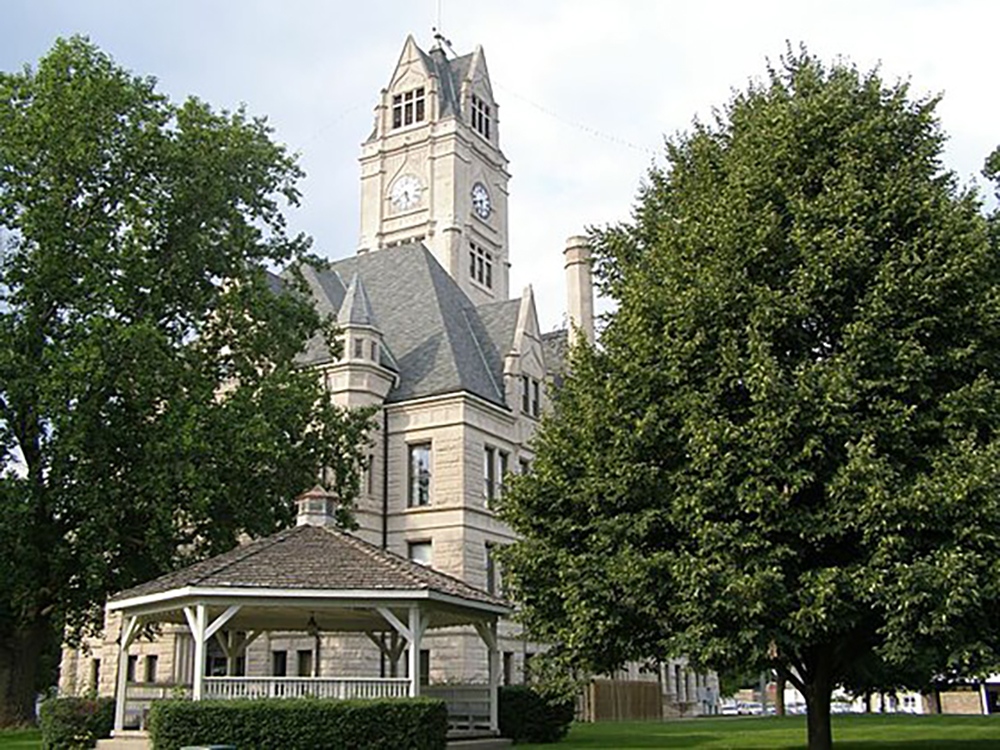
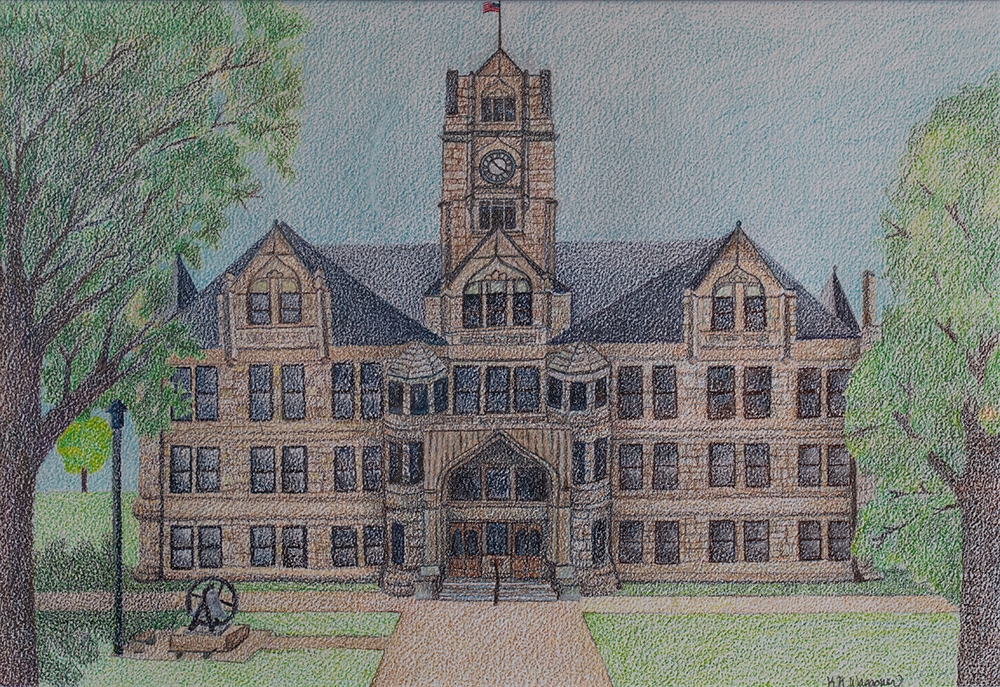
Jasper County
- Artist: Kelli N. Waggoner
- Donor: Jasper County Bar Association
- Medium: Crayon
The Jasper County Courthouse in Rensselaer is a building from 1898. It was listed on the National Register of Historic Places in 1983 and is located in the Rensselaer Courthouse Square Historic District. It was erected in 1898 at a total cost of $141,731.94. The Courthouse Square is defined by a retaining wall of concrete, about 18″ high and a foot wide. The building stands on a bedrock and has four floors plus a basement and a clock tower. The clock tower is 120 feet (37 m) high. The building is faced with Bedford limestone and features medieval elements. Entrances on the north and south sides are framed in two-story Tudor arches supported on clusters of columns. Flanking these entrances are three-story round towers. Centered over the entrance is a wall dormer, which is surmounted by the clock tower. The clock tower also has a wall dormer on each face of its pyramidal roof. The clock tower, itself, has three floors; the first has windows, the second contains the clock, and the third the bell.
Jay County
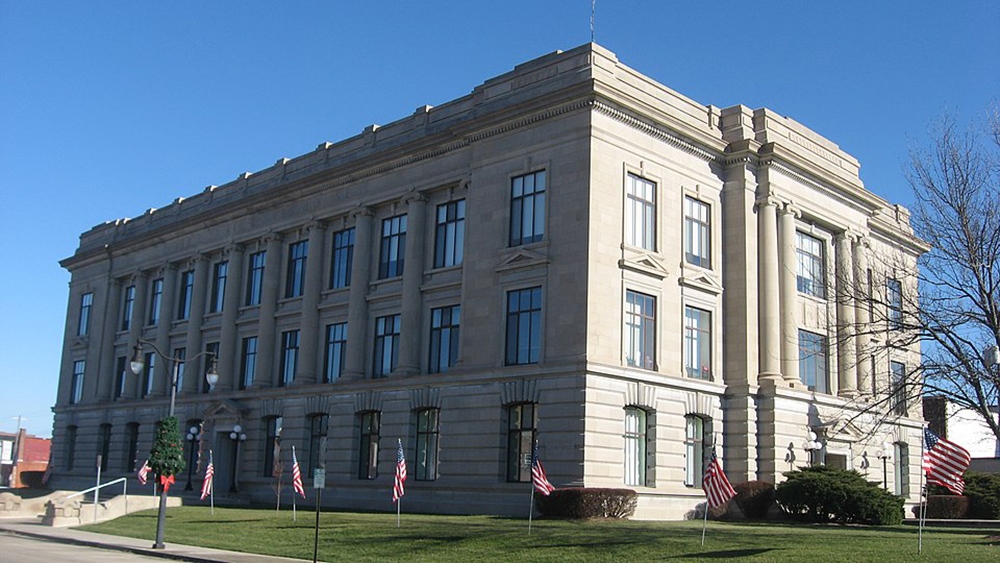
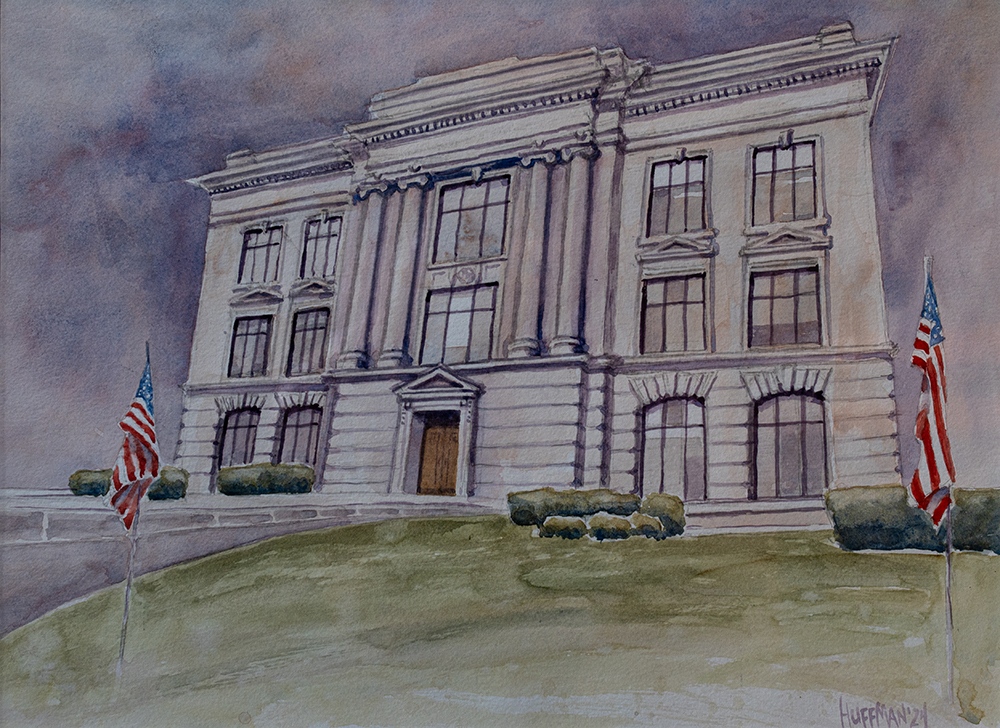
- Artist: Cathleen Huffman
- Donor: Cathleen Huffman, Watercolor Society of Indiana
- Medium: Watercolor
The Jay County Courthouse is in Portland. It was built between 1915 and 1919 and is a three-story, Renaissance Revival style limestone building with a low roof behind a parapet. It is five bays by eleven bays with a rusticated exterior base and smooth upper floors and paired Ionic order engaged columns. It was listed on the National Register of Historic Places in 1981. It is located in the Portland Commercial Historic District.
Jefferson County
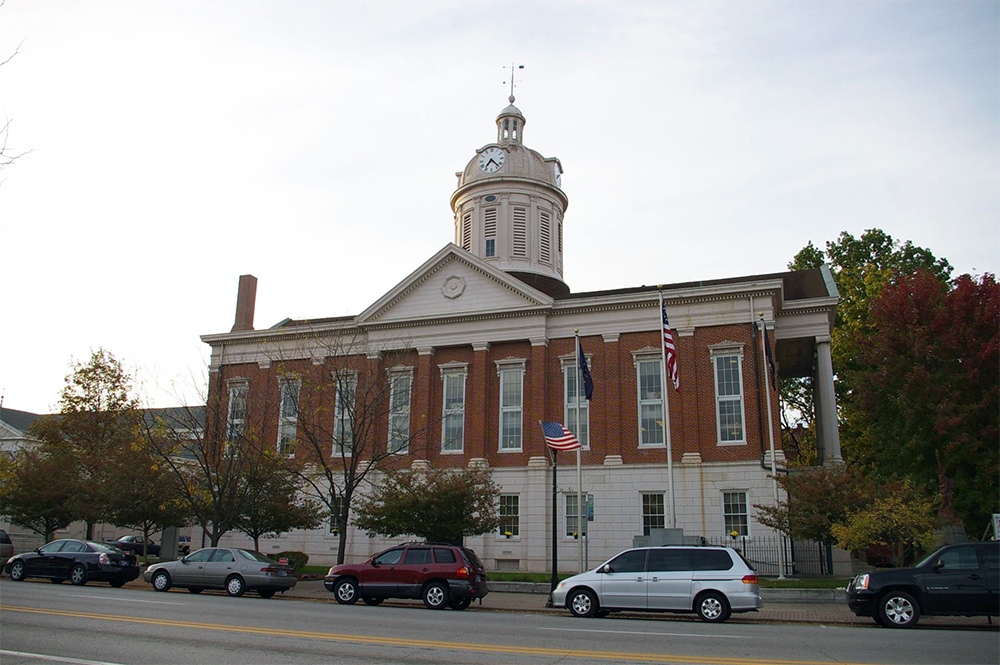
- Artist: Sheryl Thurston
- Donor: Hon. Sheryl Thurston Watercolor Society of Indiana
- Medium: Watercolor
The first Jefferson County courthouse was a two-story log structure, built in 1812 after Madison was established as the county seat. A fire destroyed that structure, causing the current courthouse to be constructed in 1854-1855. The current courthouse was designed by architect David Dubach in the Greek Revival style. A fire broke out in May 2009 during renovation, destroying the clock tower and most of the third floor. The massive 3100-pound bell also fell. Repairs were completed in 2011, including a modern chimes system to replace the original bell. The exterior design has remained largely the same since its original construction.

Jennings County
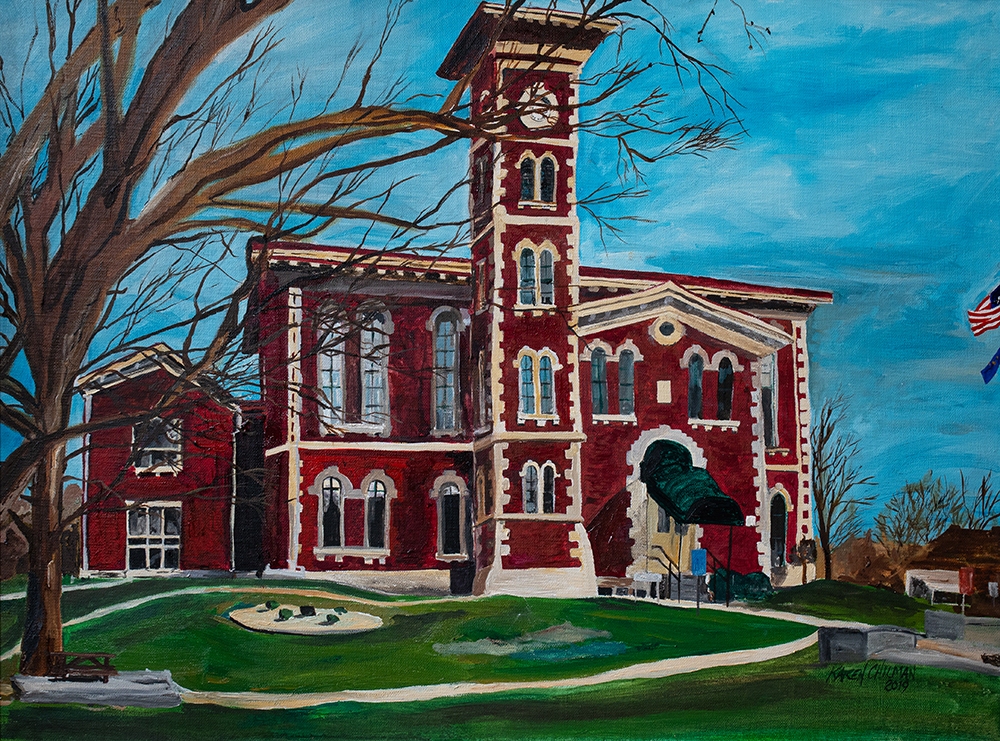
- Artist: Karen Chilman
- Donor: Hon. Jon Webster; Jennings County Bar Association
- Medium: Oil on Canvas
The current Jennings County Courthouse in Vernon was constructed between 1857 and 1860 and is the third courthouse for the county. The Italianate-style building, designed by Isaac Hogg, cost about $26,375 and has survived two tornadoes (1917 and 1932), has been remodeled twice (1963 and 1983), and was the site of the first all-women jury in the U.S. in 1921. Notable historical events include a visit from Richard Nixon in 1971 and an 1860 speech by Henry Ward Beecher. The building is in the Italianate style and has a foundation made from local limestone. A clock with a carillon was added to the tower around 1985.
The courthouse is believed to have been a stop on the Underground Railroad.

Johnson County
- Artist: Karen Christensen
- Donor: Karen Christensen, Watercolor Society of Indiana
- Medium: Watercolor
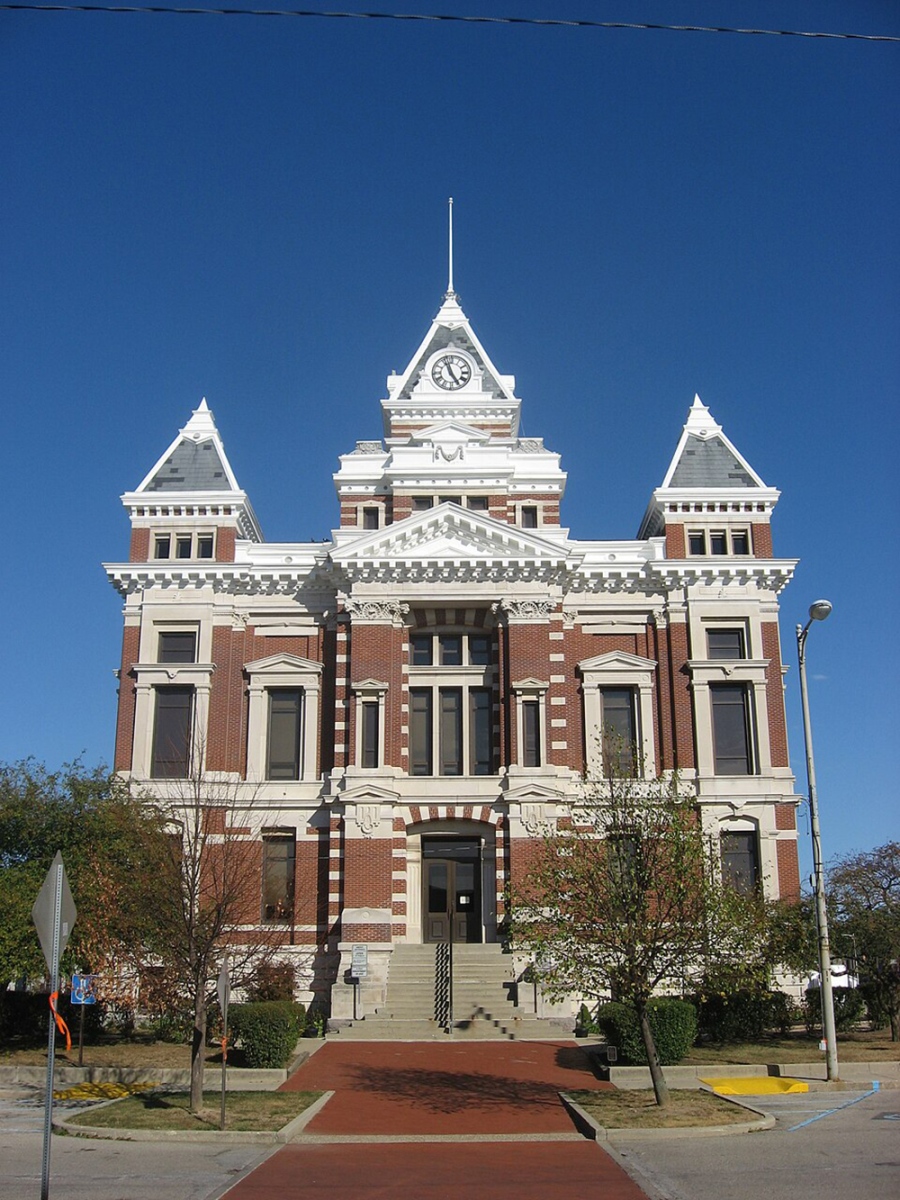
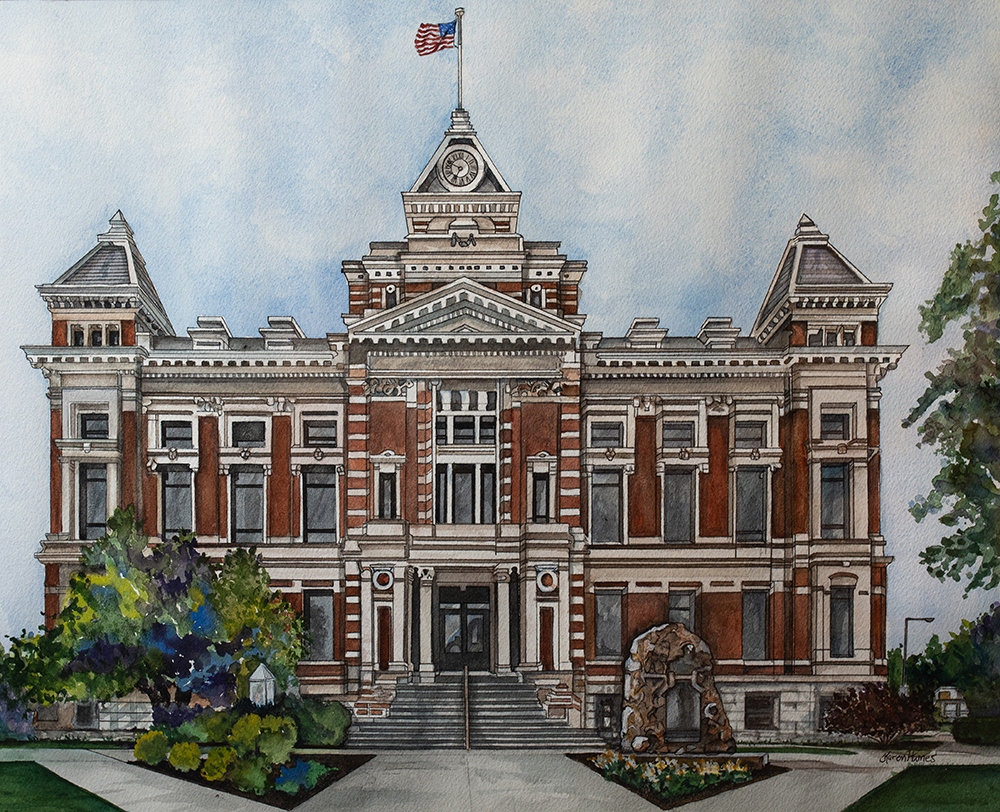
The Johnson County Courthouse is in Franklin. The courthouse was built between 1879 and 1881 and is a two-story, red brick building with elements of Second Empire, Neo-Jacobean, and Romanesque Revival style architecture. It has a low hipped metal roof topped by a central tower and has smaller corner towers topped with pyramidal roofs. It was designed by George W. Bunting, who also designed courthouses at Frankfort (Clinton County) and Anderson (Madison County). It was listed on the National Register of Historic Places in 1981.
Knox County
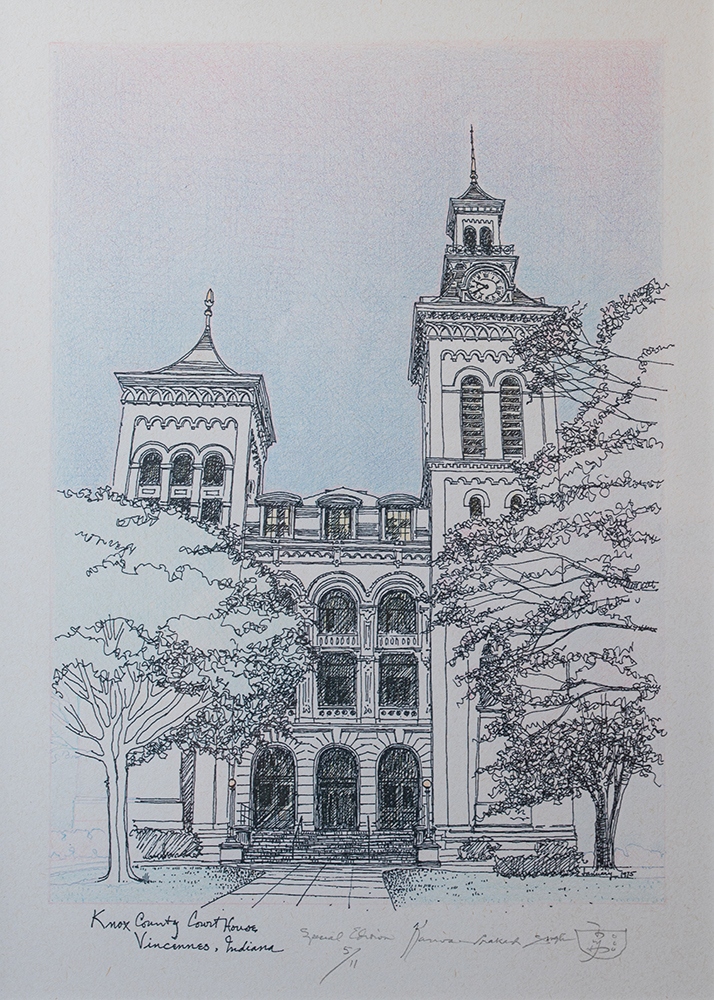
- Artist: K.P. Singh
- Donor: Knox County Bar Association
- Medium: Pen & Ink, Pencil
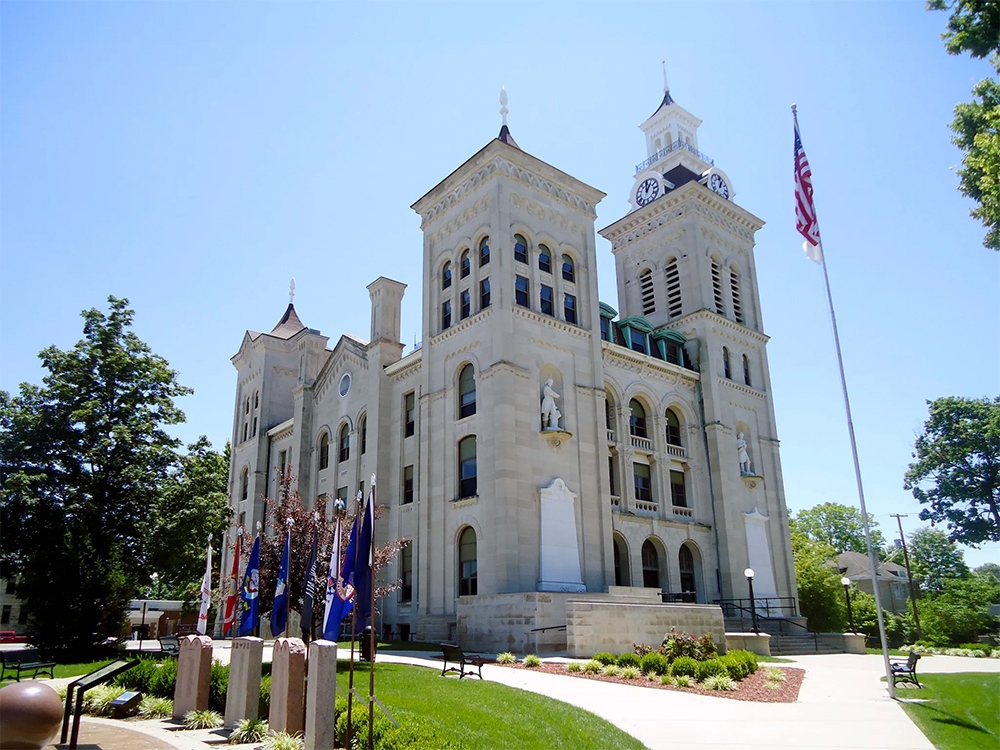
The history of the Knox County courthouse is tied to the city of Vincennes, the state’s oldest city, and the evolution of county government. Knox County was formed in 1790; Vincennes was founded in 1792. Even given the age and history of the area, the county has had only three courthouses, all located in different places.
Before a dedicated courthouse, government functions were housed in various buildings in Vincennes, which was the capital of the Indiana Territory from 1800 to 1813. The first courthouse was built in 1813. The second was built in 1856. The current Knox County courthouse was built in 1873-1874. Designed by architect Edwin May, it was constructed of Indiana limestone. It is sometimes cited as the first public building erected as a soldiers’ memorial in the United States.
Kosciusko County
- Artist: Karen Christensen
- Donor: Karen Christensen, Watercolor Society of Indiana
- Medium: Watercolor
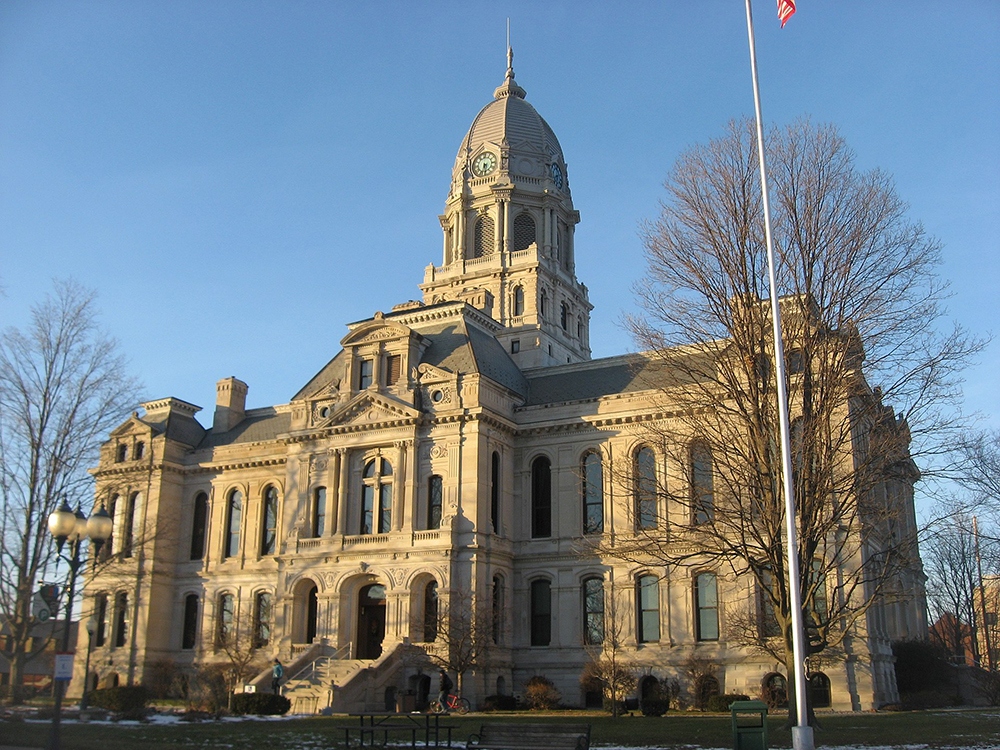
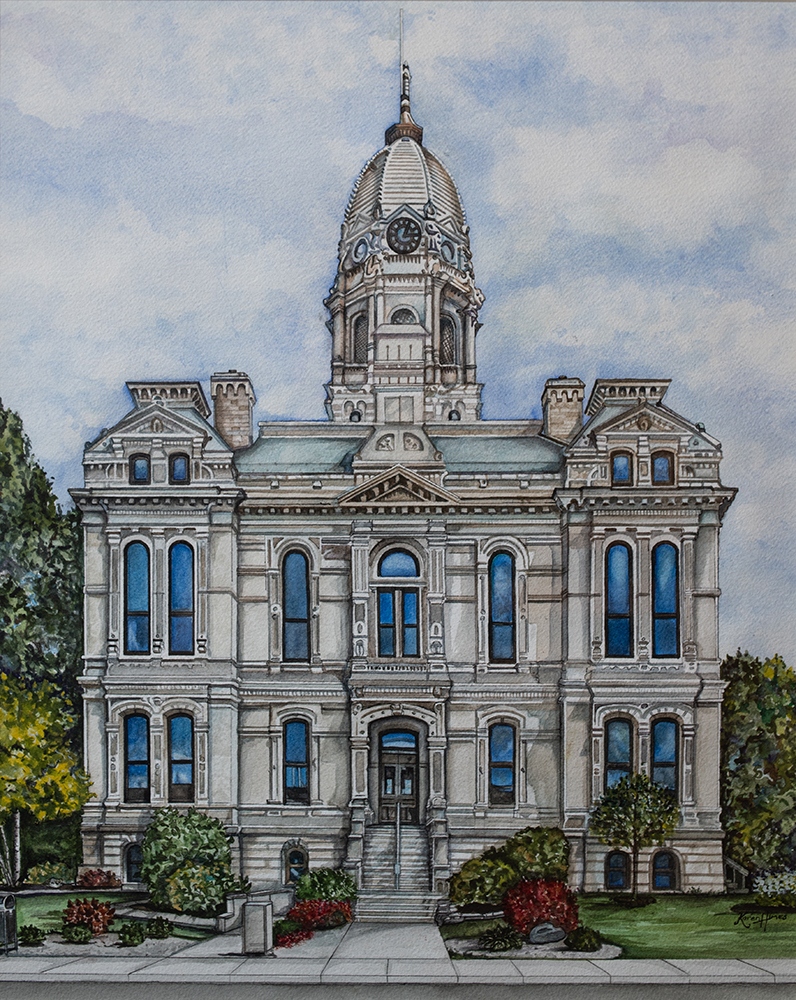
The Warsaw Courthouse Square Historic District is in Warsaw. It was listed on the National Register of Historic Places in 1982. The courthouse is Victorian Eclectic, (Thomas J. Tolan and Son, architect; Hiram Iddings, builder). It was constructed between the years 1882-1884 at a cost of almost $200,000. The building’s ornate limestone façade is highly articulated with decorative scrolls, garlands, and classical columns. It is topped with a 162-feet domed tower visible for miles around. It is Second Empire Style, limestone construction, mansard roof with straight sides, central pavilion, paired windows, metal roof curbs, arched double doors with glass panels, belt courses, porthole dormers, tall chimneys with decorated caps. Eyebrow-like window heads and paneled frieze boards. A two-shelled dome with four clocks crowns the building. The Court House is surrounded by native hardwood trees. On the southeast corner of the square is a Civil War cannon. A World War II cannon is sited on the southwest corner of the square. On the Northwest corner is a World War II tank.
LaGrange County
- Artist: Cathleen Huffman
- Donor: Cathleen Huffman, Watercolor Society of Indiana
- Medium: Watercolor
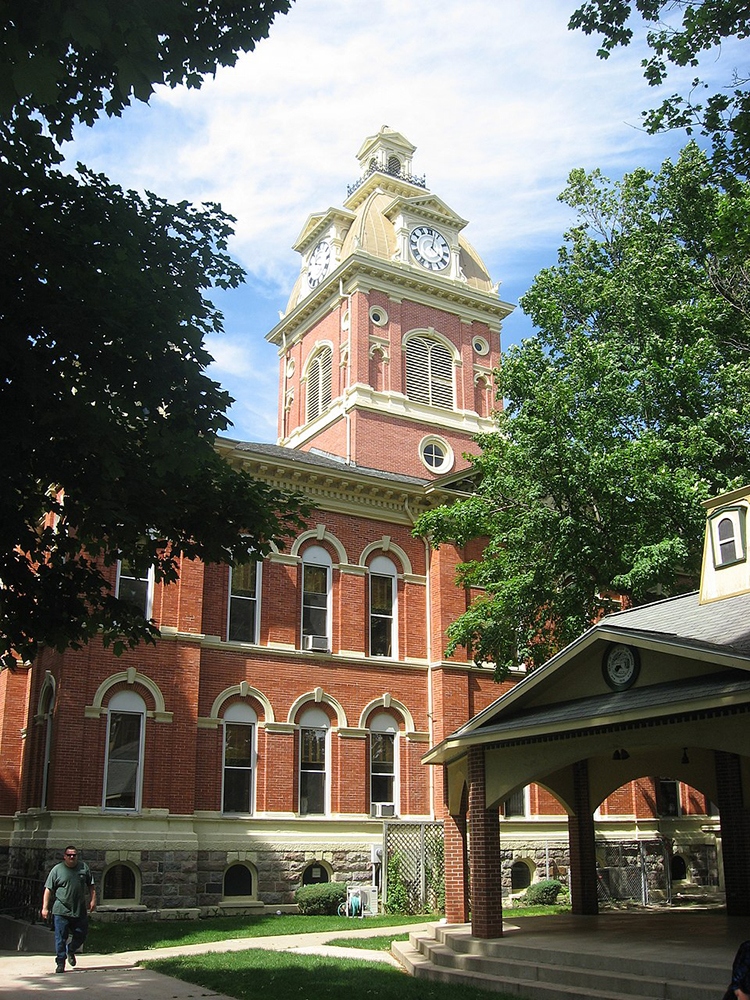
The LaGrange County Courthouse is in LaGrange. It was designed by Thomas J. Tolan, & Son, Architects of Fort Wayne, Indiana and built in 1878–1879. It is a two-story, rectangular red brick building with Second Empire and Georgian style design elements. The front facade consists of a central clock tower flanked by square corner pavilions. It was added to the National Register of Historic Places on July 17, 1980.

Lake County
- Artist: Doris Klein
- Donor: Lake County Bar Association
- Medium: Watercolor
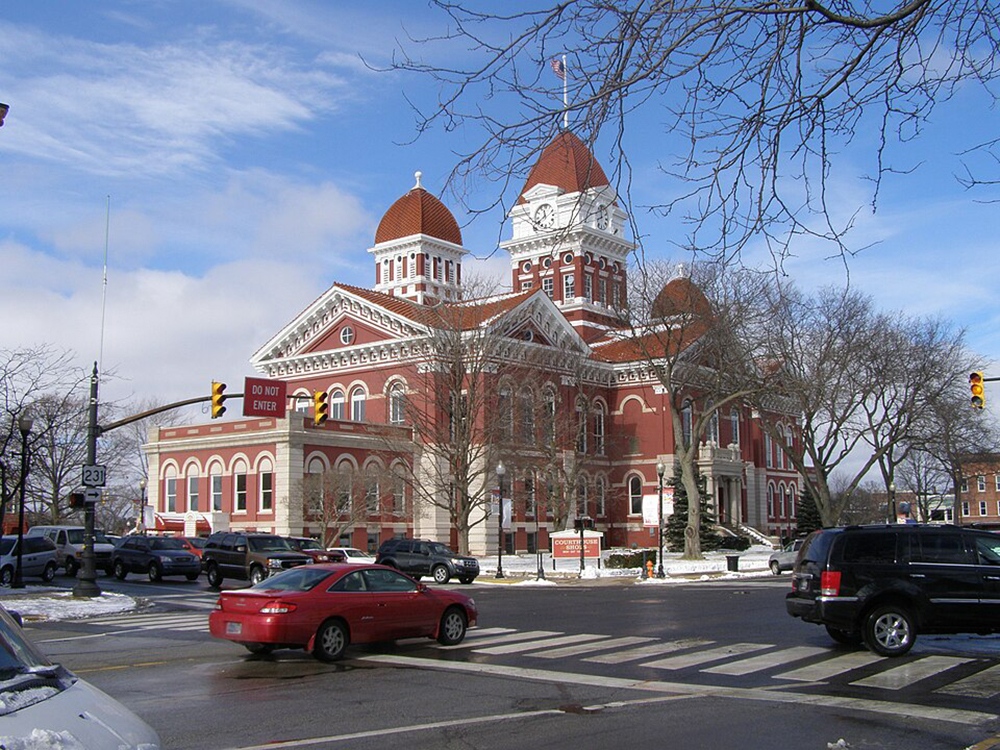
The Lake County Courthouse is in Crown Point. The courthouse, also referred to as the “Grand Old Lady”, is a former county courthouse building that now houses the Lake County Historical Society Museum, offices, and the chamber of commerce. The building is a combination of architectural styles, including Romanesque and Georgian. It was designed in 1878 by John C. Cochrane of Chicago, Illinois and is listed on the National Register of Historic Places as part of the Crown Point Courthouse Square Historic District.

La Porte County
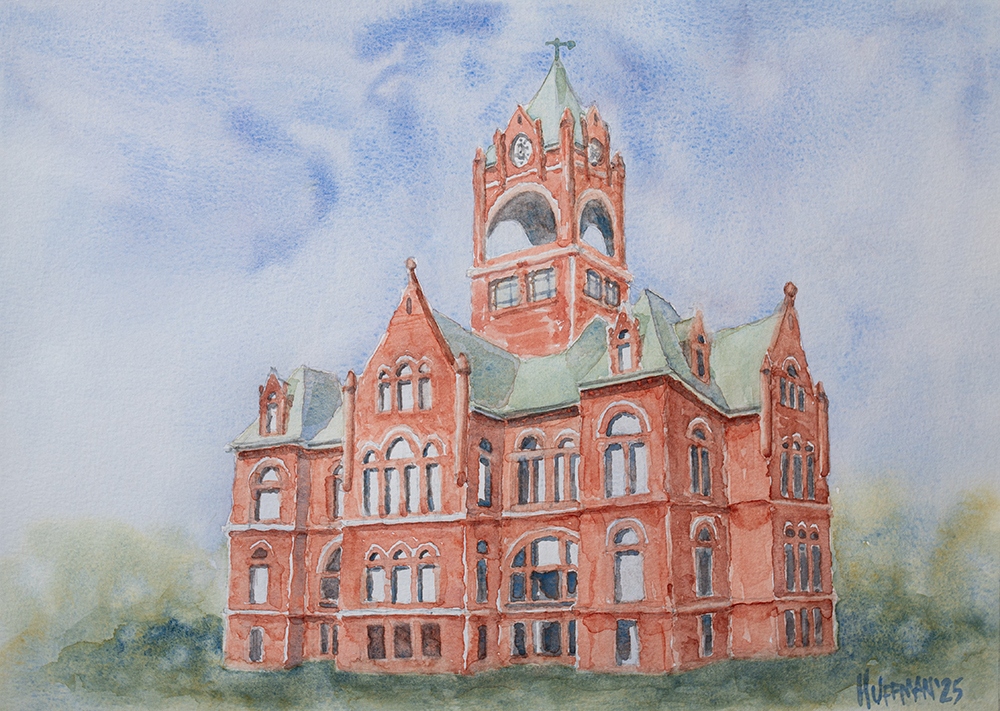
- Artist: Cathleen Huffman
- Donor: Cathleen Huffman, Watercolor Society of Indiana
- Medium: Watercolor
The La Porte County Courthouse is in La Porte. Previous courthouses were built on this site on 1833, and 1847–1848. The current courthouse was designed by Brentwood S. Tolan and built from 1892 to 1894. It is Richardsonian Romanesque architecture in style and was built with Lake Superior Red Sandstone. The building includes a tower with skylight, gargoyles and contains stained glass. It is listed on the National Register of Historic Places. The courthouse is part of the Downtown LaPorte Historic District.

Lawrence County
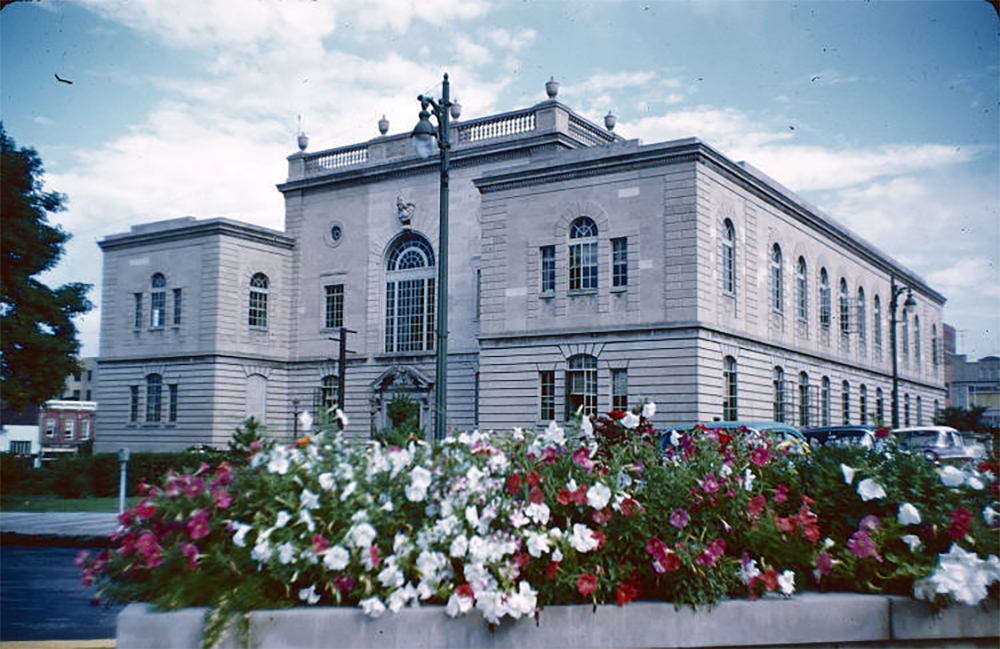
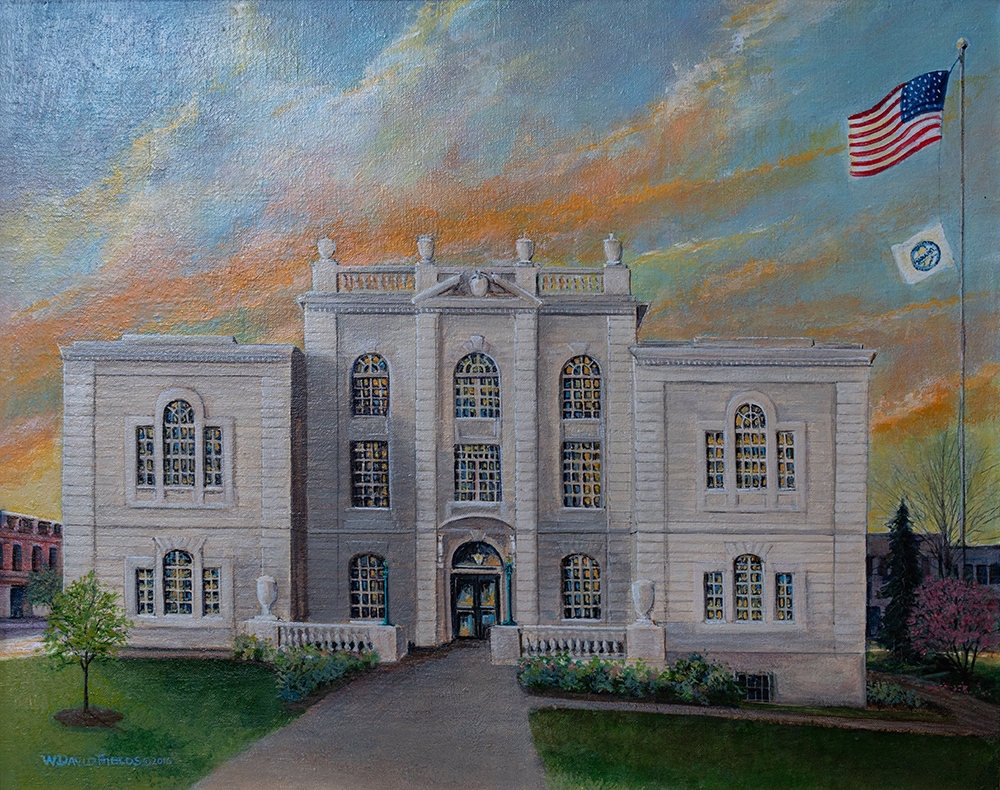
- Artist: Don Fields
- Donor: Lawrence County Bar Association
- Medium: Oil on Canvas
Lawrence County has had six courthouses. The first county seat – Palestine – saw two courthouses. The original courthouse was a log cabin built in 1818. It was replaced by a brick structure in 1821. When the county seat was moved to Bedford, the first courthouse – built in 1825 – also served as a school until 1834. Subsequent courthouses included a frame building built in 1834, a limestone structure built in 1872, and the current courthouse, built in 1930. The 1872 limestone courthouse was destroyed by fire; the new one used some of the stone walls from that structure.
Madison County
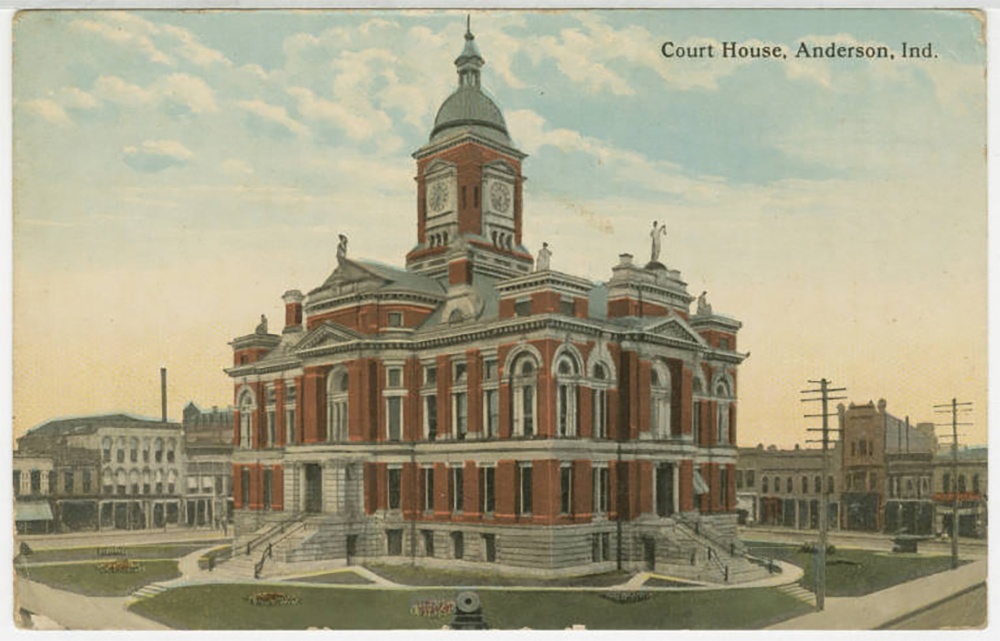
- Artist: Ruthven Byrum
- Donor: Anderson Public Library; Meredith Church
- Medium: Oil on Canvas
Madison County’s first courthouse was built in 1823 in Pendleton. The move of the county seat from Pendleton to Anderson occurred gradually, starting in 1828 and concluding in 1836. County government began the relocation process in 1828, with the first courthouse in Anderson being built and completed by 1832. It was a two-story frame structure and was replaced in 1840 by a two-story brick structure. This building was destroyed by fire on December 10, 1880. This fire also led to the loss of many early county records. Yet another courthouse was constructed between 1882 and 1884. This building was later demolished in 1972 to make way for the current government center. The main reasons cited for its demolition include it being outdated, the result of rushed construction, and being built before modern building standards for longevity.
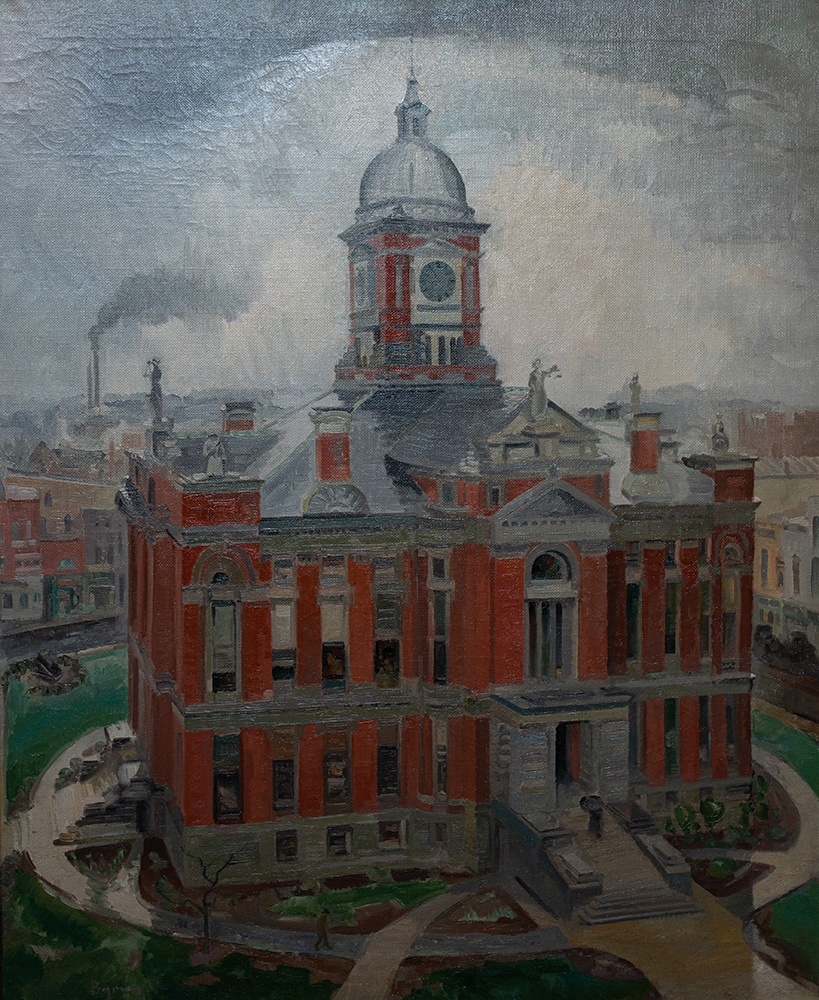
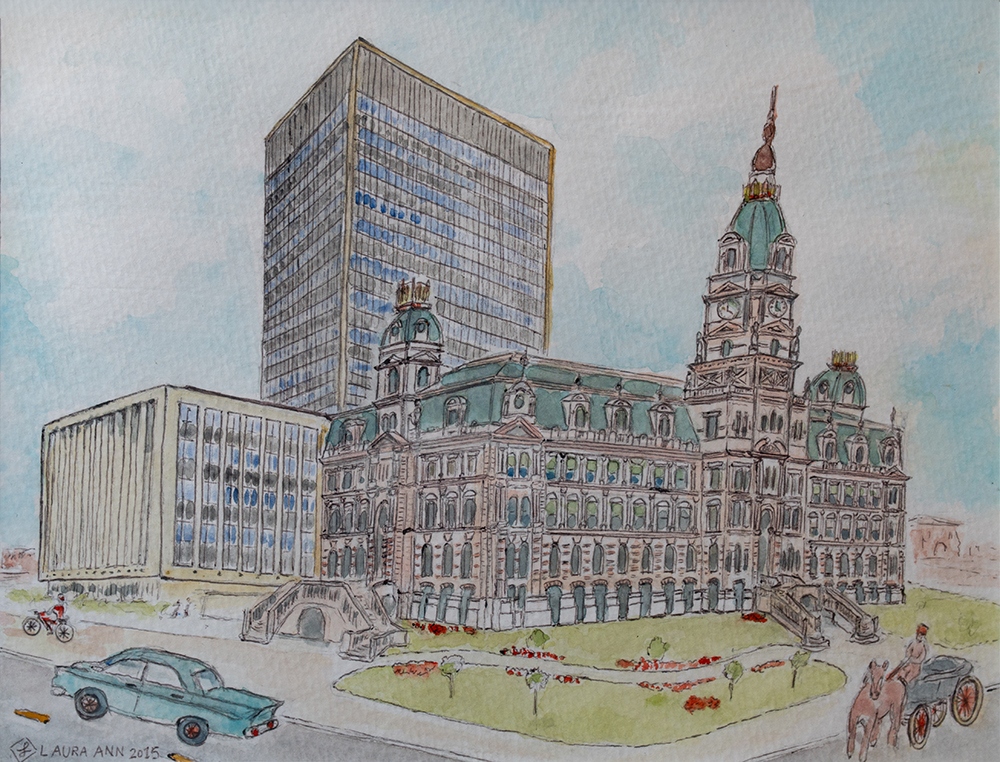
Marion County
- Artist: Laura Ann Trimble
- Donor: John Trimble (President, IndyBar; 2015-2016)
- Medium: Watercolor
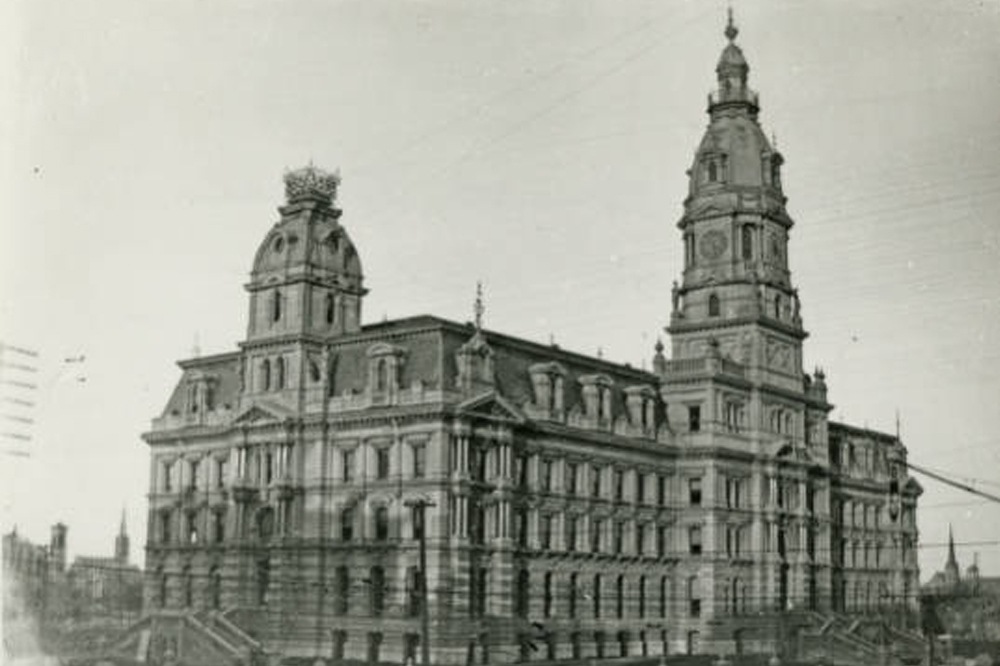
The historic Marion County Courthouse, built in 1876, was designed by Isaac Hodgson in the Baroque and Second Empire styles. It was made of Indiana limestone and granite. It was massive, costing approximately $1.5 million. Construction featured a central clock tower. In addition to being the courthouse, it also housed city government offices until 1910, when City Hall was built.
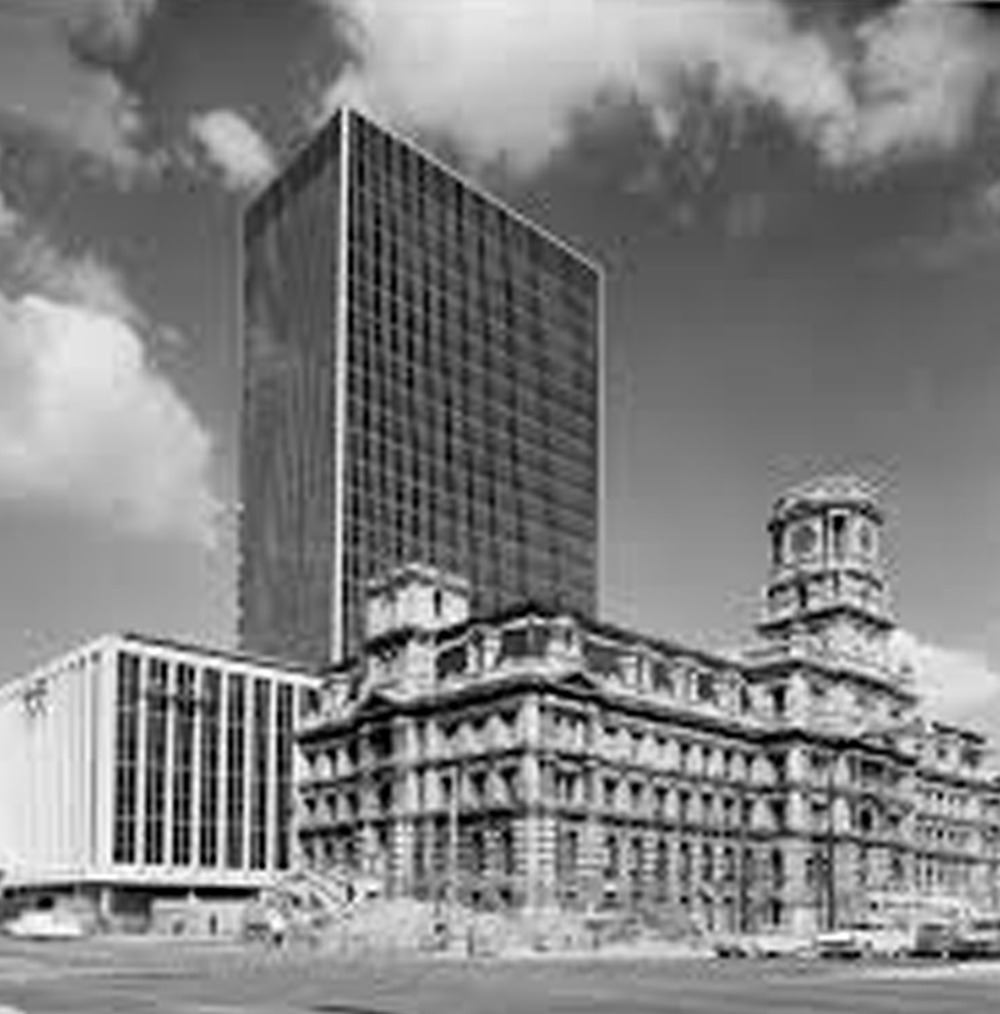
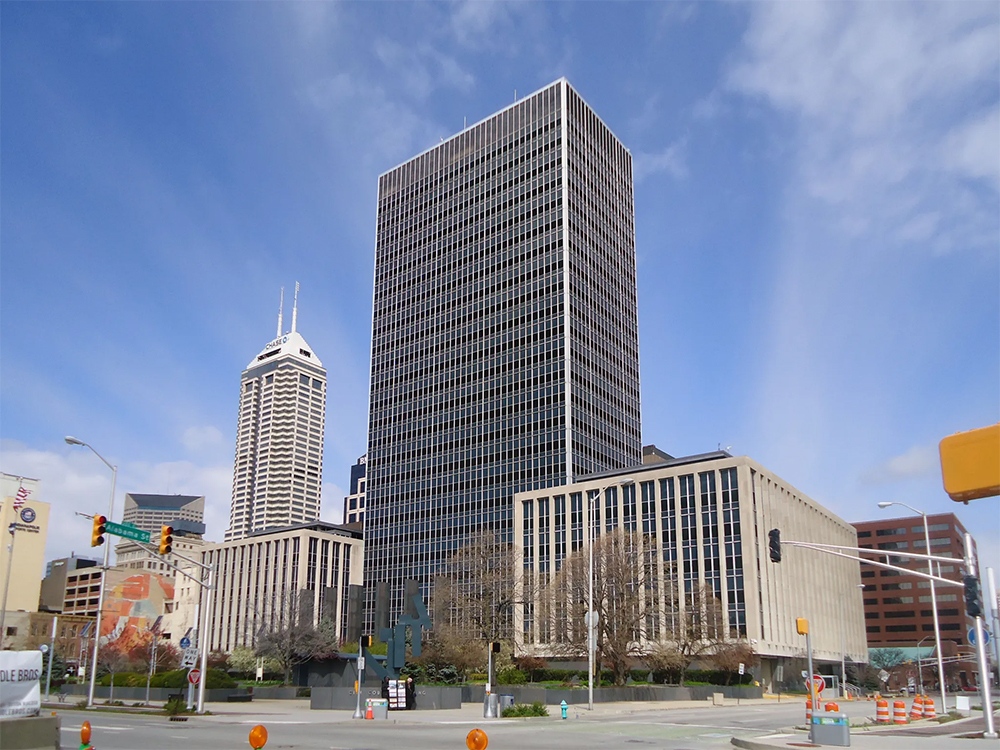
After serving for more than 85 years, the old courthouse was demolished in 1962 to make way for the new, million-square-foot City-County Building. The site where the historic building once stood is now occupied by Lugar Plaza, named after former mayor and senator Richard G. Lugar. The plaza is a multi-purpose public space that includes an interactive spray fountain, seating areas, public art, and a speaker’s platform. It is designed to be used for community gatherings, events, and celebrations.
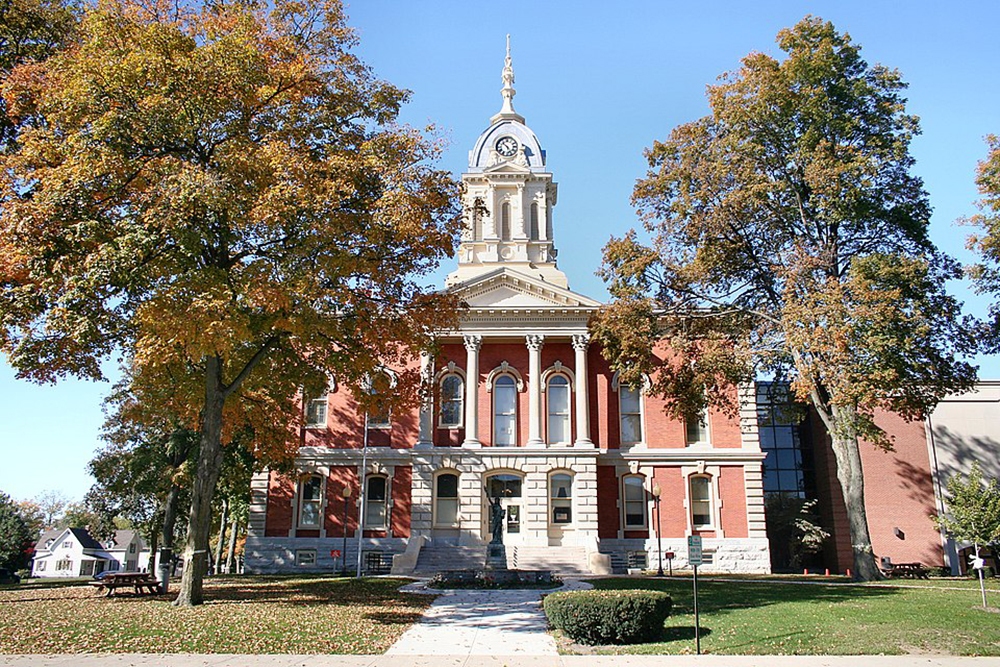
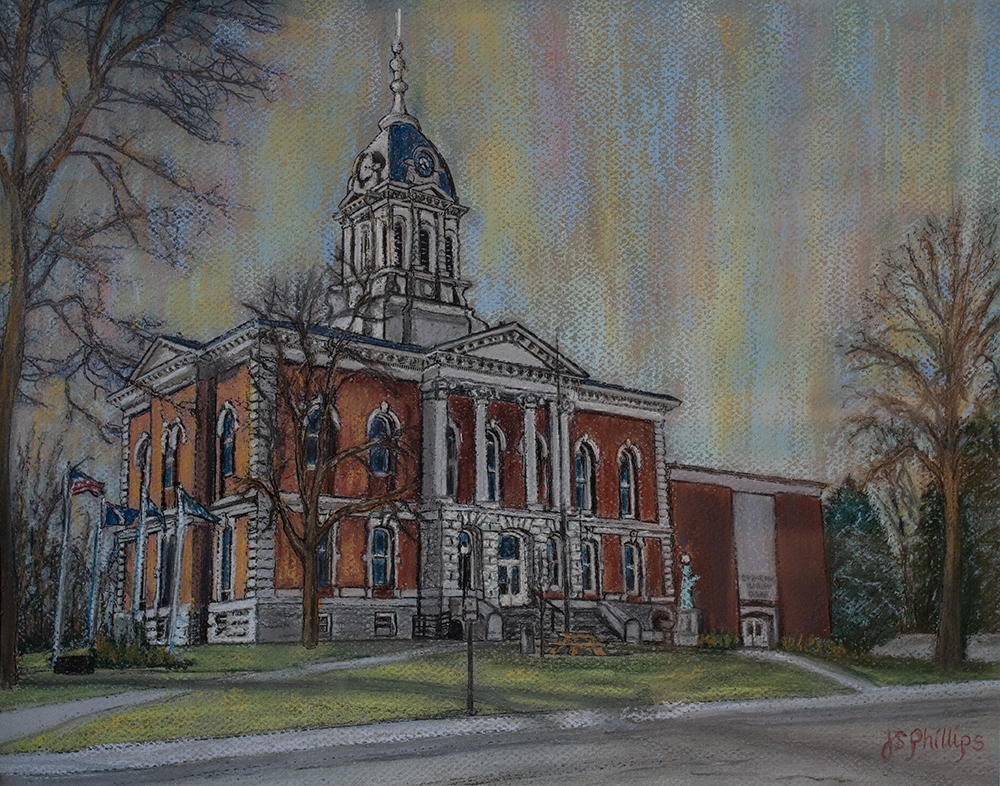
Marshall County
- Artist: Jude Phillips
- Donor: Marshall County Bar Association
- Medium: Pastel
The Marshall County Courthouse is in Plymouth. It was built between 1870 and 1872, and is a two-story, brick and limestone building in a combination of Italianate and Renaissance Revival styles. It is rectangular in form and has a hipped roof with central bell tower. It was listed in the National Register of Historic Places in 1983. It is located in the Plymouth Northside Historic District.
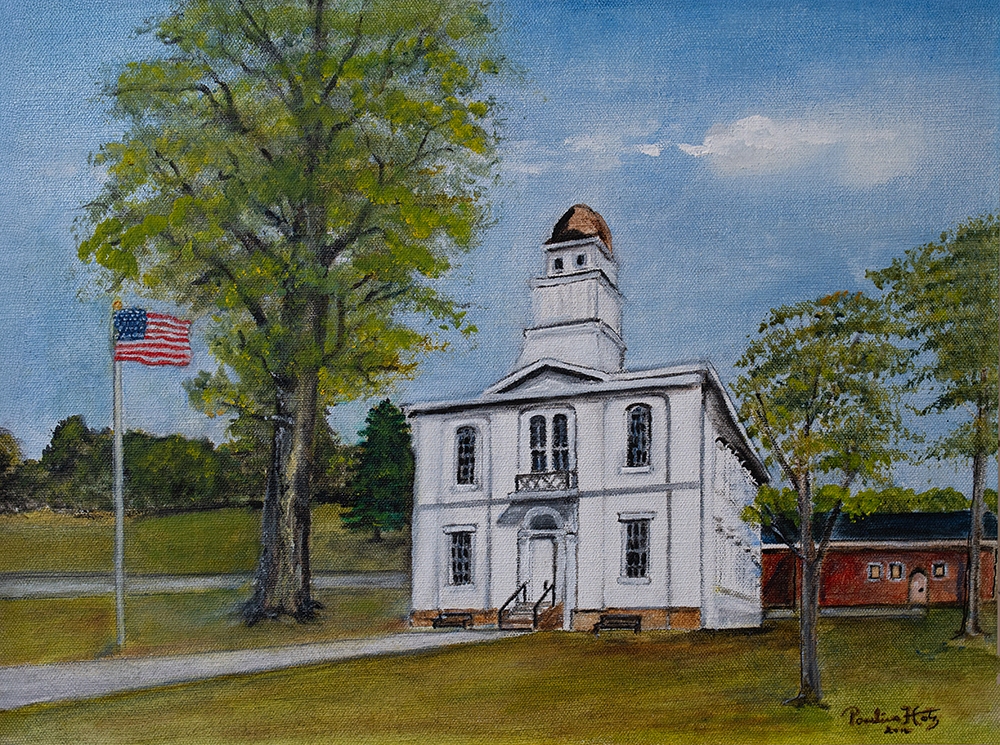
Martin County
- Artist: Polly Holtz
- Donor: Polly Holtz; Hon. Lynne E. Ellis
- Medium: Oil on Canvas
The Martin County Courthouse is in Shoals. The courthouse was built in 1876 to replace the previous courthouse, which burned down in the same year. At the time of the courthouse’s construction, Shoals had only been the county seat for seven years, and it was the ninth county seat in Martin County. The new courthouse was built with local sandstone and red brick; its design incorporates elements of the Greek Revival and Italianate styles. The new courthouse proved to be in a stable location, as the county seat has remained in Shoals since its construction. The courthouse served the county until 2002 and now houses the Martin County Historical Museum, which is operated by the Martin County Historical Society. The courthouse was added to the National Register of Historic Places on June 17, 2005.

Miami County
- Artist: Tiffany Raber
- Donor: Miami County Bar Association
- Medium: Pencil
The Miami County Courthouse is in Peru. It was built between 1908 and 1910, and is a three-story, steel frame, concrete-and-brick building sheathed in a veneer of Bedford limestone. It features a projecting portico with freestanding two-story Tuscan order columns in the Classical Revival style. The building has a flat roof topped by a squat four-sided square dome. The property includes an additional 33 contributing objects, such as a bell with stand, “Lady Liberty” statue (commonly known by many as “Statue of liberty”), retaining wall, 12 architectural lamps, and 6 street lamps. It was listed on the National Register of Historic Places in 2008.
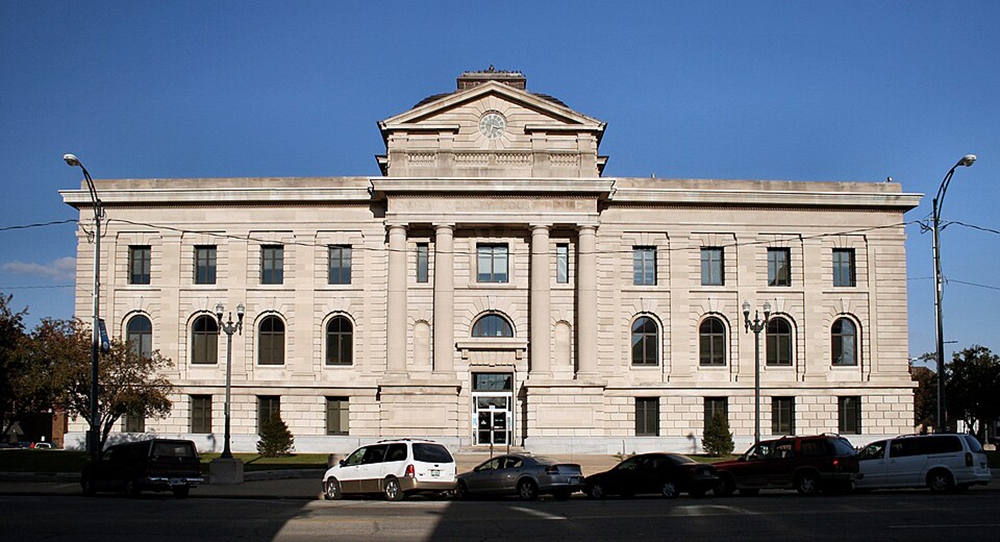

Monroe County
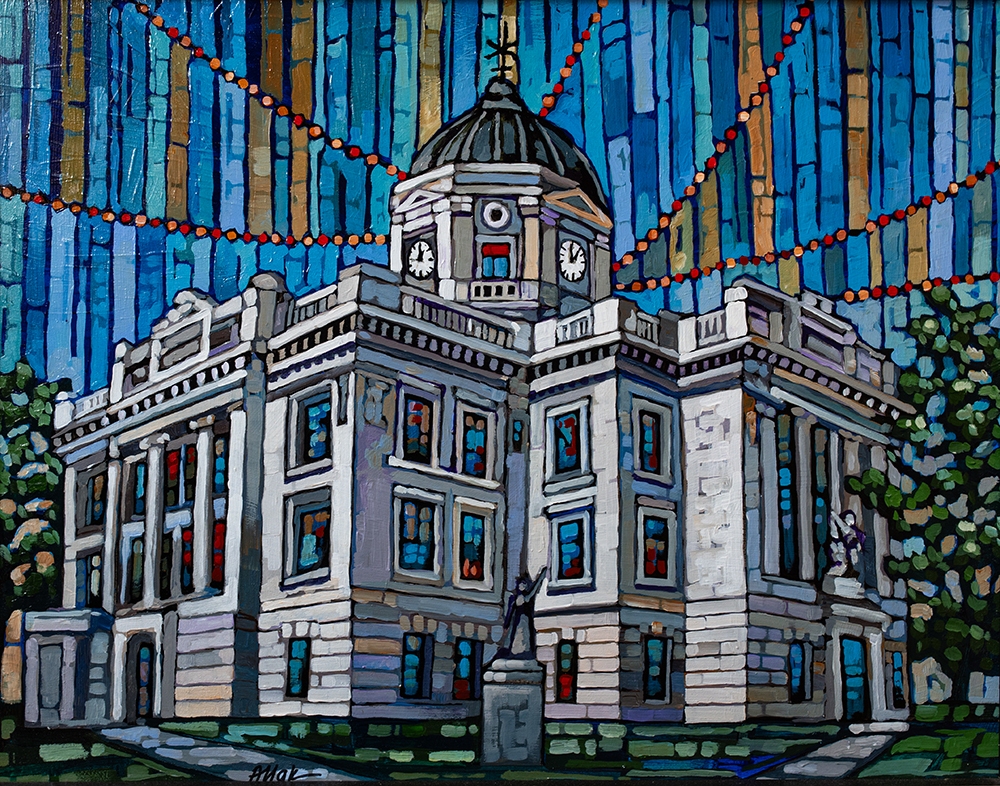
- Artist: Anastasia Mak
- Donor: Monroe County Bar Association
- Medium: Oil on Board
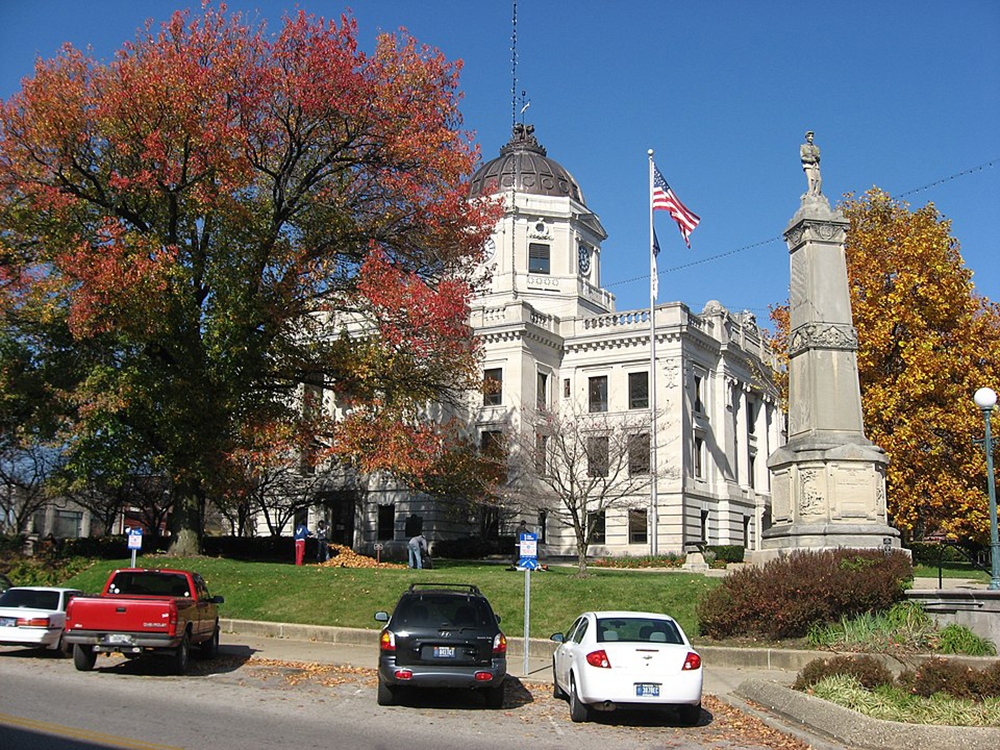
The Monroe County Courthouse is in Bloomington. It is a Beaux Arts building built in 1908. It was listed on the National Register of Historic Places in 1976. It is located in the Courthouse Square Historic District.
The first Monroe County Courthouse was ordered built in 1818 by the county commissioners, as one of the earliest items of business for the new county. The building was unable to handle all the county’s business, and in May 1819 a contract was let for the construction of a brick courthouse with a stone foundation. This replacement was finished in May 1826. It was expanded and remodeled in the 1850s and again in the 1870s. The second courthouse was replaced with a new stone building that was designed by architects Wing and Mahurin of Fort Wayne, Indiana. It was constructed from 1907 to 1908 by contractors Drake and Caldwell, at a cost of $188,000. The weather vane from the old building, made of copper and shaped like a fish, was saved and used on the dome of the new courthouse. In 1984, the building received an extensive renovation costing about $2.3 million.
Montgomery County
- Artist: Stacy Bogan
- Donor: Monroe County Bar Association
- Medium: Pastel
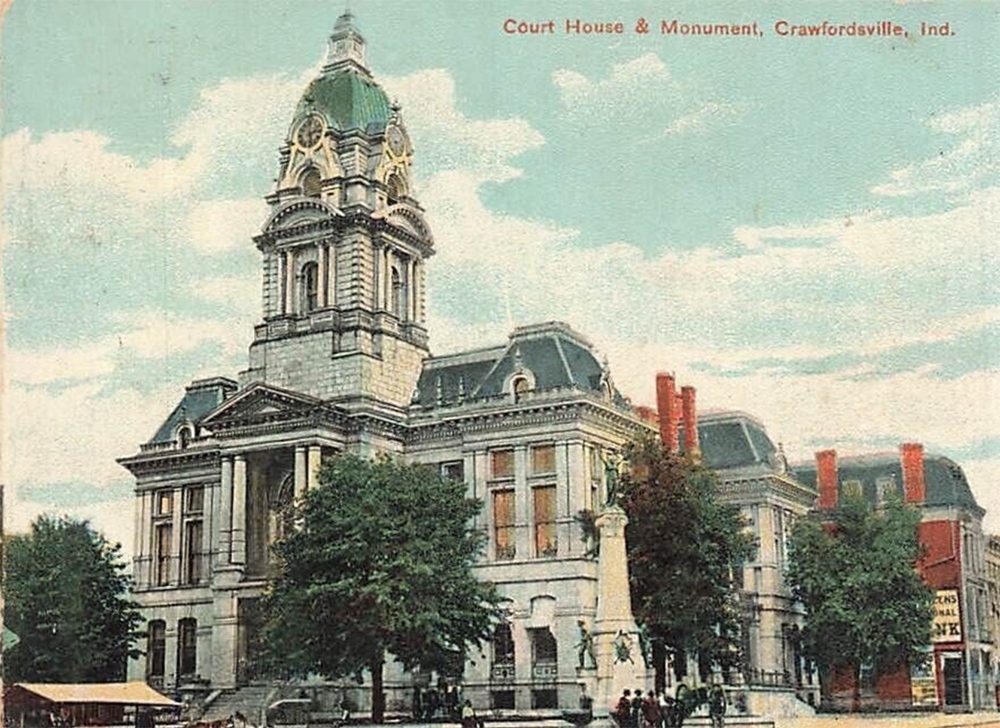
The current Montgomery County Courthouse in Crawfordsville was built in 1876 and is the third courthouse for the county. The first was a log cabin, replaced by a two-story brick building in 1833. The current courthouse, designed by George Bunting, originally featured a tall tower (155 feet) that was removed in 1941 due to structural concerns, but was restored and reinstalled 77 years later, in 2018.
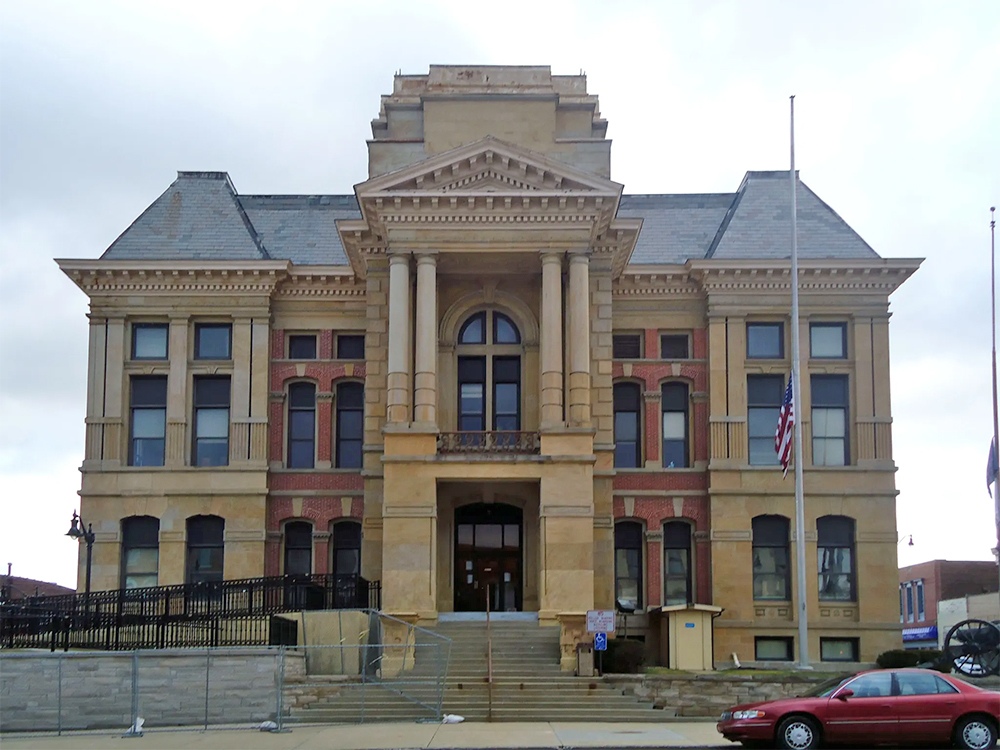

Morgan County
- Artist: John L. Mann Jr.
- Donor: Martinsville Public Library; Family of John L. Mann Jr.
- Medium: Watercolor
The Morgan County Courthouse is in Martinsville. It was built between 1857 and 1859, and is a two and one half story, Italianate style brick and stone building. It has a cruciform plan and features a five-level free-standing campanile. Additions were made in 1956 and 1975–1976. Associated with the courthouse is the original annex or Sheriff’s House. It is a two-story, five bay by two-bay, I-house. It was listed on the National Register of Historic Places in 1996. It is located in the Martinsville Commercial Historic District.
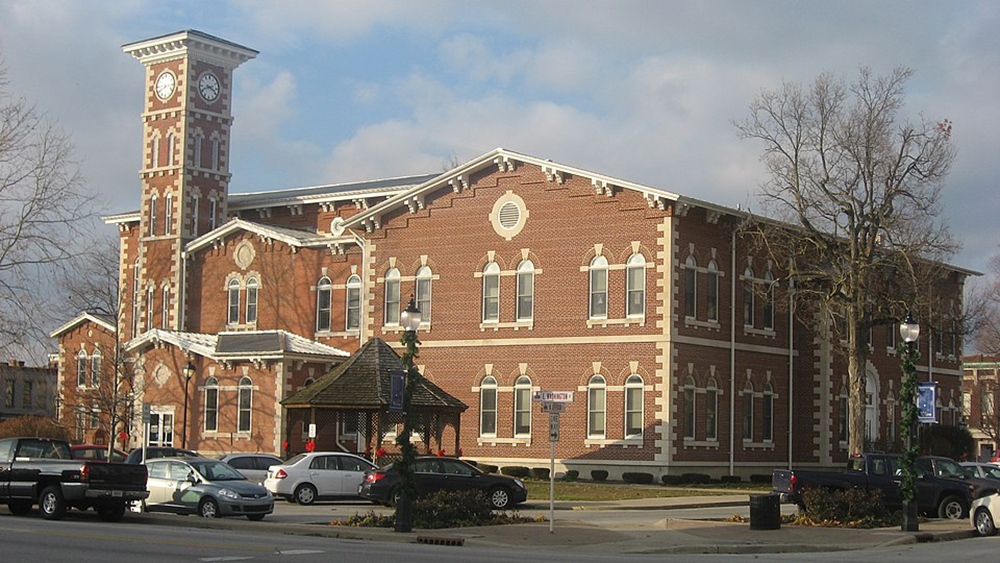

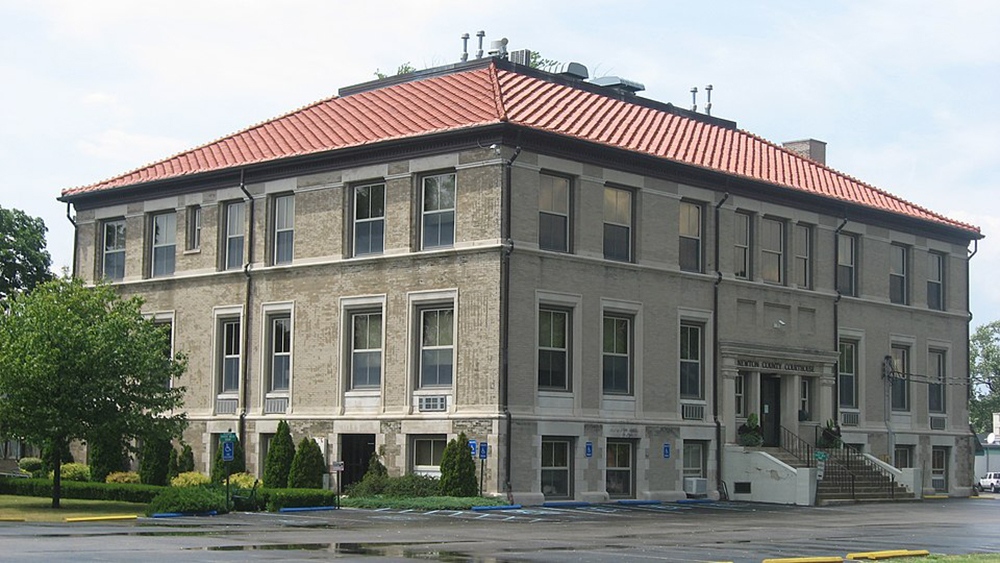
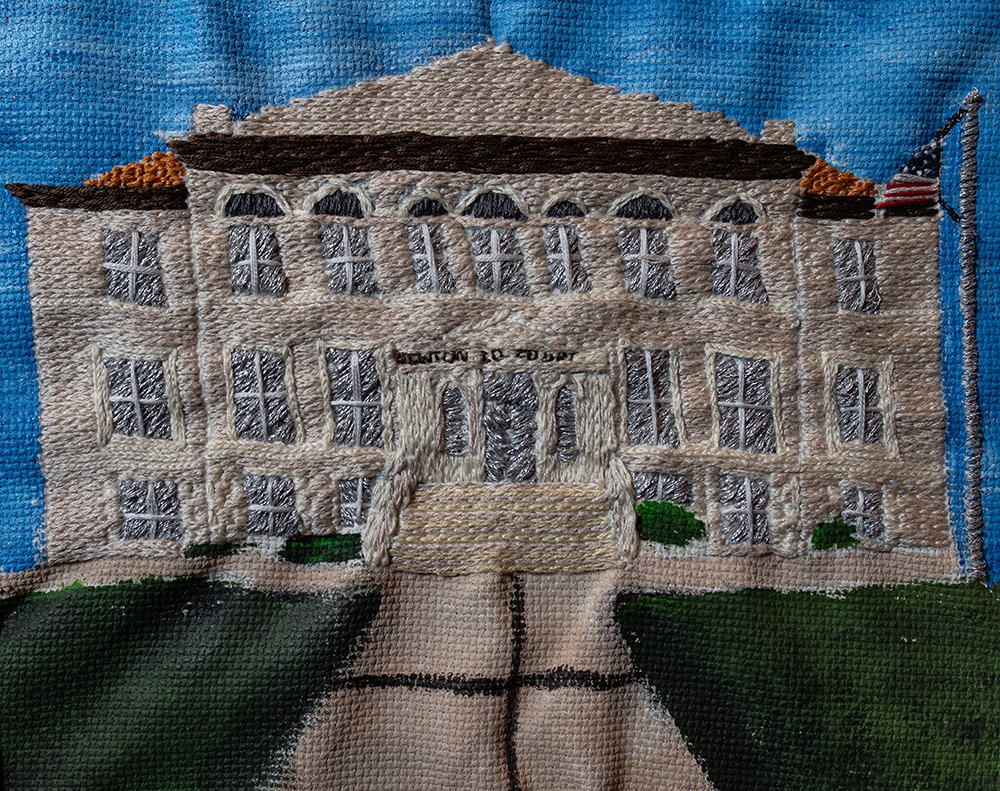
Newton County
- Artist: Delany Smith
- Donor: Newton County Bar Association
- Medium: Embroidery
The Newton County Courthouse is in Kentland. The original Newton County was formed by statute on February 7, 1835, and was roughly some 30 miles on a side, encompassing what is now the northern half of the county, the northern half of Jasper County, and a large section to the north. The northern border was cut back to the Kankakee River on February 1, 1836, with all land north of the Kankakee River going to Lake and Porter counties. The county was abolished and combined with Jasper County in 1839. On December 8, 1859, the county was recreated and the borders were redrawn to essentially their current state. The current Courthouse was built in 1906, and is a three-story, rectangular, Renaissance Revival style brick building with limestone trim. It has an architectural tile hipped roof. The front facade features round arched windows on the third floor, projecting entrance pavilion, and a pedimented parapet. It was listed on the National Register of Historic Places in 2008.
Noble County
- Artist: Cathleen Huffman
- Donor: Cathleen Huffman, Watercolor Society of Indiana
- Medium: Watercolor
The Noble County Courthouse is in Albion. It was designed by E.O. Fallis & Co. and was built in 1887. It is a two and one half story, Richardsonian Romanesque style red brick building with limestone trim. It has a steep hipped roof topped by a massive square center tower. It was listed on the National Register of Historic Places in 1981. It is located in the Albion Courthouse Square Historic District.

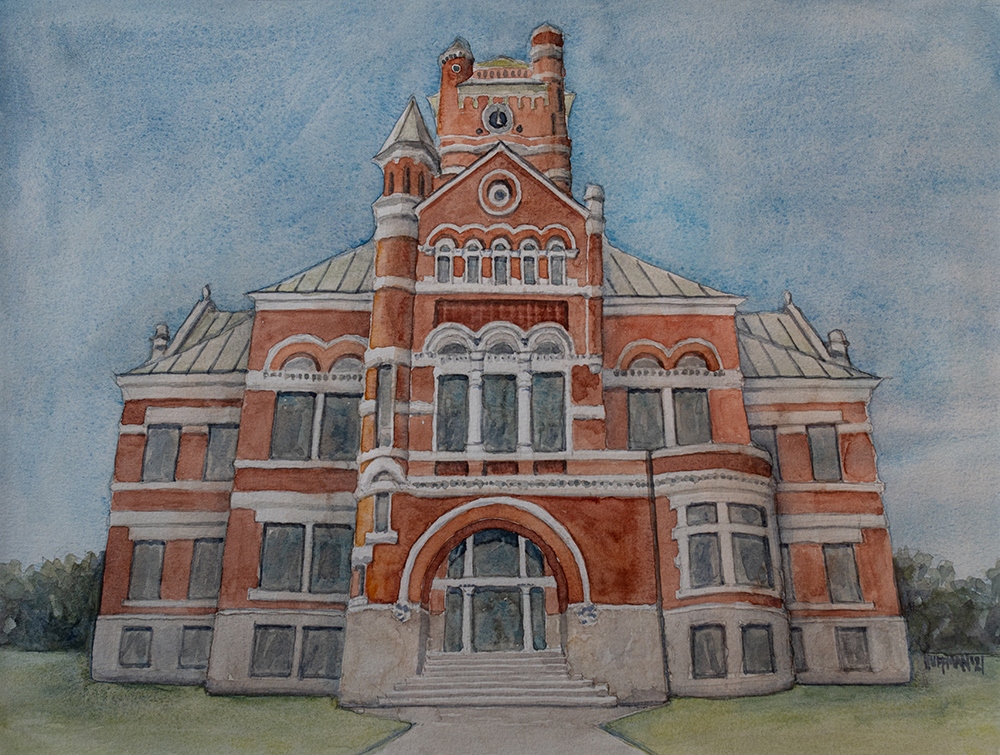
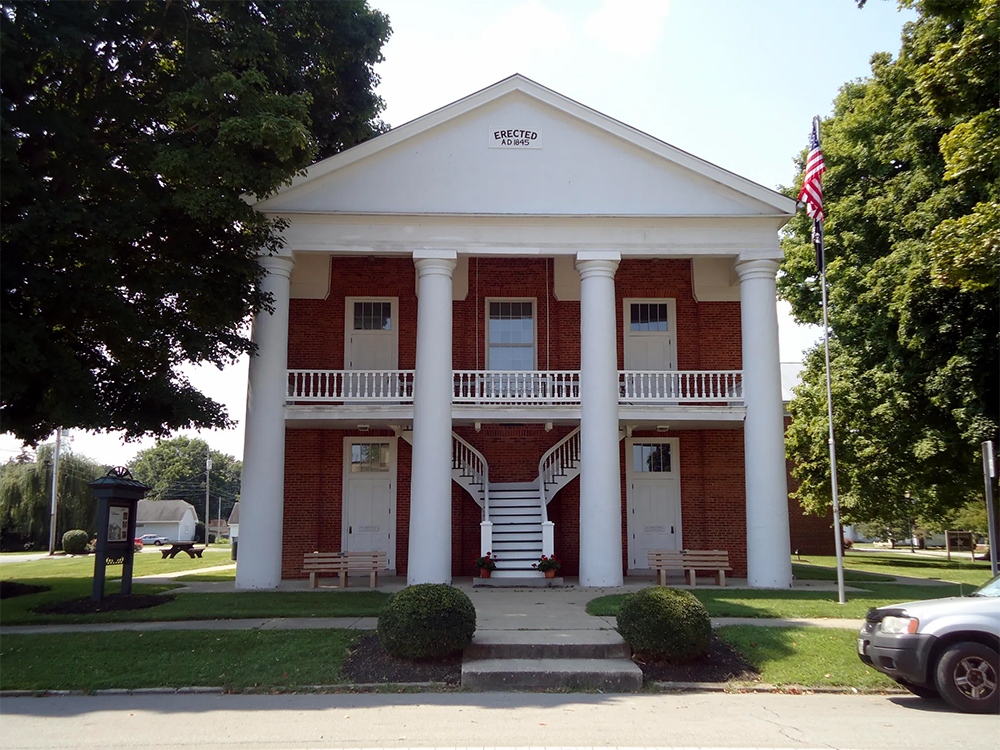
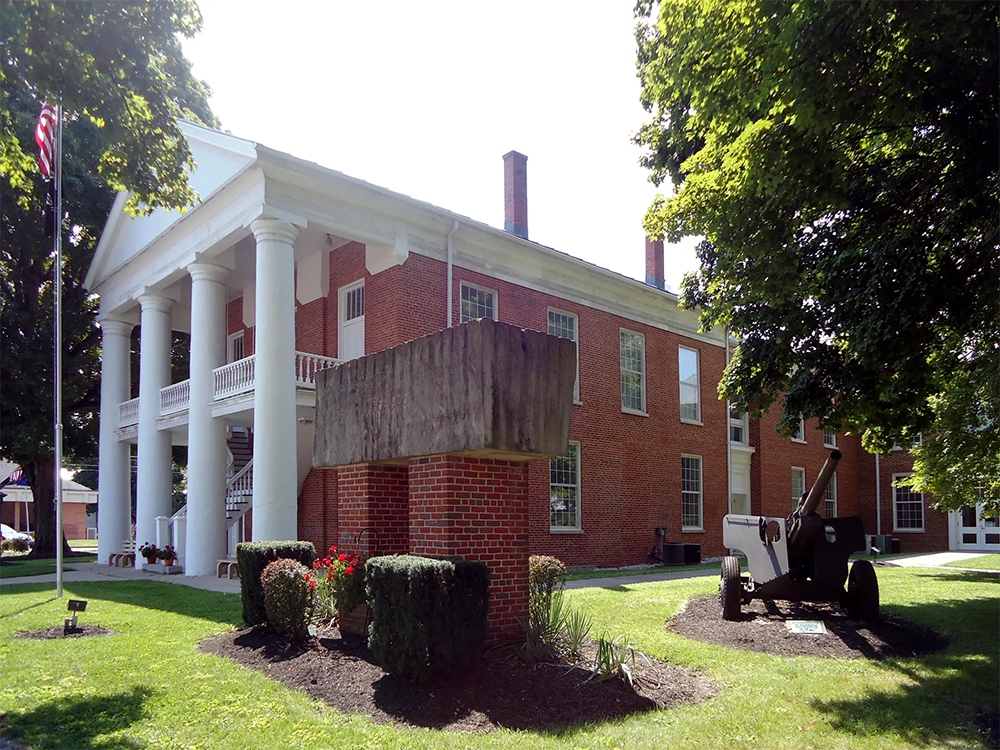
Ohio County
- Artist: Lane Siekman
- Donor: Lane Siekman
- Medium: Pencil
The Ohio County Courthouse in Rising Sun, Indiana, was built in 1845 and is the oldest continuously operating courthouse in the state. Designed in the Greek Revival style, it was constructed on land donated by Colonel Abel C. Pepper. The cornerstone was laid in a Masonic ceremony on July 4, 1844. Over the years, it has been restored, with a porch added in the early 20th century and a significant remodel and restoration in 1987. The original courtroom furniture, including the judge’s podium and benches, is still largely in place.

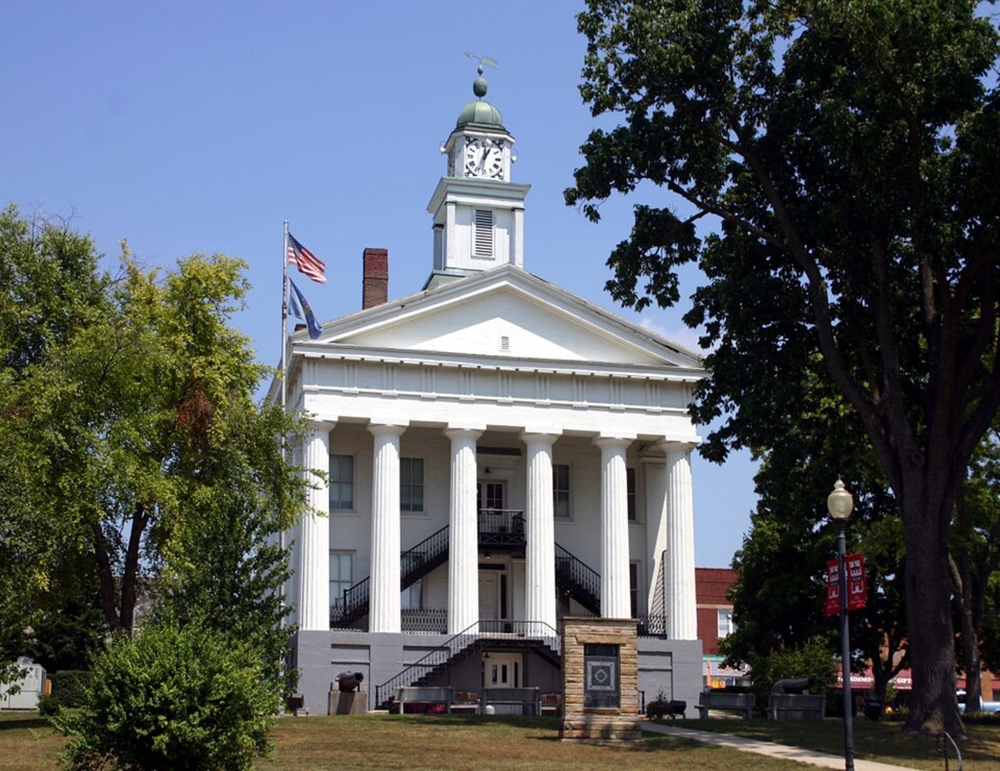
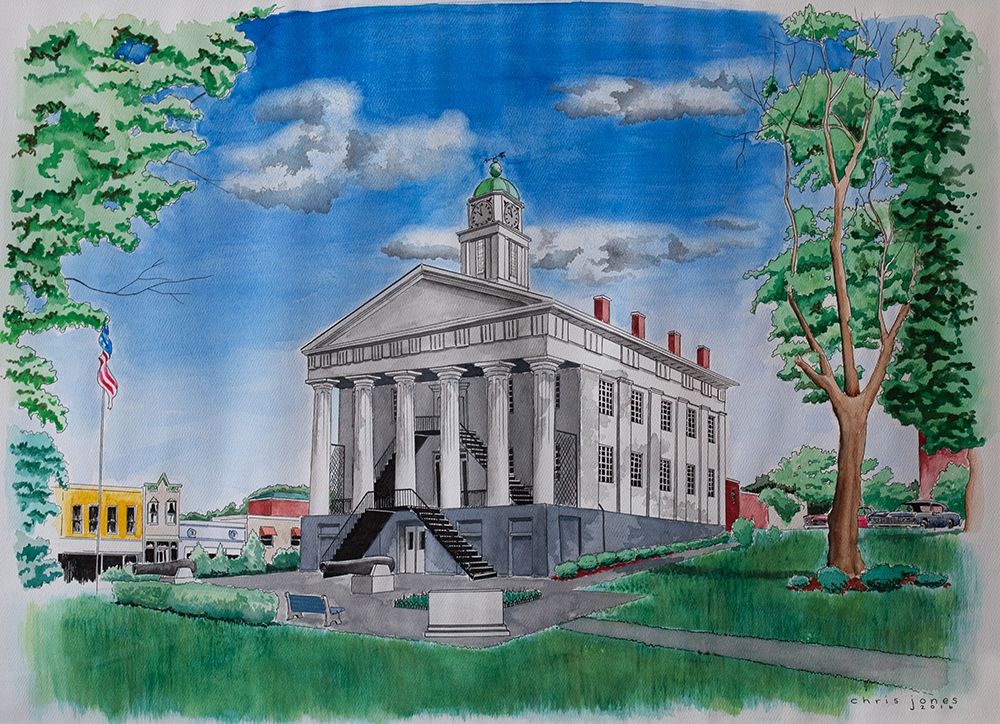
Orange County
- Artist: Chris Jones
- Donor: Orange County Bar Association
- Medium: Watercolor
The Orange County Courthouse is in Paoli, at the intersection of State Roads 37, 56 and US Highway 150. The courthouse is one of the two oldest courthouses in Indiana that have been used continuously, the other being in Rising Sun (Ohio County). The Orange County Courthouse was built 1847–1850. It is a good example of the Greek Revival style of architecture. The courthouse is distinguished by a Doric portico with six fluted columns. It was listed on the National Register of Historic Places in 1975.
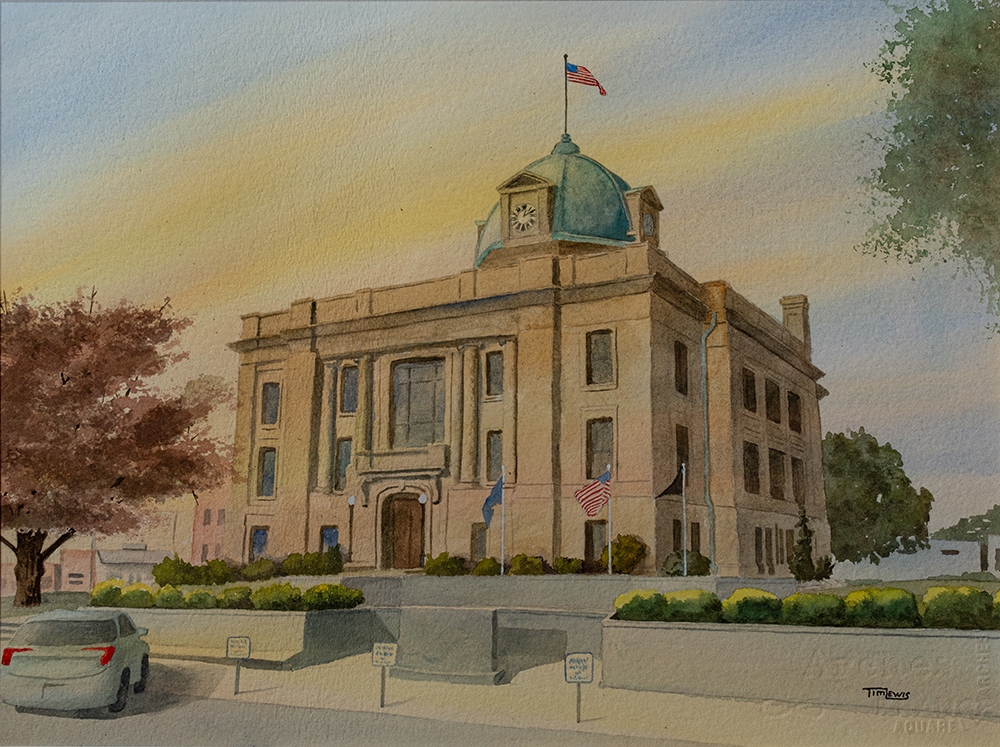
Owen County
- Artist: Tim Lewis
- Donor: Tim Lewis, Watercolor Society of Indiana
- Medium: Watercolor
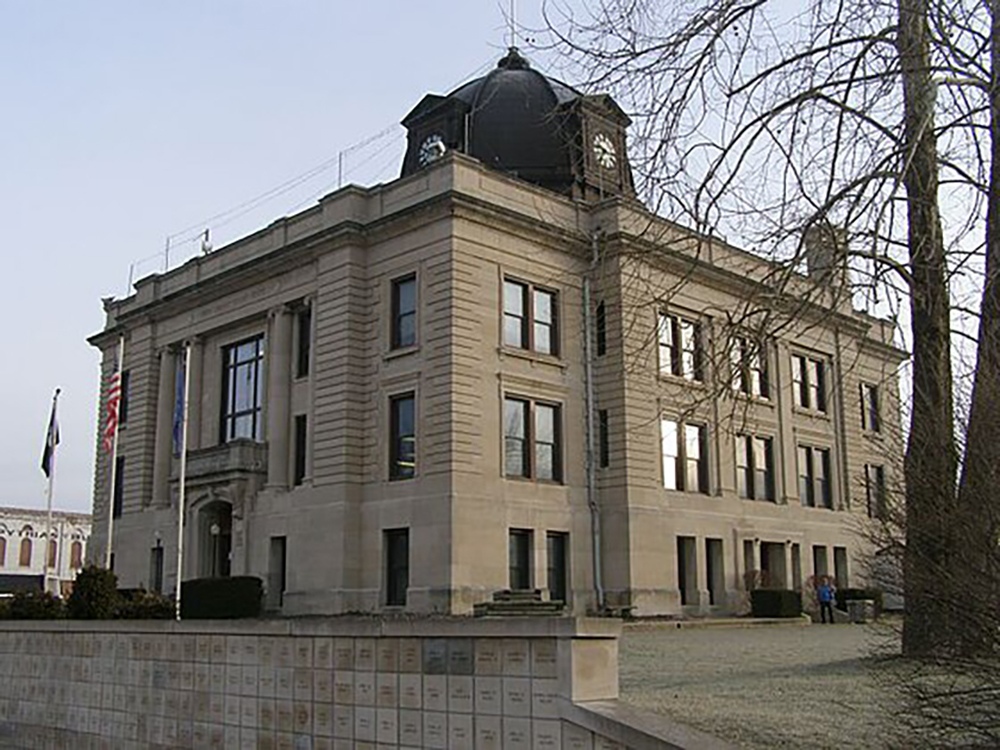
The Owen County Courthouse is in Spencer. It was the work of Jesse Johnson and Christian Kanzler & Son and built in 1910–1911. It is a three-story, with basement, Classical Revival style limestone building. The flat roof is topped by a copper dome with four-sided Seth Thomas clock. It was listed on the National Register of Historic Places in 1994.
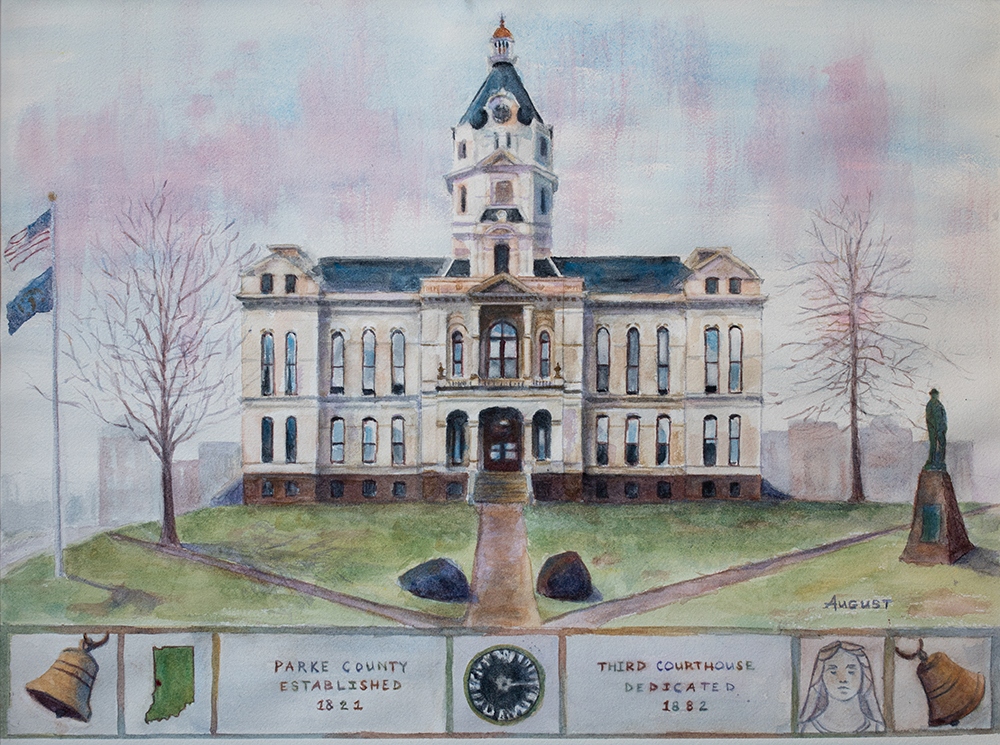
Parke County
- Artist: Krista August
- Donor: Krista August, Watercolor Society of Indiana
- Medium: Watercolor
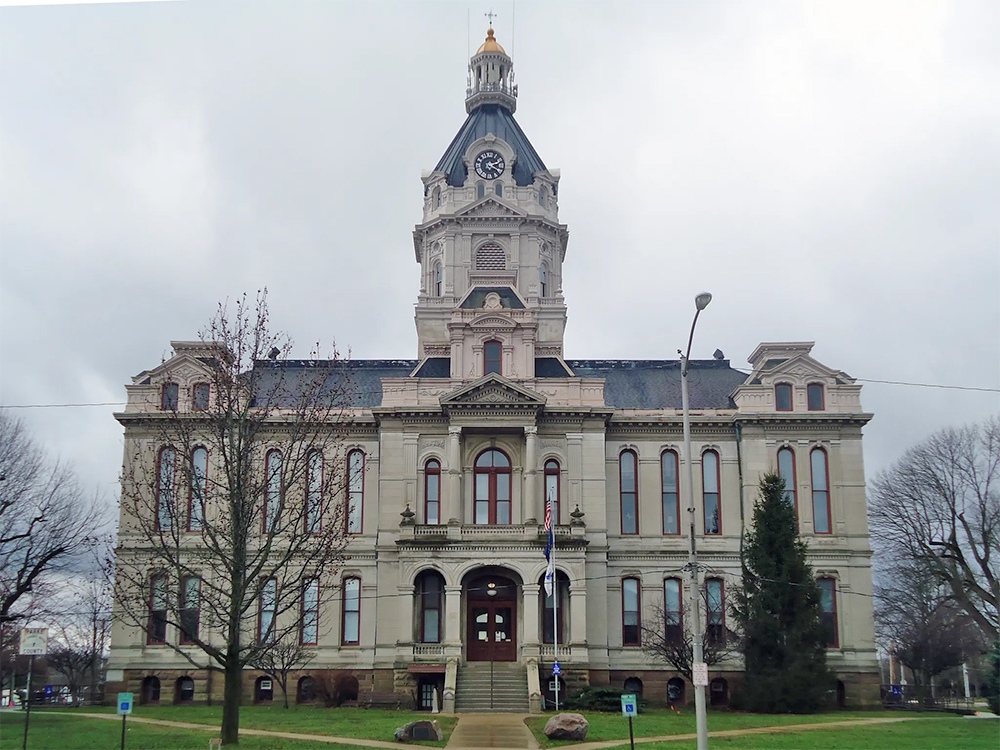
The Parke County Courthouse is in Rockville. It was constructed between 1879 and 1882 in a Romanesque Revival style and replaced two earlier courthouses. The architect, Thomas J. Tolan and Son, originally planned for a red brick building, but the contractor substituted stone before the foundation was finished. The building cost $79,000 and is known for its clock tower, stone carvings, and stained-glass windows. The courthouse has undergone several renovations, including one in 1950 supervised by architect Wyatt C. Hedrick and a major project completed in 1988. Previous structures include a log cabin built in 1826 and a four-square brick building completed in 1831.
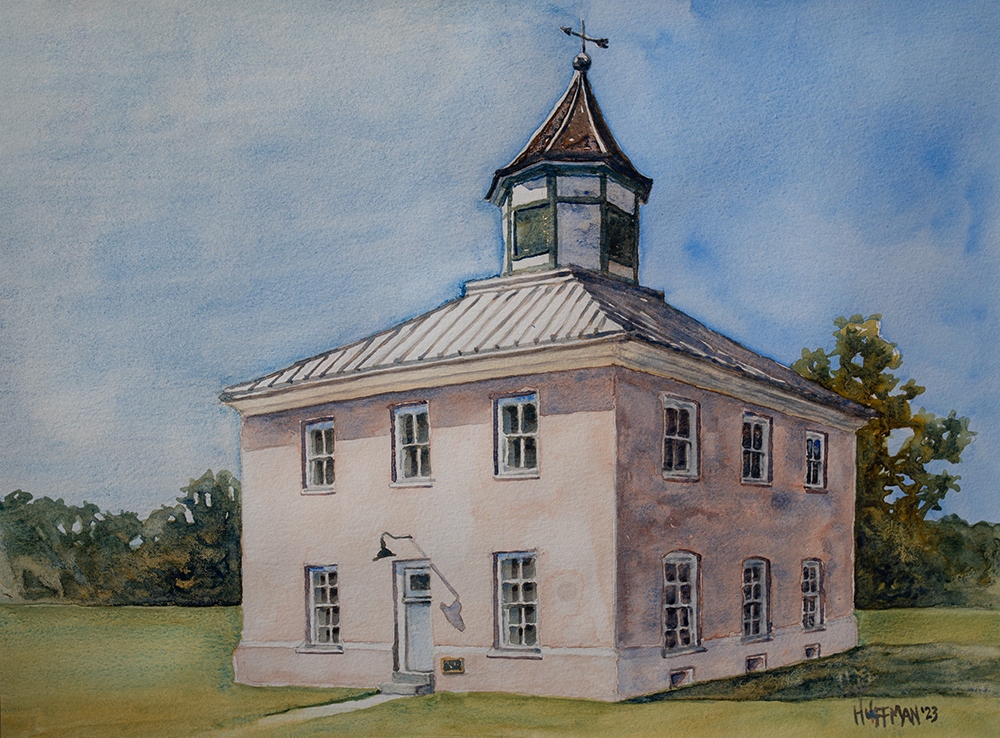
Perry County (Old)
- Artist: Cathleen Huffman
- Donor: Cathleen Huffman, Watercolor Society of Indiana
- Medium: Watercolor
The Old Perry County Courthouse, also known as Rome Schoolhouse, is in Rome. It was built in 1818, and is a two-story, square brick building with a hipped roof topped by a central cupola. The building served as the seat of county government until 1859. It then housed a school until 1966. It was listed on the National Register of Historic Places in 1981.

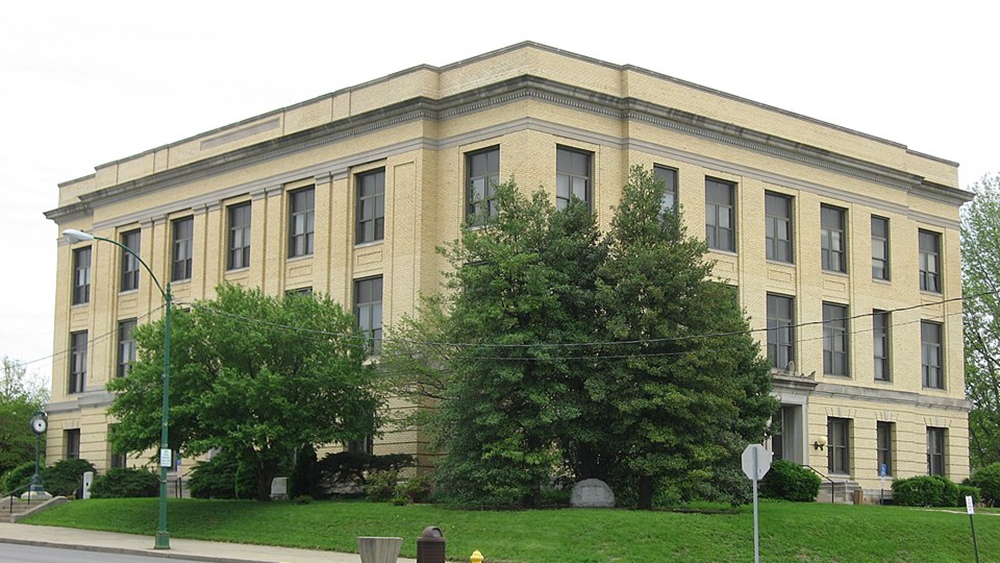
Pike County
- Artist: Estelyn Eversoll
- Donor: Pike County Bar Association
- Medium: Watercolor
The Pike County Courthouse is in Petersburg. It was designed by architects Elmer E. Dunlap and of Jasper N. Good and built in 1922. It is a three-story, Neoclassical style, nearly square, concrete and buff brick building with slightly projecting pavilions on three sides. It measures 114 feet by 109 feet. Also on the property are five contributing objects: a GAR memorial, veterans’ memorial, and three metal street lamps. It was listed on the National Register of Historic Places in 2008.

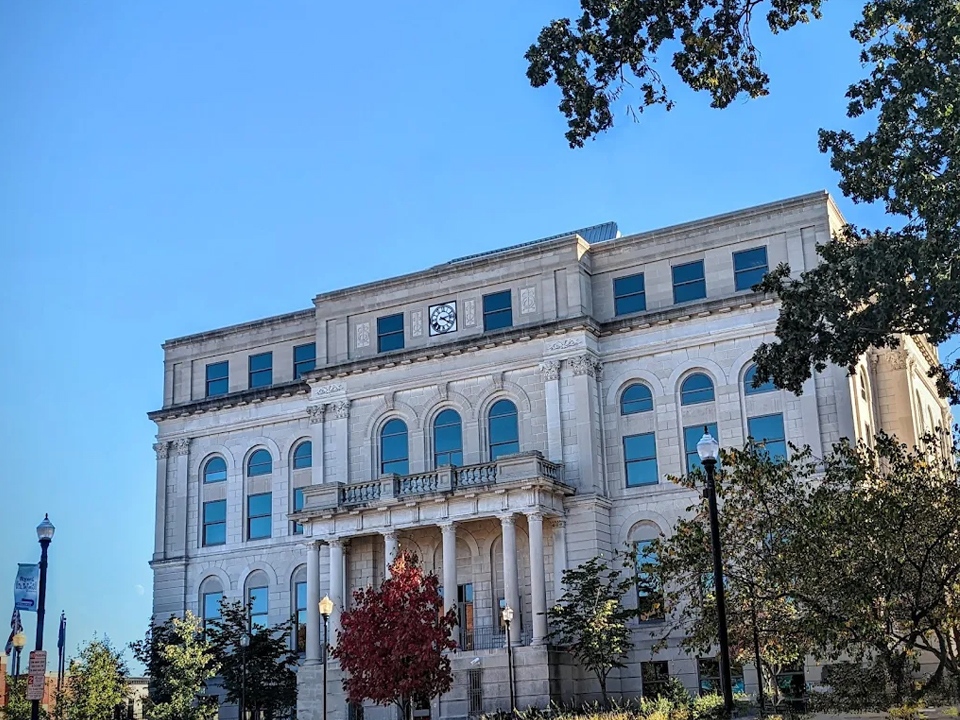
Porter County
- Artist: Mia Baker
- Donor: Porter County Bicentennial Committee; Indiana Dunes Tourism
- Medium: Oil on Canvas
The Porter County Courthouse is in Valparaiso. The current building replaced the brick building in 1883. The current building is 128 feet by 98 feet. It was built with a square tower rising out of the center. The tower was 168 feet tall with a clock on each side. Built of Indiana limestone from Ellettsville, it cost $125,909. During construction there were several problems with the building stone. It was eventually finished at an additional $10,000 cost. The County Courthouse has always occupied this site. The first Courthouse was built in 1837. It was a wooden frame construction at a cost of $1,250. In 1853 it was replaced by a brick building (40 x 60 foot) at a cost of $13,000. An old photograph I the Historical Society of Porter County shows a Greek Revival style building. Rectangular shape with a belfry rising above a pilastered portico. The belfry is three horizontal bands, the second with louvers for a bell and a small domed top.
On December 27, 1934, the Courthouse caught fire. The temperatures were below zero degrees Fahrenheit. The fire rose through the 168-foot tall tower sending ashes across the city. It took local fire departments and some from Gary and LaPorte to finally contain the blaze. When it was out, the central structure was severely damaged, and the building was gutted. The building was repaired at a cost of $172,000 by a Lafayette firm. The profile was lowered and the tower has not been rebuilt. The current building is much of what was restored in 1937.
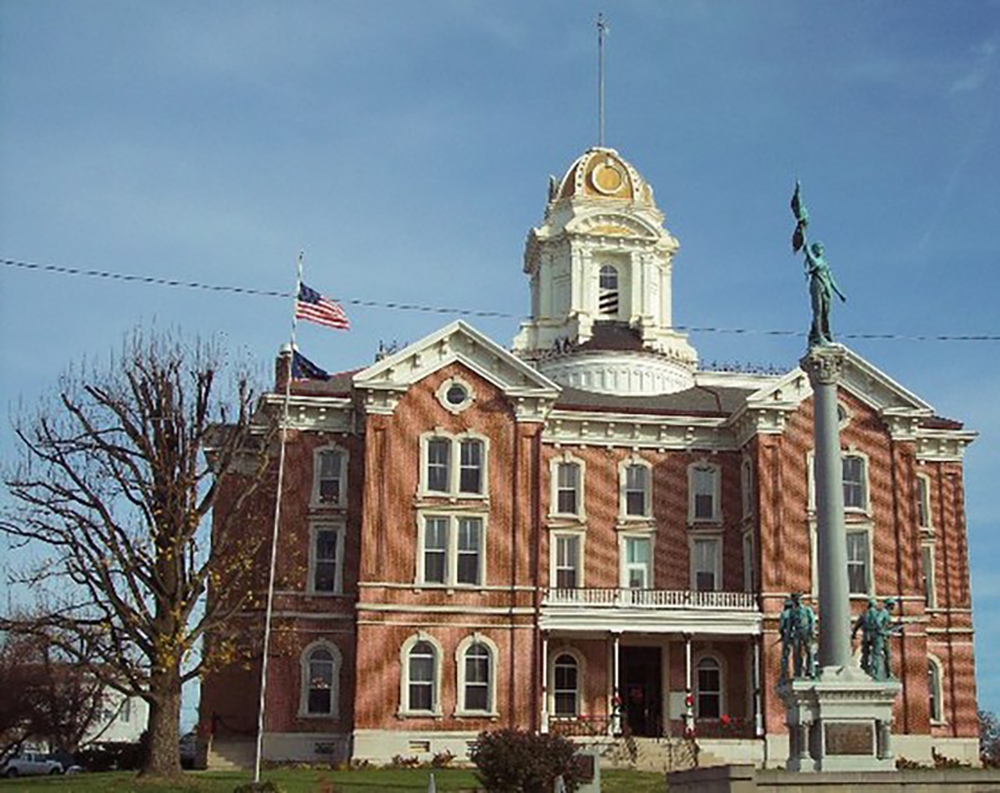
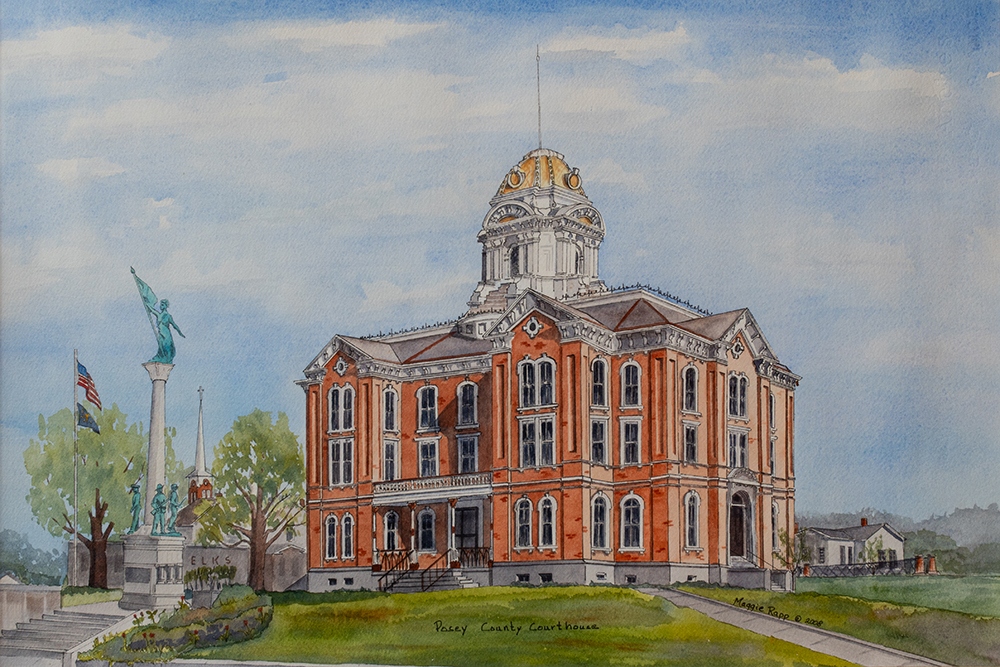
Posey County
- Artist: Maggie Rapp
- Donor: Posey County Bar Association
- Medium: Watercolor
The Posey County Courthouse Square is in Mount Vernon. The courthouse was built between 1874 and 1876 and is a red brick building consisting of a central rectangular mass flanked by two projecting gabled pavilions. It predominantly reflects the Italianate style of architecture with arched windows and brackets. It has Second Empire influences in the segmental pediments and mansard roof of the lantern that tops the domed roof. Also on the property is the contributing Posey County Soldier’s and Sailor’s Monument (1908). It was listed on the National Register of Historic Places in 1989.
Pulaski County
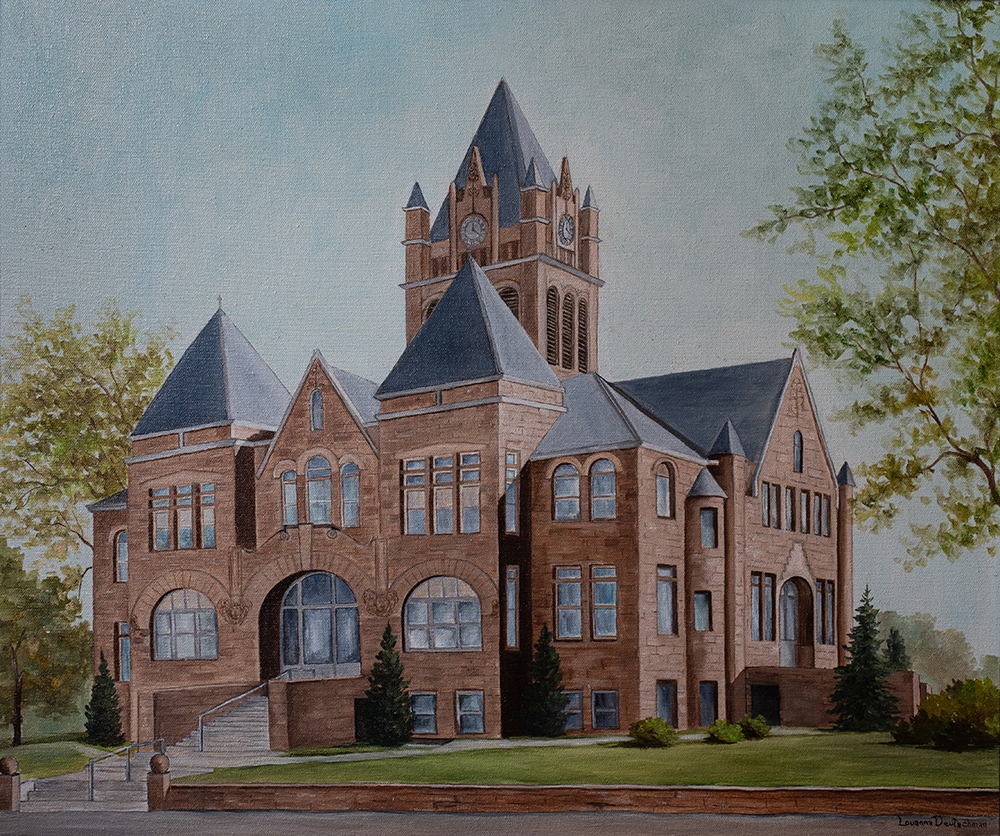
- Artist: Louanna Deutschman
- Donor: Pulaski County Bar Association
- Medium: Oil on Canvas
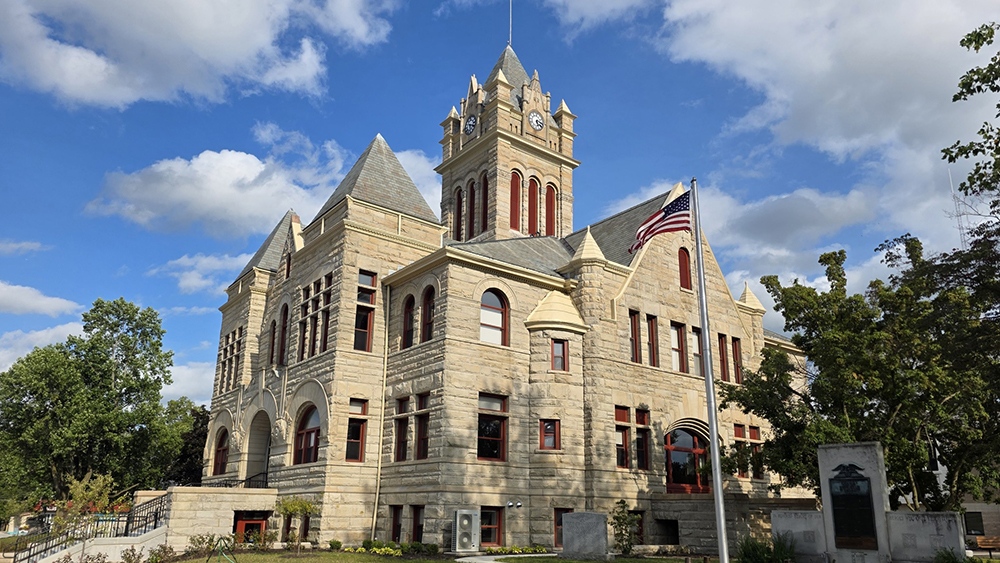
The Pulaski County Courthouse, built in 1895, is the third to be located on the courthouse square in Winamac and the fourth government center since the formation of the county in 1839. The first courthouse, a “good, hewed log house” held both the first circuit court and a school. In 1843, the county commissioners began the construction of a frame courthouse on a donated lot but soon ran out of money; the building was finally completed in 1849. A second courthouse, a large two-story brick building, was completed in 1862. The county jail, a separate building, stood alongside it on the public square.
By 1890, talk again turned to improving the seat of government. It was built in 1894–1895, and is a massive three-story, nearly square, Romanesque Revival style limestone building. It measures 88 feet by 90 feet and is topped by a slate hipped roof. The building features a 106 feet tall square clock tower topped by a pyramidal roof. Located on the courthouse lawn are monuments to Pulaski County veterans who died in World War I, World War II, Korean War, and Vietnam War, an original survey marker (called by many a “concrete obelisk), and a sculpture honoring the county’s Native American heritage. It was listed on the National Register of Historic Places in 2007. The courthouse was renovated in 2024-25 at a cost of $13.4 million.
Putnam County
- Artist: Matt Rees
- Donor: Greencastle Arts Council; Heritage Preservation Society of Putnam
- Medium: Ink Block Print
- NOTE: Two artists’ renderings were featured at the Indiana Landmarks showing; only one was listed in the database.
The current Putnam County Courthouse in Greencastle was dedicated on July 4, 1905, and was completed in 1905. Designed by architect J.W. Gaddis of Vincennes, the courthouse is constructed of Bedford limestone. It has a four-story design with a glass dome in the rotunda. The design includes marble, oak woodwork, and mosaic tile floors. Its total cost was approximately $175,730. It replaced a courthouse that was built in 1856.


Randolph County
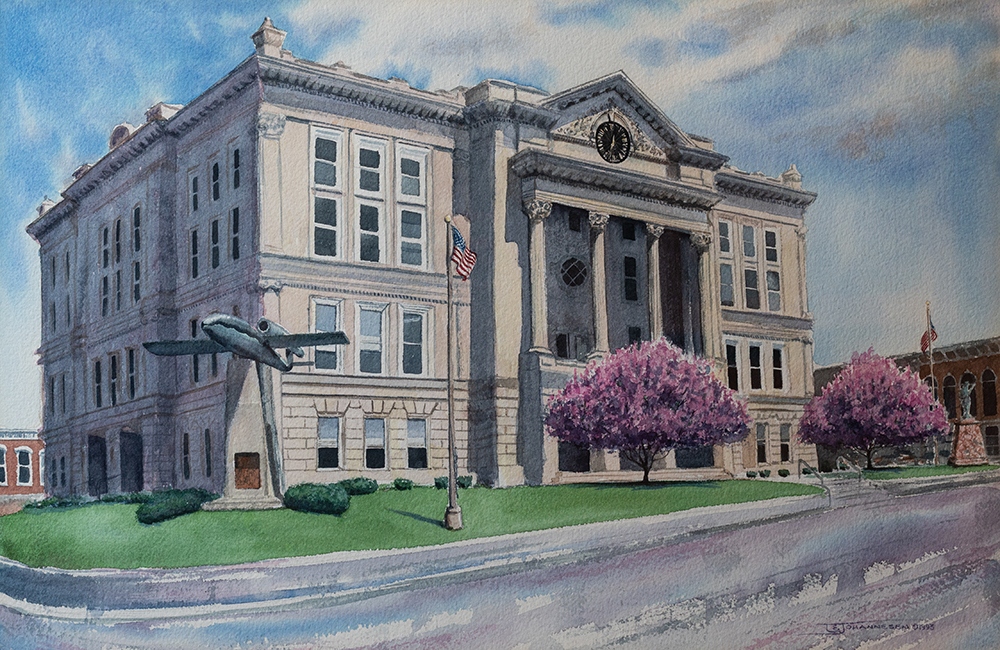
- Artist: Sheryl Thurston
- Donor: Sheryl Thurston, Watercolor Society of Indiana
- Medium: Watercolor
The Winchester Courthouse Square Historic District is in Winchester. The district encompasses 52 contributing buildings and 10 contributing structures in the central business district of Winchester. The district developed between about 1875 and 1950 and includes notable examples of Italianate, Romanesque Revival, and Classical style architecture. The courthouse was built in 1875. It was added to the National Register of Historic Places in 2001.

Ripley County
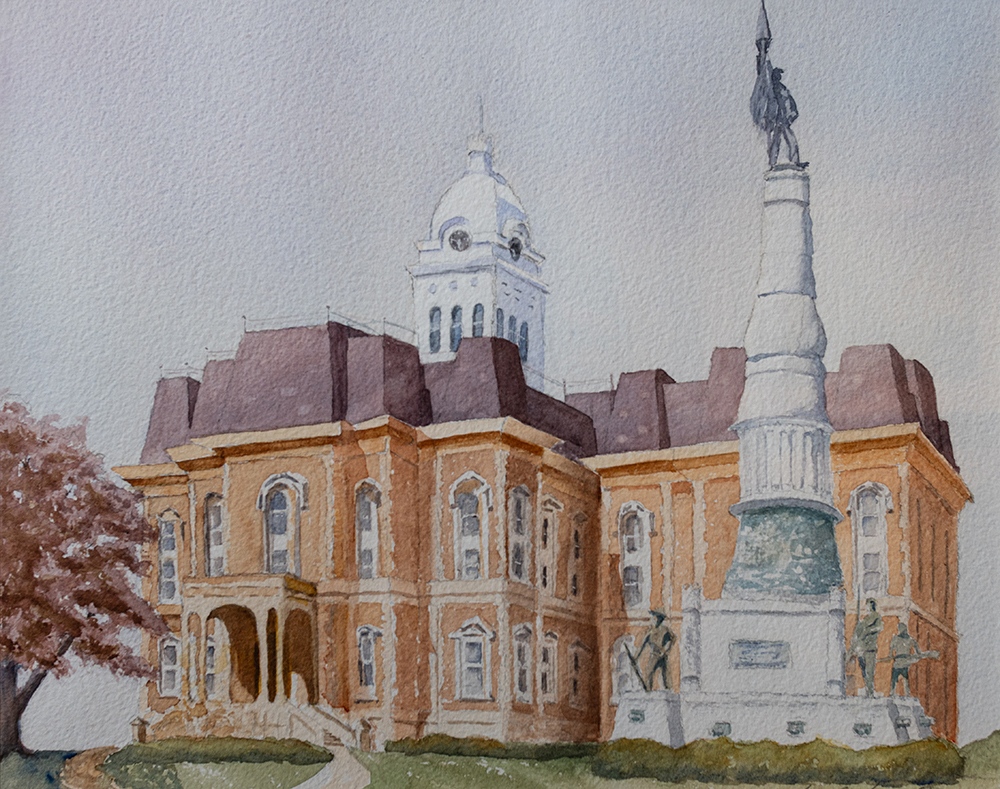
- Artist: Marianne Wiggers
- Donor: Ripley County Bar Association
- Medium: Watercolor, Pen & Ink
The Ripley County Courthouse is in Versailles. It was built between 1860 and 1863, and is a three-story, cross plan, Greek Revival style brick building. It features a bell tower and high pitched gable roof. An addition was constructed in 1971–1972. It was added to the National Register of Historic Places in 2009.

Rush County
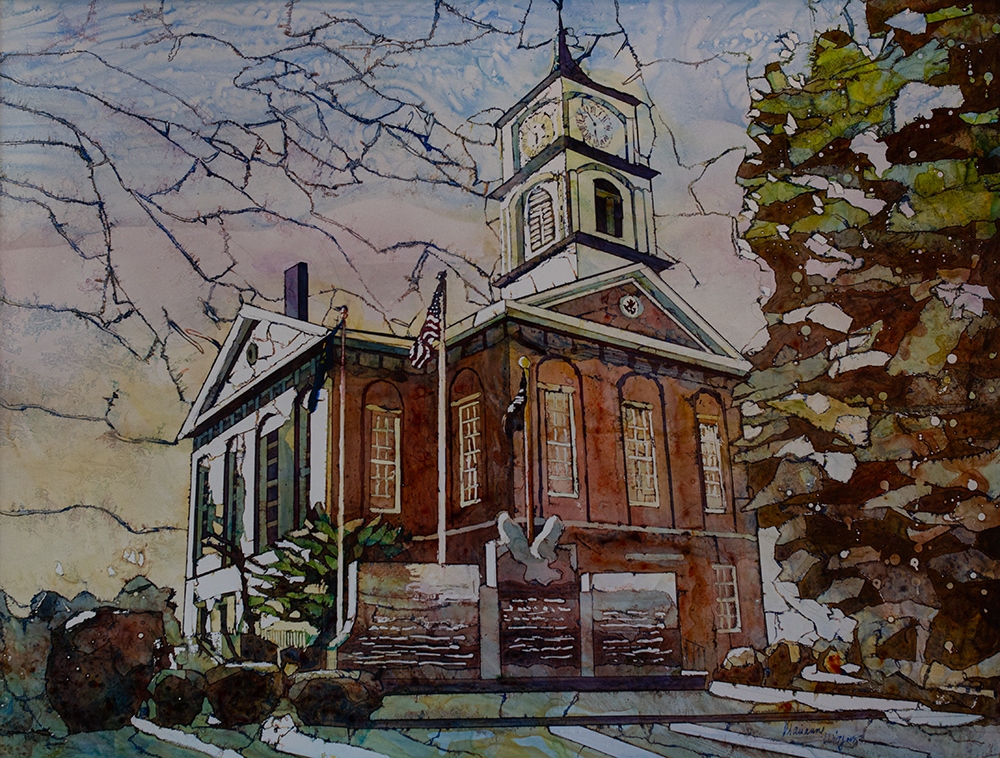
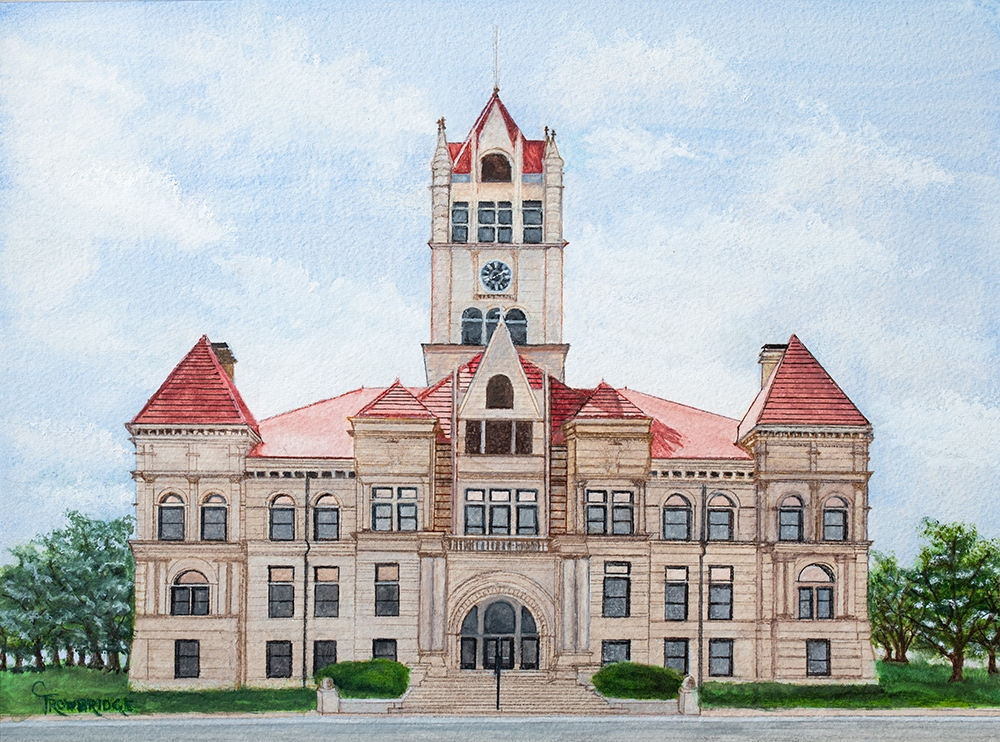
- Artist: Chuck Trowbridge
- Donor: Chuck Trowbridge, Watercolor Society of Indiana
- Medium: Watercolor
The Rush County Courthouse is in Rushville. It was designed by the architectural firm of A. W. Rush & Sons of Grand Rapids, Michigan, and was built in 1896, and is a three and one half story, steel frame building sheathed in rock faced stone in the Richardsonian Romanesque style. The irregularly shaped building has four towers at each end of the building with pyramidal roofs. It features a 196-foot tall clock tower with a pyramidal roof and conical turrets. It was listed on the National Register of Historic Places in 1975.

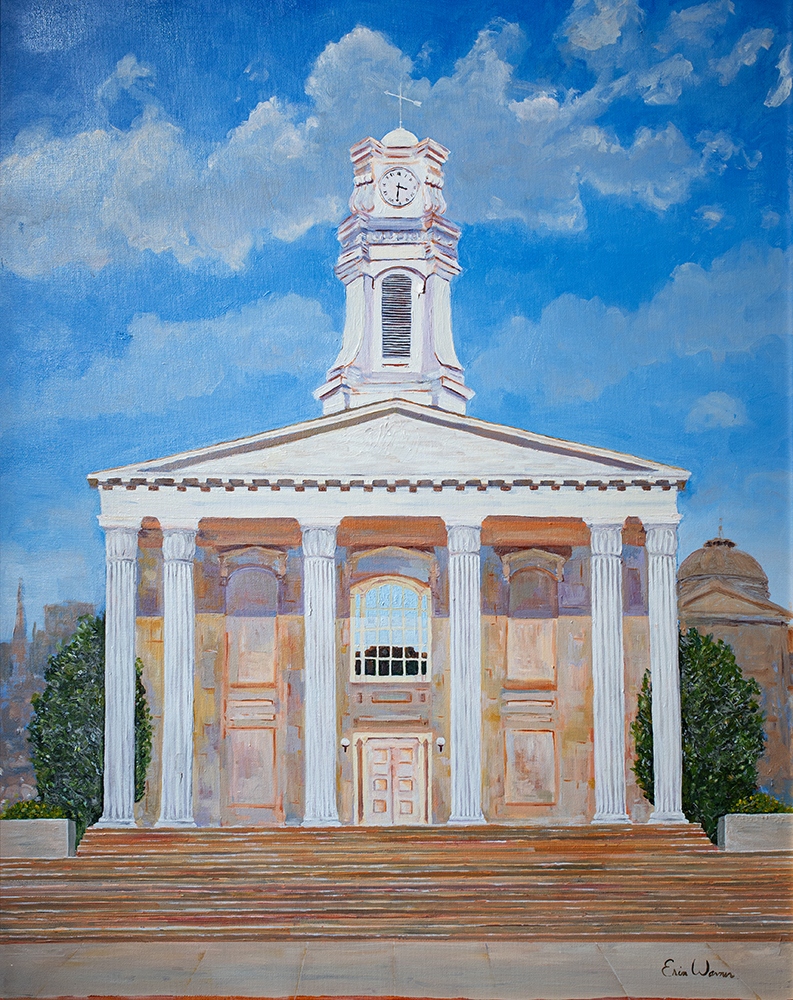
Saint Joseph County (the 2nd)
- Artist: Erin Warner
- Donor: St. Joseph County Bar Association
- Medium: Oil on Canvas
The Old Courthouse, also known as the Second St. Joseph County Courthouse, is in South Bend. It was designed by architect John M. Van Osdel (1811-1891) and was built in 1853. It is a two-story, Greek Revival style stone building. The building measures 61 feet wide and 93 feet deep. It features a projecting front portico supported by Doric order columns and a front gable roof topped by a cupola. It was moved to its present site in 1896. Following construction of the Third St. Joseph County Courthouse, the Old Courthouse housed the local G.A.R. chapter and historical museum. The building now houses office of the Traffic and Misdemeanor Court and Small Claims Court. It was listed on the National Register of Historic Places in 1970. It is located in the West Washington Historic District.

Scott County
- Artist: Karen Christensen
- Donor: Karen Christensen, Watercolor Society of Indiana
- Medium: Watercolor
The current Scott County courthouse was built in 1873-1874 and designed in the Italianate style by architect Andrew R. Baty. It is the second courthouse in the county’s history. The first courthouse (1821-1874), a two-story brick building, was built in the first county seat, Lexington.
From 1822 to 1870, there were several attempts to move the county seat to a more central location. This created significant animosity among citizens, but ultimately Scottsburg was designated the new county seat in 1871. The current courthouse began after an injunction related to the county seat relocation was resolved. The cornerstone was laid in 1873, and the building was completed in 1874. It was built with red brick and limestone trim and cost approximately $20,000.
The structure underwent a renovation in 1979. In 1997, a major addition tripled the courthouse’s space, but the original 1874 structure remains the west wing of the current building. The addition was designed to be aesthetically sympathetic to the original Italianate design. The courthouse is the centerpiece of the Scottsburg Courthouse Square Historic District, which was listed on the National Register of Historic Places in 2003.


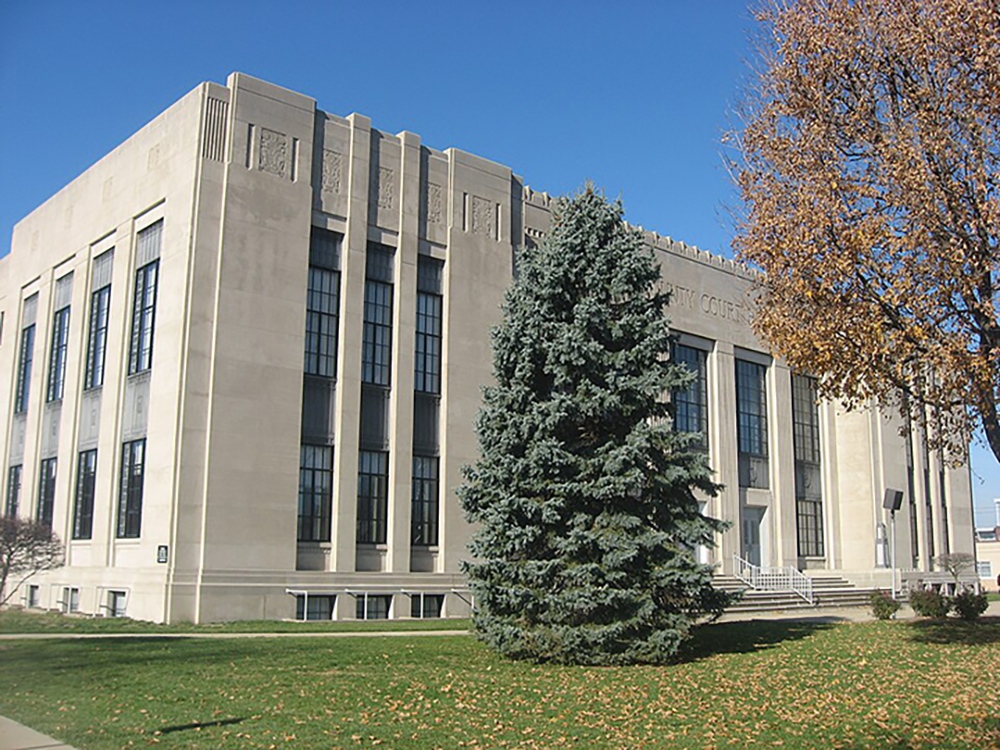
Shelby County
- Artist: Laura Clopp
- Donor: Shelby County Bar Association
- Medium: Pencil, Pen & Ink
The Shelby County Courthouse is in Shelbyville. It was built in 1936–1937, and is a two- to three-story, rectangular, Art Deco style limestone building. The building features a recessed five bay central section with two-story, fluted Doric order pilasters and bas relief panels. Also on the property is a contributing 1931 statue of an American Civil War soldier. The building’s construction was funded in part by the Public Works Administration. It was listed on the National Register of Historic Places in 2011.

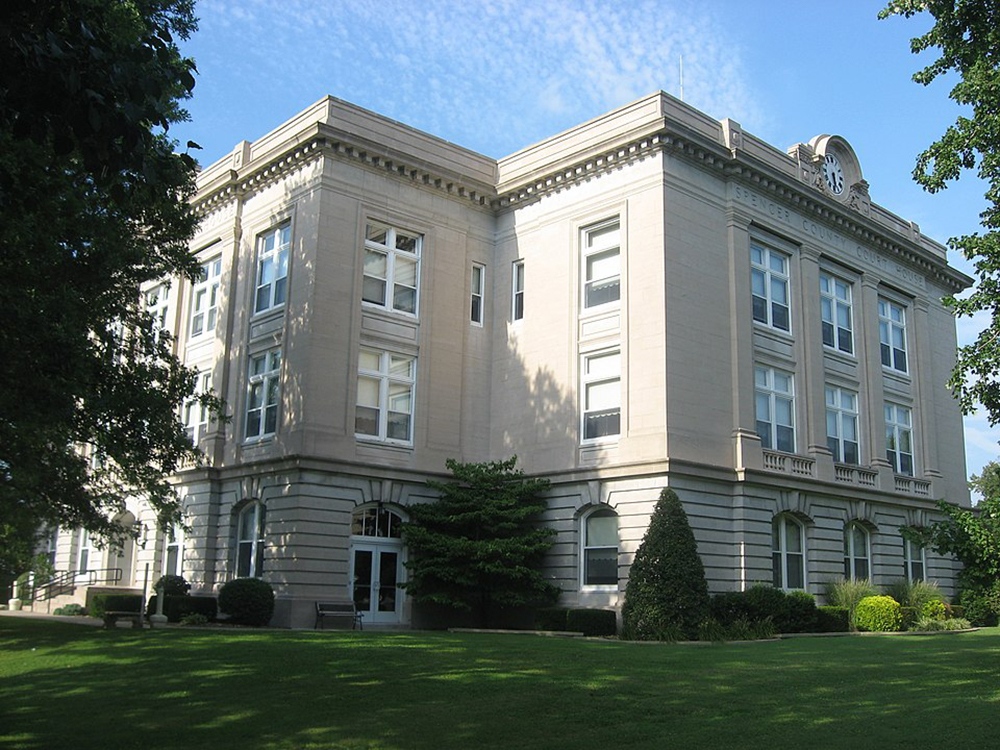
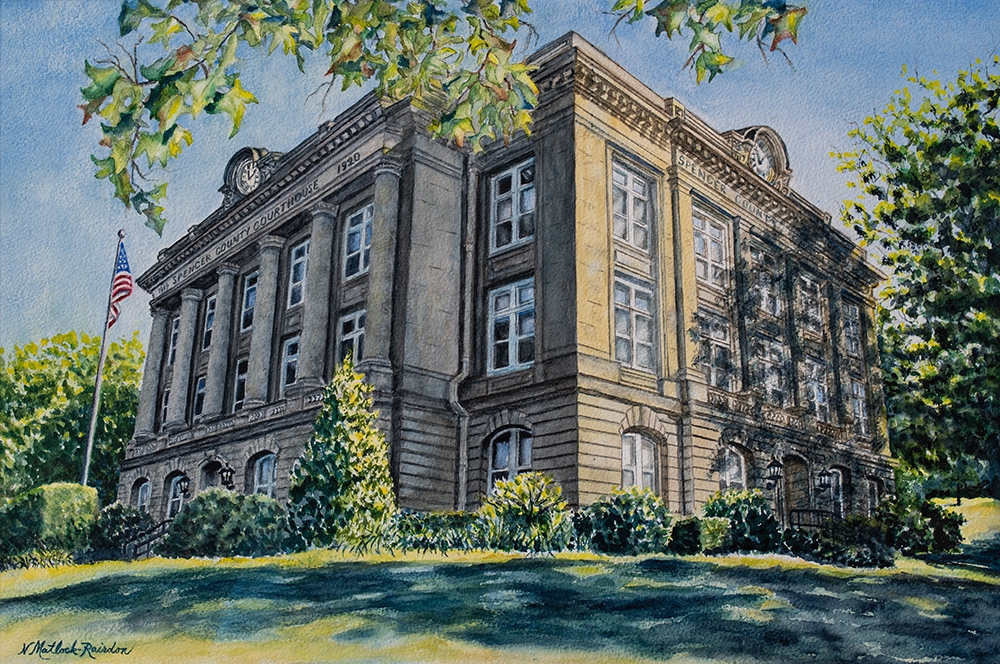
Spencer County
- Artist: Nancy Raredon
- Donor: Nancy Raredon, Watercolor Society of Indiana
- Medium: Watercolor
The Spencer County Courthouse is in Rockport. It was designed by architect Elmer E. Dunlap and built in 1921. It is a three-story, rectangular, seven bay by five bay, Neoclassical style limestone building. The main facade features a projecting five bay central section with engaged Roman Doric order columns. The interior is organized around a central rotunda topped by a shallow stained glass dome. It was listed on the National Register of Historic Places in 1999.
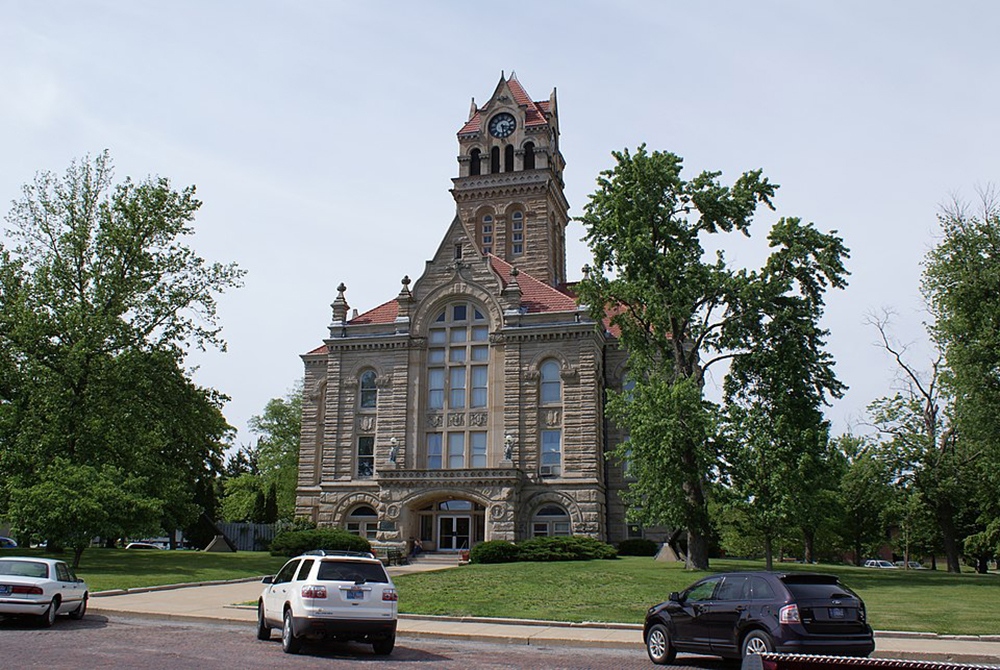
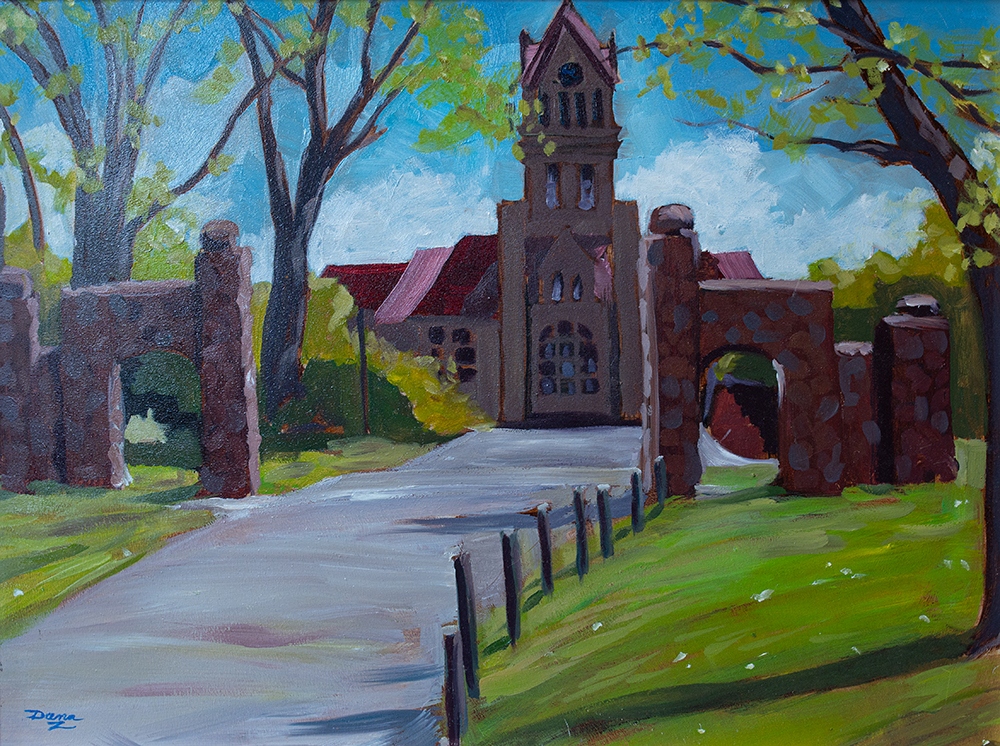
Starke County
- Artist: Dana Zier
- Donor: Dana Zier & Anonymous
- Medium: Oil on Board
The Starke County Courthouse is in Knox. It was designed by the architectural firm of Wing & Mahurin, of Fort Wayne and built in 1897. It is a three-story, Richardsonian Romanesque style Indiana Oolitic limestone and terra cotta building. It has a Greek cross-plan and is topped by a tiled hipped roof. It features a 138 feet tall clock tower located at the roof’s center. It was listed on the National Register of Historic Places in 1986.
Steuben County
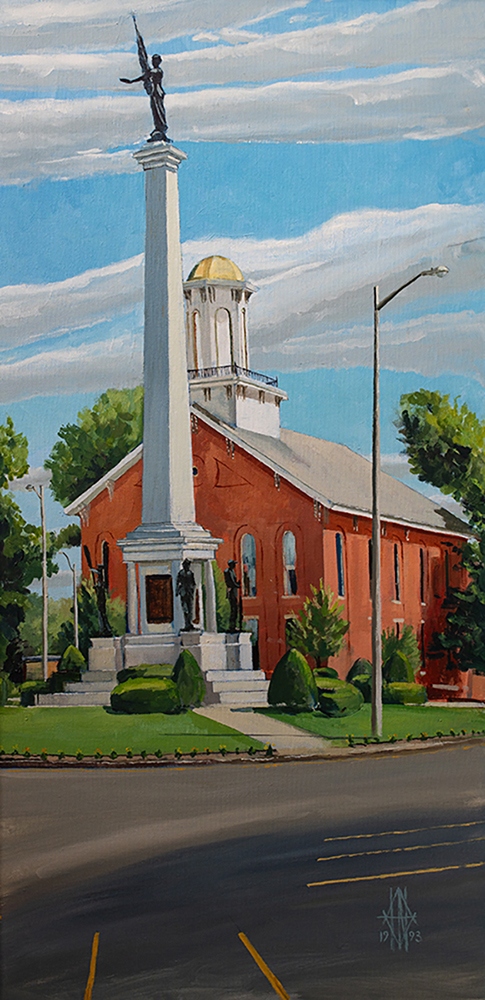
- Artist: Unknown
- Donor: Hon. William Fee
- Medium: Oil on Canvas
The Steuben County Courthouse is in Angola. It was built in 1867–1868, and is a two-story, rectangular, brick building with Greek Revival, Italianate, and Romanesque Revival style design influences. It features a gable roof with bracketed eaves and topped by an octagonal domed cupola with a square base and captain’s walk. It was listed on the National Register of Historic Places in 1975.
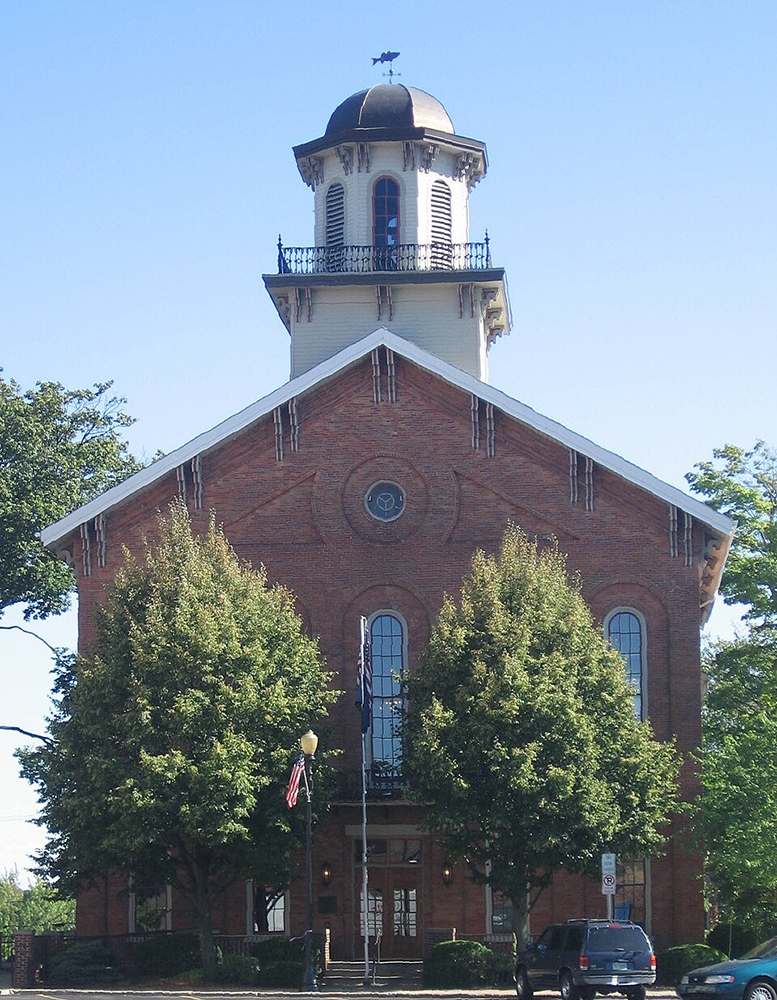
Sullivan County
- Artist: James J. McBride
- Donor: Sullivan County Bar Association
- Medium: Pencil
The Sullivan County Courthouse is in Sullivan. It was built between 1926 and 1928, and is a three-story, nearly square, steel frame and concrete, Beaux-Arts style building faced in limestone. All four faces are nearly identical and feature a traditional Corinthian order composite cornice. The center of each facade has a rounded arch parapet with clock. The building is nearly identical to the Vermillion County Courthouse. It was listed on the National Register of Historic Places in 2008.
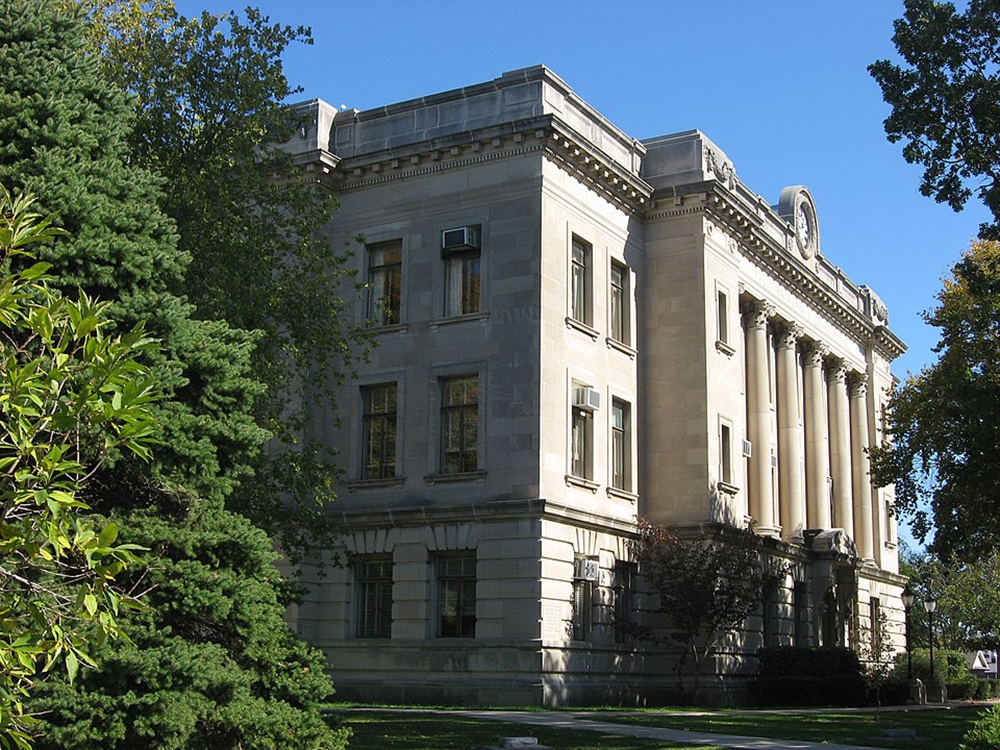

Switzerland County
- Artist: David Beardmore
- Donor: Switzerland County Bar Association; Switzerland County Visitor’s Bureau
- Medium: Oil on Canvas
The Switzerland County Courthouse is in Vevay. It was built between 1862 and 1864, and is a three-story, rectangular Greek Revival style red brick building with limestone and white painted wood trim. The building measures 52 feet by 96 feet. It features a tall, pedimented tetrastyle portico with fluted Corinthian order columns. The building is topped by a copper clad dome with cupola. It was listed on the National Register of Historic Places in 2009.
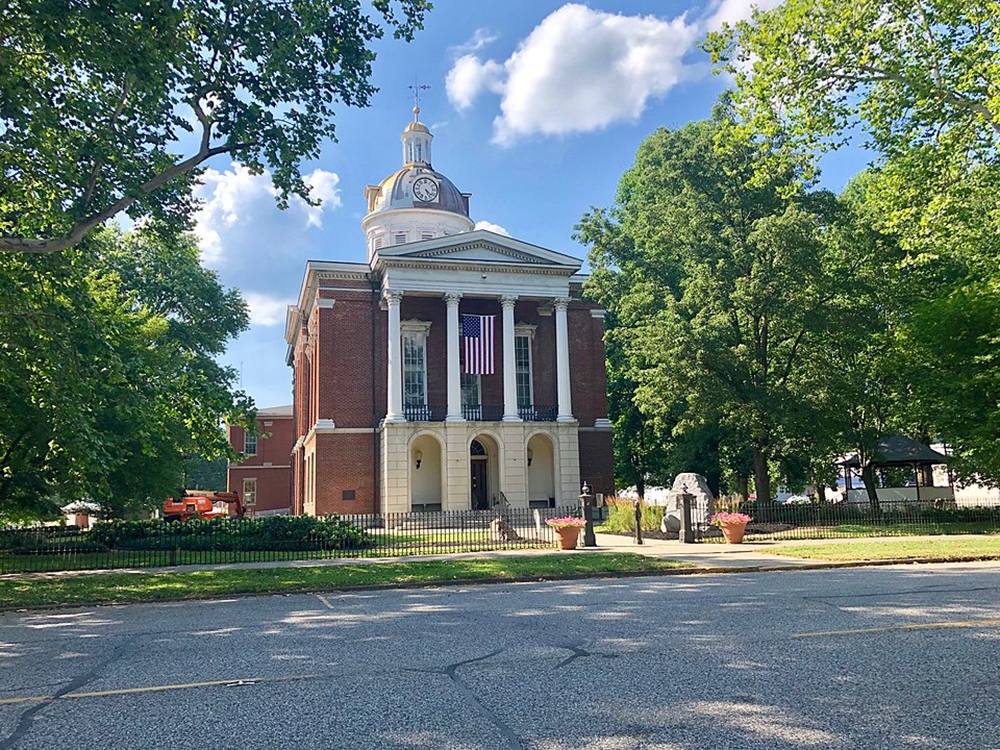

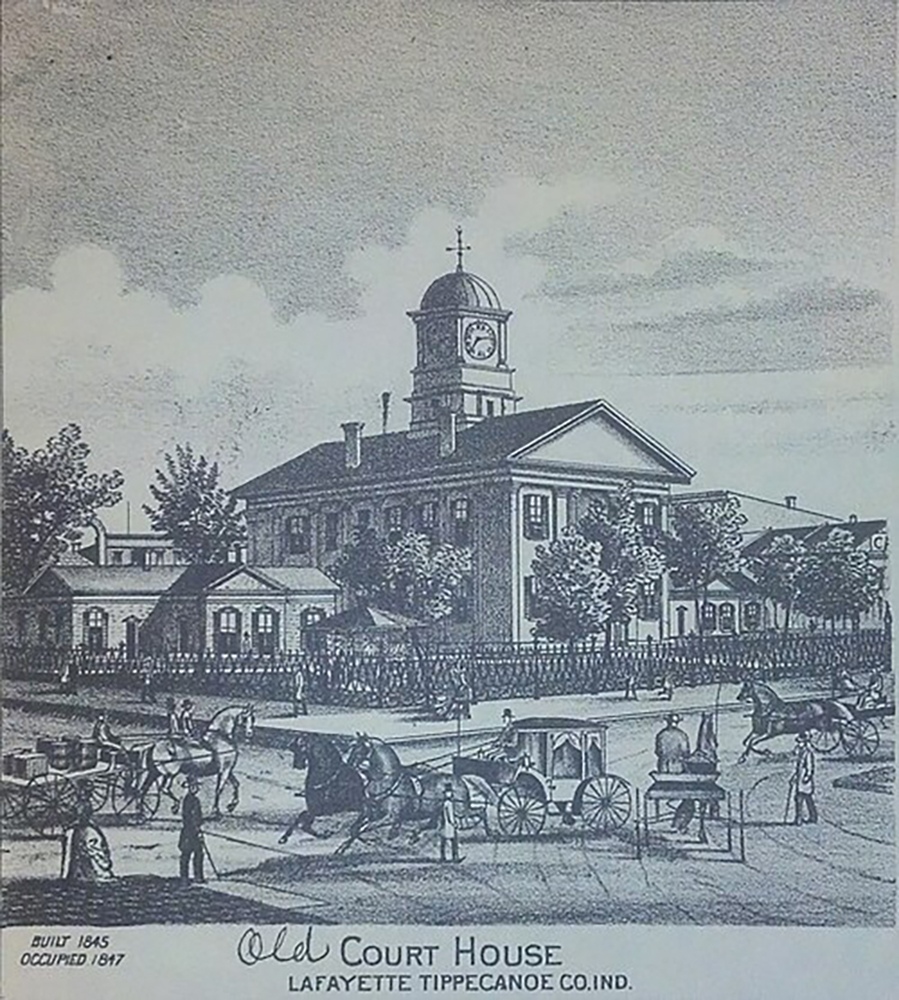
Tippecanoe County
- Artist: Kathryn Clark
- Donor: Hon. Samuel Conrad & Hon. Chad Kukelhan Tippecanoe County Bar Association
- Medium: Oil on Canvas
The Tippecanoe County Courthouse is on the public square in the Downtown Lafayette Historic District. It was listed on the National Register of Historic Places in 1972. When the county was first organized in 1826, rooms were rented in which to conduct county business, until 1829 when the first courthouse was built; it was a two-story brick building. It was replaced by a larger brick building in 1845 at a cost of about $3,000; there was a fire in this building in the 1840s, but it was extinguished before it could do any damage. The third and current courthouse was built on the site from 1881 to 1884 at a cost of about $500,000. It is built of Indiana limestone and is two-and-a-half stories tall on a raised basement. Architecturally, it is a pastiche of styles including Second Empire, Beaux Arts, Baroque, Rococo, Georgian and Neo-Classical. Paul Goeldner in his study of Midwestern courthouses called the building the “epitome of county capitals”.
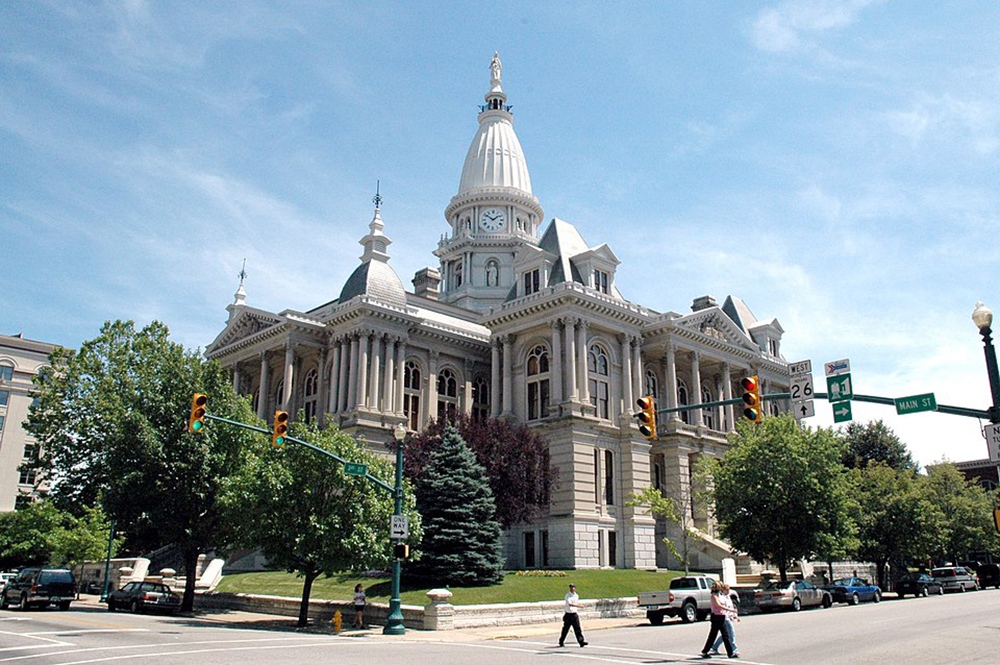

Tipton County
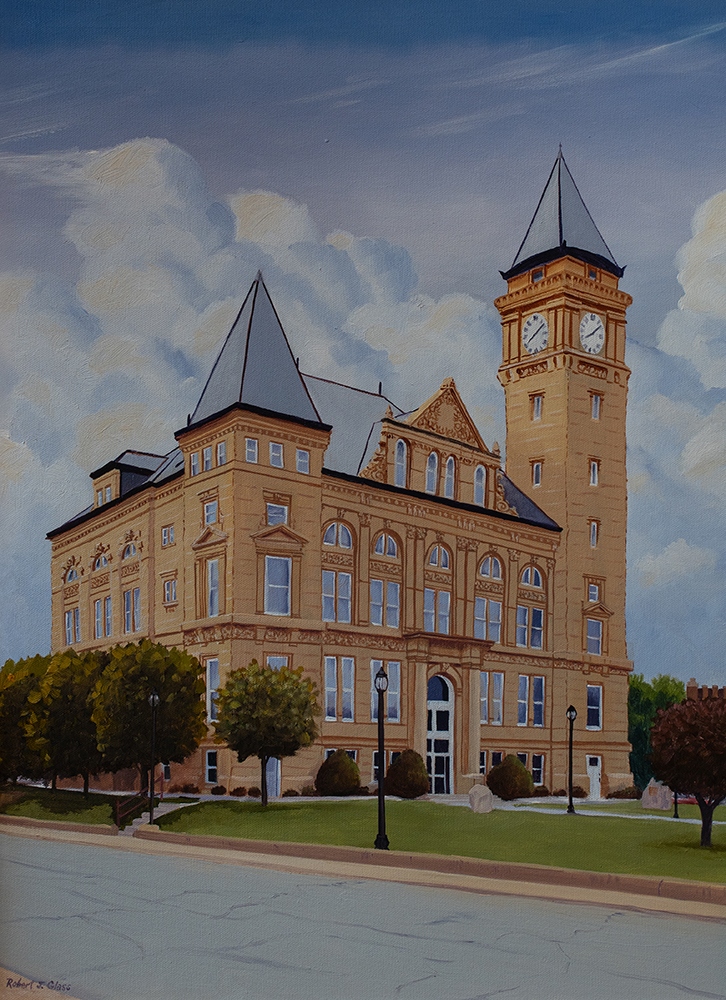
- Artist: Robert J. Glass
- Donor: Tipton County Bar Association
- Medium: Oil on Canvas
The Tipton County Courthouse is in Tipton. The courthouse is Tipton’s third and was completed in 1894. The courthouse is an example of Romanesque Revival style architecture and was designed by Adolph Scherrer who also designed the 1888 Indiana State Capitol and Tipton County Jail and Sheriff’s Home. Sherrer took over the architectural design work for the Indiana Statehouse project from Edwin May who died in 1880. Five years after the completion of the capitol building project in 1888, Scherrer began work on the Tipton County Courthouse building. It is built of sandstone in a Romanesque Revival style with a clock tower that rises 206 feet above the ground. It is topped by a flagstaff. The building was constructed by Pierce and Morgan of Indianapolis during 1893 and 1894 at a cost of $170,988. It is one of several Romanesque courthouses dating from the 1890s that are still in use. It was added to the National Register of Historic Places on March 1, 1984.
Union County
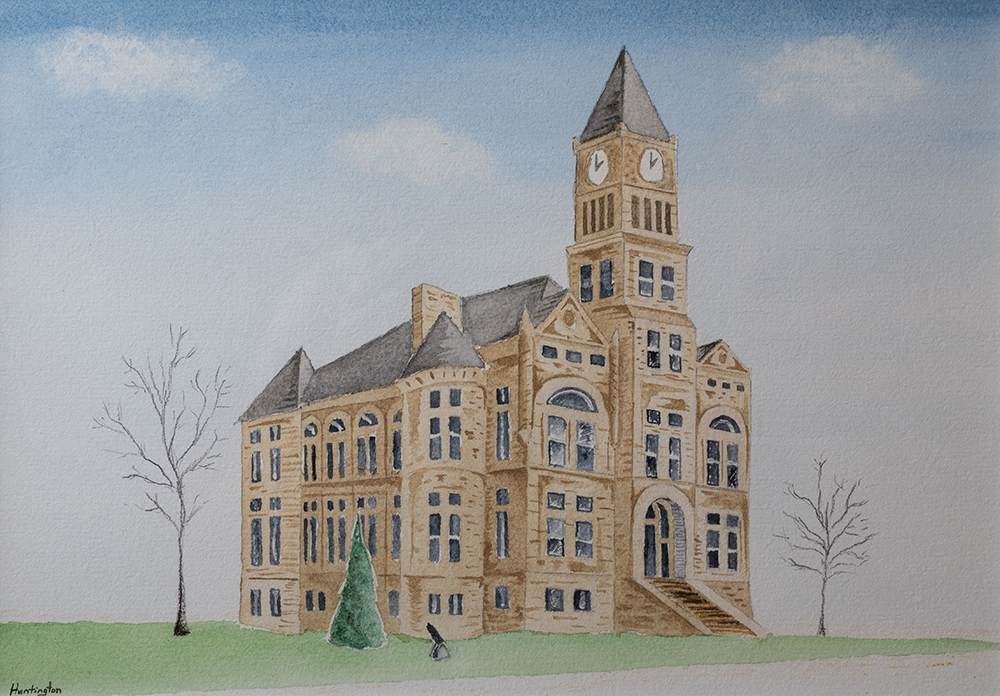
- Artist: Howard “Tad” L. Huntington
- Donor: Howard “Tad” L. Huntington
- Medium: Watercolor
The Union County Courthouse is in Liberty. It was designed by noted Indianapolis architect George W. Bunting and built in 1890–1891. It is a two-story, rectangular, Richardsonian Romanesque style rock faced ashlar stone building on a raised basement. It has a hipped roof and features an arched entrance and four-story clock tower. It was listed on the National Register of Historic Places in 1987. It is located in the Liberty Courthouse Square Historic District.

Vanderburgh County
- Artist: Maggie Rapp
- Donor: Evansville Bar Association
- Medium: Pen & Ink
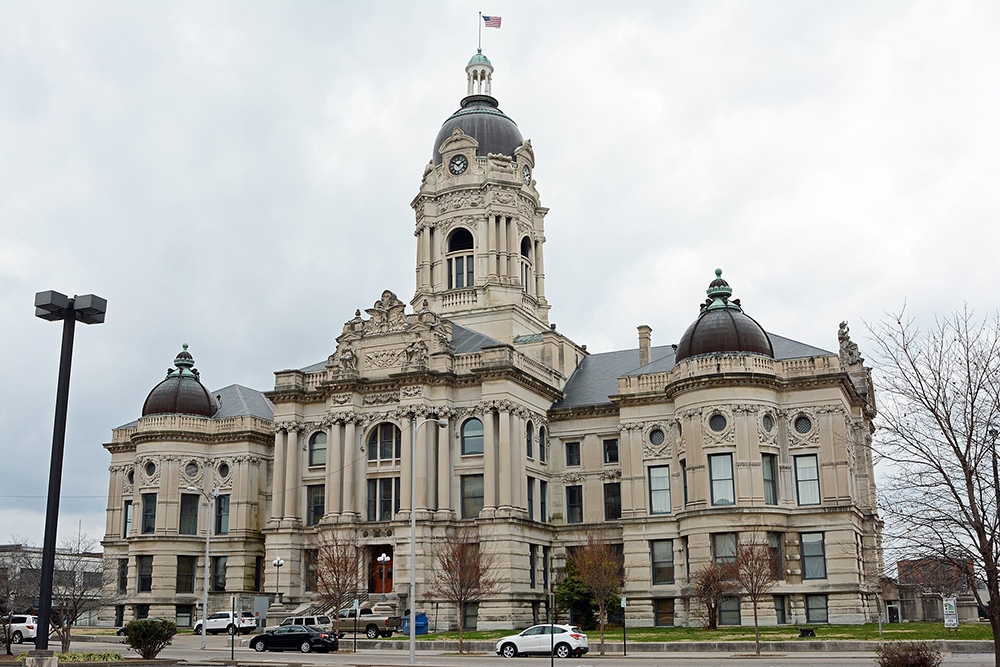
The Old Vanderburgh County Courthouse, often simply called the “Old Courthouse,” was once the center of Vanderburgh County government. Construction started in the spring of 1888 and was completed in November 1890. The building was ready to be occupied by the county government in early 1891. It sits in the heart of downtown Evansville. The building was designed by architect Henry Wolters of Louisville, Kentucky and constructed by Charles Pearce & Company of Indianapolis. The 19th century German Beaux-Arts architecture masterpiece cost $379,450 to build. The Old Courthouse occupies an entire city block, bounded by Court, Fourth, Vine and Fifth Streets, with each side being encrusted with sculptures and stone carvings in Indiana limestone. The fourteen main statues of human figures are the work of Franz Engelsmann, who studied under the great German masters before setting up his studio in Chicago. In addition, carvings of vegetables, fruits, and flowers indigenous to the area adorn the capitals of the forty-eight pairs of pilasters around the entire building.
Before the courthouse was built, the site was a basin where canal boats on the Wabash and Erie Canal would deliver cargo and turn around for the return trip north. After the advent of the railroads and the canal’s abandonment, the site was filled in and the courthouse was constructed upon it. A tunnel runs beneath Vine Street connecting the Old Courthouse to the Old Vanderburgh County Jail.

Vermillion County
- Artist: Tanya Roberts
- Donor: Tanya Roberts, Watercolor Society of Indiana
- Medium: Watercolor
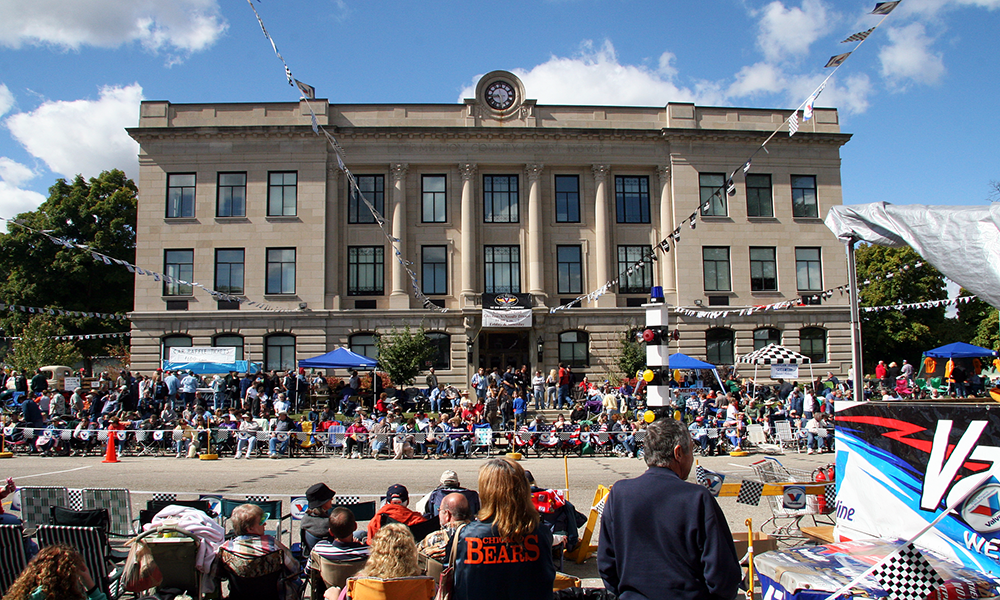
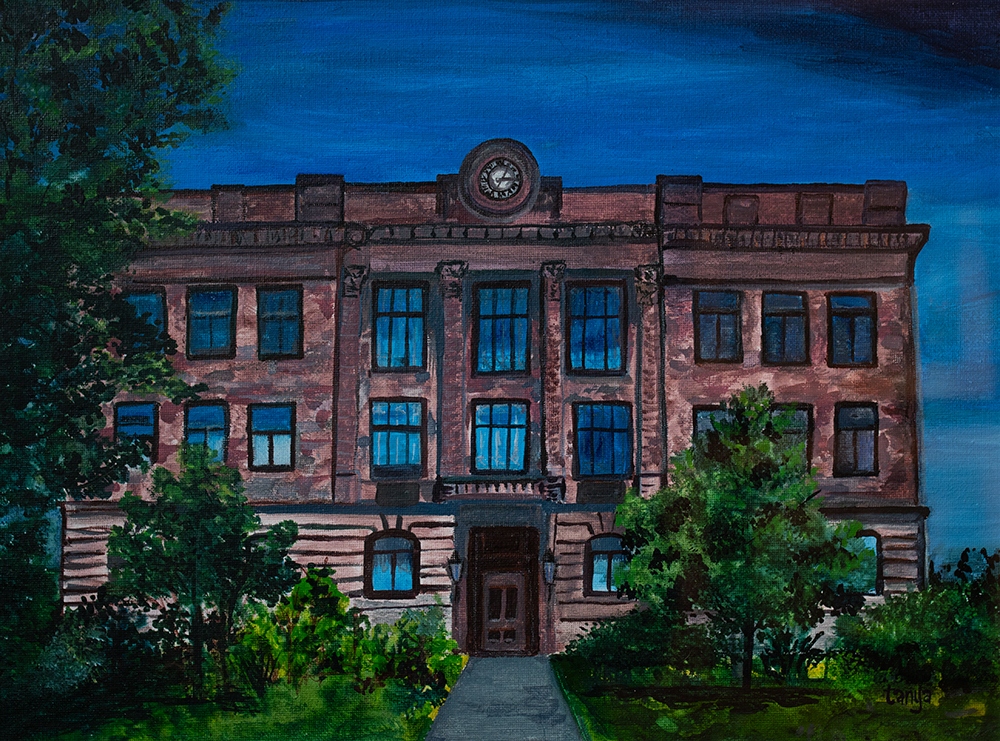
The Vermillion County Courthouse, in Newport, was built from 1923 to 1925 to replace the previous courthouse, which burned down in 1923. Architect John B. Bayard designed the building in the Classical Revival style. The building’s design features a clock along the roof line on each side and Corinthian columns spanning the second and third floors in the front. Vermillion County’s government has operated out of the courthouse since its construction, and the courthouse is one of 84 historic county courthouses surviving in Indiana. The building is nearly identical to the Sullivan County Courthouse. The courthouse was added to the National Register of Historic Places on December 19, 2007.
Vigo County
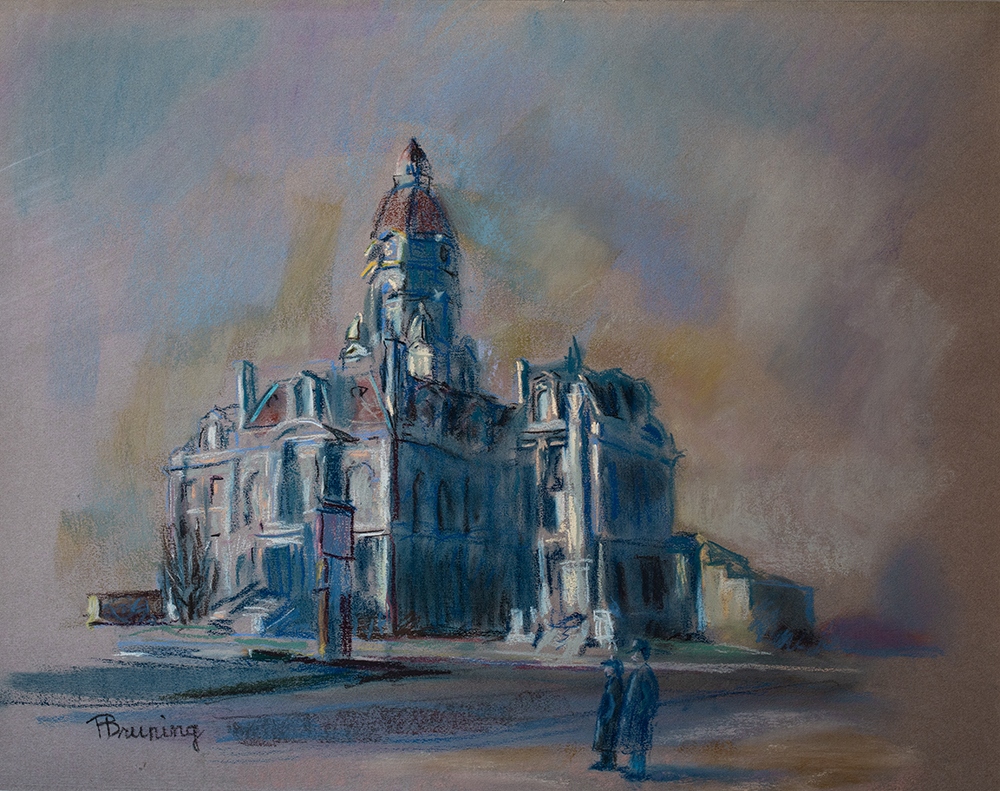
- Artist: Peter Bruning
- Donor: Vigo County Public Defender’s Office
- Medium: Pastel
Vigo County was formed in 1818 by the Indiana General Assembly and construction of the county’s first courthouse began that year. In the meantime, the temporary courthouse was the Eagle and Lion Tavern on the corner of Wabash Avenue and Second Street. Early records show that on May 13, 1818, Nathaniel P. Huntington was allowed $10 for drawing up bonds; John M. Coleman $350 in part pay for building foundations; William Durham $400 in part pay for building walls, and Elihu Hovey and John Brocklebank $300 in part pay for building Court House. In November 1818, public records show that Charles B. Modesitt was allowed $25 for “clearing off the public square,” indicating that the work of building the Court House began in 1818, though the structure was not completed until 1822. This original structure was brick with a broad arched transom and an interior with elevated box seats and steps. An aisle ran through the center of the building, dividing the structure into a south side dedicated to seating and a north side for the express use of the court and room for a judge’s bench, lawyers’ tables and a jury box.
The bottom floor of the courthouse was completed in 1822 and quickly became the place for court business, political gatherings, elections, public town meetings, lectures, sermons and more. This structure served until 1866.
In 1868, the structure was declared unfit for use. A temporary courthouse was established in a four-story brick building on the corner of Third and Ohio streets until a more permanent structure could be built. It was assumed that the original courthouse would be fixed and returned to use, but this never occurred, and the temporary structure ended up being used for 22 years. The building of a new courthouse was stalled in part by squabbling among the city council and a special election in May 1871 in which the vote was 450 for and nearly 4,000 against the project, where it was then ordered that no new courthouse be built at that time.
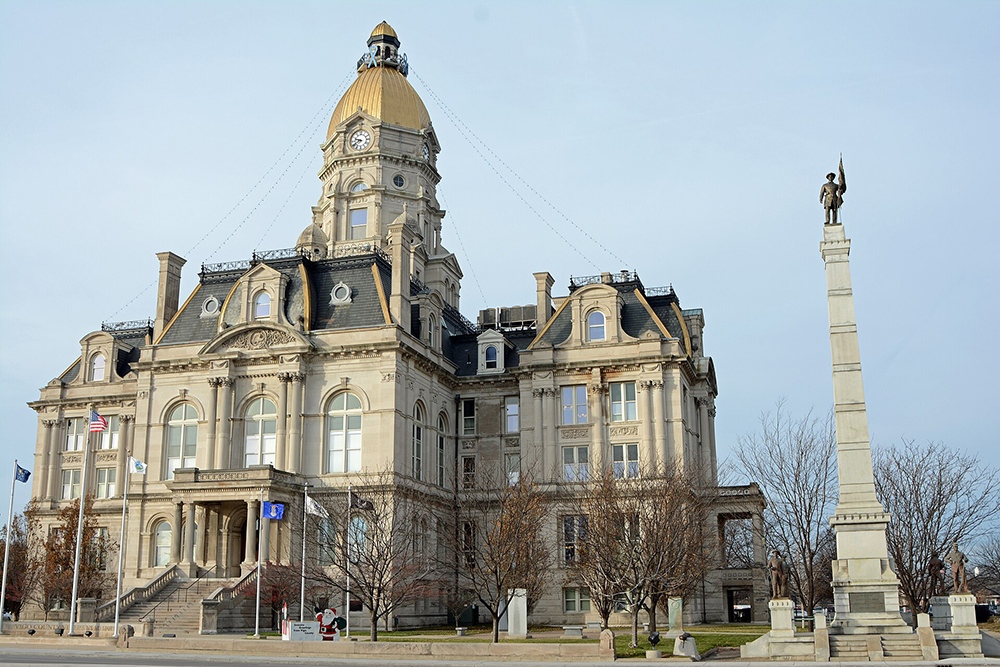
The second courthouse is a Second Empire-style structure designed by Cincinnati architect Samuel Hannaford. Work began on the current structure when a 10,000-pound cornerstone was laid on August 28, 1884. The building was constructed by the Terre Haute Stone Company at a cost of $443,000. The courthouse is made from Indiana limestone gathered from Stinesville, Indiana quarries. Cast-iron work in the roof and dome as well as windows and cresting were completed by Phoenix Foundry and Machine Works. The courthouse was dedicated on June 7, 1888. It is of similar style to the Vanderburgh County Courthouse. It was listed on the National Register of Historic Places in 1983.
Wabash County
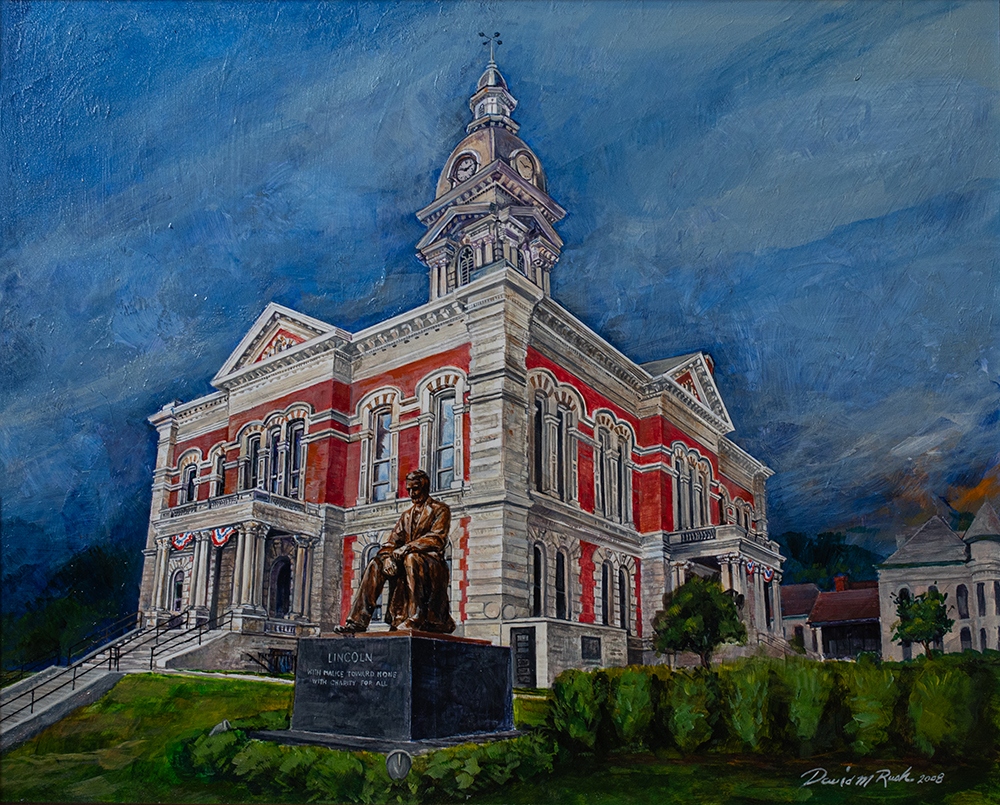
- Artist: David M. Rush
- Donor: Wabash County Bar Association
- Medium: Oil on Board
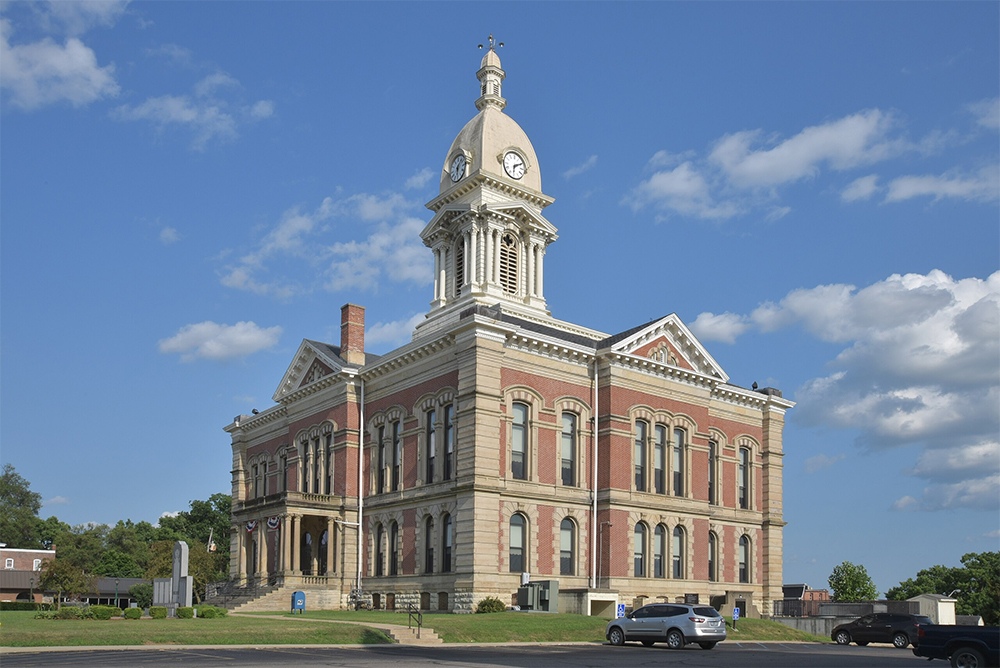
The current Wabash County courthouse is the third to be built. It was constructed in the Italian Renaissance style. Designed by architect B.V. Enos, it was completed at a cost of $95,000 and features a domed clock tower, round-arch windows, projecting pavilions, stamped metal ceilings, encaustic tile floors, and a grand staircase. It is notable for being the site where the first electrically lighted city in the world was demonstrated. This demonstration took place in 1880, using four Brush arc lights placed on top of the building to illuminate the public square.
Warren County
- Artist: Karen Christensen
- Donor: Karen Christensen, Watercolor Society of Indiana
- Medium: Watercolor
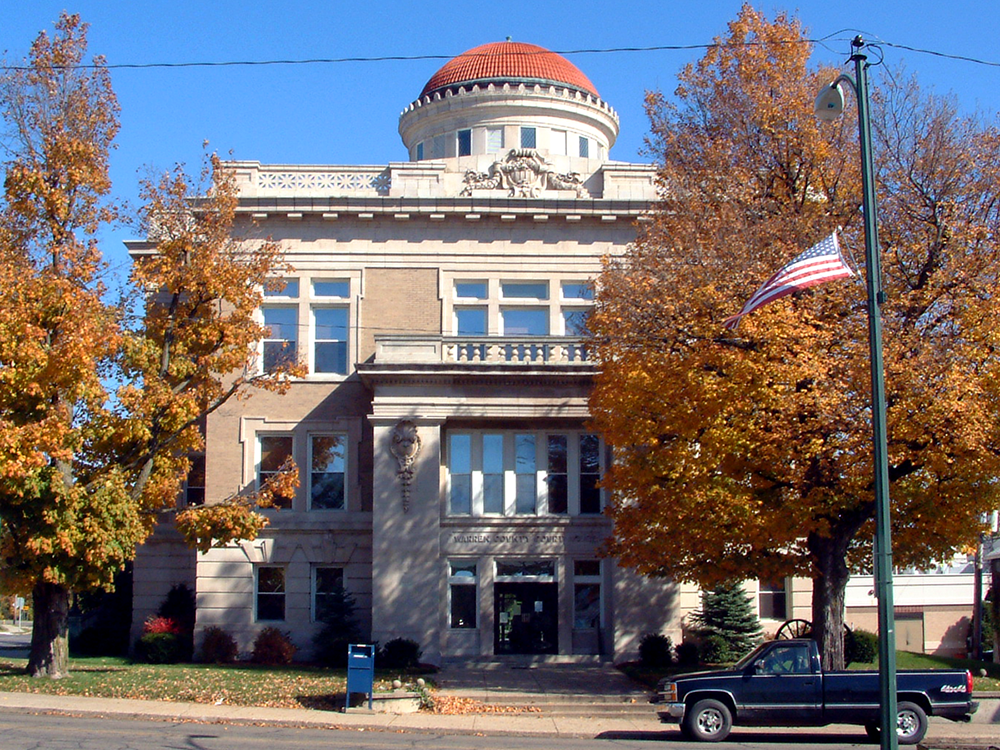
The Warren County Courthouse is a stone building constructed in 1908 in Williamsport. It was added to the National Register of Historic Places on March 19, 2008.
At the first Warren County seat of Warrenton, a log house owned (and occupied) by Enoch Farmer was used for general court and county purposes. When the county seat was moved to Williamsport, a log house belonging to the town’s proprietor, William Harrison, served as the courthouse starting in July 1829. In 1832, plans were made for a new building, and in July of that year the construction bid was won by E. W. Jones and Seth Flowers. The new building was to be made of brick, 40 feet (12 m) square and 23 feet (7.0 m) high, and was to be completed by August 1833; but various problems delayed this until mid-1834. The cost of construction was about $2000. In 1835 the building was strengthened and improved.
In 1870 a specially appointed committee determined that the old building was unsafe, and plans were begun to replace it; but opposition to the plan delayed progress until early 1871. The plans called for a new brick building to be constructed in what is now known as “Old Town”, the original portion of Williamsport that was on the shores of the Wabash River. The firm of Hays and Evans of Bloomington, Illinois was awarded the job with a bid of $48,400. The county did not have sufficient funds for the project, so $10,000 worth of county bonds were issued. The new courthouse was accepted in December 1872.

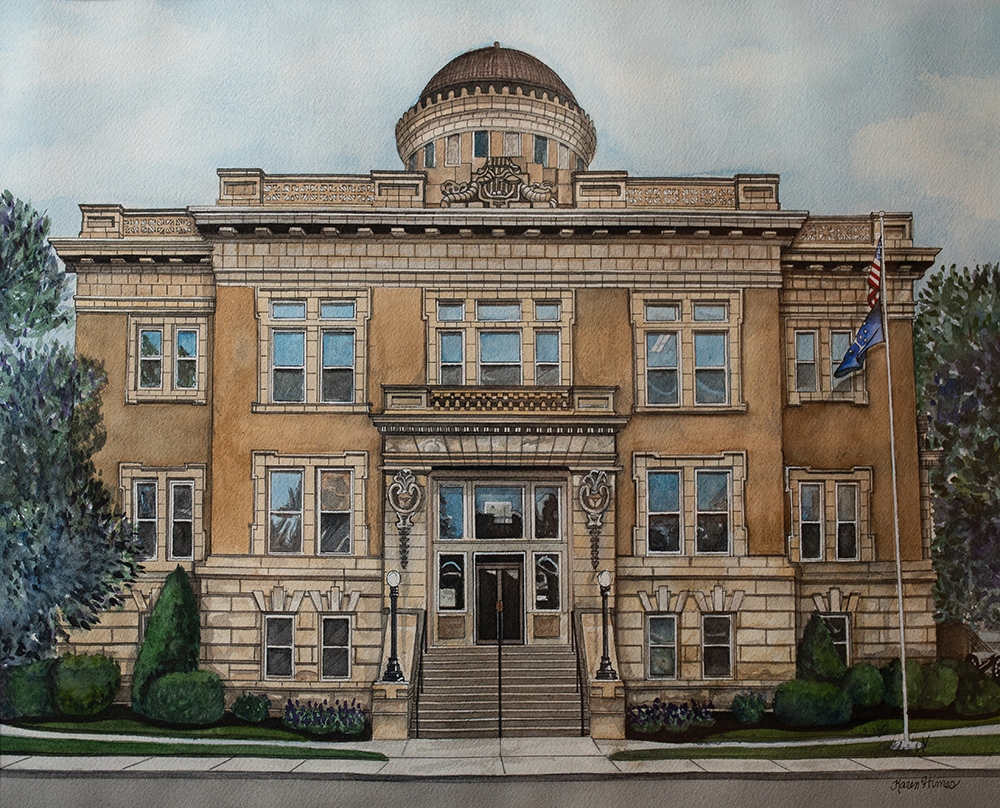
Warrick County
- Artist: Nancy Raredon
- Donor: Nancy Raredon, Watercolor Society of Indiana
- Medium: Watercolor
The current Warrick County Courthouse in Boonville was completed in 1969 at a cost of $2 million. It replaced an earlier building that was demolished the same year. The preceding courthouse, constructed in the 1880s, was made of pressed brick and featured a five-foot clock and a 3,200-pound bell. That building was a significant upgrade from its 1856 predecessor.
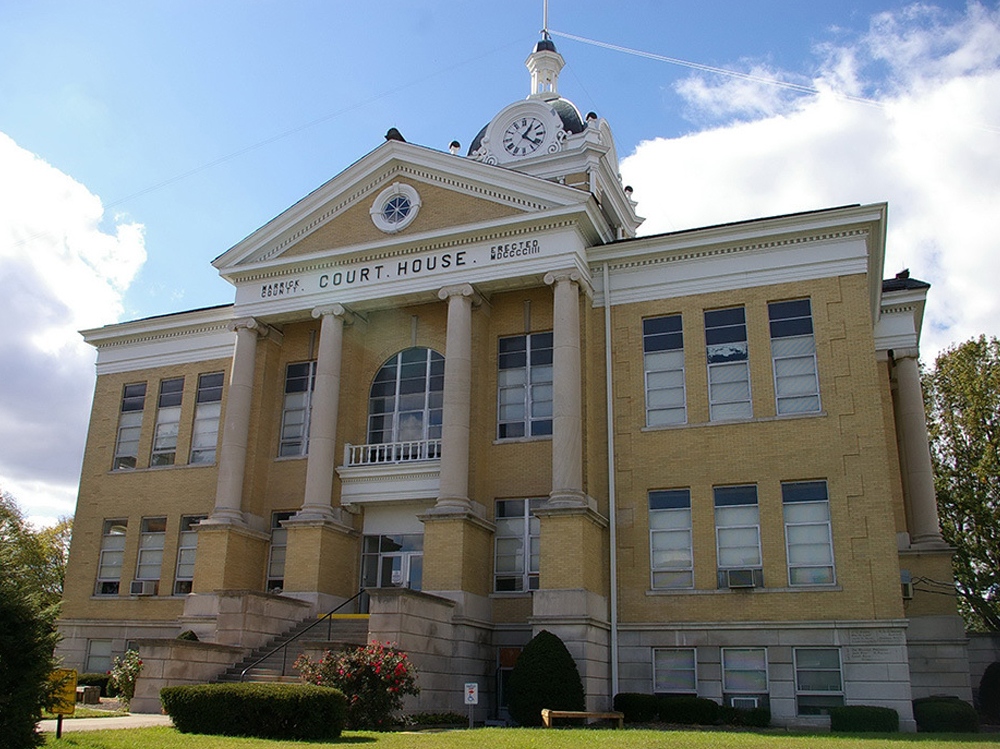
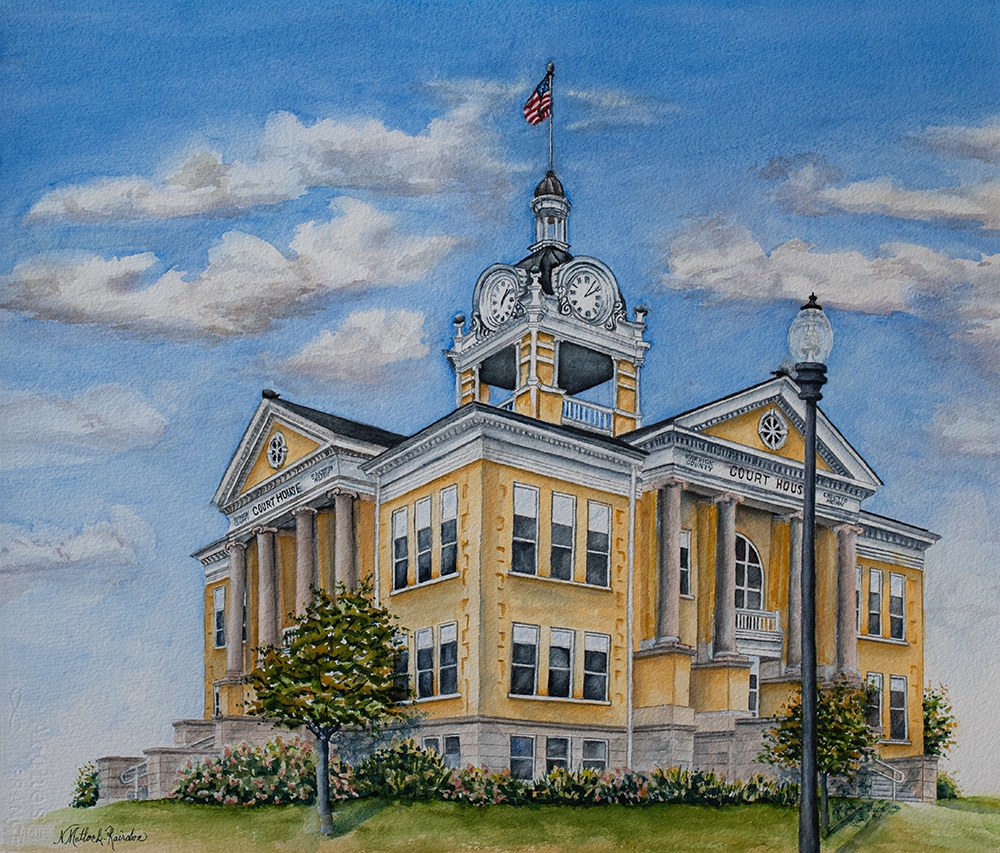
Washington County
- Artist: Richard L. Clark
- Donor: Washington County Bar Association
- Medium: Oil on Canvas
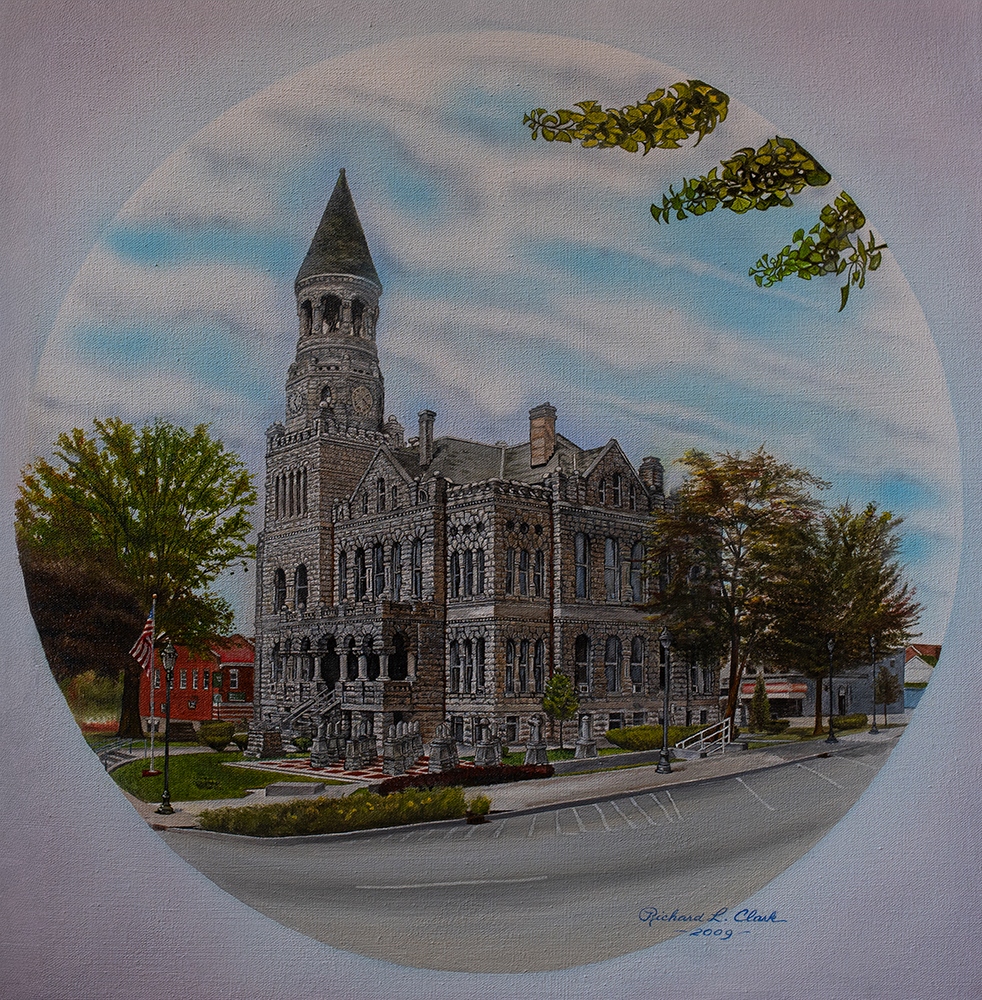
The Washington County Courthouse is in Salem. It was designed by Harry P. McDonald and his brother, both of Louisville, and built in 1886. It is a Richardsonian Romanesque building and faced with limestone from the area was used in the construction. It is two-stories above a raised basement and features a five-story corner clock tower with a conical roof. It is the third courthouse at that location. It was listed on the National Register of Historic Places in 1980. It is located within the Salem Downtown Historic District.
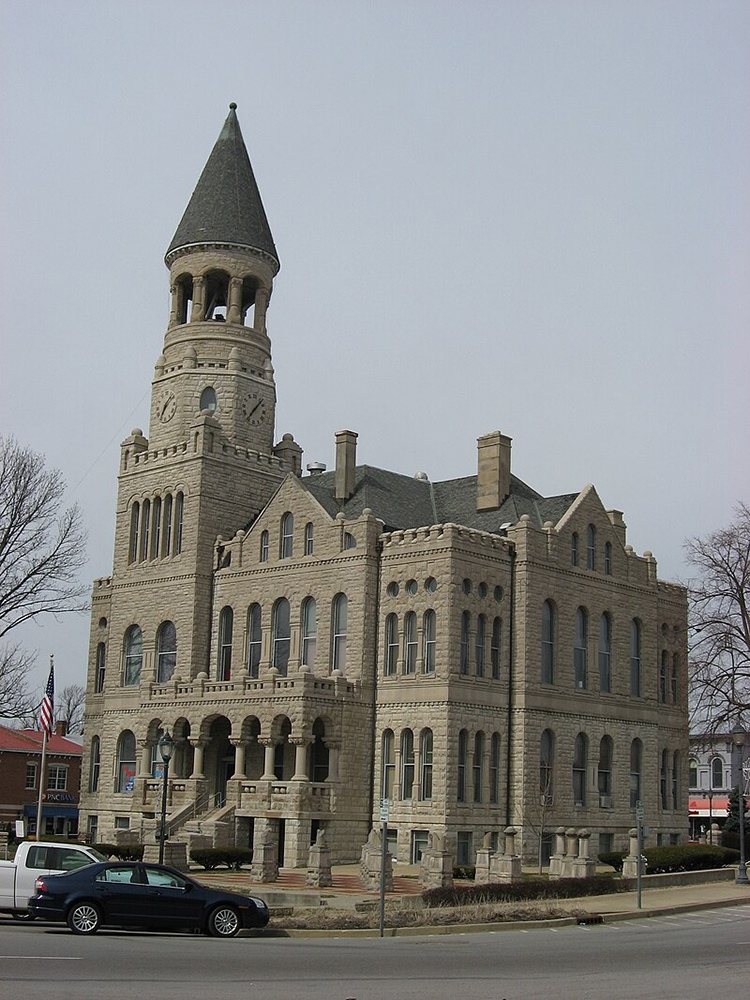
Wayne County
- Artist: Jack Phelps
- Donor: Wayne County Bar Association
- Medium: Pen & Ink
The Wayne County Courthouse is in Richmond. It was built during the period 1890–93, and is in the Richardsonian Romanesque style. The building was designed by Cincinnati, Ohio, architect James W. McLaughlin and the construction was supervised by New Castle, Indiana, architect William S. Kaufman. The U-shaped building measures approximately 214 feet by 128 feet, and is constructed of brick faced with Indiana Limestone. It features a projecting entrance pavilion, high pitched hipped and gable roofs, large semicircular arches, and octagonal corner tower. Architectural historians Michael Tomlan and Mary Raddant-Tomlan have suggested that the Wayne County Courthouse was influenced both in terms of exterior design and elements of interior layout by Henry Hobson Richardson’s Allegheny County Courthouse in Pittsburgh, Pennsylvania. It was listed on the National Register of Historic Places in 1978. It borders the northern boundary of the Old Richmond Historic District which includes some of Richmond’s earliest extant architecture.
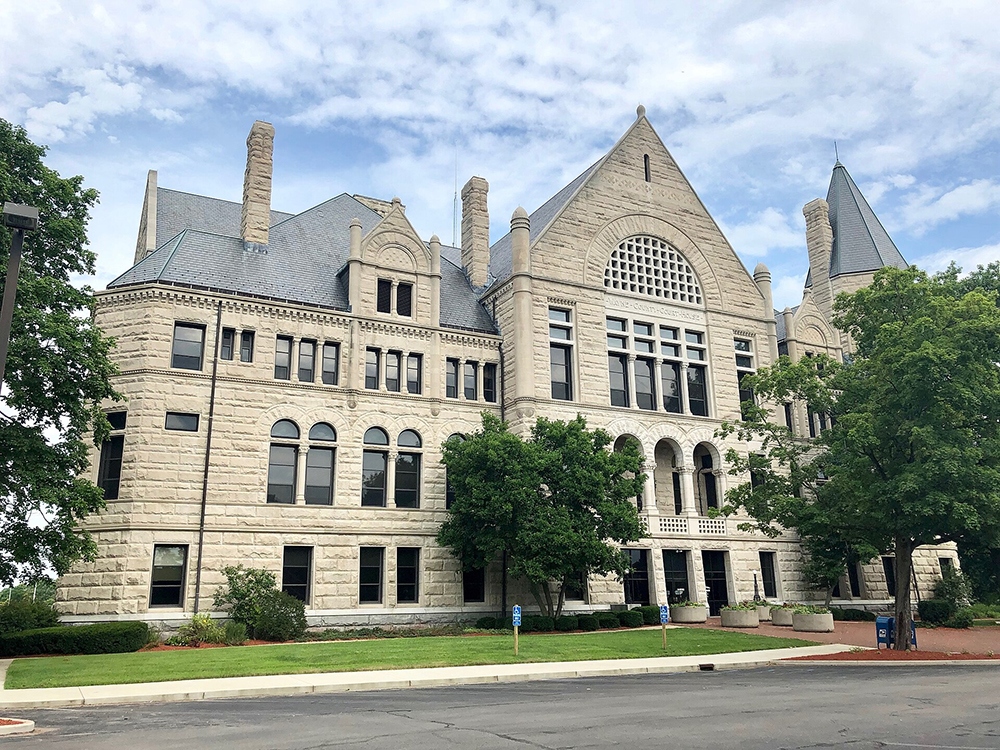
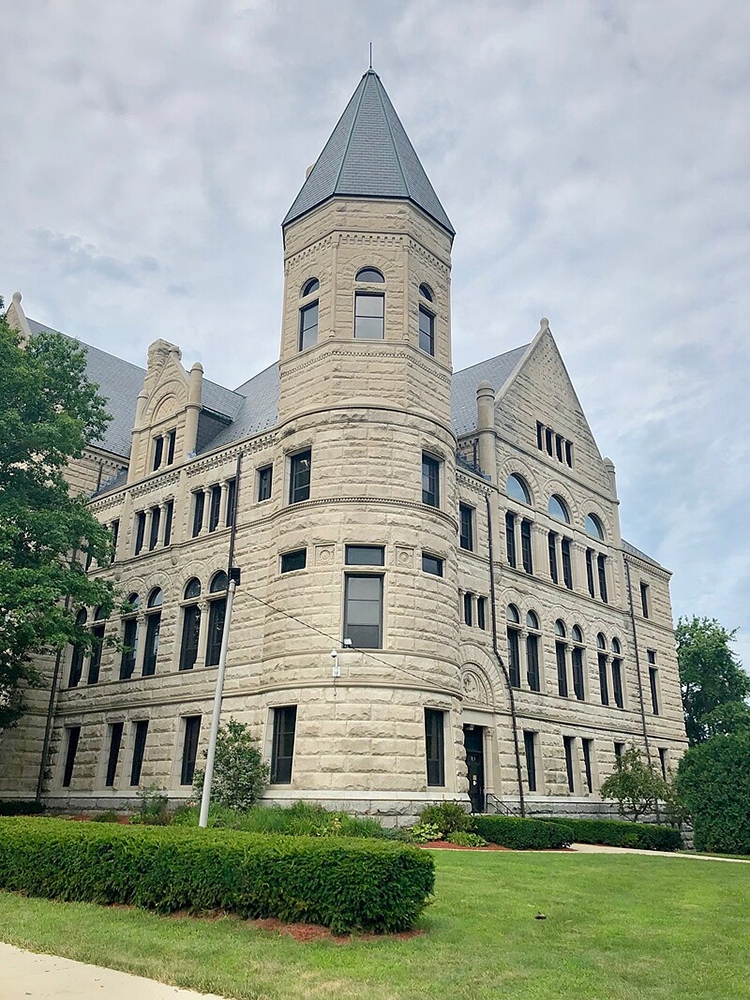
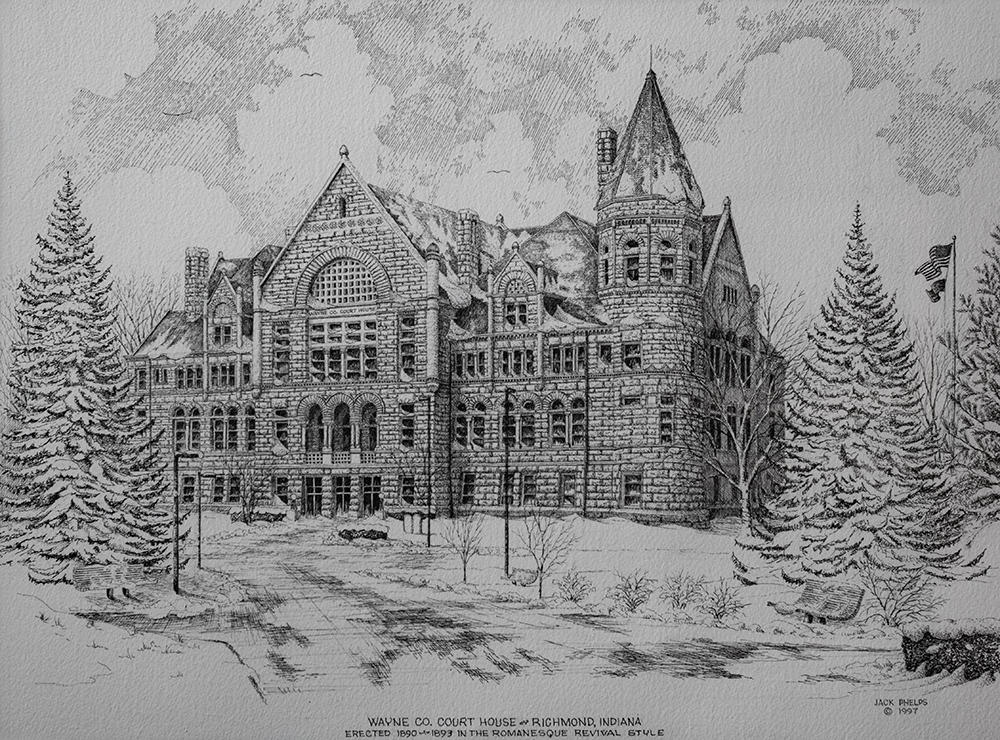
Wells County
- Artist: Don Skinner
- Donor: Wells County Bar Association
- Medium: Watercolor
The Wells County Courthouse is located in Bluffton. It was designed by architect George W. Bunting and built in 1889. It is a two-story, Richardsonian Romanesque style sandstone building topped by a high hipped roof. It has a gable roofed wing and features a four-level corner clock tower and corner turret. It was listed on the National Register of Historic Places in 1979.
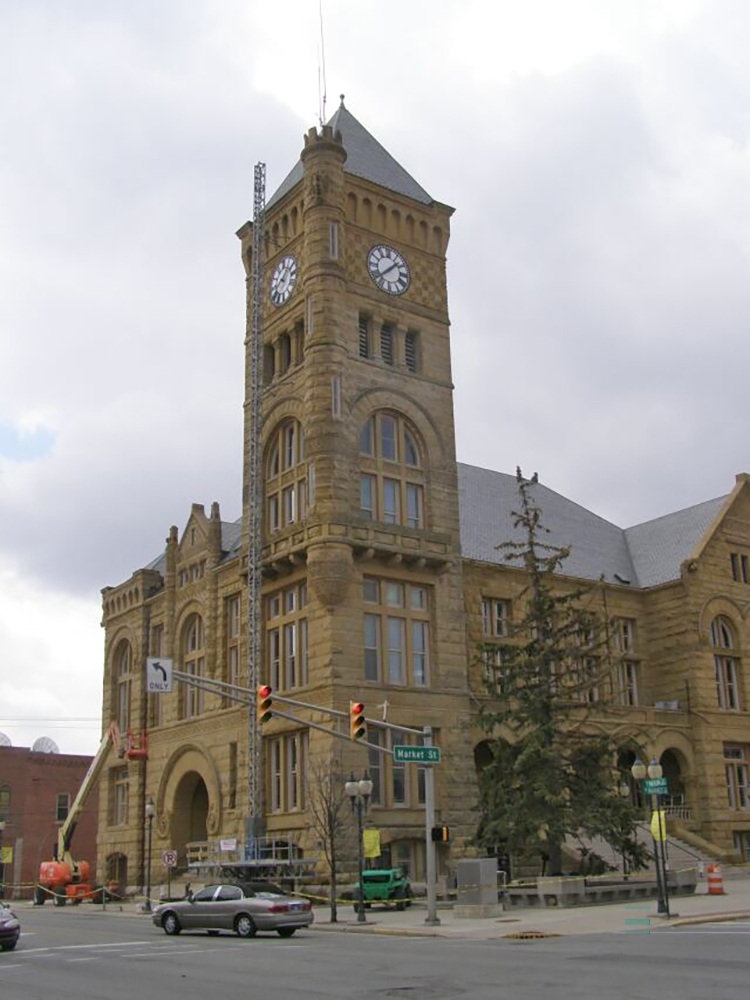

White County
- Artist: Rena Brouwer
- Donor: White County Bar Association
- Medium: Watercolor
The White County Courthouse is in Monticello. The modern three-story building was built between 1975 and 1976 and was designed by Longardner & Associates. It is the fourth courthouse in the county’s history. Its predecessor was a stately limestone building constructed between 1894 and 1895. It was destroyed in the Super Outbreak tornado of April 3, 1974, which also devastated much of downtown Monticello.

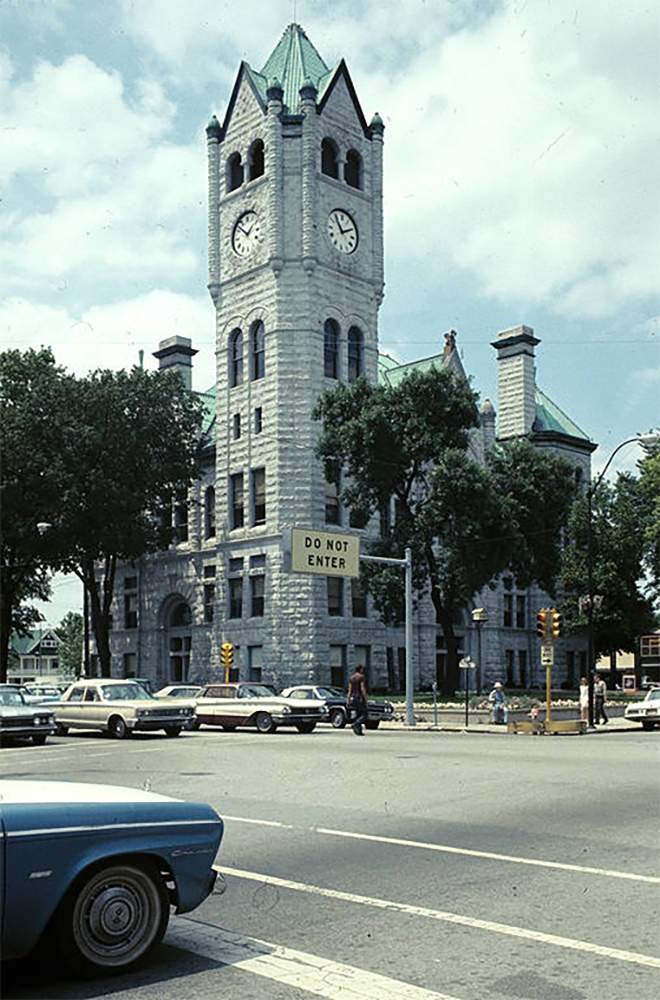
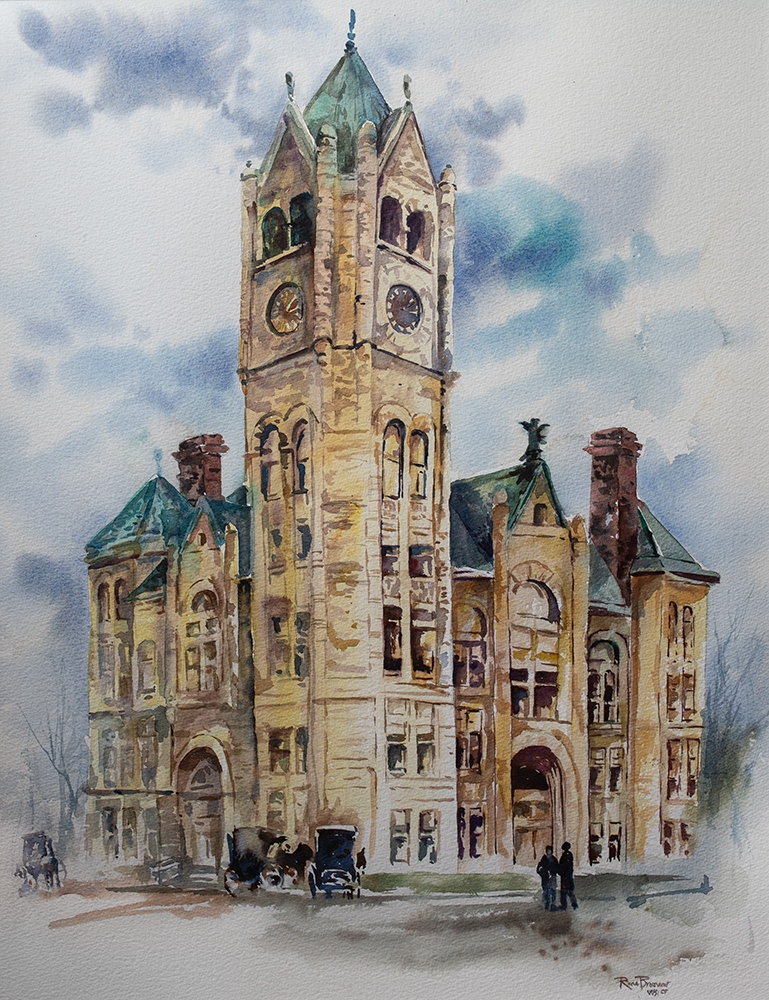
Whitley County
- Artist: Jeanette Brown
- Donor: Whitley County Historical Society
- Medium: Oil on Canvas
The Whitley County Courthouse is in Columbia City. It was constructed in 1888 and is a three-story, cruciform plan, French Renaissance style Indiana limestone building designed by Brentwood S. Tolan. It has a slate roof and galvanized iron central dome. The courthouse was added to the National Register of Historic Places on February 16, 1979.