This is the nineteenth in a Series of Reminiscences by E. R. Brown. Brown was born in Pulaski County on August 9, 1845. His writings are abstracted from the “Pulaski County Democrat” on microfilm housed in the Pulaski County Public Library, Winamac, Indiana. Find links to earlier entries at the end of this article.
Published in “Pulaski County Democrat,” July 6, 1922
I can readily see that an early experience of a small farm lad, much as it might loom up in his memory, might well be of little public concern. Yet what he saw at some certain time and conditions as they were then may be of interest to others.
The longest piece of that one noted highway still remaining substantially where it formerly was is that extending from Lowey’s grove, north of Pulaski to a short distance this side of the old T. J. Galbreath home four miles or so down the river. With possibly a few slight changes the present road between those points is the same as the old one, established almost ninety years ago. That it should follow the township line between Monroe and Indian Creek, or any survey line as far as it does was an exception to the rule But instead of running due north this side of the
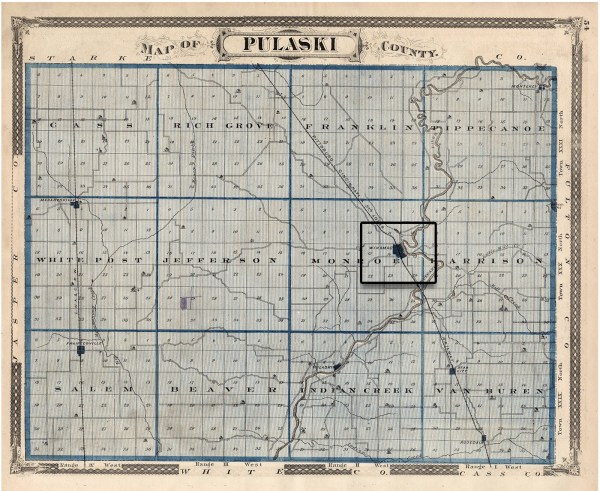
Galbreath place as the present road does, the old road continued along the river bank, affording a fine view of the water, including an almost perfect fish dam, until the place known as the Wm. Key farm was passed, and with little if any deviation from a straight course, cut diagonally across the Phillip Walters farm (now Mr. Whipple’s) and other land and passed the Laben Estes home (now J. C. Ren’s) as it does now. There the present road turns due north again, but the old one made no turn until it reached the ridge beyond where the railroad now is, where it was joined by the road from Logansport. When the railroad came it crossed this old road much nearer the river than it does the present road. Then near its junction with the Logansport road, this old road I am describing, turned and came directly to what was then the south end of Front street at the crossing of Washington street, as many of our older citizens will recall. The fields south of town, as well as the ground occupied by Rowan’s addition, then stood thick with timber and the road cut diagonally across all of them.
This old road was familiar to a great many people. Besides being much traveled by non-residents it was for many years the only one by which those living down the river on either side could reach the county seat except in a dry time. The present road directly south and the one now most traveled to Pulaski and other points down the river on this side were not opened until much later and could not be used for hauling in a wet time until long after they were opened. Almost every family which lived along this old road at an early time is represented at the present time in Winamac. Beginning particularly at Lowry’s grove we have descendents of the Bowers, Mowrys, Shelharts, Doyles, Nyes, Galbreath, Keys, Estes and perhaps others. Along this stretch of road our two honored citizens, formerly judges of our circuit court, Burson and Nye, once toiled as plain farmer lads. Both have dropped corn by hand, covered it with a hoe, tended it with one horse and single shovel plow and husked it when their fingers were stinging with cold. Both had cut wheat with a cradle, bound it with its own straws and perhaps threshed it with a flail or trampled it out with horses. And both doubtless have rendered many important decisions while on the bench, which will be cited as good law long after they are gone. I doubt whether either ever gave them more serious thought that as boys they had some problem getting a day off to attend some show or other function and where the price was to come from.

After reaching here I was permitted to give the place the once over and after that no one could truthfully say I had never seen a town with houses on both sides of the street, I did think Winamac was some town. Our town was then mainly if not wholly on Front street between Main and Madison, the west side being mostly occupied with small business places and the east side with cheap dwellings, generally unpainted. I do not recall any of them being more than one story high. The balance of the town plat seemed to be thickly covered with bushes. I have recently seen a statement that Winamac had 200 people in 1850. My judgment would be that not over 150 lived in the town limits at the time of my visit. We now have eleven other towns, nine of them on railroads, three besides this one being incorporated. If none of them, including our own, has made a remarkable growth it is some satisfaction to reflect every bit of growth that they have made, all the facilities they have developed and the entire wealth that they have accumulated has been because of the improvement of the country around them.
Some changed in seventy years!
Links to Earlier Articles
- Part one (Common Inconveniences) October 2018 newsletter.
- Part two (Land) June 2019 newsletter.
- Part three (Trees & Timber) November 2019 newsletter.
- Part four (The River) February 2020 newsletter.
Later editions are carried as separate posts.
- Part five (Public Roads)
- Part six (Schools)
- Part seven (Markets & Trading Points)
- Part eight (It’s Mills)
- Part nine (Wild Game)
- Part ten (Feathered Wild Game)
- Part eleven (Animal Pests & Birds of Prey)
- Part twelve (Fishing in the Early Days)
- Part thirteen (Wild Fruit)
- Part fourteen (Early Commerce on the Tippecanoe)
- Part fifteen (It’s Homes and Home Life)
- Part sixteen (House Raisings)
- Part seventeen (Clothing a Family)
- Part eighteen (Log Rollings)