One of Winamac’s best remembered citizens was Mac Carper, known for his well-stocked and progressive drug store downtown. He came by his industrious nature naturally. Obadiah Carper, his father, was an early white settler and businessman.
From F.A. Battey and Co.’s Counties of White and Pulaski, Indiana, 1883, we know some of his family’s history. Obadiah Carper was born in Massillon, Ohio, in 1818. He learned the trade of inside finisher of houses before marrying Martha Miller. In 1841, they moved to Iowa for a short time, then returned to Ohio to live in Harrison County. Next, they moved to Whitley County, Indiana. In 1861 the family moved to Winamac, where they “embarked in the grocery trade.”
He must have been an excellent businessman, because he soon acquired a considerable amount of property. In 1863, he erected the Carper House. He ran the hotel until 1872, selling it at that time to go into farming north of town. He sold the farm and returned to Winamac in 1878, building a house where he lived until his death in 1880.
Carper House
While this article is about Mac Carper, the son, the Carper House is worthy of some information.
The Carper House was a frame construction. It was a large hotel, including a restaurant, that had been built to accommodate railroad passengers. It was situated on the northeast corner of Main and Market Streets. As noted above, Obadiah Carper sold the hotel in 1872. In December 1880, the same year as Mr. Carper’s death, it was destroyed by fire.
Being in a prime location – across the street from the Courthouse – the property was quickly leased. In 1881, Henry Baker rented the property to run a livery and feed stable. At this time, wood-frame structures were giving way to sturdy brick buildings. On the west side of Market Street, the Keller Block was completed and opened for business. The Frain Hotel was erected immediately following the loss of the Carper House. In fourteen years, the old courthouse and jail would be replaced by the courthouse that now stands.
Mac Carper
Obadiah and Martha had five children. Their youngest, Marshall, was born in Whitley County in 1858. Marshall – known as Mac – learned telegraphy and was employed at different stations along the Pan Handle railroad until 1874. At that time, he began clerking in Winamac. In the spring of 1877, he formed a partnership with G.W. Dolph in the drug business. The firm of Dolph & Carper were among the best in town. Per the writer in the Battey book, they carried a stock of about $1,000 value and transacted an average annual business of $12,000. In 1881, he married Lola Hathaway. In the 1880s, it appears Dolph & Carper was one of three drug stores in Winamac, the others being Morehart Bros. and F. W. Thomas & Co.
A Search for Evidence Based on a Photograph
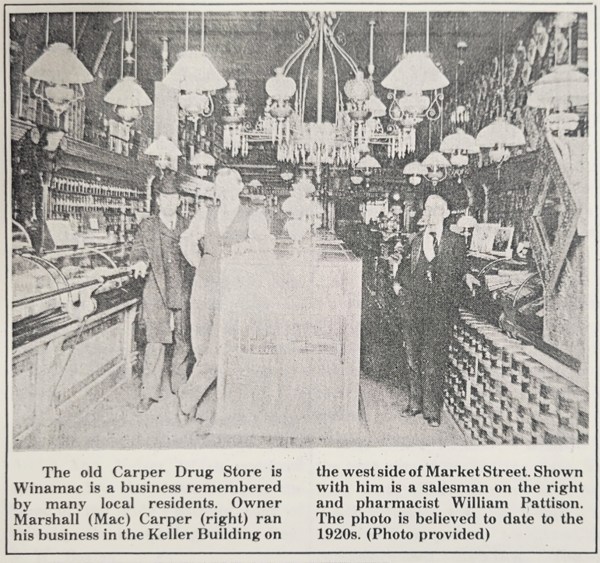 In 1989, the local newspaper asked Library staff about a photograph. The photo was published in the paper on May 24, 1989. It is unclear if the following article was published or if it was used as a program. Assuming the piece to be dated sometime in the spring of 1989, it follows.
Ask the Library … More About “Mac” Carper … And His Drug Store
About six weeks ago the Journal asked the library for help dating a picture of Carper’s Drug Store. Unfortunately the newspaper picture is a little unclear in a couple of crucial spots, however, we decided to forge ahead anyway. The most obvious clue in the picture is the lighting, which places the date prior to 1902 when at least the majority of businesses in town had electricity. The weather was cold (or at least chilly) since the salesman is wearing a coat. It’s difficult to judge W.D. Pattison’s age, although he appears young. He was about 20 when he began to work for Mac Carper in 1893. The soda fountain on the left side of the picture (and covered – another sign of cold weather) was put in place in 1895. Now to get down to the nitty-gritty. IF that’s paint behind Mac Carper and IF that’s a beveled plate glass and hand rubbed, polished, quarter sawed white oak cigar case that Pattison is leaning against, then the date must be between October 1896 and February 1897, because the case arrived in the spring of 1896, and the paint was moved to a different area of the store by spring of 1897. Mac always seemed to like to start out his year with something new.
So that’s my “best guess” for the date of the picture, but I’ve been wrong before … and next week I might even tell you when.
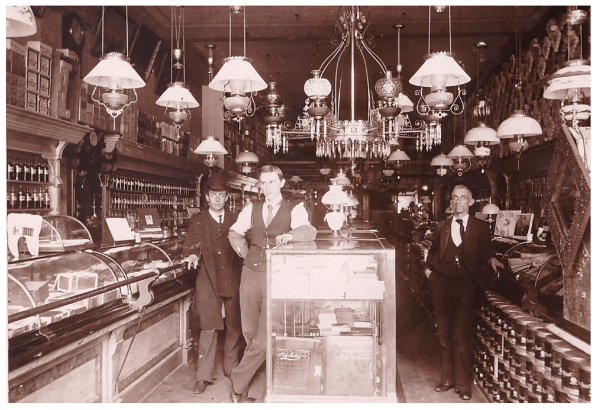 The Historical Society was in possession of this same photograph, sharper and clearer, in its files of the Pattison family. William D. Pattison is second from the left in this photo.
The Articles Leading To The Library’s Conclusions
LOCAL PAPER – APRIL 18, 1895
 In about three weeks Mac Carper will have in position in his drug store one of the best and handsomest soda fountains ever seen even in towns double the size of Winamac. It is made from tile, and is far superior to marble. It is a twelve-syrup fountain, stands ten feet high from the floor, and is expected to produce a quality of “sweetened wind’ that is second only to the elixir of life. It will stand on the south side of the room, and will occupy quite a “chunk” of space.
LOCAL PAPER – DATE NOT ON THE COPY RECEIVED BY PCHS
We told you some time since M. Carper would be seeking to add another story to his already immense storeroom, stacked from wall to wall and top to bottom in every inch of wall space with his mammoth stock of goods. He has not added the extra story, but he has had a gallery built running around both sides and the back end of the room which makes the handling and caring for his goods much safer and more convenient. The goods which he has in his room could be displayed in two rooms in an ordinary manner and still the stock would look crowded. Mac has learned the method of using every nook and niche to good advantage.
LOCAL PAPER – MARCH 6, 1896
Through press of duties last week we failed to say anything about Mac Carper’s new cigar and candy cases. They are marvels of workmanship in beveled plate glass and hand rubbed, polished, quarter sawed white oak and an entirely new departures from the old standard ideas of show cases. The cigar case has a storage case beneath with a counter front of plate glass and the stock on sale rests on wire netting beneath which absorbent material filled with water is kept to keep the cigars in prime condition at all times. If there is a finer equipped drug store in northern Indiana than is Carper’s please speak up because we believe he is just man enough to keep up his end of the string all times. He not only believes in having everything convenient but handsome as well.
LOCAL PAPER – DATE NOT ON THE COPY RECEIVED BY PCHS
It wouldn’t do for Mac Carper to let a Springtide go by without making some new improvement in his store. This time he has erected a series of substantial shelves on the gallery in the rear of the room on which to place his stock of mixed paints so that he could have more room on the main floor.
LOCAL PAPER – DATE NOT ON THE COPY RECEIVED BY PCHS
A bracket lamp just over one of M. Carper’s fine show cases and hung on the frame between the front door and show window on the south side came loose from its moorings some time Sunday night and crashed through the fine plate glass top of the case and fetched up standing in the candies in the case beneath. Strange to say neither lamp chimney nor bowl was broken by the fall.
Additional Information from the Pulaski County Public Library
For several years, the Library has published “Flashback Friday” photos either in the newspaper or on Facebook. Being an industrious Facebook user, this author conducted a search of their page and came up with these snippets containing information on the family Carper.
FLASHBACK JULY 5, 2013
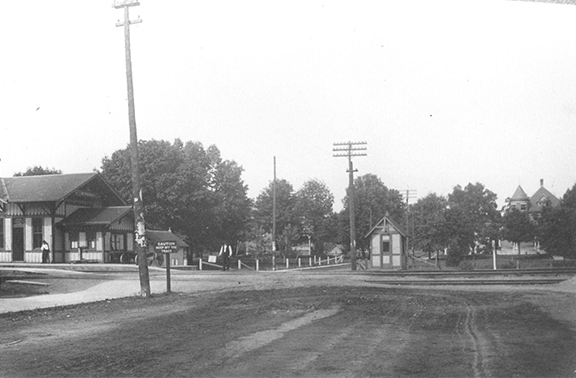 Flashback Friday! Here’s another “Wayback” photo. Our train is long gone now, but since 1862 it had been part of Winamac’s life blood. Unfortunately, it also caused a lot of loss of blood, the final straw occurring in 1905 when young Bessie Enyart was run down by a fast mail train making up time. At that time the town council decided “Enough” and demanded change. As a result in 1907 this crossing guard was established along with the viaduct farther up the line. The viaduct is gone, but the crossing guard’s “little house” can be seen today at the old depot. The guy with the flag is Ferdinand Ross, and that house in the background belonged to Mac Carper, and was practically brand new.
FLASHBLACK AUGUST 30, 2013
 Flashback Friday! The flashback this week is an old Winamac postcard from around 1910. It’s Market Street, and except for the cars on the street things don’t look too different from today. Except—and it’s hard to read the sign—or even see it—the Palace Theatre sits in what used to be the Carper House livery barn. You could get a seat for 5¢ and watch pictures that actually moved. (The Carper House was a pretty ritzy hotel, till it burned in 1881 and was replaced by the Vurpillat Opera House.) The barn was demolished in 1917 to build a bank. And if you go on down across the street, there’s the old jail on the courthouse lawn. One of my favorite things in this picture is the wooden Indian standing outside the barber shop. I wonder where it got to.
FLASHBACK MARCH 6, 2015
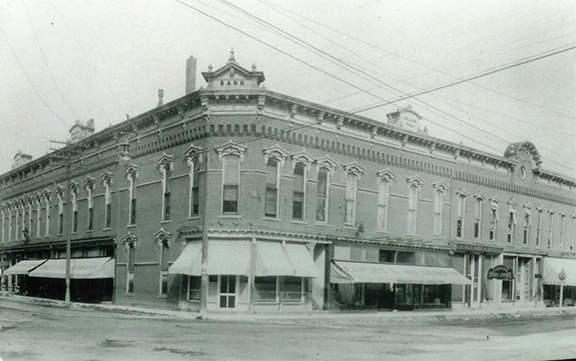
 Flashback Friday! In 1907 G.B. Fawley and E.B. Holdermann came to Winamac and settled into the Keller Block on the corner of Market and Main streets. Holdermann retired from the business in 1909 and Fawley changed the name to the Big Store and carried on with John Abbott as manager. This picture shows the Bank of Winamac still holding strong in its little niche on the corner where it had been since 1881, surrounded by the Fawley and Holdermann department store. Carper’s Drug Store, another of the original occupants of the Keller block, can be seen north on Market. Fites’ jewelry store is next, with his unusual sign (a pocket watch?) standing on the street edge of the sidewalk. Finally there’s George Keller’s clothing store (which many years later became Shank’s.)
FLASHBACK JULY 14, 2021
 Carper Drug Store sold postcards. This collage shows three of the county’s Courthouses and the school. These cards were from the Weldy Collection.