 This piece uses some articles from Newsweek and an editorial from the South Bend Daily Tribune. For more information, including local connections to the trial, come to the new Historical Museum when it opens in July!
January, February, and March 2025 mark the 45th anniversary of the Ford Pinto Trial, the trial that brought Winamac – for one brief moment – into the national spotlight.
This trial was a bellwether. The concept of corporations being held criminally liable was new; corporations throughout the country watched to see if this could be their new future. From Wikipedia: 117 lawsuits regarding rear-end collisions were brought against the company. The two most significant cases were Grimshaw v. Ford Motor Company (California 1978) and State of Indiana v. Ford Motor Company (1980).
In Grimshaw, Ford Motor Company was found guilty. The jury awarded $127.8 million in total damages: $125 million in punitive damages, $2,841,000 in compensatory damages to passenger Richard Grimshaw, and $665,000 in compensatory damages to the family of the deceased driver. The jury award was the largest against an automaker at the time. The judge reduced the jury’s punitive damages award to $3.5 million, which was “still larger than any other punitive damage award in the state by a factor of about five.” Ford subsequently decided to settle related cases out of court.
The case in Indiana turned out quite differently. Ford Motor Company was found not guilty. Later that same year, a civil suit resulted in $7,500 in damages to each plaintiff.
Newsweek: Ford Goes To Trial
Tom Nicholson with William D. Marbach in Winamac
January 7, 1980
 Land O’Goshen! Winamac, Ind., hasn’t seen such excitement since the big “Power From The Past” steam-engine show last July. Harold (Hoppy) Hopkins, a local contractor, got so carried away that he even wrote a song about it: “The Ford Company has turned down / Every courtroom around, / But now they’ve found them a good little town. / Here we’ll treat ‘em right …” Winamac, a village of 2,400 on U.S. 35 about 50 miles southwest of South Bend, will be invaded this week by a small army of attorneys, reporters, television technicians and the just plain curious – and some folks in Winamac are already bubbling all the way to the bank.
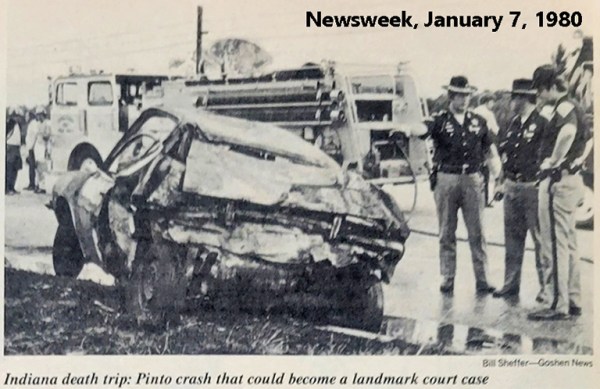
The media circus and attendant hoopla mask the serious nature of the issue at hand. In what could become a landmark case, the Ford Motor Co. goes on trial Jan. 7 in Winamac’s 85-year-old Pulaski County courthouse on three counts of reckless homicide. The case stems from a highway accident in August 1978near Goshen, Ind., in which three girls died of severe burns when their 1973 Pinto was rammed in traffic by a van.* According to prosecutor Michael Cosentino, the Pinto’s rear end collapsed on impact, the gas tank ruptured and the car burst into flames. More important, he charges that Ford knew the fuel tank was unsafe but sold hundreds of thousands of Pintos anyway.
‘Major Policy Question’: The case has enormous implications for Ford, which faces millions of dollars’ worth of damage suits from Pinto owners involved in various accidents, and it could affect any manufacturer of consumer goods. “A decision to apply the criminal process to manufacturers whose products may be involved in an accident which results in injury presents so major a policy question that it must, in the first instance, be addressed by the [Congress],” an early Ford brief stated. “Such an application of the criminal law would drastically expand common conceptions of criminal responsibility and would wipe out the basic distinction between civil wrongs and criminal offenses …”
While it faces a potential penalty of only $30,000 in fines, Ford reportedly is paying more than $1 million to a defense team headed by Nashville attorney James F. Neal, who prosecuted the major cases resulting from the Watergate scandal. In addition, the company will have about twenty attorneys, public-relations men and other officials at the trial, which is expected to last two months or so.
 Fame and Fortune: But in Winamac, the case has already brought responses reminiscent of the Scopes “monkey” trial in 1925, with some people far less interested in the case itself than in the fame – and fortune – that it will bring the town. “It’s going to be very exciting,” says Karen Hopkins, a young waitress at one of the four restaurants in town. “Nothing ever goes on in Winamac.” More to the pocketbook, the Indian Head motel, a small two-story building just north of town which normally charges $21.84 for a night’s lodging, has jacked up its room rate to $40 as long as the trial lasts. And Bill Goble, the local Pontiac-Oldsmobile dealer, quoted one reported a price of $100 a day for one of his furnished apartments, which normally rent for $265 a month. Goble says he is planning to throw in maid service and twice-a-week linen changes.
Evidence of profiteering has upset such Winamac boosters as Rick Sutton, the general manager and editor of the weekly Pulaski County Press, who doubles as secretary of the chamber of commerce. “We don’t want to be too opportunistic and we don’t want Winamac to get a negative connotation,” he says. “We want visitors to say that we treated them decently, we welcomed them and we properly escorted them out when it was over.”
John (Duke) Fagan, proprietor of the Colonial Inn, pledges that he will hold the line on prices, despite the invasion of big-city spenders. “Chicken dinner will cost you $2.50, roast beef $2.65,” Fagan told Newsweek’s William D. Marbach. “And I’m going to charge a lawyer from Ford just like I charge a guy who works in the Chevy garage.” Meanwhile, Hilda Gutwein, proprietor of the Indian Head motel, swears that she really isn’t gouging at all. I could charge $60 to $70 and the market would bear it,” she says. “But the rate’s gonna be not less than $30, not more than $40. Four people to a room is forty bucks. Thirty dollars is the minimum.”
No Church Lunches: Ford, of course, has already paid a heavy price for the Pinto’s alleged defects. Sales of the car nose-dived after widespread publicity about fatal crashes in Indiana and elsewhere. A California judge, for instance, awarded $6.3 million to a youth who suffered severe burns in a Pinto crash – and the settlement figures for pending cases would instantly skyrocket if Ford is found guilty in the Indiana trial. So perhaps the least of the company’s worries is that a women’s group in Winamac turned down a bid for catering daily lunches for Ford personnel – or that the company’s rent for nine apartments is estimated by the locals to total a minimum of $27,000 a month.
*Because of extensive publicity about the accident, Ford succeeded in having the case transferred from Elkhart County, where the tragedy occurred, to Winamac, the Pulaski County seat.
Newsweek: Ford’s Pinto: Not Guilty
Tom Nicholson with William D. Marbach in Winamac
February 25, 1980
 For four weeks, the prosecution built its case against Ford Motor Co., charged with reckless homicide in the deaths of three girls who died of burns after their 1973 Ford Pinto was rammed in traffic. Witness after witness took the stand in tiny Winamac, Ind., to testify that the Pinto was moving when it was rear-ended by a van and that it burst into flame on impact – “like a large napalm bomb going off,” as one witness described it. But last week, Ford chief attorney James F. Neal finally opened his defense – and his very first witness stunned the crowded courtroom.
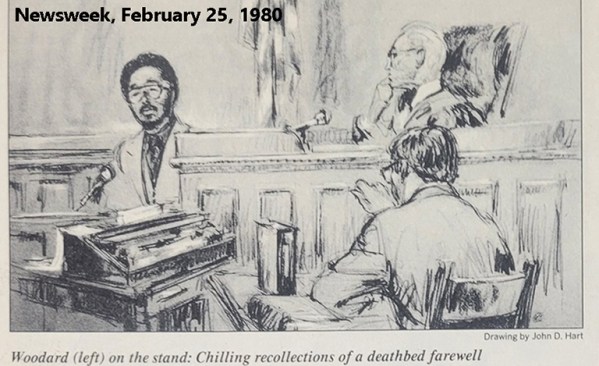
Levi Woodard Jr. said he had been on duty as an orderly at Elkhart General Hospital on Aug. 10, 1978 – the night 18-year-old Judy Ulrich was rushed into the emergency room, near death from burns suffered in the crash. “I felt she kind of had an idea that she was going to die,” the young orderly told the hushed courtroom. As he comforted Ulrich, Woodard testified, she told him what had happened. According to Woodard, Ulrich said that she had stopped at a self-service station and put the gas cap on top of the car, forgetting to screw it back on when she took off. As she drove down the road, Woodard said, she saw the cap fall off the roof and roll across the highway. “She put her [emergency] flashers on and … made a U-turn to go back and pick up the cap. She said she saw the van coming but it didn’t look like it was going to stop and then it hit her.” At the time of impact, Woodard testified, Ulrich said that her car was standing still.”
Big Bang: Woodard’s account of his conversation with Ulrich may have damaged the prosecution’s case. With seven witnesses backing him up, prosecutor Michael Consentino has maintained that both vehicles were moving – and that the Pinto’s gas tank ruptured upon impact. He has also charged that Ford knew the gas tank was unsafe but sold hundreds of thousands of Pintos anyway. The state’s star witness, Harley Copp, once a high-ranking Ford engineer, testified that “the Pinto did not have a balanced design. The car had the ability to take a 40-to-50-mile-per-hour rear-impact collision without causing serious injury to the occupants … but the fuel tank did not.” For cost reasons, Copp claimed, the tank was designed to withstand only a 20-mph crash, which would make it unsafe even in a relatively low-speed collision. But Neal had a safety witness of his own. Douglas Toms, former head of the National Highway Traffic Safety Administration, testified that the ’73 Pinto was a “very conventional” automobile – no more prone to bursting into flame on rear impact than any other sub-compact of that year.
That was an important point for Ford. Although the company faces a potential penalty of only $30,000 in the Indiana case, a guilty verdict could result in multi-million-dollar damage suits filed by other Pinto owners involved in accidents.
South Bend Daily Tribune
March 16, 1980
Had the jury failed to reach a verdict, the judge in Ford Motor Co.’s reckless homicide trial said he probably would have acquitted the automaker, a Detroit newspaper said today.
The Detroit Free Press reported that Judge Harold Staffeldt said he had the power to do so, even if the jury in Winamac, Ind., had found Ford guilty.
The nation’s No.2 automaker was found innocent on Thursday of criminal charges in the deaths of three young Indiana women who died when their 1973 Ford Pinto was struck from behind and burst into flames.
During the long trial, prosecutors contended Ford knew that Pintos could explode after rear-end collisions but did nothing abou tit. Ford lawyers said the Pinto was comparable to other small cars of its day.
EDITORIAL: Landmark Trial
The Ford Motor Co. has been acquitted of reckless homicide in the fiery deaths of three teen-aged girls, but even so, a concept of potential criminal liability has emerged from the 10-week trial in Winamac that should be considered in all types of corporations.
Corporate responsibility has long been acknowledged in civil courts, but this was the first attempt to hold a corporation guilty of a crime by failing to warn consumers adequately of possible defects in the product.
As it turned out, a jury made up of persons mainly from rural Indiana found that the huge auto manufacturer did act responsibly in the design problems it had with its subcompact Pinto car.
But in the 10 weeks of running stories in both the print and electronic media on a national s cale is the kind of thing product designers and producers should want to avoid. It was costly, too, for Ford, although the reported million dollars spent might not seem large to such a corporation, particularly in view of what conviction might have meant.
It was a unique place to hold a trial of such importance. Far from the hurly burly of the cities with their crowded streets and hurrying drivers, the population from which the jurors were chosen still represented the staunchness, firmness, and integrity expected of such an environment.
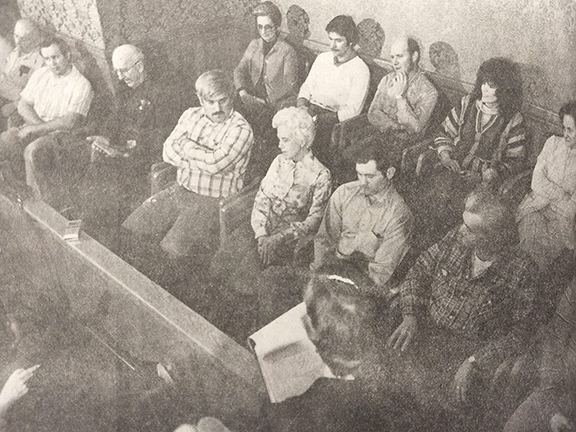
The first vote by the jury in its marathon 26 hours of deliberation was eight for acquittal and four for conviction, and subsequent votes eased toward the final unanimous verdict for acquittal.
Judge Harold Staffeldt put heavy pressure on the jury to reach a verdict. It had reported several times that it could not. The judge should not b faulted for his insistence. Ten weeks of testimony and probably as good a jury as could ever be obtained made the circumstances such that a finding seemed imperative.
While Ford officials and attorneys were jubilant over the verdict, some very uncomplimentary testimony was elicited at the trial and lessons were learned which undoubtedly will be heeded in corporate boardrooms throughout the country. Some of the jurors said they did not think the Pinto a safe car, but evidence was insufficient to convict.
Prosecutor Michael Consentino, from Elkhart County where the deaths occurred, had complained that some important parts of his case did not get judicial clearance. And he noted, too, that his trial budget was only $20,000. Still, we do not feel that this was a case whose outcome was dictated by the size of the defendant.
Winamac now can return to normal. This was quite an event for that stable community, with herds of the national press and legions of corporate counsels and executives descending on the town. The residents must be a bit relieved that it is all over.