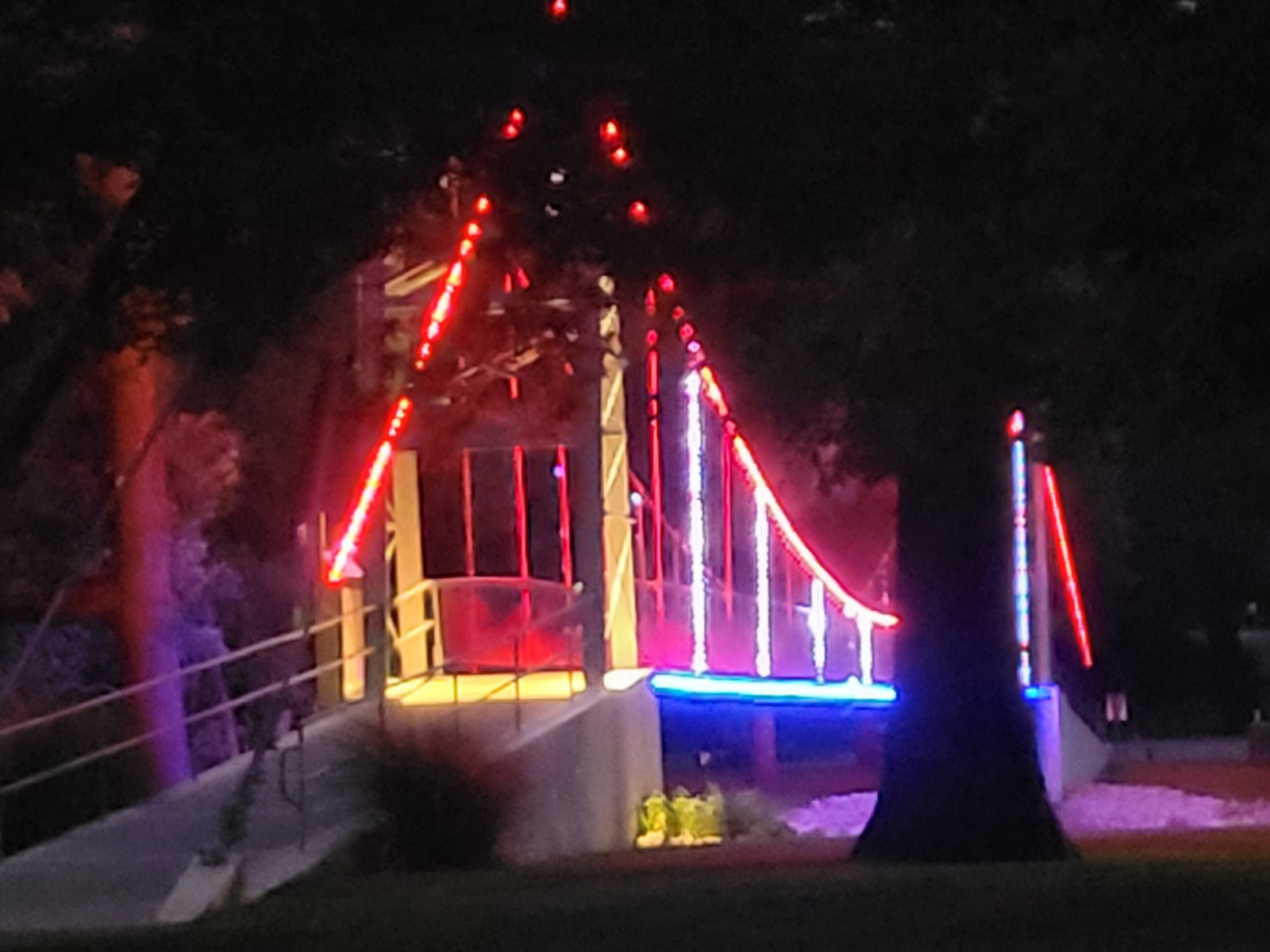
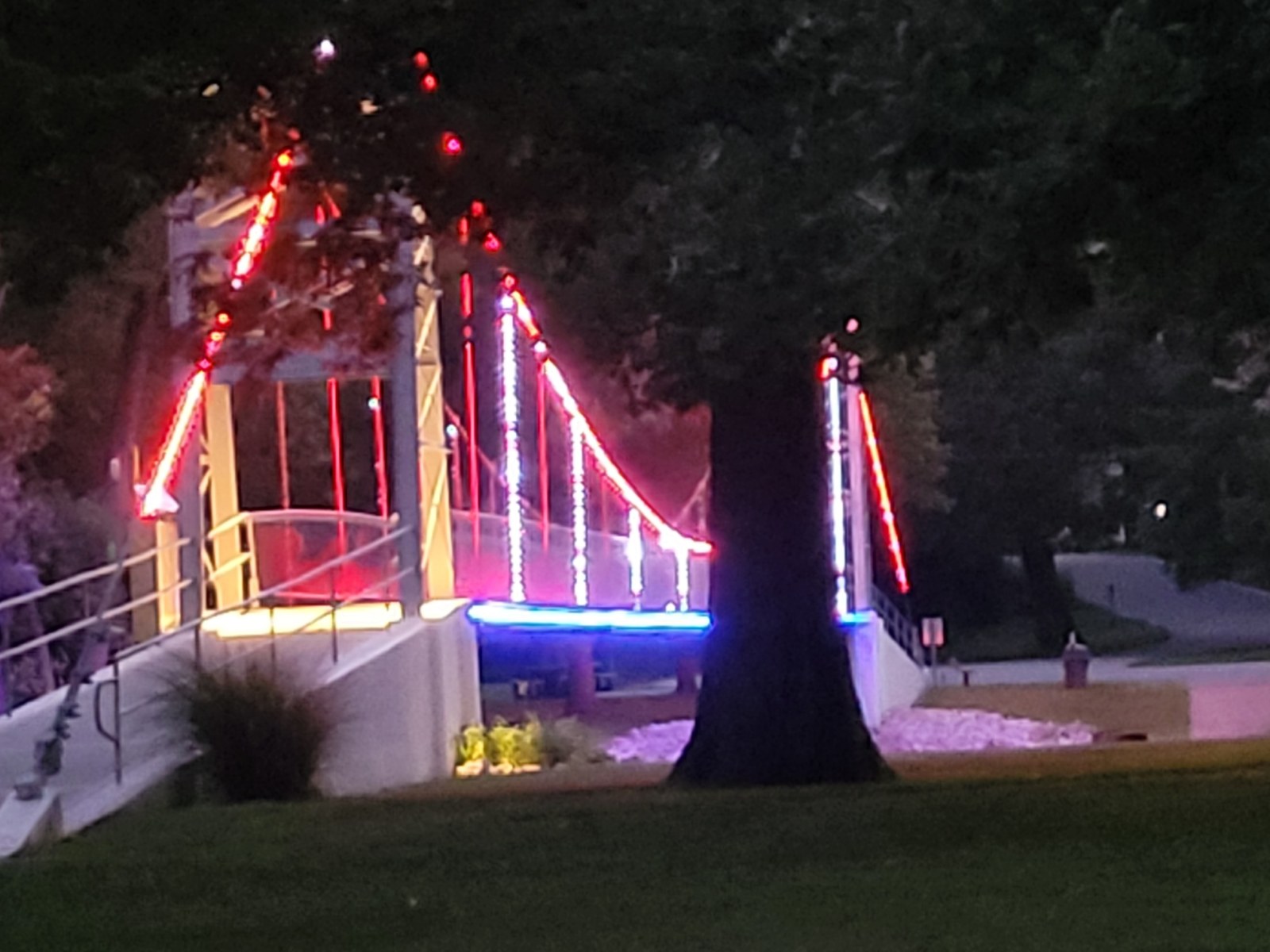
A Brief Summary
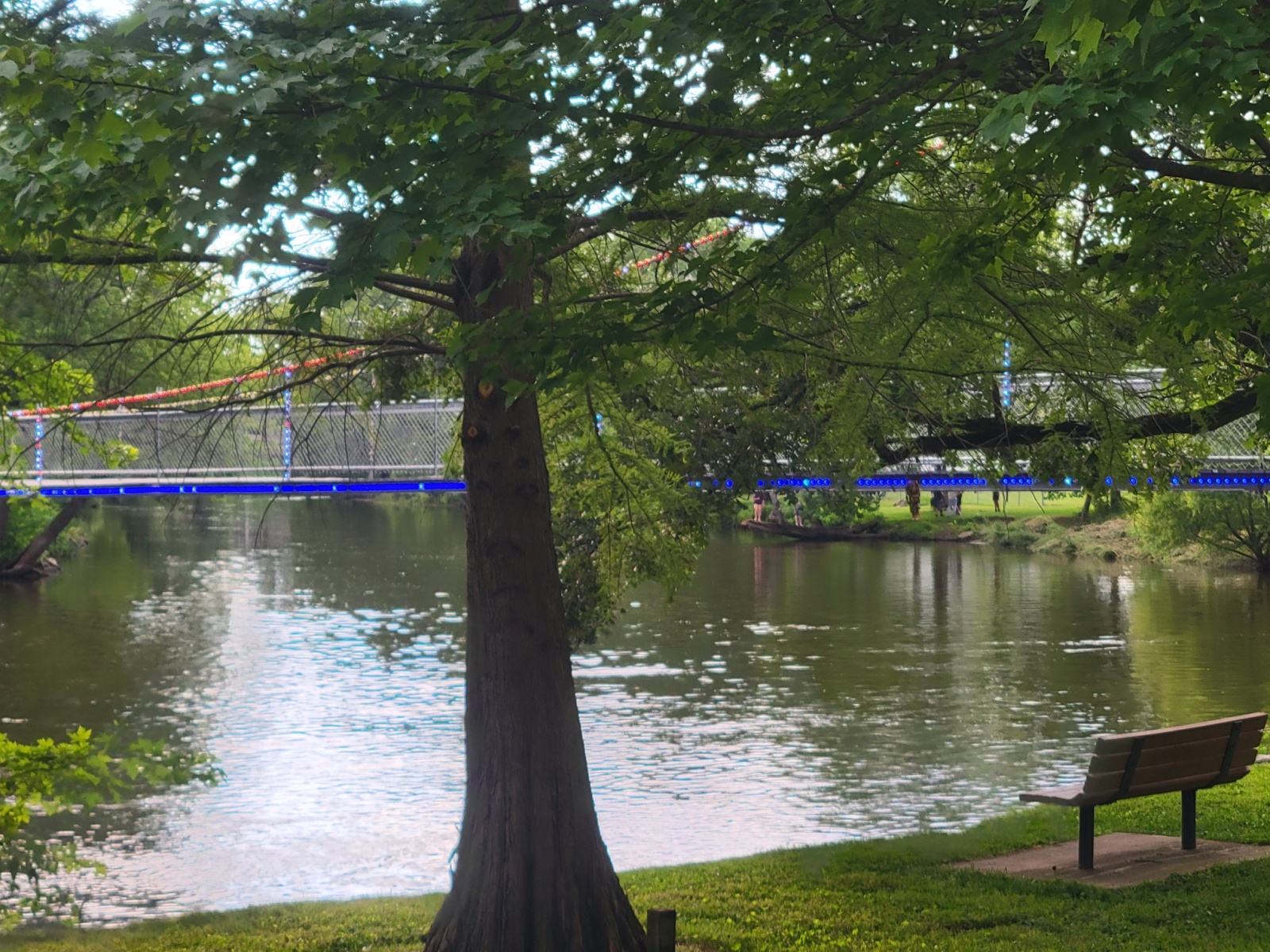
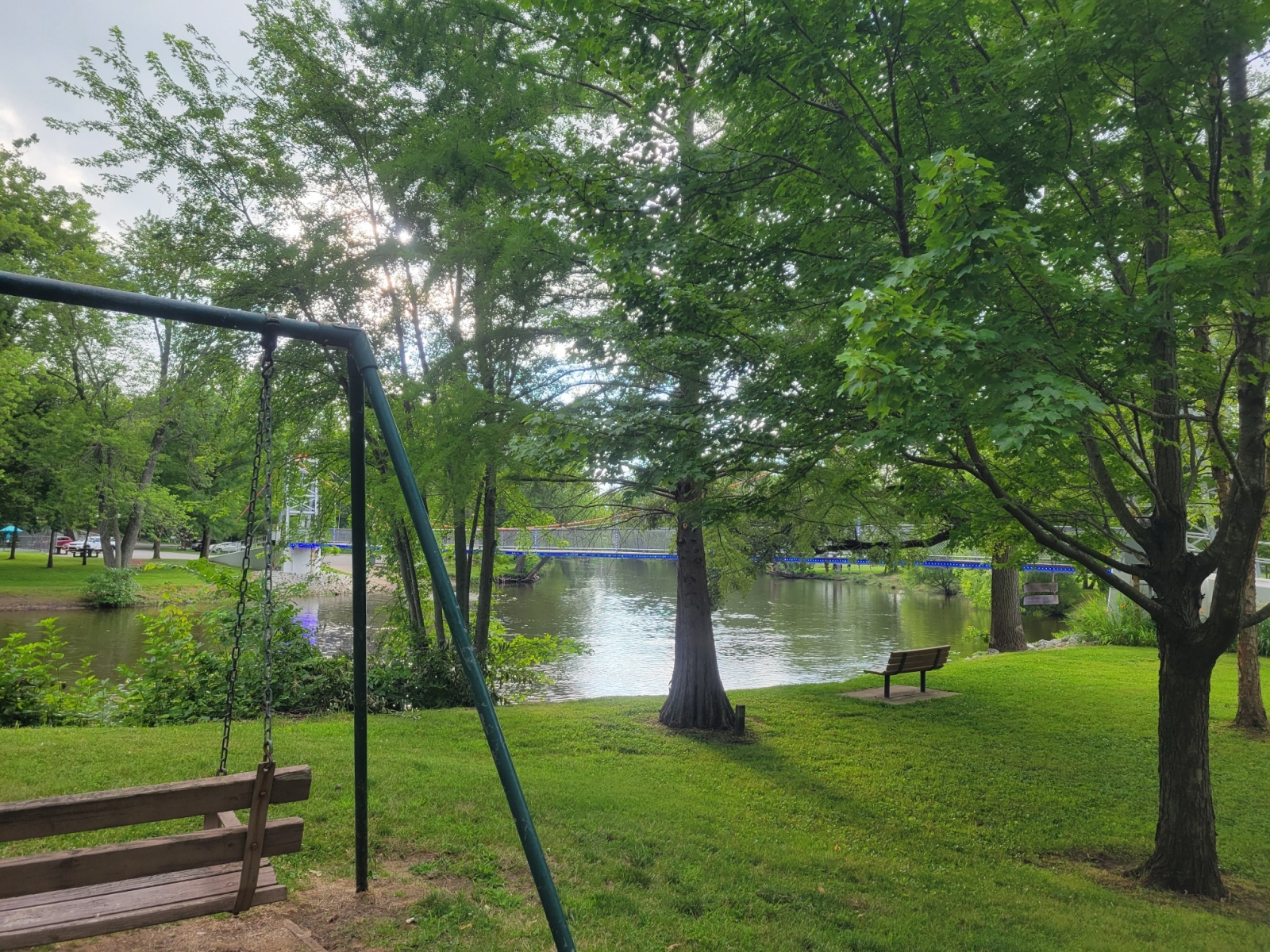
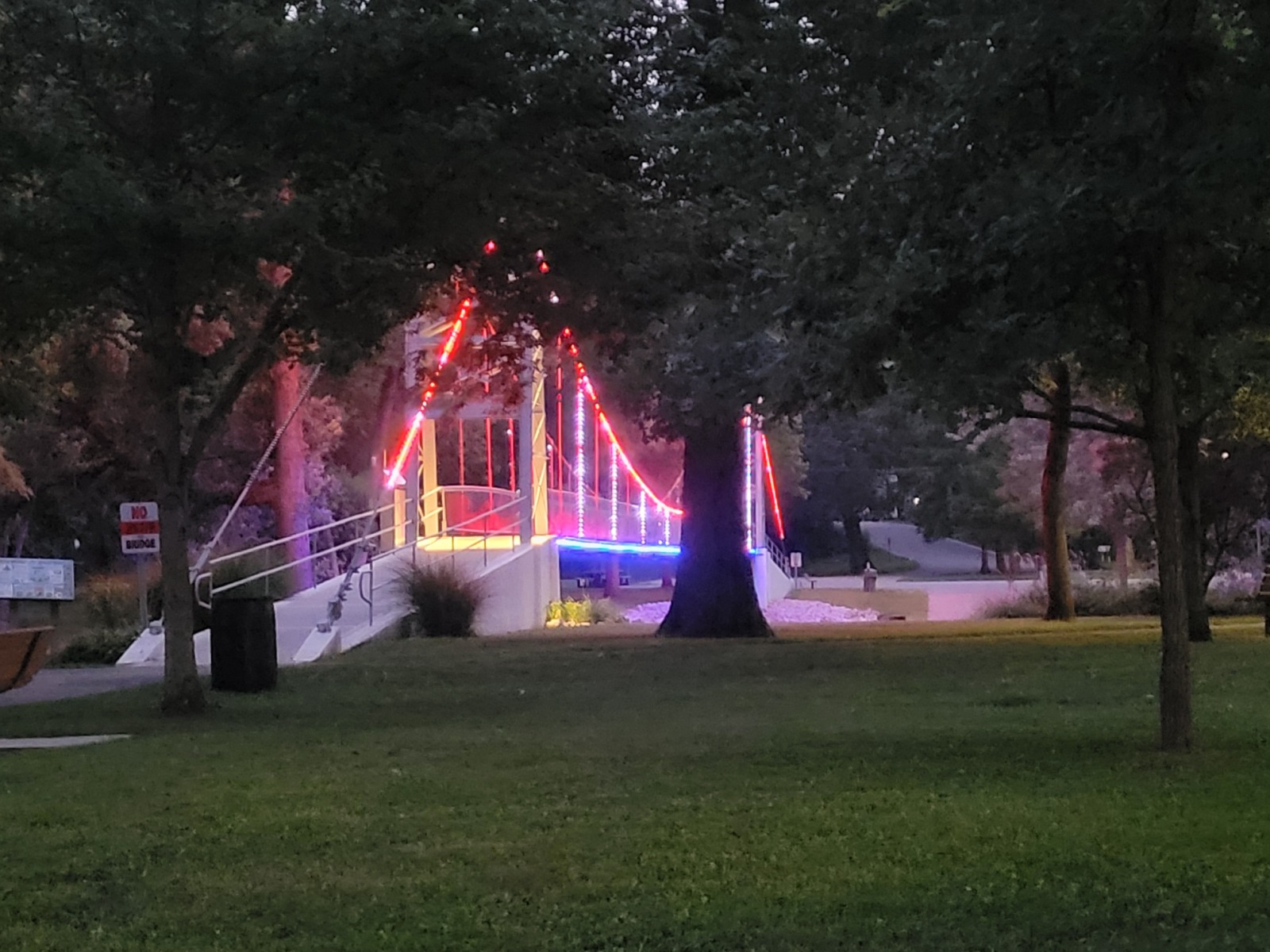
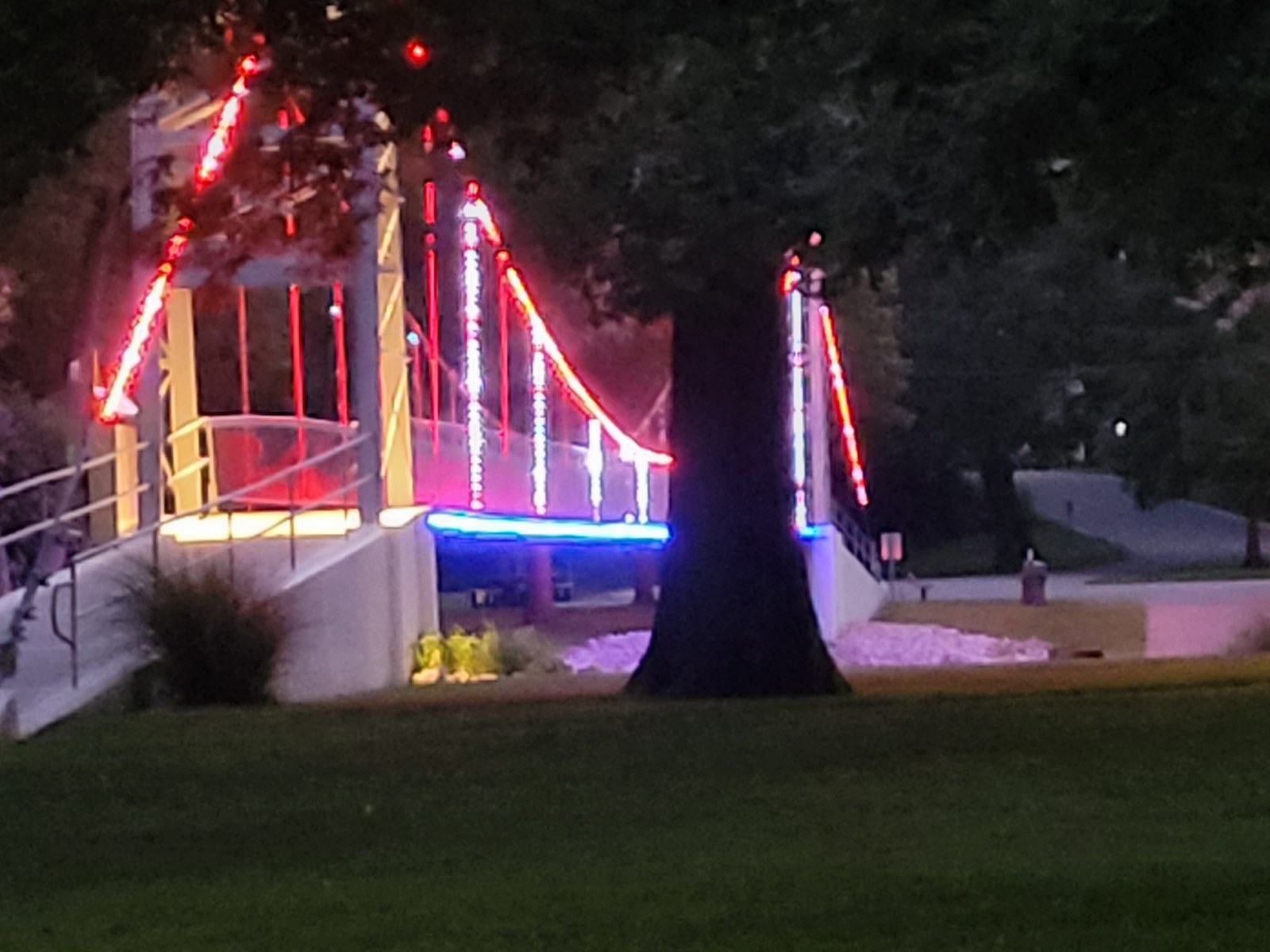
Memorial, a suspension footbridge, spans the Tippecanoe River, linking two parks from the Winamac Town Park system: the Artesian Well Park and the Winamac Town Park. Memorial is the only bridge from the Bridgemeister suspension bridge inventory to cross the Tippecanoe River.
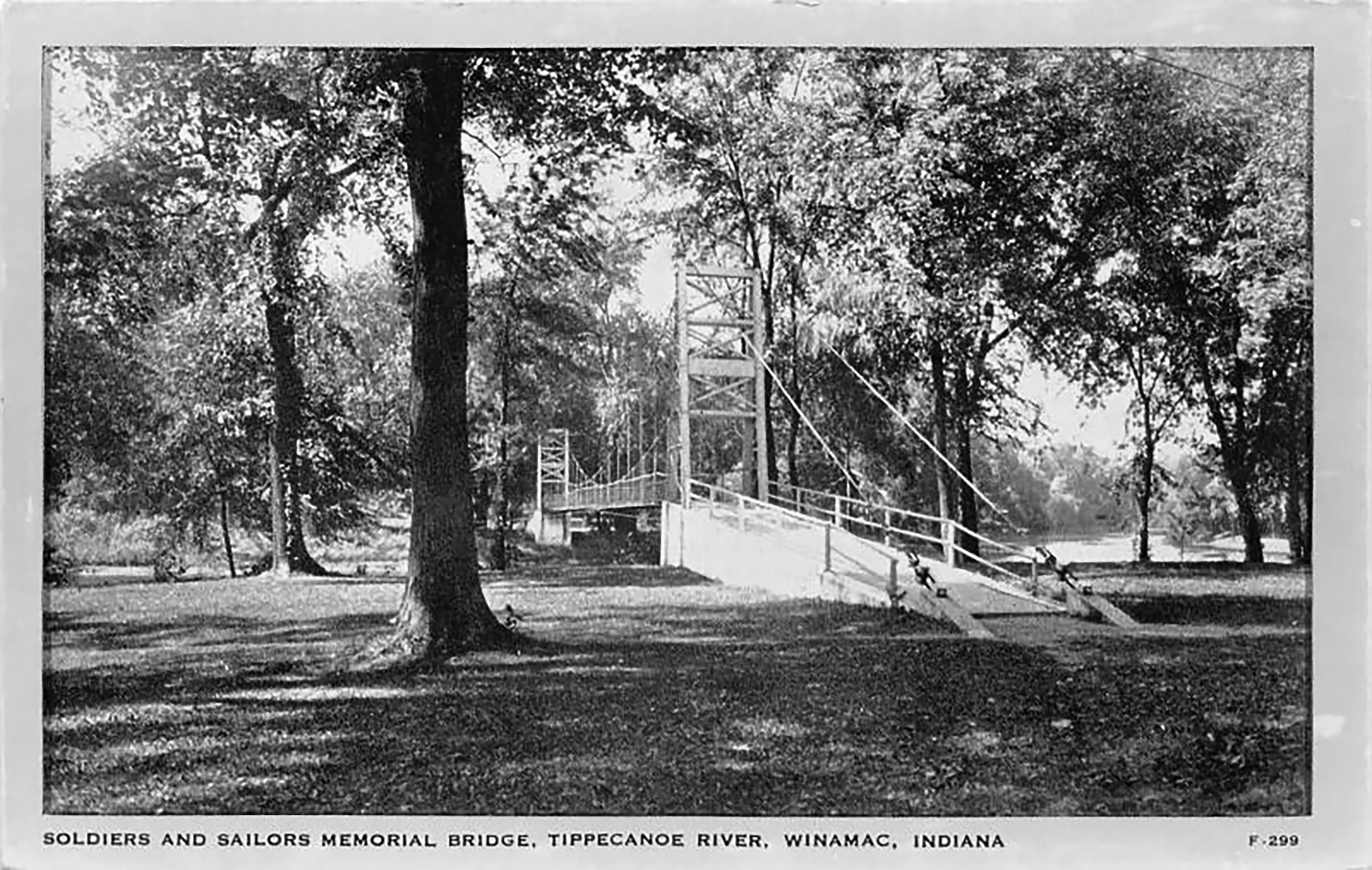
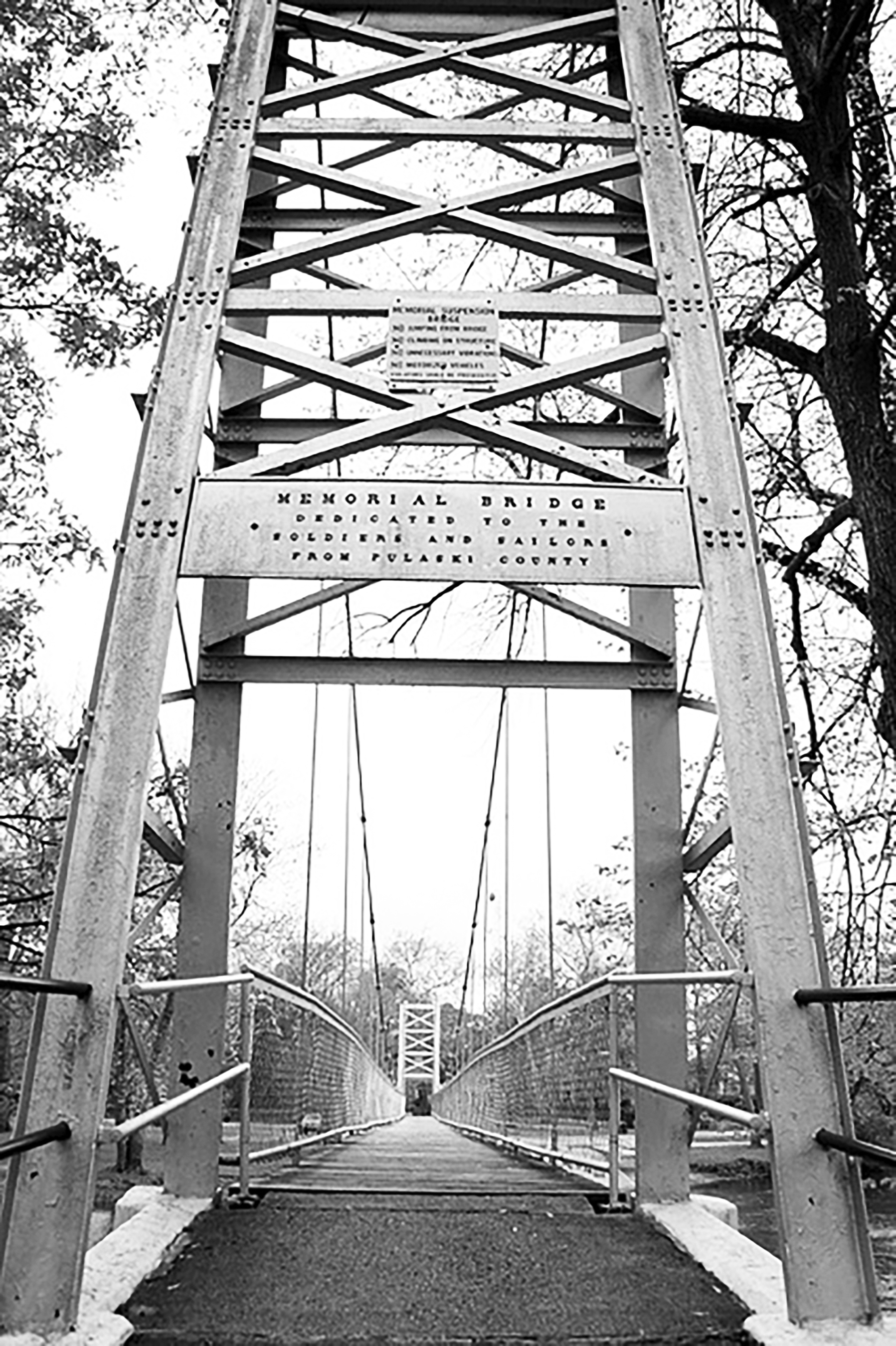
Memorial is a single-span suspension-type bridge, 200 feet long and five feet in width. On each side of the river are steel towers, approximately thirty feet high and embedded in concrete bases. Two steel suspension cables, each one and one half inches in diameter, stretch from tower to tower. The ends are attached to concrete anchors embedded in the earth about fifty feet behind each tower. The deck is suspended from vertical steel suspender cables, each one inch in diameter. The deck, originally made of creosote material, is suspended at a height presumed to be well above danger from high water. The deck is attached to the steel cables above by steel rods. “Stay” cables on each side of the bridge prevent erratic swaying. Long inclines to afford easy access on each side are held in place by concrete walls reaching back as far as the cable anchors.
This bridge, from historical references to the builder going to Chicago after receiving the bid and receiving parts via railroad train, and from a review of metal parts of the bridge, appears to have been a kit bridge from the Chicago South Works, a now-closed subsidiary of US Steel.
National and International Databases
Bridgemeister: https://www.bridgemeister.com/bridge.php?bid=849
BridgeHunter: https://bridgehunter.com/in/pulaski/memorial/
Application for National Register (written 2022, not turned in)
Memorial spans the Tippecanoe River connecting the main area of the Town Park (on the peninsula) with the smaller section of the park. Vehicular bridges have spanned the river south and north of that area, replaced on occasion when they lost their battle with the river, but solutions for pedestrians took a back seat. Temporary pedestrian bridges were placed in the vicinity of Memorial’s location until 1886. An iron footbridge was erected that year, but it did not outlast the river. Another “permanent” footbridge was placed in 1892. That bridge had to be moved immediately, as the sand on the river bottom caused the walk to settle unevenly. When that bridge was eventually destroyed, the Town resorted to their original solution, temporary wooden bridges placed “in season.”
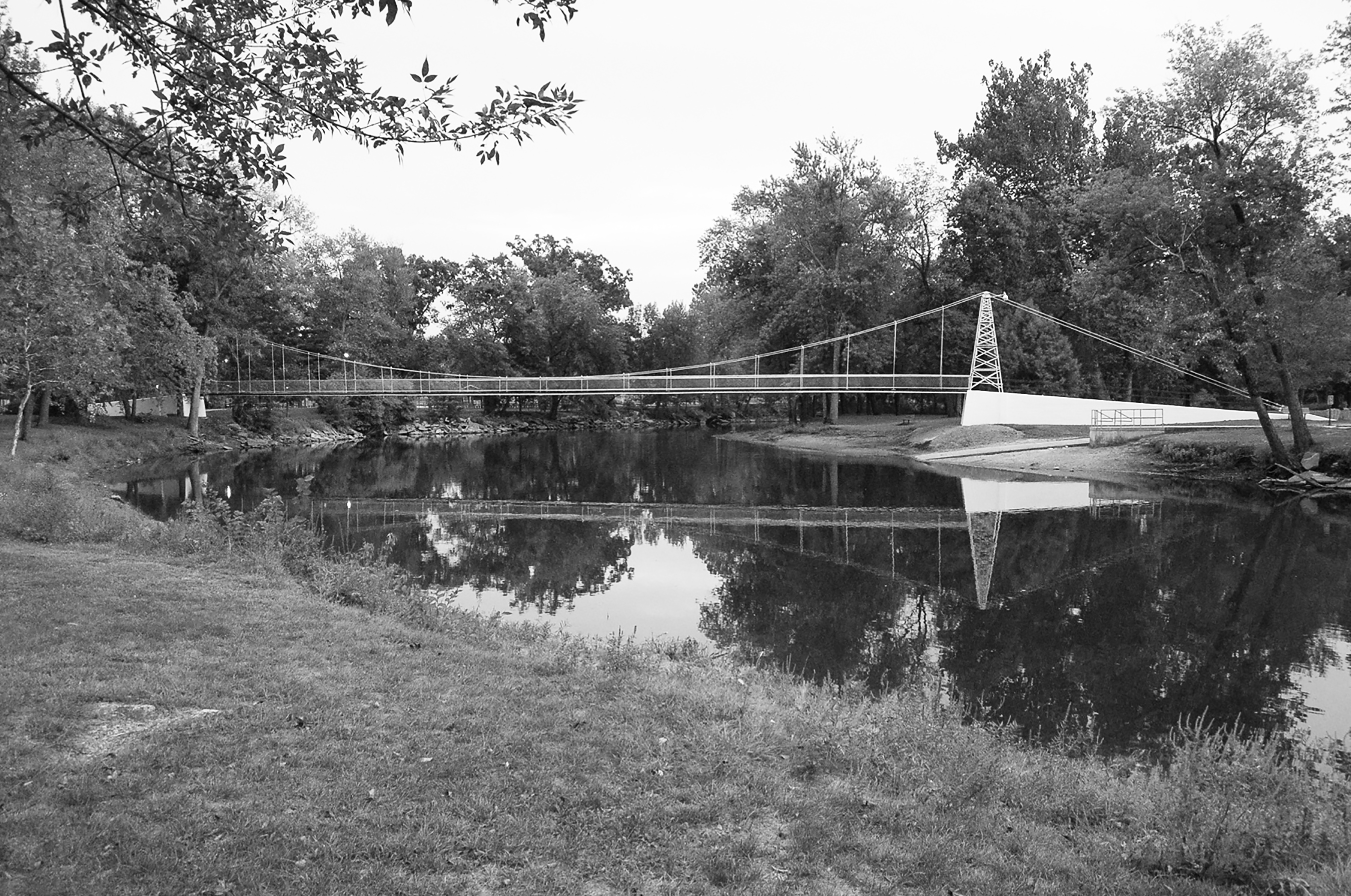 The Tippecanoe River floods every year. Some years, flooding is severe, particularly at the area of the horseshoe bend surrounding the park. R. E. Nutt, the engineer and eventual contractor for Memorial, developed specifications to place the bridge well above danger from high water. He designed a single span suspension bridge, 200 feet long and five feet wide, with steel towers embedded in concrete. Steel suspension cables stretch from tower to tower, and suspender cables hold the deck in place.
Research into Mr. Nutt’s background unearthed campaign materials as he ran for and secured election to the office of Pulaski County Surveyor. In those materials, he touted his experience as a bridge builder. Research did not ascertain for whom he worked to gain that experience, but an investigation into his family history found a brother-in-law, John W. Frain, who was partial owner of the Winamac Bridge Company.
The Winamac Bridge Company was known for several bridges. Local bridges that survive, although no longer used for vehicles, include the Woodruff Bridge south of Winamac, and the only surviving Stearns Truss Bridge, now in use as a pedestrian bridge at a historic park in Delphi. No amount of research could find Mr. Nutt as a named employee of the Winamac Bridge Company. However, the 1910 U.S. Census placed R.E. Nutt and family in the home of John W. Frain in Iowa. Newspaper accounts place Mr. Frain in Iowa during that period of time, selling and building bridges for the Winamac Bridge Company in that area of the country.
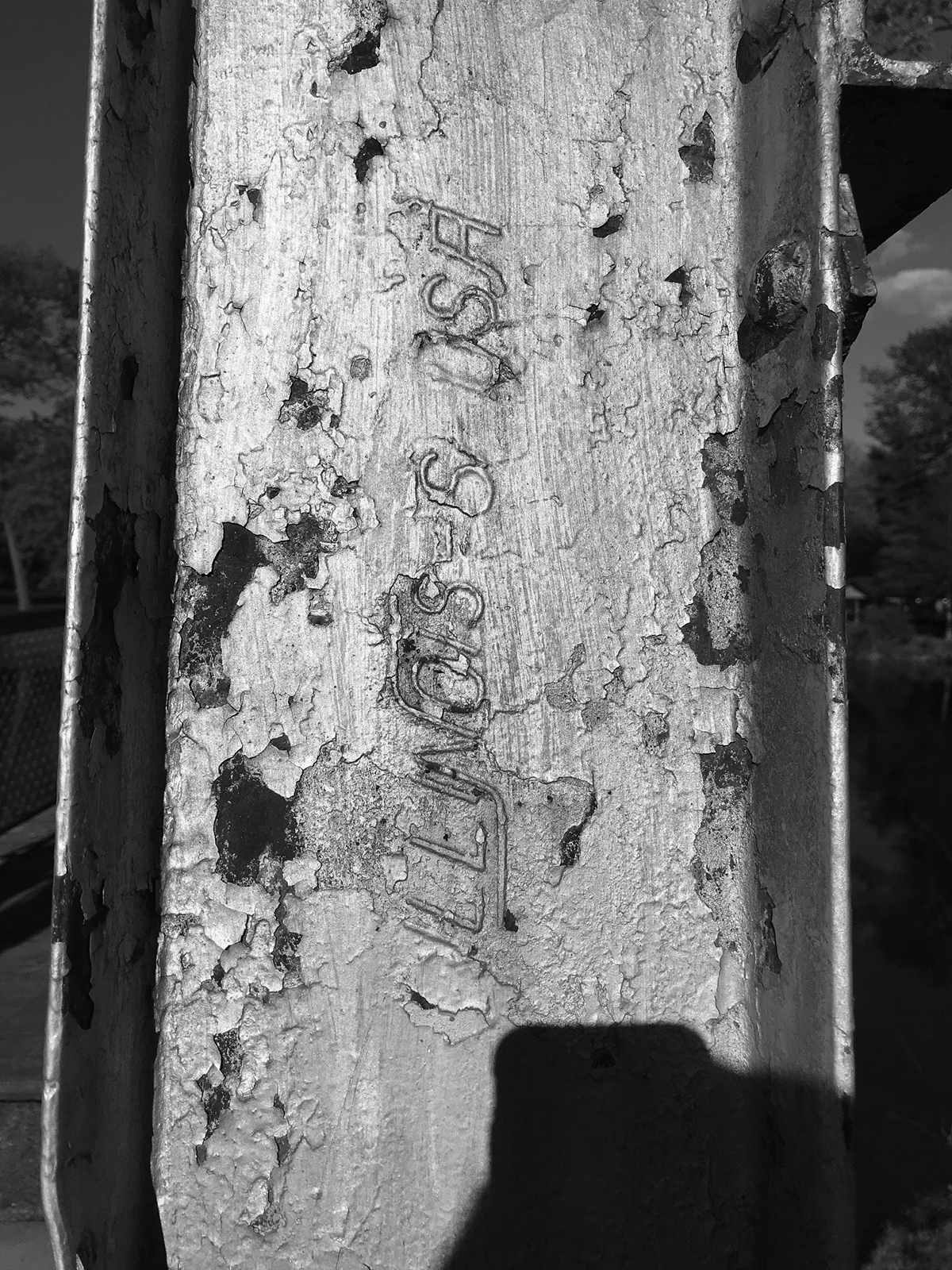
Working on a theory that the bridge was a “kit bridge,” much like a Sears home, an inspection was made of the bridge towers. Markings on the eight legs of the towers indicate they were constructed by the Chicago South Works, a subsidiary of Illinois Steel. The markings are consistent with steel markings in the 1910-20 timeframe. The South Works was located at the mouth of the Calumet River, just over the Indiana State line. The company would have been well known to a bridge engineer from Winamac.
From this information, it was determined the towers were shipped as a prefabricated set. One railroad car would have contained the surprisingly few number of parts.
We received research assistance from a former employee of the Indiana Department of Transportation. He opined that Mr. Nutt would have done the site layout, determined the span length, determined the necessary height above potential flood waters, and determined the footing depths. Mr. Nutt would then have placed an order with the South Works, who more than likely had an appropriate prefabricated kit on hand.
Mr. Nutt signed a contract in April, guaranteeing a completion date of July 1. He met his deadline, validating the supposition that the bridge was a kit, as materials were quickly and easily obtained.
Mr. Nutt selected Winamac Cement Products Company to do the significant concrete work. That company, founded in 1921, manufactured tile for field drainage. In 1923, they had branched out to bridges, buildings, and other public works projects. According to minutes from the Town of Winamac, in 1922 and 1923, Winamac Cement Products Company and Mr. Nutt bid on a variety of projects, including sewage and sidewalk upgrades and the replacement of town water mains.
 According to two databases, national and international, Memorial is the only suspension-type bridge traversing the Tippecanoe River. It is one of twenty-one suspension bridges constructed in the State of Indiana and one of twelve still standing and in use. It appears to be the third oldest bridge that is still standing. (Some bridges in the databases are not dated.) Originally planned for community development and recreation, by the time the contract was let to Mr. Nutt on April 6, 1923, local leaders had decided to dedicate the bridge to Pulaski County soldiers of all wars, thus the name, Memorial.
History Of The Property
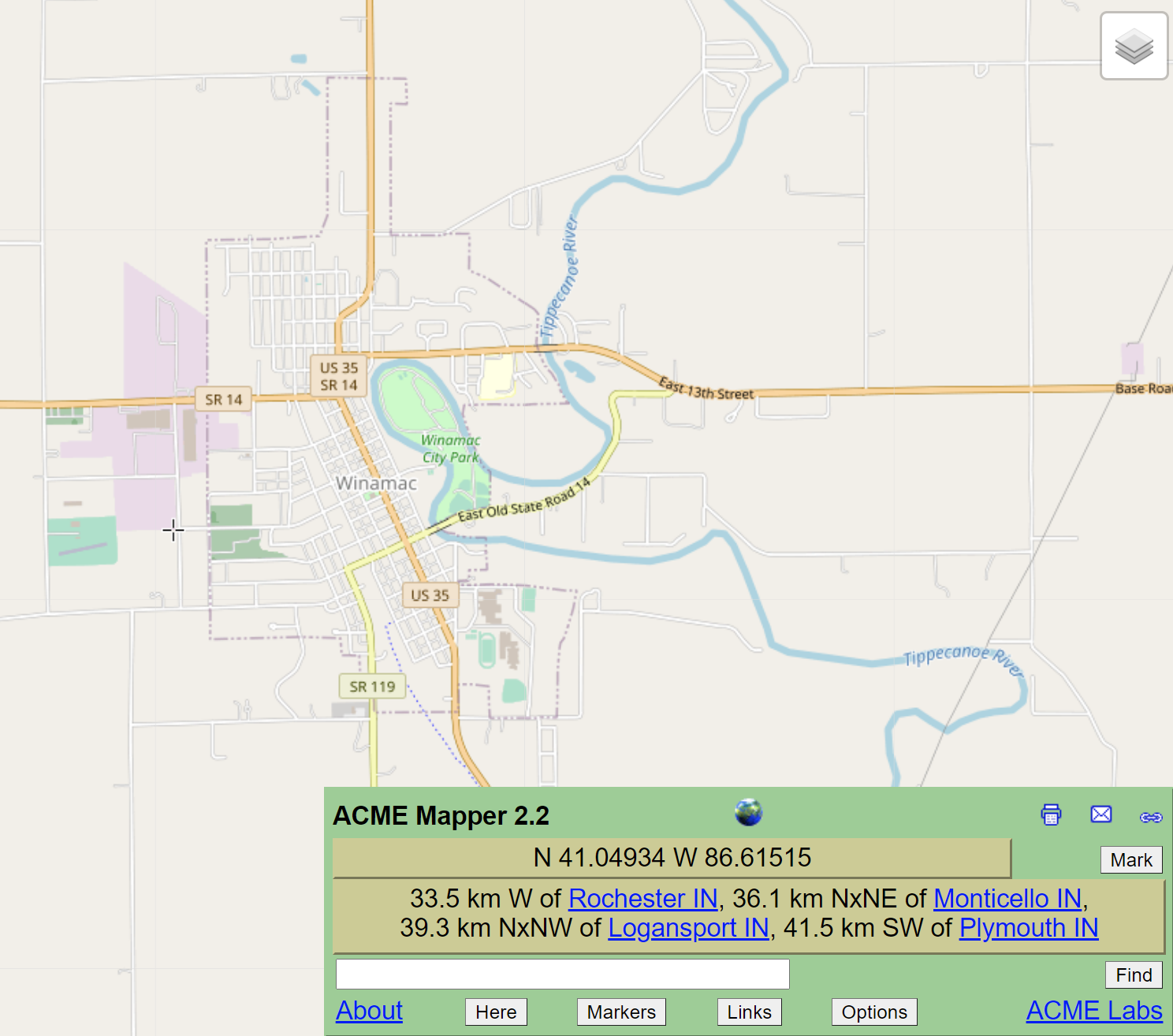 The land now occupied by the Town Park is situated on a natural and beautiful peninsula in the horseshoe bend of the Tippecanoe River. Tradition holds that this area had been a Native American campground. The theory is plausible, as local Potawatomi used the Tippecanoe as a major travel route.
White settlers began to populate the area of Monroe Township, where Winamac is now, in 1838. From that time, pedestrian travel from the settlement, then town, to the peninsula had been with temporary bridges, then a series of “permanent” bridges that could not outlast the river, and finally, again, temporary wooden bridges placed “in season.”
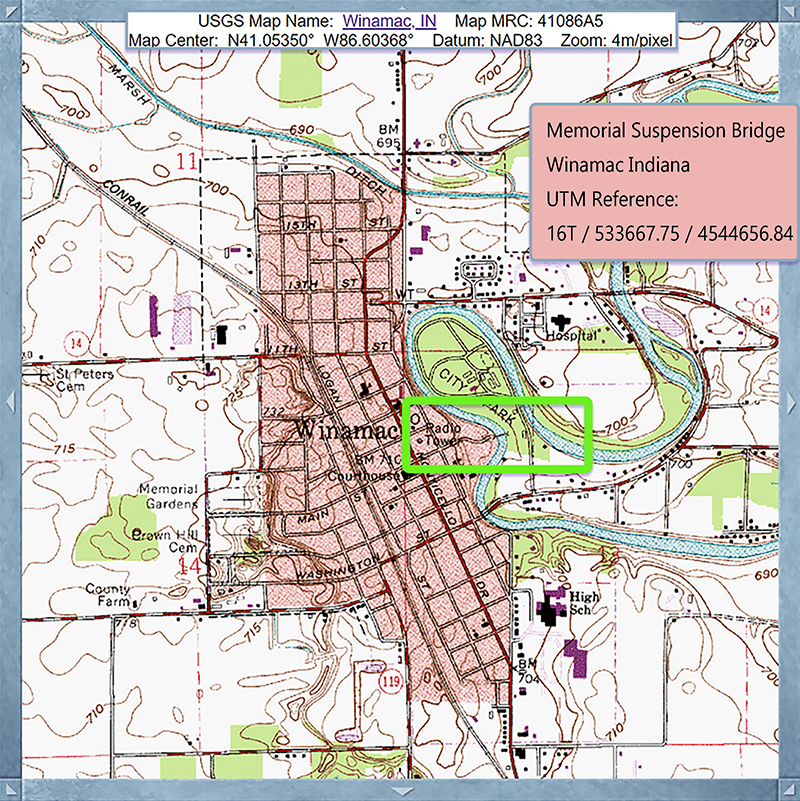
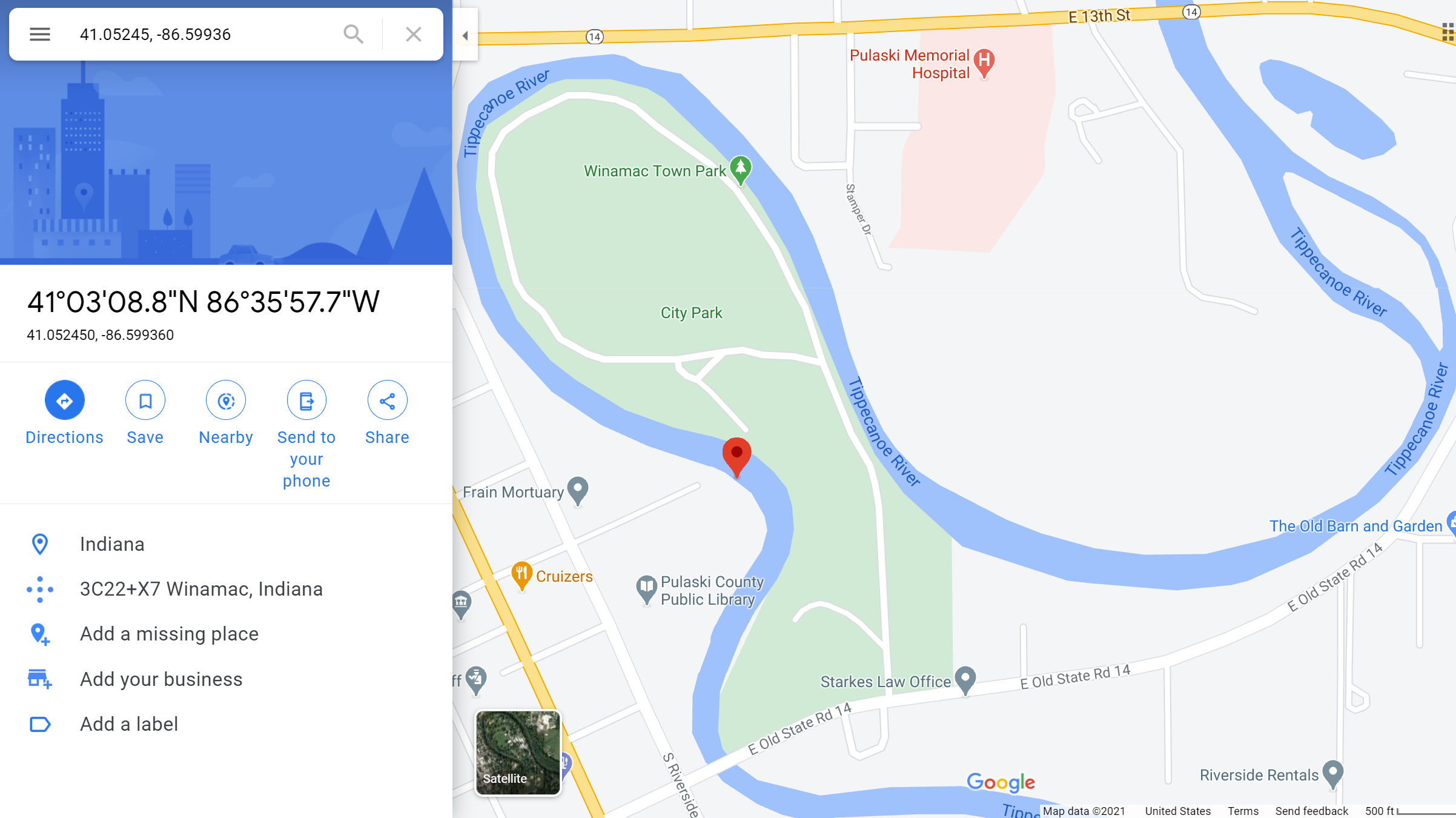 When Winamac was platted in 1839, the peninsula and some surrounding properties were owned by W. C. Barnett, a pioneer resident. A county map published in 1873 shows the property still in his name. The area was known as Barnett’s grove, or Barnett’s peninsula. It was used as pasture for milk cows. Some of the virgin timber had been cut off, but it was still heavily wooded with second-growth trees.
In 1891, the land was purchased by John C. Nye, then a Winamac attorney, later to become Judge of the Circuit Court. He had plans for a park that would attract large crowds of people willing to pay admission to attractions that would be scheduled. While he owned it, each summer, a wooden footbridge was put across the river from some point near the artesian well to the park. The bridges would be erected in time for the annual Old Settlers’ picnic and would remain in place until high water or ice removed it. No bridge ever survived the winter and some had to be replaced before they had been in use for a month.
 The temporary bridges were made of long-legged trestles set in the bed of the stream where it was fairly shallow. These supported boards that were laid lengthwise. Side railings were fastened to uprights. The bridges had to be taken down each fall, as ice during the winter would ruin it.
While Mr. Nye owned the land, from 1891 to 1908, he allowed citizens to use the peninsula as a park. The 1907 Plat Map of Winamac records it as “Nye Park.”
When Mr. Nye sold the land in 1908, the new owner planned to clear the trees and construct buildings for private use. Citizens joined together to save the land, and the Winamac Park Association was formed. The organization purchased the land, allowing the “river park” to be used free-of-charge by citizens. Fourteen years later, in 1922, the Park Association reincorporated in order to raise funds. At the end of 2021, the Winamac Kiwanis Club had been formed. The two organizations joined forces and imagined Winamac as a tourist destination.
The Park Association raised enough money to improve the river park on the peninsula. They purchased and installed new playground equipment, bath houses, a band stand, a dance pavilion and other amenities. A dedication ceremony was held on July 23, 1922, to celebrate the newly outfitted park.
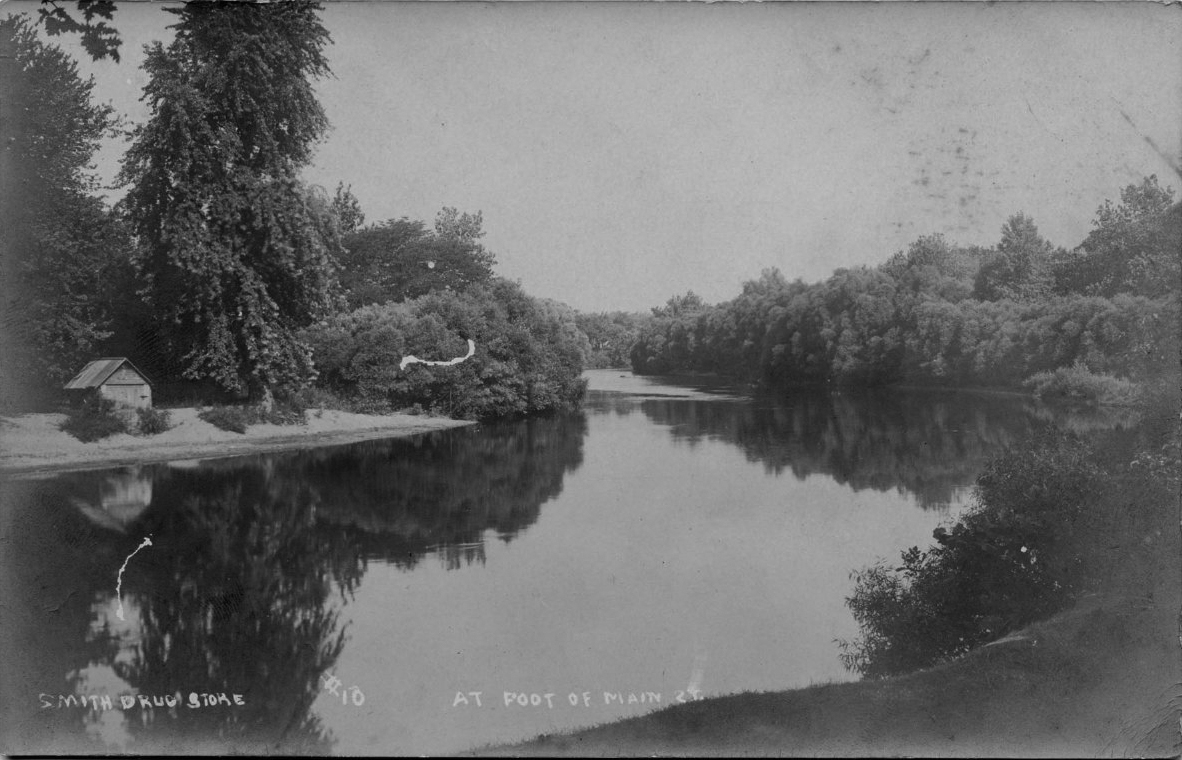
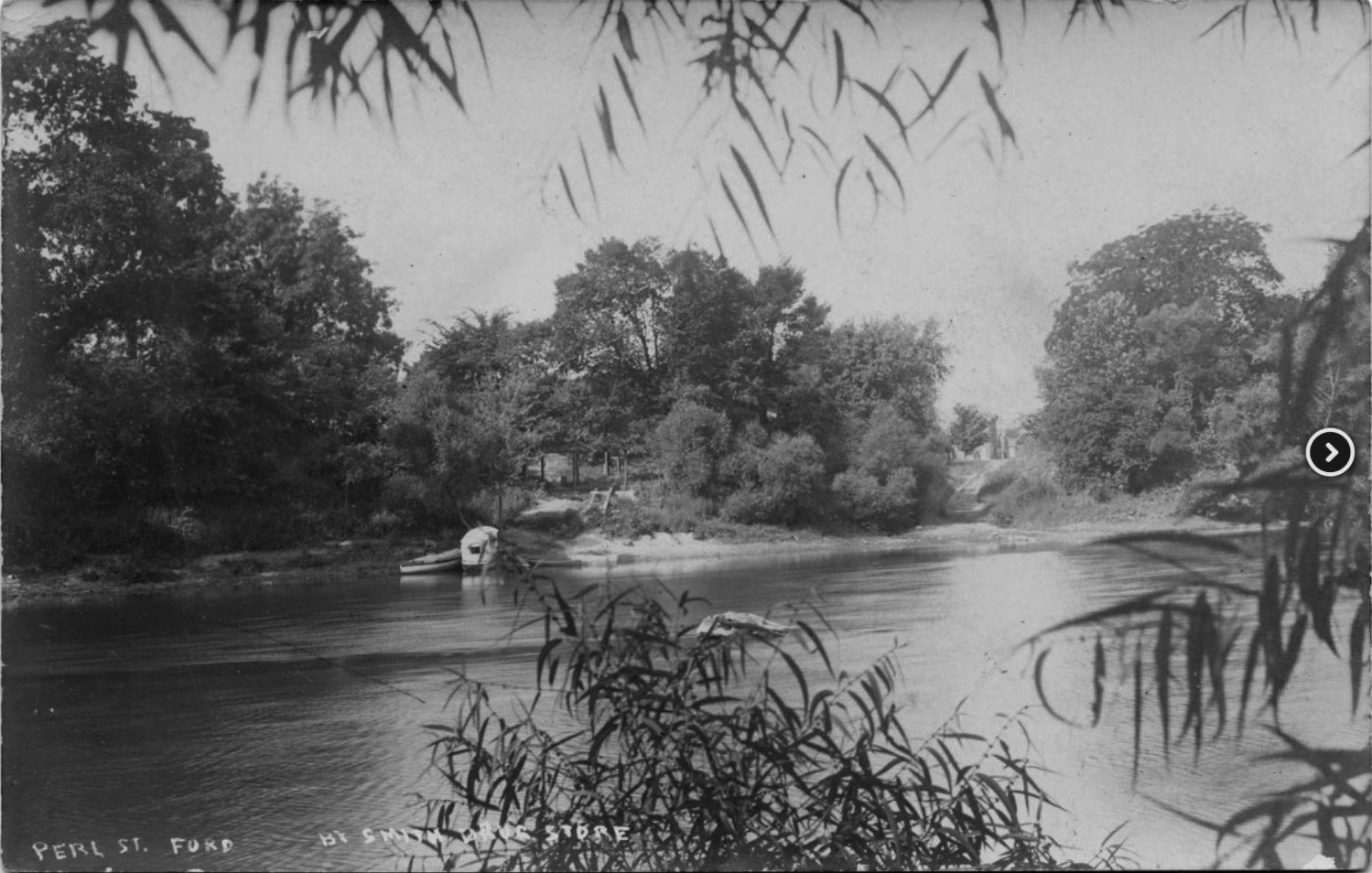
It can’t be determined from Town minutes, but either the descendants of Mr. Nye approached the Kiwanis Club, or the Club approached them. They family still owned land on the west side of the river. The plots of land included the already-historic Artesian Well, discovered by accident in 1887 by the Winamac Gas and Oil Company. The high hopes of a “big boom” for the town were dashed when, instead of oil or natural gas, the company struck artesian water. The area by the Artesian Well was also the site of two local fords from the town to the park and the place that both permanent and temporary bridges were placed, at the foot of either Main Street or Pearl Street.
A representative of the Kiwanis Club approached the Town Council with the idea of purchasing the land. Minutes were not specific, and it is unknown if the Town, at that time, envisioned another public park. While their intent was not clear in the minutes, they were amenable to the purchase. Water Street was vacated, and by 1923, this area had become a campground. The work of preparing the property fell to Kiwanis.
Either through invitation or self-driven in this regard, R. E. Nutt spoke to the Park Association about a suspension bridge that he believed could be installed for $2,000. The Association approached the Town, asking them to share expenses on a 50/50 basis. The Town agreed, so long as they did not have to pay more than $1,000. Minutes from the Park Association were not found, but the two local newspapers kept townspeople up to date about plans for a bridge, a permanent bridge that would connect pedestrians from the town to the park, that would allow out-of-town campers to make use of park facilities. The Park Association announced that bids would be received for a permanent bridge, with a requirement that it be completed by June 1. While they expected several quotations, only Mr. Nutt placed a bid. By the time the quotation was developed in March, prices of cement and steel had risen dramatically. The bid was for $3,197. The Town was represented at the meeting, steadfast in its determination to pay no more than $1,000. The bid was tabled to allow the Association to meet with Kiwanis and determine a path forward. Before that meeting could take place, however, a member of the Association went from business to business to raise funds. $1,600 was raised in a matter of days, giving them hope of moving forward.
One has to consider the time. In 1923, The War to End All Wars was still a raw memory. Pulaski County delivered 662 men to the War; thirty-three did not return. When the contract was signed with Mr. Nutt on April 6, 1923, the combined group of town leaders had determined the bridge should be dedicated to “soldiers and sailors” from the Civil War forward. Thus, it would be named “Memorial.” The completion date was pushed to July 1. Mr. Nutt left almost immediately for Chicago to procure supplies, and construction was underway by early May.
While Memorial was under construction, the Kiwanis Club put their members to work. The new town park was given a general clean-up and put in shape for use by auto tourists. “Combination dining tables and seats for the use of picnic parties” were constructed. These were rather a new idea. They may have been around for a while, but the first patent for a picnic table was filed in 1903. The Kiwanis Club was on the cutting edge with this installation. Two camp stoves were erected and a cinder walk from the well to the footbridge was installed.
On the “river park” side, the Park Association made additional improvements. A twenty-foot-wide graded cinder drive from the road entrance to the park was installed to enable two rows of cars to pass. It extended through the park as far as the bathing bench. Another band stand was erected with lumber remaining from the previous footbridge, and a permanent refreshment stand was built that contained kitchen conveniences and refrigerator. An additional bath house was built containing eighteen private compartments, an office, and separate sections for men and women. Bathing suits were purchased for rental for men, women, and children. This bath house was for persons who could afford to pay. The bathhouses erected the year before were still available to the public at no charge. Gravel and stones were dredged from the beach, and depths on the now-sandy bottom were marked for bathers. Two additional diving boards at various depths were added. Steps were built to the water’s edge and a number of seats were placed on the bank for visitors to watch water sports.
Memorial was dedicated on July 4, 1923, on schedule.
Suspension-type bridges are rare in the State of Indiana, especially of this age. Three suspension bridges in Indiana are listed on the Indiana Sites and Structures Inventory. The Turkey Run Suspension Bridge, built in 1917-18 is listed as outstanding. The Foster Park Footbridge in Fort Wayne, built in 1920, is listed as a contributing resource to the park. Indiana State Highway Bridge Number 154-77-06536, the Sullivan-Hutsonville suspension bridge, was built in 1939 but has been demolished. Based on research of the Bridgemeister.com and BridgeHunter.com websites, Memorial could be the third oldest suspension bridge in Indiana still in operation. (Several are undated.)
Historic Context
In 1923, the bridge was conceived to provide pedestrian travel from the new town park to the “river park,” which was situated on a peninsula in a horseshoe bend of the river. The Winamac Park Association and the Winamac Kiwanis Club, with assistance from the Town of Winamac, also had a goal to establish a premier tourist destination for the area.
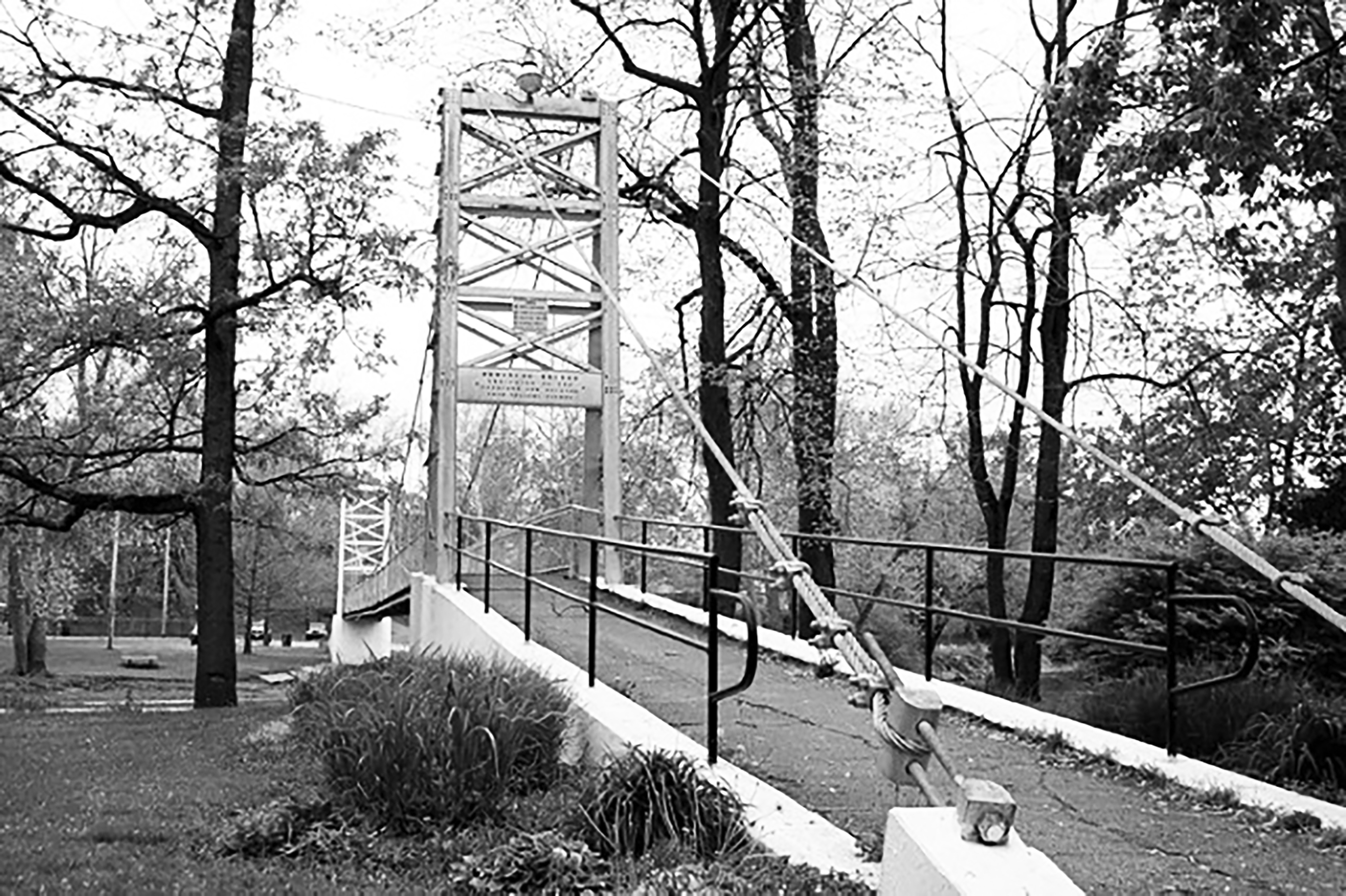
Since the time Winamac was settled, travel from the town to the peninsula had been via a series of “permanent” bridges, which were always destroyed in floods or temporary wooden bridges placed “in season.” The peninsula had been privately owned, but from 1891 to 1908, the owner had allowed citizens to use his land as a park. In 1899, it was reported that the owner, J.C. Nye, had enclosed four acres of what they were calling “the park” with a fence to exclude cattle. The plans were, now that cattle were separated from most of the land, to keep the grass down with a one-horse lawn mower. “Incandescent sparks” would light the building and grounds; city water was to be piped in, and entrance would be by a foot bridge across the river east of the Artesian Well
When Mr. Nye sold the land in 1908 to a man who planned to clear the trees and use it for himself, the Winamac Park Association formed and purchased the land. The “river park” continued to be used by citizens, and on July 23, 1922, the Park Association held a dedication service. They had re-incorporated in order to raise funds and had equipped the area with playground equipment, bath houses, a band stand, a dance pavilion, and other amenities.
Also in 1922, and with the suggestion of the newly-formed Winamac Kiwanis Club, the Town purchased the Artesian Well and surrounding land to develop it as a campground.
While Memorial was under construction, the Winamac Kiwanis Club put their members to work. The park just below the Artesian Well was given a general clean-up and put in shape for use by auto tourists. “Combination dining tables and seats for the use of picnic parties” were constructed. Two camp stoves were constructed and a cinder walk from the well to the footbridge was installed.
On the “river park” side, the Park Association made additional improvements. A twenty-foot-wide graded cinder drive from the road entrance to the park was installed to enable two rows of cars to pass. It extended through the park as far as the bathing bench. Another band stand was erected with lumber remaining from the previous footbridge, and a permanent refreshment stand was built that contained kitchen conveniences and refrigerator. An additional bath house was built containing eighteen private compartments, an office, and separate sections for men and women. Bathing suits were purchased for rental for men, women, and children. This bath house was for persons who could afford to pay. The bathhouses erected the year before were still available to the public at no charge. Gravel and stones were dredged from the beach, and depths on the now-sandy bottom were marked for bathers. Two additional diving boards at various depths were added. Steps were built to the water’s edge and a number of seats were placed on the bank for visitors to watch water sports.
Memorial was dedicated on July 4, 1923. The original purpose was to provide a method to traverse the Tippecanoe River for residents and tourists. However, Pulaski County, having laid to rest thirty-three servicemen from The Great War, was still in mourning, along with the State and nation. Feelings being strong, as plans progressed, the organizers decided the bridge would become a memorial to Pulaski County soldiers of all wars, from the Civil War forward, thus the name, Memorial. Among the attendees at the dedication ceremony were a number of gray-haired Civil War veterans, veterans of the Mexican Border Skirmish and The Great War, and Gold Star families.
Significant Properties
Per the Bridges Historic Context Study, 1830s-1965, a study that focused on vehicular bridges for the Indiana Department of Transportation: “with the introduction of new manufacturing processes in the late nineteenth century, steel became available for structural use, including in bridges. Steel demonstrated strength and versatility, resisting the failure that had plagued its iron predecessors. Rolled steel beams were introduced in 1885, facilitating the material’s use for short bridge spans. By 1895 steel overtook iron as the metal of choice. … Similarly, although there are no known extant suspension bridges constructed prior to 1966 in Indiana, we know of one notable self-anchored example built in 1939.” This statement references the Sullivan-Hutsonville vehicular bridge, demolished in 1989. While pedestrian bridges were not included in their survey, the use of steel in Memorial followed this historic trend.
Local Significance
For many years the Artesian Well served as the water supply for Winamac residents. Youngsters took turns carrying water from the well to sell to various businesses. The water-toting was compared with a newspaper route, providing some spending money for youngsters who sold the water to Winamac businessmen. The bridge and well remain historical visiting sites in Winamac and have their place earned in the town’s history.
Local newspapers covered the dedication of Memorial. From the Pulaski County Democrat, July 5, 1923. The bridge was dedicated by a Culver Military Academy Cadet Troop and the occasion was historically recorded as being a day with “no accidents, disturbances of any kind” and one of the “most successful and largest’ in the town’s history.
“The dedication of the new bridge as a memorial to Pulaski county soldiers who served in the wars gave to the occasion a patriotic touch of deep significance. In the presence of a group of gray haired veterans of the Civil War, of a number of Gold Star Mothers and of an assemblage of veterans of the World War, Major General Gignilliat of Culver Military Academy delivered a brief address to a huge crowd that assembled near the east end of the bridge. He spoke feelingly of the part Indiana has taken in the wars…. He characterized the bridge as particularly appropriate as a memorial to men who have served their country. A bridge, he declared, is a mark of the progress of civilization. The country’s ideals in its various wars have been in support of this same civilization. He referred, too, to the fact that the country’s first battle, that skirmish at Concord, was at the site of a bridge.”
One can find the names of some county residents who served in the Mexican-American War by studying the book Counties of White and Pulaski, Indiana, published by Batty in 1883. Names of veterans of the Civil War can be found in the same book and the same manner. The book also contains a list of veterans from the county who lost their lives in the Civil War. Progress of Pulaski County: Ten Decades of Development, the book of the county’s centennial celebration, lists the county residents who served in the Mexican Border Skirmish in 1916-1917. That book also lists every county citizen known to have served in The Great War and every veteran to die in that conflict.
The bridge itself retains a shirt-tail relationship to the Winamac Bridge Company, a company of some renown at the time. The company retains local significance as the builder of the only remaining Stearns Truss Bridge, now placed as a pedestrian bridge in a historic park in Delphi, Indiana. The Winamac Cement Products Company, which has remained known locally as the builder of a former county garage and a local restaurant, the Indian Head, provided a significant amount of concrete to the bridge.
State Significance
Suspension bridges in Indiana are rare. Of the twenty-one listed in a combination of online registries (Bridgemeister and Bridgehunter), only twelve remain standing. Memorial appears to be the third oldest that remains standing and in use. (Some bridges are not dated.) The two that are older (constructed in 1918 and 1920) are listed on the Indiana Sites and Structures Inventory.
Data Categories For Functions And Uses
Memorial has been an important part of the recreation and culture of Winamac and Pulaski County since 1923. Owned by the Town, it is nevertheless a County icon, used by countless children, adults and families to traverse the river by foot from one park to the other, or to stand in the middle and watch the river, or to gather for senior class pictures. For walkers, the bridge is part of the mapped walking trail in the town park system. For veterans, the bridge holds a particular significance, because it stands as a permanent testament to their service and sacrifice.
Data Categories For Areas Of Significance
Tradition holds that the peninsula, the location of the Town Park, was used as a camp by Native Americans. This is a plausible theory, as the Potawatomie and Miami tribes used the Tippecanoe River for travel.
The Town of Winamac was founded in 1839. As originally laid out, twenty blocks of eight lots each, and two fractional blocks, the streets went, north to south, Madison, Spring, Pearl, Main, Jefferson, Adams and Washington. “Next to the river on the east” Water Street (the roadway was never built), then west in order, Front (now Riverside), Monticello, Market and Logan. The town was platted to include the area next to the river where the Artesian Well was later drilled by the Winamac Gas and Oil Company.
Prior to 1856, the river at Winamac was crossed by fording or by means of a ferry. While not noted in the book, Counties of Pulaski and White, Indiana, it appears the bridges listed here refer to vehicular bridges. A wooden bridge was begun and partly completed in 1849 or 1850, but “ere it could be secured, a sudden flood washed it away.” In about 1857, a wooden bridge was built a short distance below the present one, but after being used a few years, it “shared the fate of its predecessor.” Another was built in the same place during the Civil War and it, also, was swept away. Construction of a new iron bridge began in 1875 and was completed in 1876; it was a one-span wrought-iron truss 160 feet in length.
Newspapers discuss the “new iron bridge” in 1886, without reference to it being pedestrian or vehicular. The only reference made was that all crossing of the river during repairs was at the foot of Pearl Street, which was the location of the footbridges. In 1892, a “permanent” footbridge was put up, but the “sand in the river bottom caused the walk to settle unevenly and it was moved the first of the week to more solid bottom a little up stream.”
Period Of Significance
The bridge was constructed in 1923 and has continued in use to this day without closures, with the exception of the times the parks have been closed due to flooding. The period of significance, by definition, would be from 1923 to 1971.
Significant Dates
There have been no significant alterations to the bridge, only general upkeep and maintenance.
Bibliography
1907 Plat Map of Winamac, Historic Map Works
1910 U.S. Census, Home of John W. Frain in Clay, Webster, Iowa
BridgeHunter.com, https://bridgehunter.com/in/pulaski/memorial/, April 22, 2021
Bridgemeister.com, https://www.bridgemeister.com/bridge.php?bid=849, April 22, 2021
Counties of White and Pulaski, Indiana, published by Batty, Chicago, 1883
“Here’s Winamac Indiana,” a supplement to the South Bend Tribune, Sunday, September 23, 1979. By John Nicholas, Tribune LaPorte Bureau.
Indiana Bridges Historic Context Study, 1830s-1965, Report prepared for Indiana Department of Transportation by M&H Architecture, Inc., February 2007.
Old Man at the Desk, Pulaski County Journal, date not apparent, from Winamac Park file at Pulaski County Public Library.
Progress of Pulaski County: Ten Decades of Development, Pulaski County Centennial Book, 1939
Pulaski County Democrat, April 12, 1923, Microfilm: Let Contract for Park Footbridge
Pulaski County Democrat, August 5, 1892, Microfilm
Pulaski County Democrat, August 5, 1892, Microfilm
Pulaski County Democrat, July 3, 1886, Microfilm
Pulaski County Democrat, July 5, 1923, Microfilm: Crowds Attend 4th Celebration
Pulaski County Democrat, May 12, 1899, Microfilm
Pulaski County Democrat, May 24, 1923, Microfilm: Fit Park For Use By Auto Tourists
Pulaski County Democrat, May 25, 1922, Microfilm
Pulaski County Democrat, May 3, 1923, Microfilm: Footbridge Work Starts.
Pulaski County Sesquicentennial: Its History Its Celebrations Its People, Pulaski County Historical Society, 1989.
SHAARD, https://www.in.gov/dnr/historic-preservation/help-for-owners/national-and-state-registers/shaard-database/, April 24, 2021
USGS Flood-Inundation Maps for the Tippecanoe River at Winamac, Indiana, Scientific Investigations Report 2015-5103, Prepared in cooperation with the Indiana Office of Community and Rural Affairs, MAP INCLUDED IN SECTION 10
Winamac Bridge Company file from the Pulaski County Public Library
Winamac Republican, April 12, 1923, Microfilm: Bridge will Form Soldier Memorial
Bridge History Through Newspaper Accounts
The following are articles from local newspapers that can be found at the Public Library. These articles were gathered together by Jim Phillips, a native of Pulaski County.
1886 – 1889
Pulaski County Democrat Jul 3, 1886, Microfilm: The work on the new iron bridge across the river at this place was completed on Wednesday. All the crossing of the river during the repairs was at the foot of Pearl street.
Pulaski County Democrat Aug 5, 1892, Microfilm: The foot bridge across the river to the park was put up last week. The sand in the river bottom caused the walk to settle unevenly and it was moved the first of the week to more solid bottom a little up stream.
Pulaski County Democrat May 12, 1899, Microfilm: J.C. Nye is enclosing four acres of the park with a fence to exclude cattle. Inside the enclosure the grass will be kept down with a one-horse lawn mower. Incandescent sparks will light the building and grounds, city water will be piped there, and entrance will be by a foot bridge across the river east of the artesian well.
1922 – 1923
Pulaski County Democrat May 25, 1922, Microfilm: Improvements intended to render the Winamac Park of more service to the public are planned by the Park Association which owns the wooded peninsula just across the river. It has already been arranged that the foot bridge across the river from a point near the artesian well will be kept in place throughout the season. Other plans include installation of playground equipment, dressing rooms at the bathing places, seats, swings and similar features.
Winamac Republican Jun 15, 1922, Microfilm: Town Buys Park – At a special meeting of the town board Monday night plans were made for the purchase of the park near the artesian well from the present owner, J.C. Nye. The Kiwanis Club this week appointed a committee composed of C.C. Blinn, C.H. Barnett and F.E. Keller to secure suitable equipment to make the park a first class tourist camp.
Winamac Republican Mar 1, 1923, Microfilm: New Foot-Bridge To Span River: Proposal Advanced by Park Association to Secure Steel Suspension Bridge to River Park – A meeting of the stockholders of the Winamac Park Association will be held at the offices of Reidelbach Bros., tonight, to discuss, among other things, possible plans for the construction of a permanent suspension foot-bridge over the Tippecanoe river to connect the artesian well park with the river park.
Plans and estimates have been prepared by Herbert Nutt, an engineer, of Indianapolis, and former Harrison township resident, and these plans will be open to inspection to those at the meeting tonight.
Mr. Nutt estimates that a steel suspension bridge will not cost far in excess of $2,000. An effort will be made to interest the town in going in with the park association on a fifty-fifty basis in the construction of a permanent bridge. The bridge would extend from the town park to the association park, connecting the two, at about the same place used last season, a park official states.
The park association has adopted the policy of expending all receipts from the park, except a nominal dividend, for further improvements and the permanent bridge idea has been one of the goals looked forward to for several years past.
If the bridge plan is carried out, it will probably be of steel cable suspension type, with solid abutments on both banks of the river.
Winamac Republican Mar 8 1923, Microfilm: Town Help for New Foot-Bridge: Corporation and Park Association to Join in Connecting City Park With River Beauty Spot – At the March session of the town board on Monday evening of this week, the proposal of the Park Association to go ahead and build a steel suspension bridge over the river from the town park to the association park in co-operation with the town, was considered, and it was agreed that the town would co-operate with half of the construction cost, if the town’s share did not exceed $1,000.
A stipulation was made that in case the park was disposed of in the future to private individuals or a private corporation, the town should then be reimbursed by the Park Association for the funds spent on construction of the bridge.
The Park Association has already arranged for the financing of the proposition, through a loan for the amount necessary over available funds on hand, and through sale of additional park stock in the association.
At the meeting of the Park Association held last Thursday evening, the bridge sketch was before the members. It proposes a steel cable suspension bridge, to be placed at about the location of the temporary bridge used last year. The floor of the bridge would be above high water and the approach to the bridge is proposed to be a gradual incline starting 50 feet back on the ground level, with solid concrete sides, and filled in with material to the bridge entrance. Last week’s paper stated that the plans and drawings were made by Hubert Nutt, which was an error, the plans having been made by Former County Surveyor R. E. Nutt.
According to the drawings, the width of the proposed foot-bridge will be about five feet wide, the floor to be of creosoted material. The board has asked Mr. Nutt to go ahead and prepare specifications, and bids will probably be advertised for soon, if the plans are approved. It is hoped to have the bridge in place by June 1.
The proposed bridge will be 200 feet long. A cinder path from the well will be constructed extending to the bridge approach.
Proposed improvements at the park for the coming season include a band stand, another cottage, additional bathing facilities and completion of the driveway.
A meeting of the Park Association members will be held tonight at Reidelbach Bro. office to further consider bridge and other park plans.
Pulaski County Democrat Mar 23, 1923, Microfilm: Bids To Be Received On Foot-Bridge To Park: Formal notice that bids will be received for the construction of the proposed permanent foot-bridge across the river, as previously mentioned, appears in a legal notice elsewhere in this paper.
At a meeting of the board of directors of the Park Association last Thursday evening, the plans were approved and the request for bids ordered. They are to be opened on April 2. It is stated that at least four local contractors are expected to offer proposals, and perhaps some others.
The directors also ordered a dividend of 8 per cent to stockholders in the association. While the park and its equipment are free to the public at all times, the income from concessions on picnic days and the like, the rent of the cottage and other receipts were sufficiently above the operating expense to justify the dividend.
Pulaski County Democrat Apr 5, 1923, Microfilm: Foot-Bridge Contract May Be Let Tomorrow: Whether the proposed permanent foot bridge across the river, from the artesian well park to the association park, will be constructed is to be decided at a meeting Friday evening of directors of the park association, members of the town council and directors of the Kiwanis club.
But one bid was filed on the work, by R.E. Nutt, at $3,197. This is considerably above the original estimate, explained by late increases in cost of material and enlargement of the plans.
The matter now depends largely upon the sale of sufficient additional stock in the park association to render the work possible. A committee of the association has met with gratifying results in a canvass now being made If it can report enough further subscriptions at Friday night’s meeting, it is felt that the contract will be let.
Pulaski County Democrat Apr 12, 1923, Microfilm: Let Contract For Park Footbridge: Directors Accept Bid of R.E. Nutt For The Work – To Be Finished By July 1 – Cinder Driveway, Band Stand and Refreshment Stand in Plans for Further Immediate Improvement – The contract for the construction of the proposed footbridge across the river, from the park below the artesian well to the Association park, was let last Fridaynight to R.E. Nutt. His was the only bid, at $3,197.
The matter had been held in abeyance pending the sale of sufficient stock in the park association to provide money for the improvement. Recent sales of stock to the amount of $2,300 were reported, which, together with the $1,000 previously agreed to be paid by the town council, placed the directors of the organization in position to close the contract.
The bridge is to be completed by July 1, according to the contract. The Winamac Cement Products Co. is to do the concrete work and expects to begin operations as soon as the river falls enough to permit.
The bridge is to be of the suspension type, 200 feet long and five in width. A steel tower about thirty feet high, embedded in concrete base, will be erected on each side of the river. Two steel cables, each an inch and a half diameter, will be stretched from tower to tower, the ends attached to concrete anchors embedded in the earth about fifty feet back of each tower. The floor will be suspended from the cables, at a height well above danger from high water. Long inclines at each side, held in place by concrete walls reaching back as far as the cable anchors, will afford an easy climb to the bridge level.
The directors of the association are making other plans for improvement of the park during the coming summer. Solomon Stout has been re-engaged as custodian and will oversee the work to be done. Some trimming has been done in the upper end of the park, and some filling is to be done at a gully in the lower part. A notice elsewhere in this paper invites the dumping of rubbish at that point, under the custodian’s directions.
Cinders have been secured as top dressing for a driveway to extend from the entrance just east of the ballpark to a point near the park house. This is to be made wide enough for two cars.
The material heretofore used for the temporary bridge is to be utilized in the construction of a permanent band stand and a refreshment stand. The swimming hold is also to come in for further attention, with the addition of more spring boards and steps. It is hoped that further playground equipment can also be added.
Winamac Republican Apr 12, 1923, Microfilm: “Memorial Bridge” A Good Name: The directors of the local park association have decided to dedicate the new footbridge soon to span the beautiful river of Indiana as a memorial to the boys of Pulaski county who have fought for their country in the Civil, Spanish and World Wars. A tablet will be placed on the structure to bring to mind the sacrifice of the soldier boys from Pulaski county. Let the children who cross the bridge for healthful play, pause and remember the sacrifices of the soldiers, which keep this country a place of opportunity for those of humble birth as well as those of far famed lineage.
Pulaski County Democrat May 3, 1923, Microfilm: Footbridge Work Starts: Work has started on the footbridge to be erected from the park below the artesian well to the Association park across the river. Contractor R.E. Nutt is not engaged in erecting his false work, and hopes to have material on the ground for permanent work within a short time. The bridge is to be about where the temporary structure was located last year.
Winamac Republican May 10, 1923, Microfilm: Overall Parade Coming Tuesday: Kiwanis Members Will Don Working Garb And Turn River Park Into Ideal Camping And Picnic Site – Winamac Kiwanis club members have orders to show up at next Tuesday noon luncheon, attired in overalls and armed with rake and shovel to spend the afternoon in cleaning up the park near the artesian well and in constructing table and ovens for tourists at the beauty camping spot nearby.
The town board has been designated as the boss gang to tell what is needed to be done, and before the sun sets next Tuesday evening the park is scheduled to look like an English lord’s estate.
The holes will be filled and the place will be leveled off for the season. The tennis courts will also be put in condition on that day and Jim Dilts, president of the tennis club states that racket enthusiasts will be welcomed on that afternoon to assist in that work.
It is understood that the town will erect a comfort station in the park on this side of the river, for the accommodation of auto campers and park visitors. Winamac is already listed on the state park board map as possessing a tourist camping ground.
The board of directors of the Kiwanis club has worked out a plan to finance all public enterprises of the town for the coming season, by arranging a budget to be contributed to by the business and professional people, and other citizens of the place.
A letter was sent to practically every business place in town on Tuesday telling of the plan and a committee composed of all the directors plan to call on the various citizens soon in carrying out the plan.
The budget will include an appropriation for the band concerts, Fourth of July celebration, Old Settlers’ Picnic Day, Farmers’ Annual Picnic and other attractions that may be taken hold of by the town. The plan is arranged to avoid numerous solicitations for each enterprise as the time approaches for its financing.
Pulaski County Democrat May 24, 1923, Microfilm: Fit Park For Use By Auto Tourists: Kiwanis Club Members Spend Afternoon at Cleaning and Building – New Footbridge Progresses – Work on Permanent Structure Across River Well Under Way – Attention to Tennis Courts Near Artesian Well – The city park just below the artesian well was given a general clean-up and put in shape for use by auto tourists Tuesday afternoon by members of the Kiwanis club, who armed themselves with rakes, shovels and other implements following the regular weekly luncheon at noon and went to the park as a group of volunteer workmen.
The results accomplished, besides a collection of blistered hands and sore backs, included clearing away the winter’s collection of dead leaves, the filling of small holes, the erection of combination dining tables and seats for the use of picnic parties, construction of two camp stoves, work on a cinder walk leading from the well to the permanent footbridge now under construction, and rehabilitation of the tennis courts.
Contractor Nutt and a crew of men are actively engaged on the new foot-bridge. The two steel towers have arrived and have been put in position, one on either side of the river. Workmen are now building the concrete abutments surrounding the towers, the steel cable from which the bridge will be suspended is here, the false work is in place for the erection of the floor, and there appears little doubt that the bridge will be ready for use well before the Fourth of July.
The cleaning of the park fitted well into a program of general town cleaning that was approved by the Kiwanis club at its meeting the week previous. At that time Dr. W.H. Thompson, as town health officer, reminded the club that last year a representative of the state board of health, after an inspection of Winamac streets and alleys, declared that the town was second in cleanliness to only one other in the state. The doctor voiced an appeal to citizens that sincere efforts be made to push Winamac into the front rank during the present year.
The work of Marshal Johnson in keeping clean the brick streets of Winamac was also commended, and a unanimous vote of approval for his efforts was extended by the club.
Pulaski County Democrat Jun 7, 1923, Microfilm: Celebration of 4 thIn Winamac: Three Organizations To Join In Monster Program – Dedicate Memorial Bridge – Structure to be Inscribed to the Memory of al Pulaski County Men Who Have Served in the Wars – Formal opening of the new suspension foot bridge across the river below the artesian well, which is to be dedicated on that day to Pulaski county men who have served the country as soldiers or sailors, is to be part of a monster Fourth of July celebration now being planned.
The celebration is to be under the joint management of the Winamac Park Association, the American Legion and the Kiwanis Club. The park association is financing the bridge and other park improvements, and is to be in general control of the day’s events and of the concessions. The Legion is to have charge of the parade and the dedicatory exercises, while the Kiwanians will look after the contests, the fireworks and the music.
Pulaski County has no permanent memorial of any kind to its sons who served the country in time of peril. It has been therefore resoled, by the citizens who are sponsoring the bridge, that its heavy steel towers and cables, backed by immense concrete abutments and spanning the Tippecanoe from shore to shore, form an appropriate emblem of the united strength upon which the welfare of the nation rests, and that the bridge may fittingly be dedicated to those who have borne arms in support of the union.
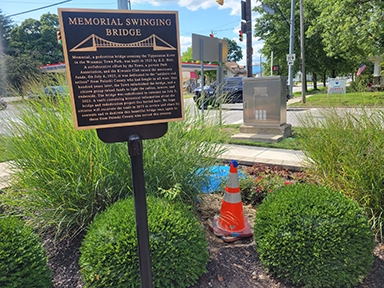
Orders have been given for special memorial tablets, one to be placed on either end of the bridge, with the following inscription:
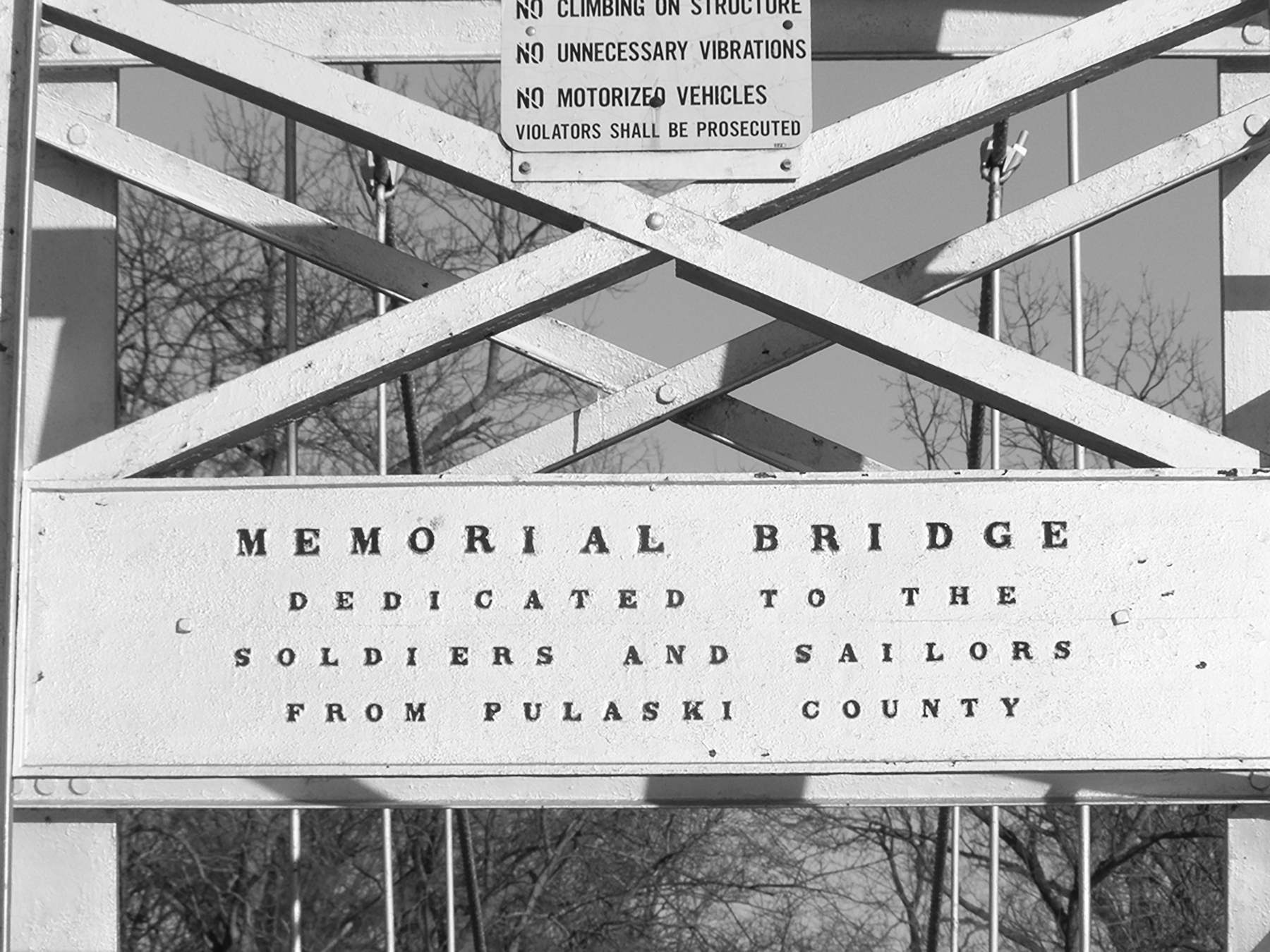
Memorial Bridge Dedicated to All Soldiers and Sailors of Pulaski County Who Have Served Our Country
Negotiations are now under way for the engagement of a speaker of renown to deliver a dedicatory address. Other features of the day’s exercises will be similarly appropriate to the occasion. Further plans are being worked out on a scale calculated to make the forthcoming celebration of the Fourth one of the most elaborate and impressive ever held in Pulaski County.
In addition to the completion of the new bridge, other extensive improvements in the Association park will be ready by that time. Work has been started on a bath house, divided into about twenty rooms, where bathing suits will be kept for rent and where privacy may be secured by both men and women. It is to stand between the pavilion and the present free bath houses. Permanent refreshment and band stands are under way, the interior of the pavilion is to be redecorated and the floor prepared for dancing, and further playground equipment installed. The association has contracted with Harry Kistler to take charge of all concessions. He is to operate the refreshment stand, oversee the renting of bathing suits and rooms, and so on. Solomon Stout continues as custodian.
Pulaski County Democrat Jun 14, 1923, Microfilm: Culver Staff to Dedicate Bridge: General Gignilliat to Conduct Memorial Ceremonies – Part of 4th Celebration –Congressman Cook to Deliver Patriotic Address – Busy Day’s Program to Close with Display of Fireworks – The dedication of the Memorial Suspension Bridge across the Tippecanoe river in Winamac, on July 4th, is to be conducted by Brigadier General Gignilliat of the Culver Military Academy, assisted by his staff and squads of students from the naval school, the summer school and the woodcraft camp.
Learning that the bridge is to be dedicated to Pulaski county soldiers of all wars, as a part of exercises under the auspices of the American Legion, General Gignilliat announced his complete readiness to take part in the ceremonies, when visited Friday by Winamac representatives having the affair in charge. He expressed regret that the date falls only two days after the opening of the Culver summer term, and before organization of the school will have been sufficiently effected to permit the bringing of a large troop of cadets.
One-pound field pieces will be brought from the academy for the purpose of firing propersalutes. These will probably be in charge of regular army officers, it is stated.
Congressman Samuel E. Cook of Huntington, the Eleventh district’s member of the national house of representatives, is to deliver an address appropriate to the occasion. Judge Cook, in accepting the invitation over the telephone, likewise expressed pleasure over the prospect of spending the day with Pulaski County constituents.
Further details of the day’s program are being given attention. For the first time in several years there will be a display of fireworks, fired in accordance with regulations from the office of the state fire marshal. There is to be a ball game, of course, while the park playground equipment and bathing facilities will be in full swing.
Pulaski County Democrat Jun 14, 1923, Microfilm: Soldiers And Gold Star Mothers: In order to complete the record of soldiers of Pulaski county in the recent war, every ex-soldier or a relative of every such soldier is requested to fill out the coupon below and mailor bring to Dwight Fites, Winamac.
A complete list of mothers of Pulaski county soldiers who lost their lives during the latewar is also desired. If only that part of the blank is used, mail to Mrs. Gladys Lindesmith, Winamac, Ind. (A form was attached.)
Winamac Republican Jun 21, 1923, Microfilm: Fire-Works for Fourth of July Best Ever Here: Committee for Night Display Announces High Grade Assortment Ordered for Celebration at Winamac – The Fourth of July celebration at Winamac will have as a climax the finest display of fireworks ever brought to town, members of the committee state. So people of the county and other communities are urged to come early and stay late.
The celebration will open at ten o’clock in the morning with an auto parade, with prizes for the three best decorated cars. The crowd will then go to the park, where Congressman Cook will deliver the patriotic address of the day, at eleven o’clock.
At noon a band concert has been scheduled at the park during the dinner hour. Right after dinner the baseball game is on the schedule. The bathing beach will also be open to the public after dinner, and dancing will also be in full swing at the park pavilion, with aspecial orchestra engaged for the day, both afternoon and evening.
The permanent refreshment stand is completed at the park and the new suspension foot-bridge, which will be dedicated to the soldiers and sailors of all wars, will be completed in plenty of time for the Fourth.
The dedication exercises will be held at three o’clock in the afternoon. General Gignilliat of Culver Military Academy, with the officers and scouts and woodcraft boys are to be present, and Gen. Gignilliat and staff will have charge of the dedication ceremonies. Several naval guns will be brought by truck to Winamac, to use in the ceremony.
Winamac Republican Jun 28, 1923. Microfilm: Full Day for July Fourth is on the Program:
New Foot Bridge Ready For Occasion – Fireworks on Hand – Royal Centre For Ball Game– All plans are set for the Fourth of July celebration which will be held in Winamac next Wednesday, starting with the parade of decorated autos from the court house about 10:30 o’clock, going to the park for the address of Congressman Cook.
All Winamac stores will be closed for the day, except drug stores, eating houses, etc. and Winamac business and professional men are on the schedule to sell hot dog sandwiches, ice cold pop and similar delicacies at the park stands, as the returns from the stands will be turned over to the park association for the suspension bridge fund.
Winamac bakeries will be closed from 12 to 5 o’clock on the Fourth.
 The principal ceremony of the day will be the dedication of the new foot-bridge in memory of the soldiers and sailors of all wars, from Pulaski county. The detailed program for the dedication is given in the program below. Thirty members of the American Legion from Star City and other legion members from Medaryville and Monterey will join with the post at Winamac in attending the dedication.
- The Program: Parade – 10:30 A. M. – forms at court house, and arrives at Park at 11:00 a.m.
- Address 11:00 a.m. by Congressman Cook at park.
- Dinner 12:00 noon.
- Ball Game 1:00 p.m. at park.
- 3 p.m. Address and unveiling of tablet at Memorial Bridge by Gen. Gignilliat of Culver Academy.
- Roll call of service men.
- Volley by escort.
- To The Colors.
- National Salute.
- 7 p. m. – Band concert.
- 8 p. m. – Grand display of fireworks.
The fireworks display for the night arrived on Wednesday and has been found to be far the best ever brought to Winamac. The fireworks will be held in front of the ball parkgrandstand, from the ball field. The fireworks program is as follows:
The display opens with four 9-inch salutes. Then follow: sheets of Erin; silver mist; birds of paradise; golden stars; the National Flower; the American comet; Our National Colors; Heart of France; American Legion Poppy (forming the letters); Vesuvius; Indiana State Flower; The Golden Poppy; Rose of Heaven; Star Clusters; Violets; Snowflakes; Sensation (a1923 novelty); Pride of the North; colored repeating bombs; Angel’s Breath; Pansy Bed; Shower of Emeralds; PiffPoffPuff; Parachute Searchlight Shell; The Wall Flower; Diamond Stars; The Rainbow; Silver Stars; Scarlet Nasturtiums; The Diamond Necklace; Red Fire Illumination; Magnesium Wheel; Egyptian Pyramids; Silver Crystals; Liberty Fountains; Ruffled Monster; Giant Spirals; Maid of the Mist; Falls of the Yosemite; Machine Gun Fire, etc.
The free bathing beach and public and private bath house will be ready for visitors on the Fourth.
Winamac Republican Jun 28, 1923, Microfilm: Warfield Knebel Post No. 336 of Star City American Legion have been invited to participate in the Fourth of July celebration to be held at Winamac at which time the dedication of the Memorial Suspension Bridge to all the soldiers of the county will take place.
Pulaski County Democrat Jul 5, 1923, Microfilm: The Home Guards, an organization of boys from 10 to 14 years of age, just recently organized, were in the park Monday afternoon looking after a flower bed which they have placed along the river bank just north of the new foot bridge. They also have a flower box at the west side of the court house. The organization has twelve members and is under the auspices of the Missionary society of the M.E. church.
Pulaski County Democrat Jul 5, 1923, Microfilm: Crowds Attend 4th Celebration: Observance of National Holiday in Winamc Big Success – Memorial Bridge Dedicated –Culver Officials Conduct Formal Exercises – Display of Fireworks Most Elaborate Ever Seen Here – Yesterday’s celebration of the Fourth in Winamac was one of the most successful affairs of the kind ever held here. The crowd was one of the largest ever seen here on such an occasion, the weather was ideal, the program was carried out with but few disappointments, not an accident marred the day’s events, and there was no disturbance of any kind.
The parking space in the Association park was literally covered with automobiles; hundreds of cars were parked in town and in the town park at the artesian well, the occupants going to the big park by way of the new suspension bridge, and during the evening the roads were lined with cars bringing in people for the night fireworks.
The dedication of the new bridge as a memorial to Pulaski county soldiers who served in the wars gave to the occasion a patriotic touch of deep significance. In the presence of a group of gray haired veterans of the Civil War, of a number of Gold Star Mothers and of an assemblage of veterans of the World War, Major General Gignilliat of Culver Military Academy delivered a brief address to a huge crowd that assembled near the east end of the bridge. He spoke feelingly of the part Indiana has taken in the wars, dwelling upon the fact that the first soldiers to lose their lives in both the Civil and World War were Indiana men. He characterized the bridge as particularly appropriate as a memorial to men who have served their country. A bridge, he declared, is a mark of the progress of civilization. The country’s ideals in its various wars have been in support of this same civilization. He referred, too, to the fact that the country’s first battle, that skirmish at Concord, was at the site of a bridge.
Following his address, which the general closed with the formal words of dedication, the veil which covered the memorial tablet on that end of the bridge was pulled aside. Then followed a roll call of Pulaski county men who lost their lives in the World War, some comrade in the American Legion answering to each name with the words: “Died in the service of his country.”
Culver cadets who accompanied the general fired a volley, taps were blown, and there was an impressive salute to the colors ending with the national salute from the one-pound cannon that the Culver officers had brought.
A line of decorated automobiles, headed by the band in a bunting bedecked truck, formed a procession on the downtown streets in the forenoon and moved to the park, where a large part of the assemblage gave close attention to a scholarly address by Congressman S.E. Cook of Huntington. Judge Cook indulged in little spread-eagle oratory such as characterizes many Fourth of July addresses, but confined himself to object lessons as based upon the pages of history. It was a talk full of information and sound logic.
The Winamac band, under the direction of R.E. Wilson, rendered numerous concerts throughout the day. There was dancing in the park pavilion, and hundreds of people enjoyed a plunge in the Tippecanoe in the vicinity of the new bath house. The ball game afforded the pleasure to a crowd that filled the grandstand. The refreshment stands, operated by Winamac business men for the benefit of the park association in its efforts to raise funds for further improvement of the park, were overtaxed to supply food and soft drinks. The size of the crowd so far exceeded expectations that the refreshment supply was exhausted late in the evening.
The display of fireworks was by far the most elaborate every attempted here. The committee of businessmen purchased a complete outfit from a reputable company, with the various pieces numbered as to the order of firing. There were numerous aerial bombs and rockets, some of them carrying tiny parachutes supporting colored lights. Several “set” pieces brought expressive “ah-h-s” from the crowd. The display was made along the south side of the ballpark, with the people massed both within and without the enclosure.
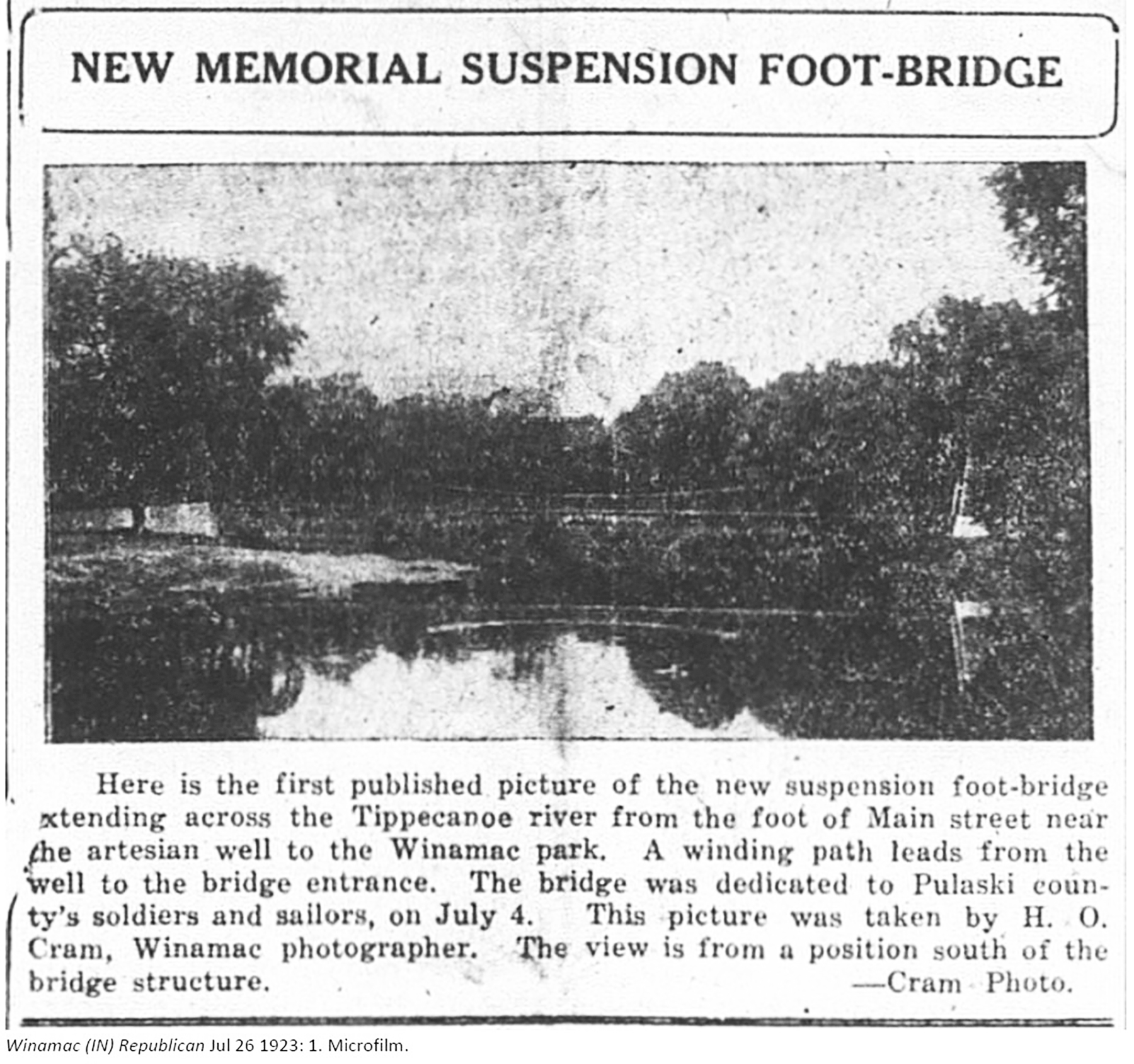
Pulaski County Democrat Jul 12, 1923, Microfilm: Tourist Likes Camp Site At Winamac: M.C. Larson, a tourist traveling from Fresno, Calif., to Columbus, Ohio, camped in the Winamac park below the artesian well Friday and Saturday. In conversation with Winamac citizens he declared that the Tippecanoe river, the well and the general conditions combine to make the camping site the finest he has found in all his travels. He added that the new Memorial bridge increases the attractive appearance of the park.
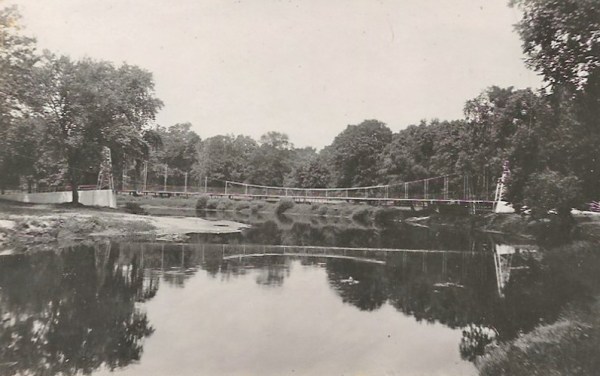
Winamac Republican Jul 26, 1923, Microfilm: New Memorial Suspension Foot-Bridge:
Here is the first published picture of the new suspension foot-bridge extending across the Tippecanoe river from the foot of Main street near the artesian well to the Winamac park. A winding path leads from the well to the bridge entrance. The bridge was dedicated to Pulaski county soldiers and sailors on July 4. This picture was taken by H.O. Crim, Winamac photographer. The view is from a position of the bridge structure.
1934
Pulaski County Democrat Aug 9, 1934, Microfilm: An ordinance was passed setting a fine of $25 as the penalty for jumping upon, climbing the cables or otherwise abusing the Memorial suspension footbridge across the river. Lads old enough to know better have been observed in unnecessary antics on the structure, and the ordinance was made of record so they can be handled in court. It is published in full elsewhere in this paper.
AN ORDINANCE
PROHIBITING CERTAIN ACTS IN CONNECTION WITH THE SUSPENSION MEMORIAL BRIDGE OVER THE TIPPECANOE RIVER AT WINAMAC, PROVIDING PENALTIES FOR THE VIOLATION THEREOF, AND DECLARING AN EMERGENCY.
SECTION I. BE IT ORDAINED BY THE BOARD OF TRUSTEES OF THE TOWN OF WINAMAC, INDIANA, That it shall be unlawful for any person to shake by grasping the cable or hand-rail, jump up and down upon or otherwise cause unnecessary vibration of the suspension Memorial Bridge over the Tippecanoe River, connecting the two parks owned by the town of Winamac, Indiana.
SECTION II. Any person violating this Ordinance shall, upon conviction, be fined in any sum not exceeding Twenty-five Dollars ($25.00).
SECTION III. An emergency existing for the immediate taking effect of this Ordinance, the same shall be in full force and effect from and after its passage.
JOHN C. SHANK, FRANK H. KING, THEODORE H. DUNKIN, WILLIAM D. PATTISON, JESSE C. LESTER, Board of Trustees, Town of Winamac. Attest: T.D. HOWE, Town Clerk, August 9.
R. E. Nutt, Engineer
 A little bit of research on the Memorial SwingingBridge raised questions about the man who built it, R.E. Nutt.
First, a testament to this man’s acumen.
Photo courtesy Pulaski County Public Library
Bridgemeister.com lists sixteen suspension bridges that have been built in the State of Indiana. Additional suspension bridges were found on the BridgeHunter.com website, bringing the number to twenty-one. These lists carry all suspension bridges, those still in use and those lost to us.
Mr. Nutt Built a Bridge That Would Last
Memorial is one of twelve still standing. Several bridges are not dated as to construction, but it appears Memorial is one of the oldest.
The oldest still in use, in Turkey Run State Park, was constructed in 1918. Following damage in the April 2013 flood, “everything is new except the main cables.” The bridge in Foster Park, Fort Wayne, was built in 1920. No significant refurbishing was noted in the online databases. Three of the standing bridges are not dated, but two of the undated bridges appear to be relatively recent in construction. The others were built in 1966, 1988, 1994, and the 2000s.
Local News Coverage of Mr. Nutt During Construction
The local newspapers covering the idea for and the construction of the bridge said little about Mr. Nutt, even misnaming him (twice). This was 1923, and he had been elected three times to serve as County Surveyor, serving from 1917 through 1922, but they didn’t get it right. For some reason, they didn’t focus on the engineer, the builder, a local man.
With the exception of mentioning his name in the bidding and construction process, these snippets are all that were gleaned about Mr. Nutt from local coverage in 1923.
Winamac Republican, March 1, 1923: New Foot-Bridge To Span River: “Plans and estimates have been prepared by Herbert Nutt, an engineer, of Indianapolis, and former Harrison township resident, and these plans will be open to inspection to those at the meeting tonight.”
Pulaski County Democrat, March 9, 1923: Permanent Foot Bridge to Park Across the River: “Plans for a bridge have been drawn by R. E. Nutt, who estimates that the structure can be erected for about $2,000.”
Winamac Republican, March 8, 1923: Town Help for New Foot-Bridge: “Last week’s paper stated that the plans and drawings were made by Hubert Nutt, which was an error, the plans having been made by Former County Surveyor R. E. Nutt”
Mr. Nutt’s Commitment to Memorial
In March 1923, Mr. Nutt appeared before the Winamac Park Association with a proposal to construct a permanent suspension footbridge over the Tippecanoe River.The bridge would connect the Association-owned river park with the Town’s recently purchased artesian well park. He estimated the bridge would “not cost far in excess of $2,000.” The Park Association made a decision to approach the Town of Winamac to share costs on a 50/50 basis. The town agreed to participate, so long as their share did not exceed $1,000.
Originally, the bridge was conceived as a point of pedestrian travel from one park to the other. The purpose was to secure for the town a first-class tourist destination. As plans progressed, the bridge was also to become a memorial to Pulaski county soldiers of all wars, thus the name, Memorial. With that decision, the Town, the Park Association and the Kiwanis Club determined that bridge construction should be complete by June 1.
The consortium asked Mr. Nutt to prepare specifications, and bids were let. At least four local contractors were expected to submit bids, but in the end, only one was received. Mr. Nutt’s bid was for $3,197, considerably above the projected cost. Mr. Nutt explained the price of steel and cement had jumped since the specifications and estimates had been presented.
The matter of letting the contract was tabled to allow the Park Board Association to meet with the Kiwanis Club and make a plan. Before that meeting, the Park Association asked the community for assistance. They immediately sold $1,600 in Association stocks, which was enough to allow the plan to go forward. Before the bridge was complete, they would raise the sales to $2,300.
Mr. Nutt secured the contract on April 6. The contract stipulated completion of the bridge in time for a Fourth of July celebration, and the date of completion was moved back one month, from June 1 to July 1. To meet his contractual obligations, Mr. Nutt traveled to Chicago the next week to secure the earliest possible shipment of materials.
Construction began in May 1923 and was completed before July 4, 1923.
Not only was this project completed short of three months from receiving the contract, but the bridge itself has stood for 98 years as a testament to Mr. Nutt’s engineering expertise.
The Professional Saga of Mr. Nutt
 A search of draft records during the WWI era discovered Mr. Nutt had registered for the draft in Pulaski County in 1918 at the age of 38. He listed his occupation as County Surveyor. By relying on the local newspaper articles during the building of Memorial, one would learn little about Mr. Nutt. The newspapers misidentified him as Herbert Nutt from Indianapolis, who used to live in Harrison Township, then as Hubert Nutt, Former County Surveyor. Whether he had been Surveyor of Pulaski County or another county was not mentioned. As an aside, Mr. Nutt had been raised in Harrison Township but, as an adult, he lived in Winamac. By 1923, he had moved to Kokomo. It’s unknown if he moved before or after the bridge was built.
With that date reference, the County Genealogist searched election records and found he ran successfully to be the Pulaski County Auditor three times. In those days, county elected officials held office for two years. In 1916 he ran as a Republican against the incumbent Democrat, Clarence Paul. Mr. Nutt won by about 300 votes. In1918, he ran again against Democrat Simon Hickle and won by about 500 votes. In 1920, he ran against Democrat William A. Fritz and won by about 700 votes. He did not file to run in the May 1922 primary and moved to Kokomo shortly after leaving office.
Author’s note: One would assume that in a community as small as Pulaski County, the local newspapers would have correctly identified a man who had just left office after serving – apparently successfully – for six years, from January 1917 through December 1922.
Given the election information, staff at the Pulaski County Public Library did a microfilm search and found Mr. Nutt’s campaign advertisements in 1916 and 1918. The photograph that accompanies this article was used in both years. (Apparently, he did not advertise in 1920.) Newspaper photos were grainy, but this original photograph was found with the records from the Winamac Masonic Lodge, which closed, and whose records went to the Lodge at Royal Center. Mr. Nutt at one time served as Grand Master of the Winamac Lodge.
Per bid advertisements found online, Mr. Nutt signed as an engineer. He is listed in the Indiana State Board of Registration Annual Report and Register of Professional Engineers and Land Surveyors (1921-22 Edition), once as Pulaski County Surveyor and three times as living in Kokomo.
From the Winamac Republican, October 26, 1916, is an article about the Republican candidates from the local party. About Mr. Nutt, they say, “Born in Pulaski county and having lived here and become familiar with the needs and observed the character of all parts of the county through bridge construction work and road construction work a nominee is presented on the Republican ticket this year who is amply fitted for the work of county surveyor. R. E. Nutt never before sought public office at the hands of the voters of the county, but his business dealing with all who have come in contact with him mark him as a man in whom the tax-payers and citizens the county over can have utmost confidence. [Illegible] work in the engineering duties and drafting have fitted him for the accuracy that the office of surveyor demands, and his host of friends shows the high personal regard in which he is held, and stamp him for a fair and square public official if the citizens of the county so honor him at election time.”
The same statement appeared in the form of an advertisement for his election in the November 2, 1916 edition.
From his long-form campaign advertisement (Pulaski County Democrat, November2. 2016):
To the Citizens of Pulaski County: There are a great many voters in the county whom I have been unable to see personally. I hope that no one will think unfavorably of me, or refrain from voting for me, on account of this. I have made the best canvas that was possible for me to make but have been unable to cover the entire county.
If you should see fit to elect me to the office of Surveyor, I assure you that the office will receive my constant personal attention, that I will give you courteous treatment, and above all things a square deal to everybody.
I believe that my qualifications are such that I need not be backward about asking any voter for his support. I am competent to make all my own bridge plans, or any kind of drawings that would be necessary. I would be more than pleased to show you some of my work along this line, and let you judge for yourself as to my ability. I have had years of experience in estimating. This will enable me to place a correct estimate on the bridge, road and ditch work.
My experience with the practical side of all of this work, and the knowledge I have obtained by having years of experience in actually performing the work, have given me a very close realization of just what is necessary to obtain the best results. I wish to add that I have a mathematical education that will enable me to handle the work of the office with ease, should you see fit to elect me on November 7th.
The one thing that I want to get before the people is, that if I am elected, I can and will conduct the office in such a manner that you will not regret having supported me.
Thanking you for any support you may wish to ge [sic] me in this election, I am,
Sincerely yours, Russell E. Nutt. Republican nominee for County Surveyor.
A short-form version of the advertisement was found, but the paper and date are not on the printout. In it, he said, “I feel that my years of experience with almost all kinds of public work, of most of which I have an intimate knowledge, together with my ability as a draftsman and engineer, should enable me to be of great value to the taxpayers of PulaskiCounty.”
Professional Training as a Bridge Builder
Mr. Nutt built a bridge in Winamac that has stood for 98 years. Even so, finding local information on the man’s history as a builder of bridges proved to be nearly impossible. References were found in other places.
From the “Carmel Standard,” Friday (no date) 1926, published on the Visit Hamilton County website, is news of the dedication of Flowing Well at White Chapel. The following reference is made to Mr. Nutt: “The memorial was proposed in 1925 … to utilize this well as a public gift … Accordingly in 1926, construction was completed under the direction of A.H. Myers, general chairman of the committee; Russell E. Nutt, of Kokomo, a bridge engineer; Lincoln Purcell, of Carmel, and Wilson Kellam.”
His obituary, from the Kokomo Tribune in 1941, described him as a bridge builder and contractor.
A local obituary – newspaper unknown but captured by the Pulaski County PublicLibrary – described him as a bridge builder, “his last work in this vicinity being the bridge on U.S. Highway N.35 at the north edge of Winamac.”
His obituaries, even the local one, did not mention Memorial Bridge. The local obituary mentioned that several Masons traveled to Kokomo to attend the funeral.
Finding professional references vis a vis bridge building was a difficult task. Finally, our little “study group” spent some time investigating the possibility of his involvement with the Winamac Bridge Company.
Winamac Bridge Company
If people today are aware of the Winamac Bridge Company, they think of the StearnsTruss Bridge that used to traverse the Big Monon Ditch or the Woodruff Bridge that, while abandoned, still traverses the Tippecanoe River south of Winamac.
The Stearns Truss Bridge was designed by William E. Stearns and erected in 1905 by the Winamac Bridge Company. It is the only Stearns Truss Bridge known to still be in existence in the United States. It was placed on the National Historic Register with the work of a local Boy Scout as his Eagle Scout project, and with the help of the Pulaski County Historical Society. It was listed on the National Register in 2003 as “Pulaski County Bridge No. 31.”
In 2005, when contracts were let to clean the ditch, the bridge stood in the way. Set to demolish the bridge, the Commissioners instead accepted an offer from the Wabash and Erie Canal Park in Delphi to purchase it for $10. The bridge was moved and now, known as “Blue Bridge,” is part of their park in Delphi. It is no longer listed on the National Historic Register.
The Winamac Bridge Company also had a hand in the Woodruff Bridge, known also as the Wasson Ford Bridge. The Wrought Iron Bridge Company built the two-span through-truss bridge, a Pratt Truss, in 1890. Sometime around 1910 the north span was lost, possibly to flooding, and was temporarily replaced by a bowstring truss.
Around that time, the Winamac Bridge Company replaced the bowstring truss with a Warren Truss.
The story of these bridges may or may not have anything to do with Mr. Nutt. In1905 (Stearns Truss), he would have been twenty-five years of age. In 1910 (Warren Truss or Woodruff Bridge), he would have been thirty. We were able to connect him to the Winamac Bridge Company, but apparently, he moved to Iowa.
The Winamac Bridge Company was owned in part by John W. Frain, Mr. Nutt’s brother-in-law. Per information gathered by the Pulaski County Genealogist and the Pulaski County Public Library, Mr. Frain moved to the northwest part of the United States around this time. His task was to sell and build bridges in that part of the country.
The 1910 U.S. Census places R.E. Nutt, his wife Hilda, and their son Errett in the home of John W. Frain in Clay, Webster County, Iowa, along with five other men, who were probably employees of the Winamac Bridge Company.
Our little “study group” concluded that R.E. Nutt was, indeed, an employee of the Winamac Bridge Company, thereby gaining the experience he touted in his election efforts and the training and experience necessary to build a bridge that would stand for a century.
Mr. Nutt’s Upbringing
Per official documents, Russell Errett Nutt was born in Kewanna (Fulton County) on March 20, 1880. However, it appears he was born at the family homestead in Harrison Township, Pulaski County. The postal address of the homestead – today – is Kewanna. The house itself was on the southwest corner of 200 S and 500 E, close to the Fulton County line.
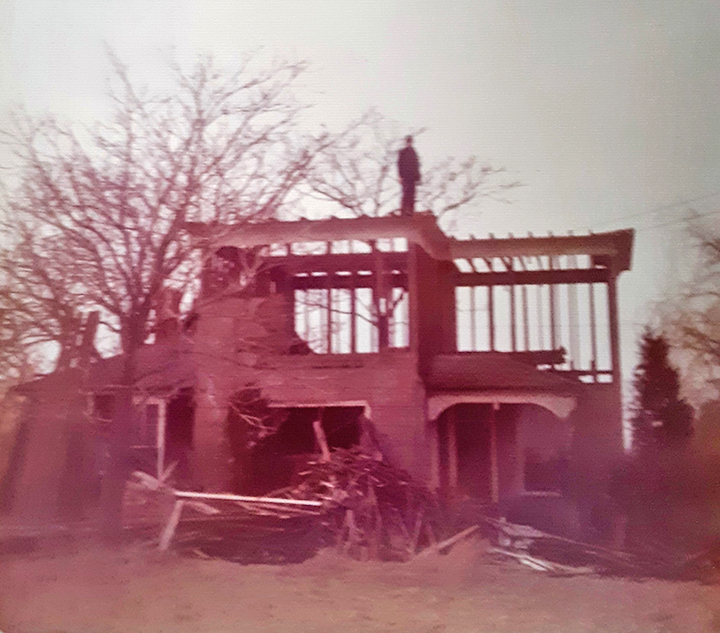
The Nutt property straddled County Road 200 South. John F. Nutt purchased the parcel on the northwest corner from William H. Croucher in 1876. The southwest corner was purchased from Sarah E. Mullins in 1881. In 1904, he deeded the land to his children, each having a 1/7 interest. John F. Nutt passed away in 1914. We have done no further property searches, but we know that the Williams family purchased the property in 1945. This photo was provided by Deb DeSchepper. It is what remained of the Nutt homestead as her father, Carl Williams, pulled it down in the late 1970s.
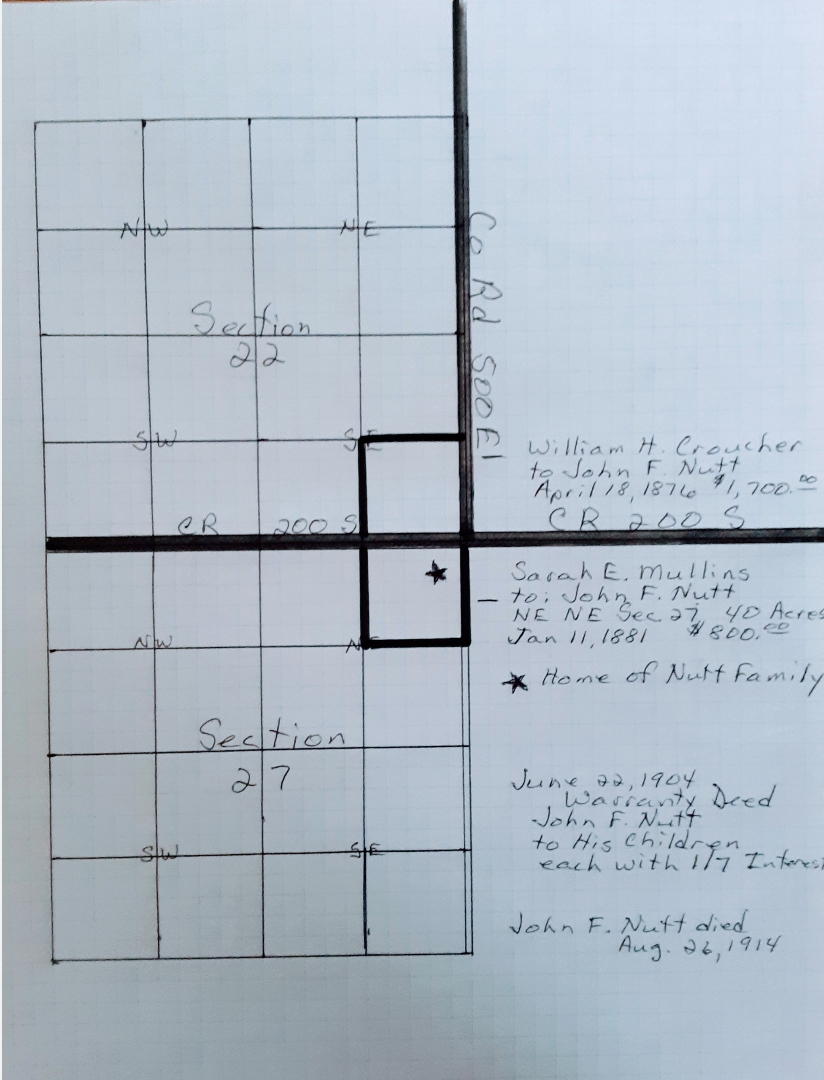 I’ve become fascinated with Mr. Nutt and his “opus,” (the Memorial SwingingBridge). As one winds around these country roads on the southeast side of Pulaski County, this location is a mere 4.8 miles from my home, or 3.6 “as the crow flies.” Who knew?
He would have gone to Fairview School, located one quarter mile west and then a mile north of where he grew up.
His formal education was not mentioned in any obituary. In fact, the 1940 U.S. Census states Mr. Nutt’s education ended at grade 8. In those days “engineer” was fairly loosely defined. Professional licensing was just getting established. He could have called himself an engineer because of his experience and training. Surveyors were able to operate in that fashion, with little formal training requirements, until 1980.
His draft registration from 1918 – he would have been 38 years old – states he was of medium build, medium height, with dark hair and gray eyes.
His Adult Years
Per the U.S. Census, in 1900, at age 20, he lived with his parents, John F. and Charlotte Nutt, in Harrison Township, Pulaski County. He married Hilda Frain on December 18, 1900. They had one child, a son, Errett Frain Nutt. (You will hear more about him later.) We know the family lived in Iowa in 1910 while he was probably employed by the Winamac Bridge Company.
The 1920 Census shows Russell, Hilda and Errett Nutt living in a home they owned at 307 North Market Street, Winamac. The addresses in that area are now 303 North Market Street (apartments) and 309 North Market Street (where a new house on two lots now sits).
At the time Mr. Nutt and his family lived on Market Street, his neighbor, two houses to the north, would have been Judge John G. Reidelbach. The Judge had purchased the home built by Dr. William Henry Thompson. By the 1940s, after both Mr. Nutt and Judge Reidelbach no longer lived there, the Thompson/Reidelbach house was converted into a hotel and became known as the Winamac Hotel. If you are familiar with Winamac and the Winamac Hotel, you have now correctly placed that residential block in your mind’s eye.
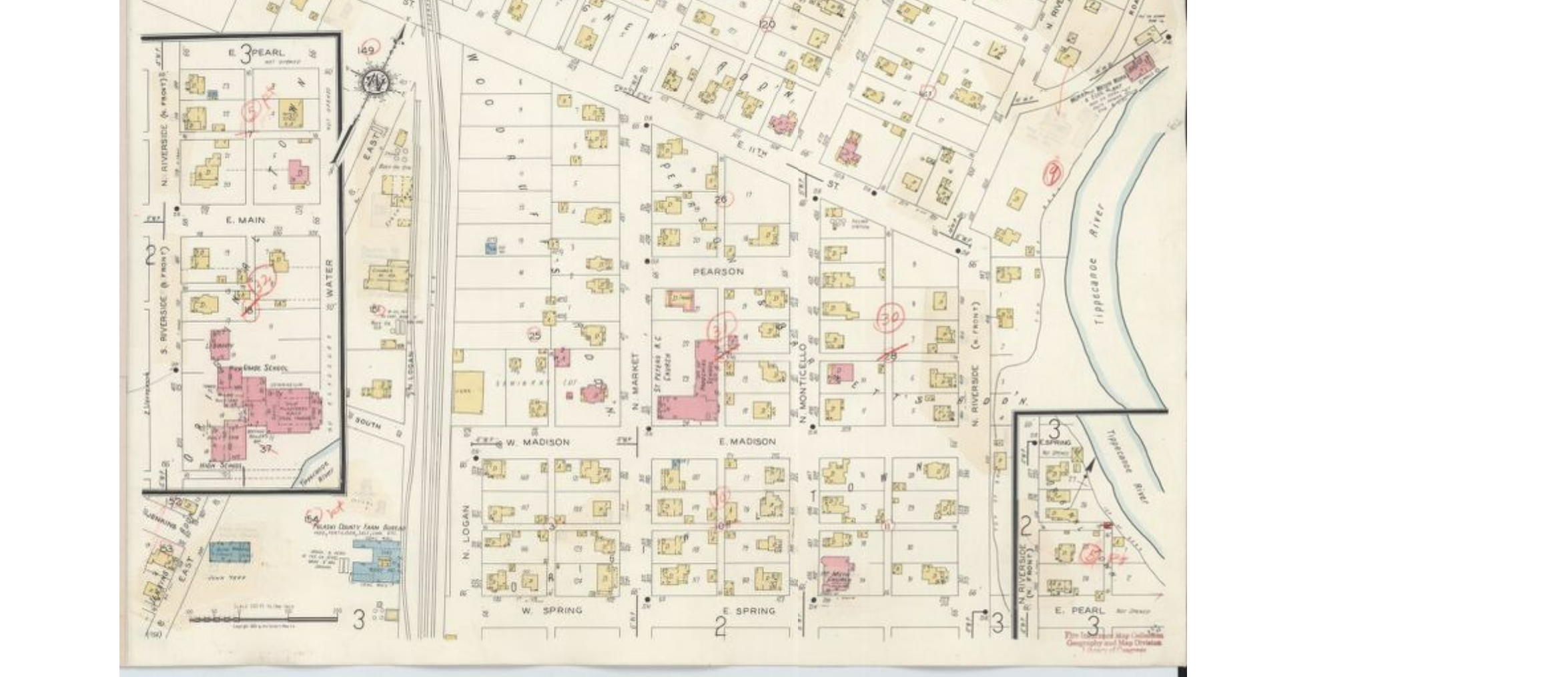 The next house to the north, across Madison Street from the first Thompson house, was built by Dr. George Warren Thompson. That house was later sold to a prominent attorney, L. A. Reidelbach.
One is left to wonder if the houses owned by the two Doctors Thompson (they were brothers) were intentionally purchased by two brothers Reidelbach. Perhaps that speculation should not be made here. I did not do research into the two families Reidelbach.
Back to the story at hand, that house is now owned by the John Simmermaker family and has been placed on the National Register of Historic Places. St. Peter’s Catholic Church is across the street.
This all goes to say, making a short story long, that in the 1920s, Mr. Nutt lived in a high class neighborhood.
According to the Indiana State Board of Registration Annual Report and Register of Professional Engineers and Land Surveyors, by some time in 1923, the year Memorial was erected, Mr. Nutt moved to Kokomo. At his death in 1941, he was buried in Kokomo.
Pulaski County Connections
It appears the Nutt family history with Pulaski County begins sometime before 1880. Apparently, his nuclear family – brothers and sisters – moved out of the area, although several individuals have mentioned having relatives that are Nutts from the Kewanna area in Fulton County. I’m trying not to laugh at that sentence.
We can tie Mr. Nutt’s family to current community families through his wife, Hilda Frain Nutt.
John Frain was one of the original (white) settlers of Monroe Township and Winamac. Two of his sons will be mentioned: George, born on February 2, 1850, and Felix, whose story will be picked up below.
William Wentz was also an original (white) settler in Harrison Township. To him was born a daughter, Fianna, on March 25, 1855.
John Frain’s son George married William Wentz’s daughter Fianna on Christmas day, 1872. Among their children was a daughter, Hilda Myrtle Frain.
Hilda Myrtle Frain married Russell Errett Nutt on December 18, 1900.
I referenced Felix Frain above. He was the grandfather of Max Frain, of Frain Mortuary, at the corner of Main and Riverside Streets. Max’s son (Dan) and grandson (Jon) still run the family business. The progeny of R. E. and Hilda Nutt are related to the family, whose business is just up the hill west of the bridge, the length of a town block. The Nutt progeny are also related to Howard Wentz, who owns Howard’s Marathon, just a hop further west and a skip a half block south.
Closing the Personal Saga
R.E. Nutt is buried in Kokomo, having passed away at the age of 61 on June 17, 1941. Per the obituary, he was a “well-known local bridge contractor.” He “suffered a stroke of apoplexy about a year ago, from which he never fully recovered. He had been seriously ill for the past three weeks.” Along with his wife, Hilda, he was survived by a son, Errett, two grandchildren, three sisters (Mrs. George Roach of Warren, Mrs. Clarice South of East Chicago and Mrs. Lesta Boyle of Santa Barbara, California), and a brother (Hubert, of Ohio). Mr. Nutt “was a member of the Masonic lodge and was widely known in central and northern Indiana.”
Errett Frain Nutt
 Errett, for all that we know, had nothing to do with Memorial. However, his history puts him just a bit closer to those of us who live in the community today. Many people reading this document will know some of the names, and will, perhaps, be related to them.
Errett Frain Nutt, the only child of R.E. and Hilda Nutt, died in1995 at the age of 92. He was born and raised in Winamac and graduated from Winamac High School. Their family was enough removed from the town that his granddaughter, when contacted by Jon Frain, knew only that his middle initial was “F,” not that it stood for Frain, and not that she had relatives in the area. She knew nothing, either, of Memorial.
This photo, courtesy of Pulaski County Public Library, is his senior photo from the 1922 Totem.
To put Errett into perspective, he graduated in 1922. Memorial was built in May and June, 1923, and dedicated in July of 1923. It is possible the family had moved to Kokomo by that time, or that they moved shortly after.
As noted above, the family lived in the neighborhood of St. Peter’s Catholic Church. Errett played the saxophone in the high school band, participated in basketball and baseball, and was a staff member of both the Totem and the Informer. Some of his classmates were Mary Bond, Eunice Emmett, Bruce Day, Olive Fry, Margene Gay, Margaret Gilsinger, Cora Grafton, Delight Holdermann, Herbert Hoch, Eleanore Lange, Dorothy Cox, Miriam Keller and Mildred Weaver.
 Should you happen to go to the Pulaski County Public Library and look at this issue of the Totem, you will find other names with which you might be familiar.
On a side note, Library staff looked at the Totems for 1923 and 1924. Memorial was such a HUGE deal for the town at that time, and nowhere in these documents is there mention or a picture of it.
From his obituary: Errett Frain Nutt was born in Winamac on April 19, 1903. On December 14, 1942, in Spartanburg, South Carolina, he married Marie L. Householder. He died on May 12, 1995, leaving his wife and two daughters, Marilyn Morgan, Kokomo and Marlene (Buddy James) Meeks, also of Kokomo. Several grandchildren survived him as well. Candace (Ron) Gaby, Jack (Monica) Morgan, Raymond (Terry) Christine, Carol (Mark) Hooker, and Mary Bilby, all of Kokomo, and David (Jan) Christine of Edmond, Oklahoma. Also surviving were 11 great-grandchildren and two great-great-grandchildren. One granddaughter, Vickie Haynes, and one son-in-law, Jack L. Morgan, preceded him in death.
Additional Information and Credits
National and International Databases:
- Bridgemeister: https://www.bridgemeister.com/bridge.php?bid=849
- BridgeHunter: https://bridgehunter.com/in/pulaski/memorial/
CONTRIBUTING TO THE PERSONAL AND PROFESSIONAL HISTORY OF R. E. NUTT: Janet Onken, Pulaski County Genealogist; Jon Frain, Frain Mortuary; Jim Phillips, former resident of Pulaski County, who gathered relevant articles from the Winamac Republican and the Pulaski County Democrat; Russell E. Nutt Obituary from the Kokomo Tribune, June 17, 1941 and from a local paper; Errett Frain Nutt Obituary from the Kokomo Tribune, May 13, 1995; John Weaver (formerly) and Crystal Weaver (currently) employed by INDOT; Pulaski County Public Library; Deb DeSchepper.
Memorial Swinging Bridge Project 2019 – 2023
In 2019, a group of residents gathered together to start a project that would culminate on the 100th anniversary of the dedication of the bridge, on July 4, 2023.
To honor the bridge and to honor the veterans for whom it stands in honor, a $300,000 fundraising project was undertaken. The results are shown in photos below.
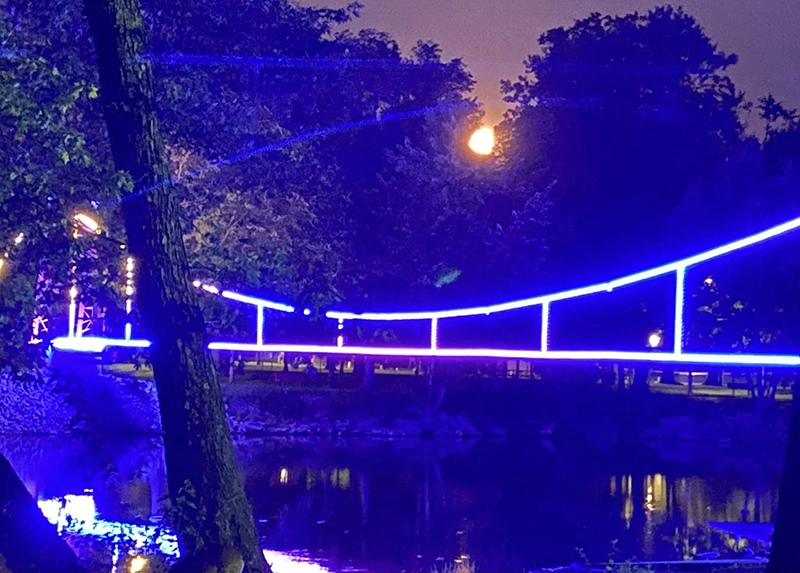
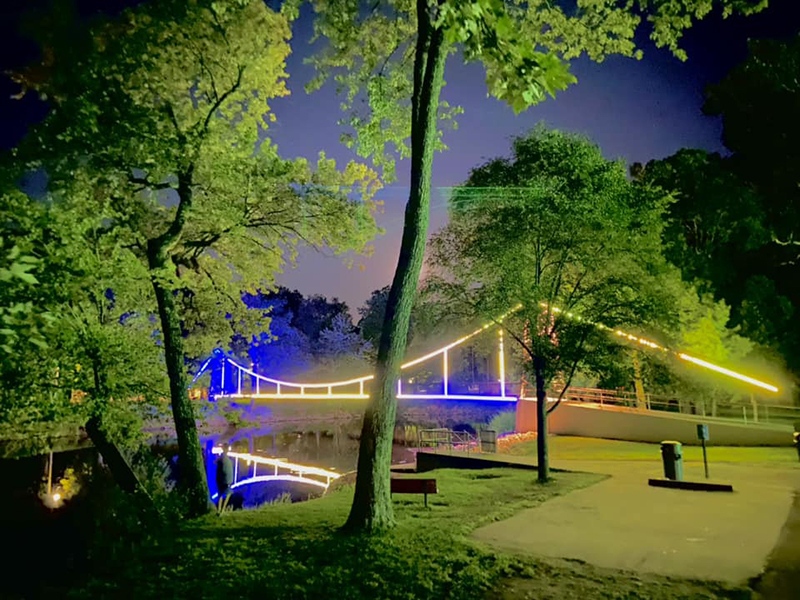


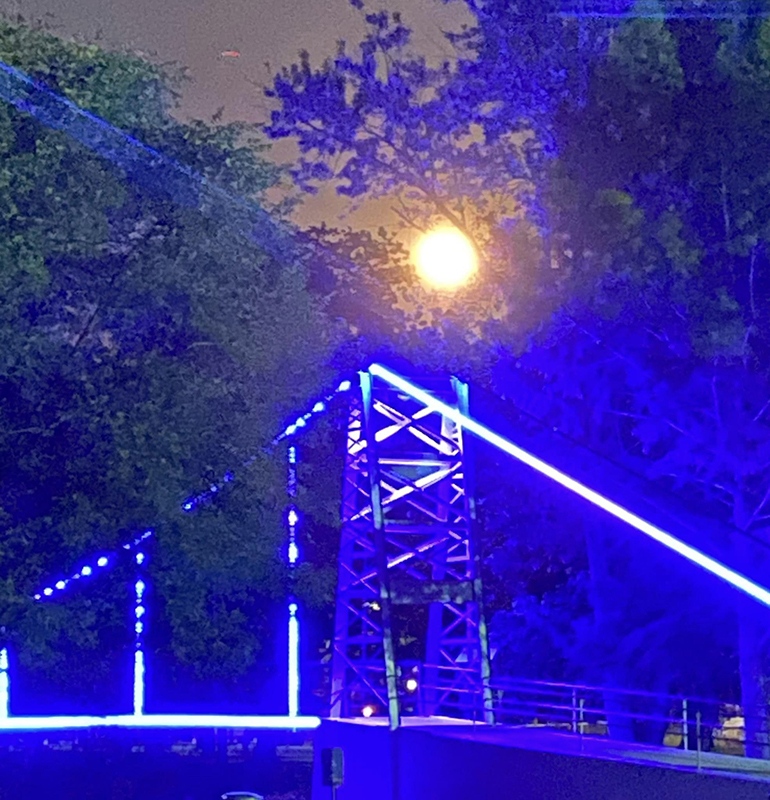
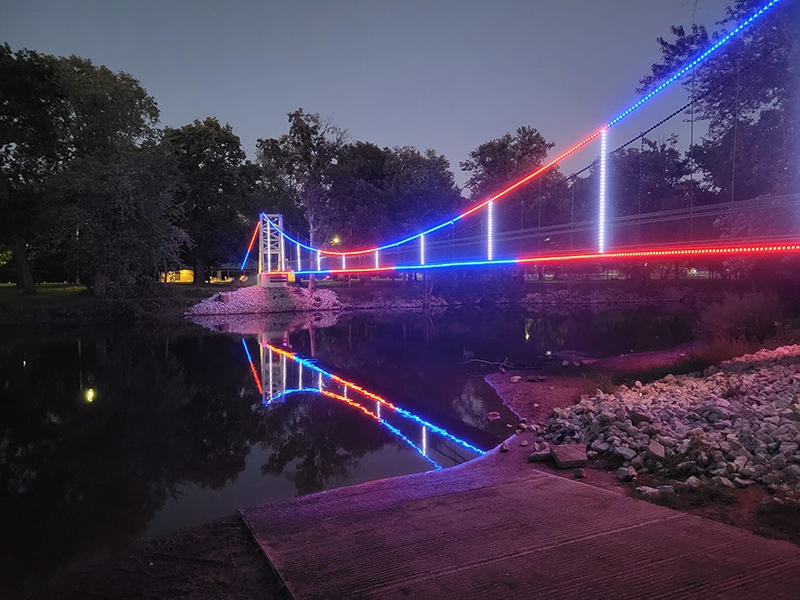
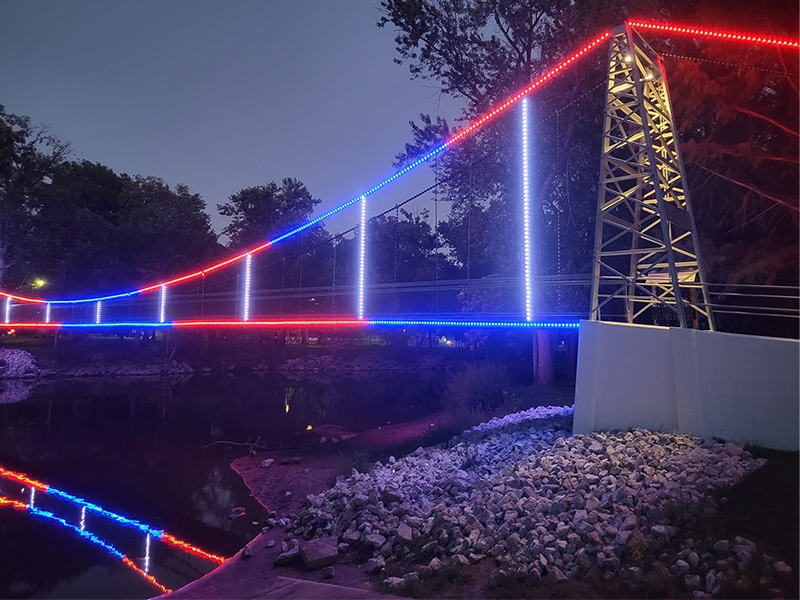
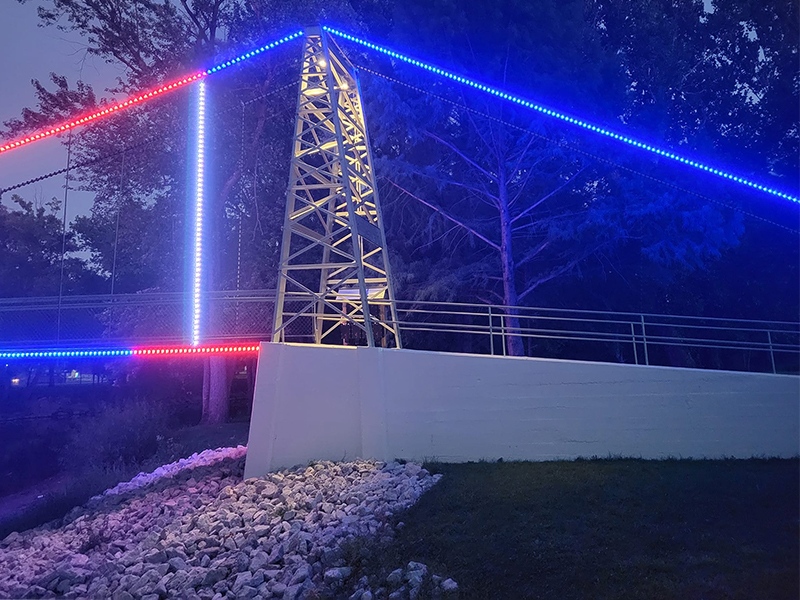
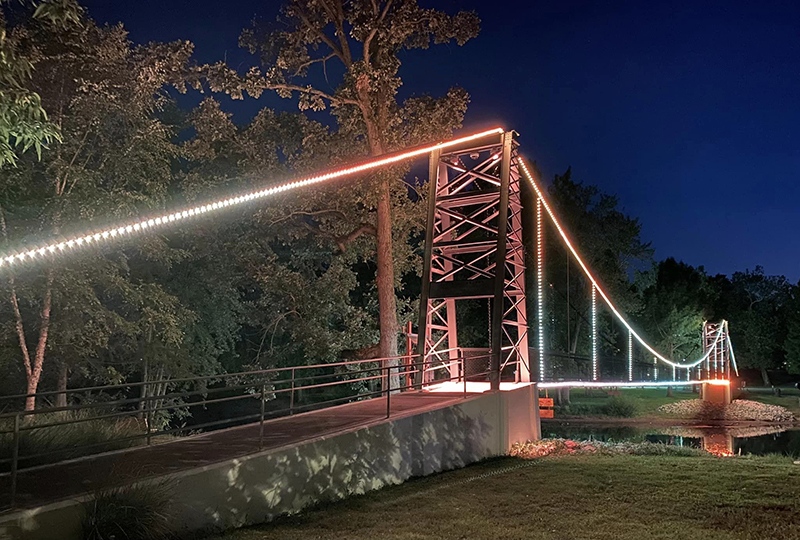
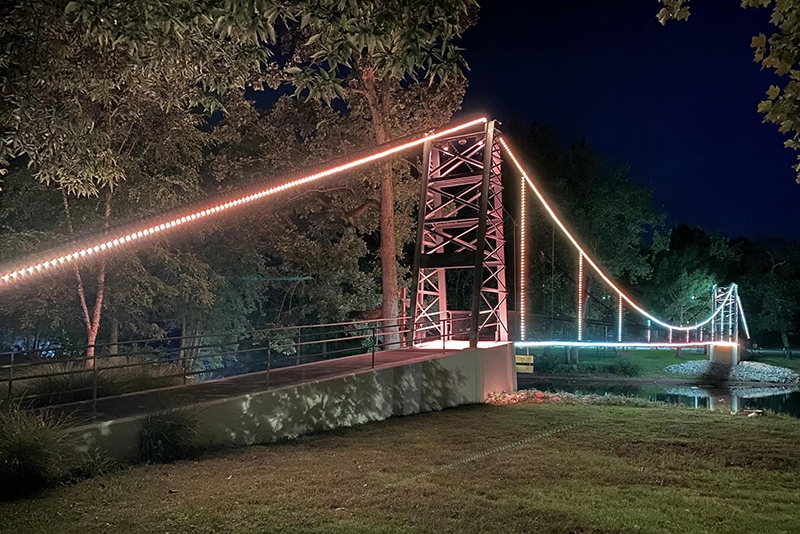

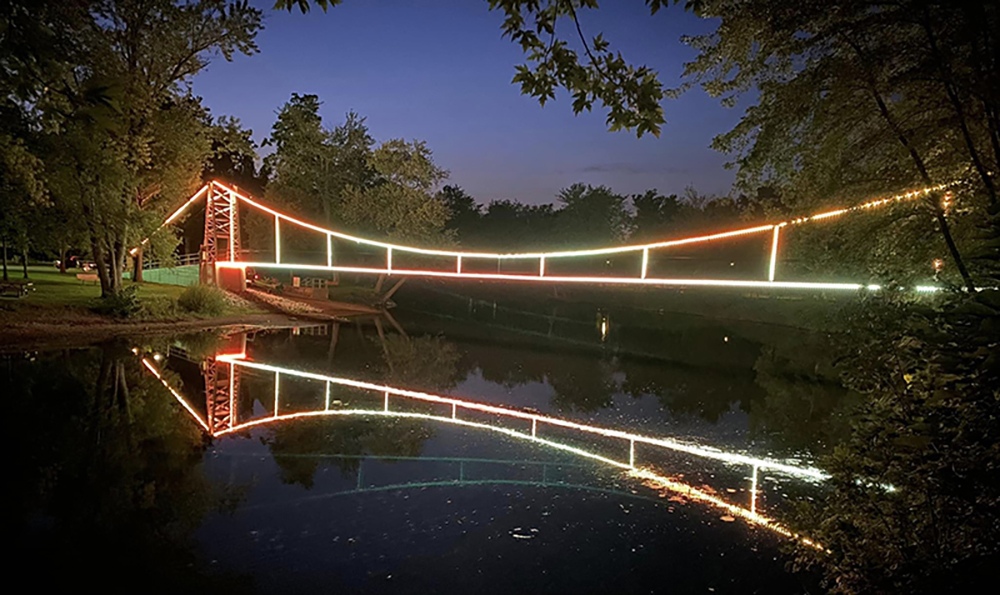
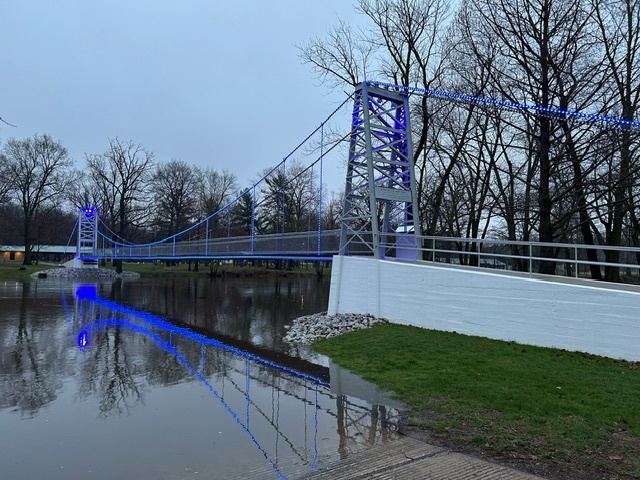
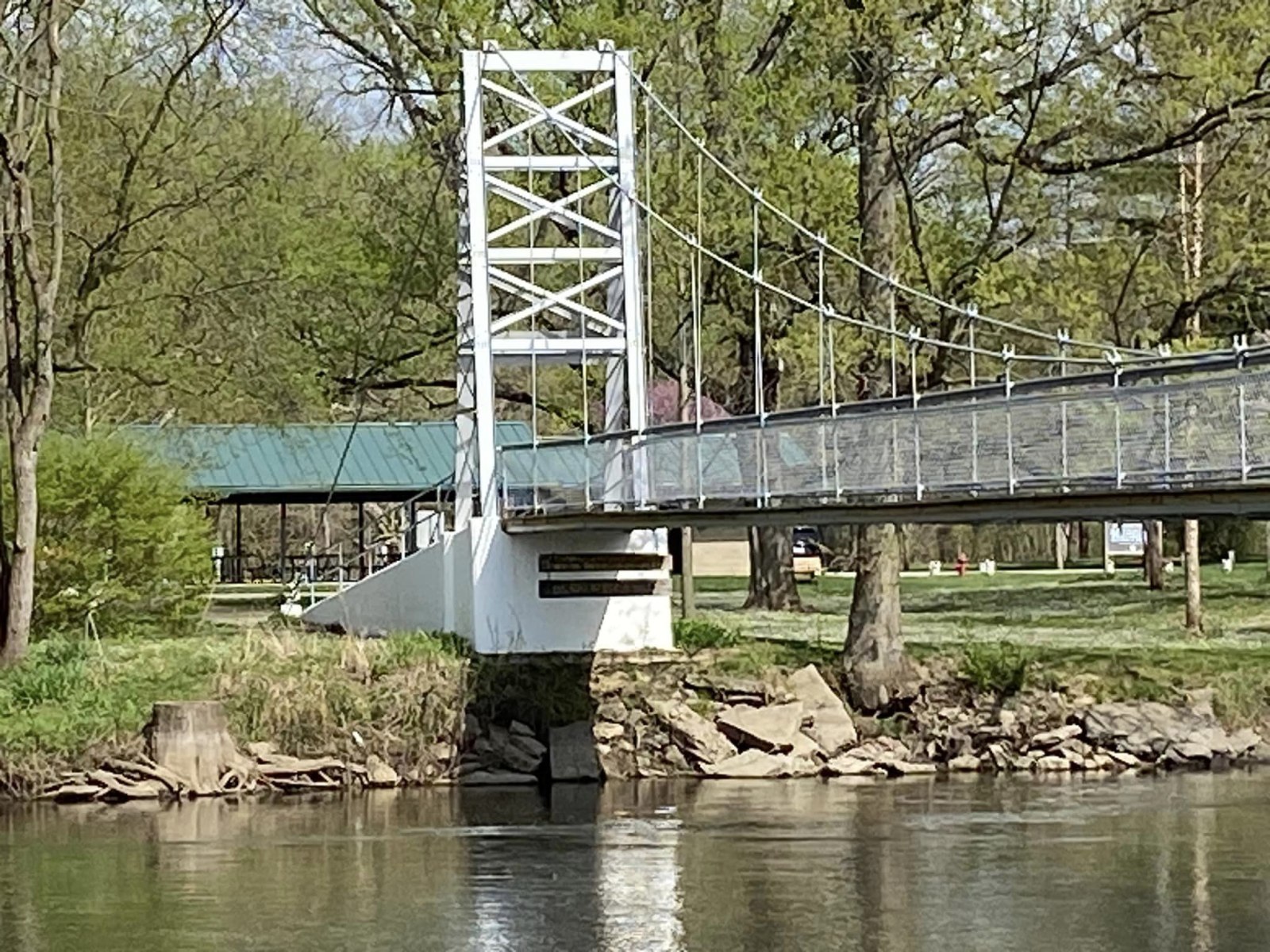
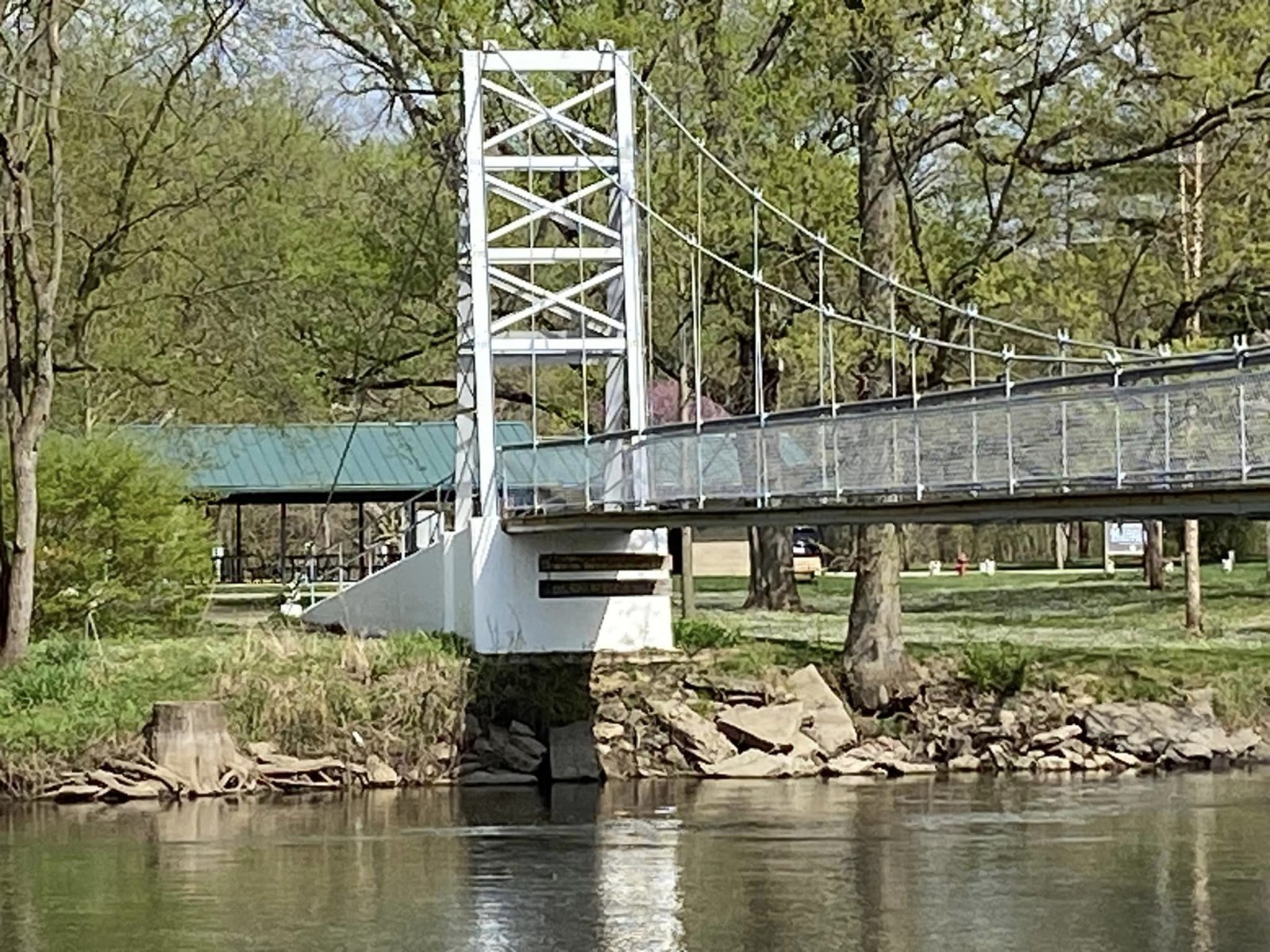
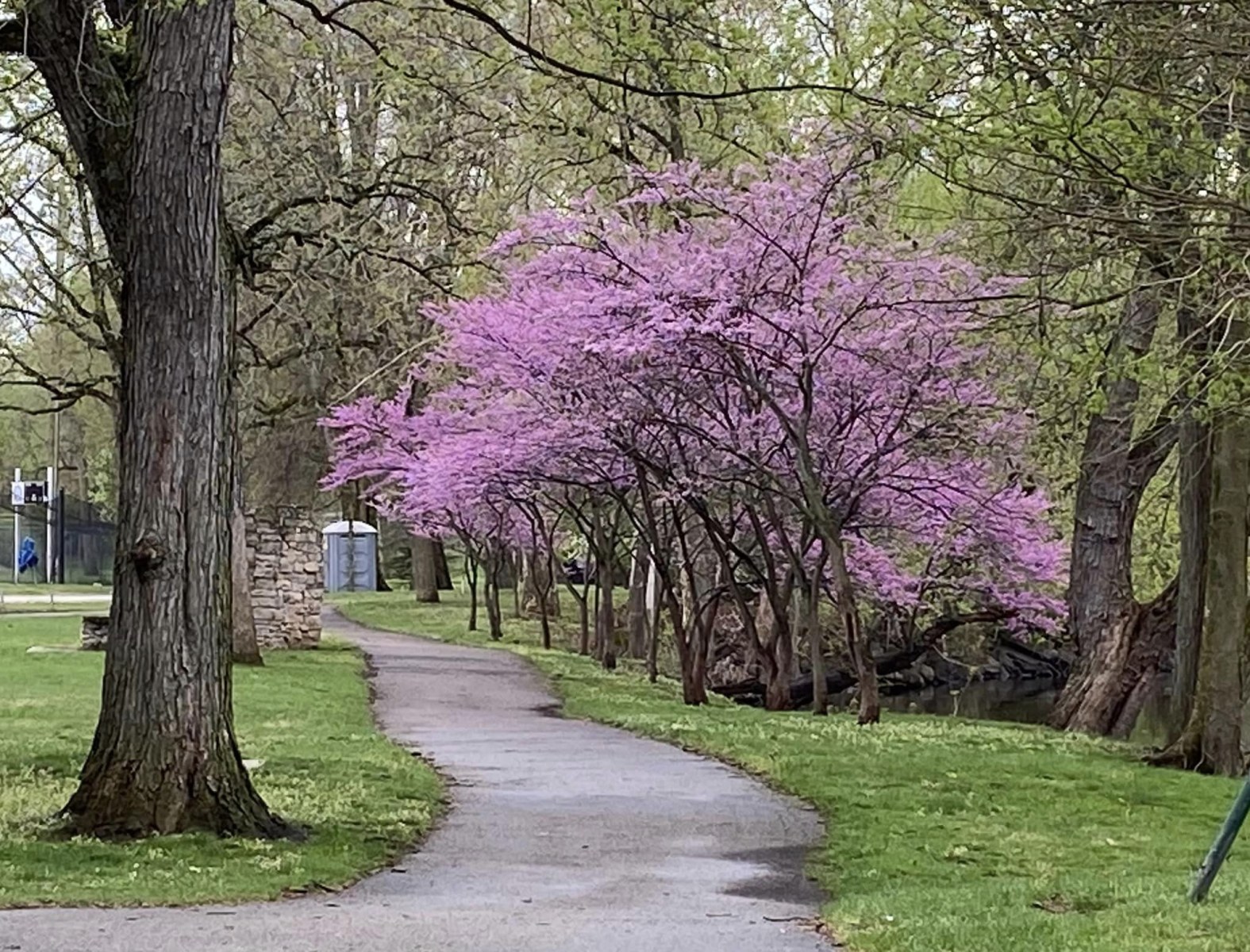
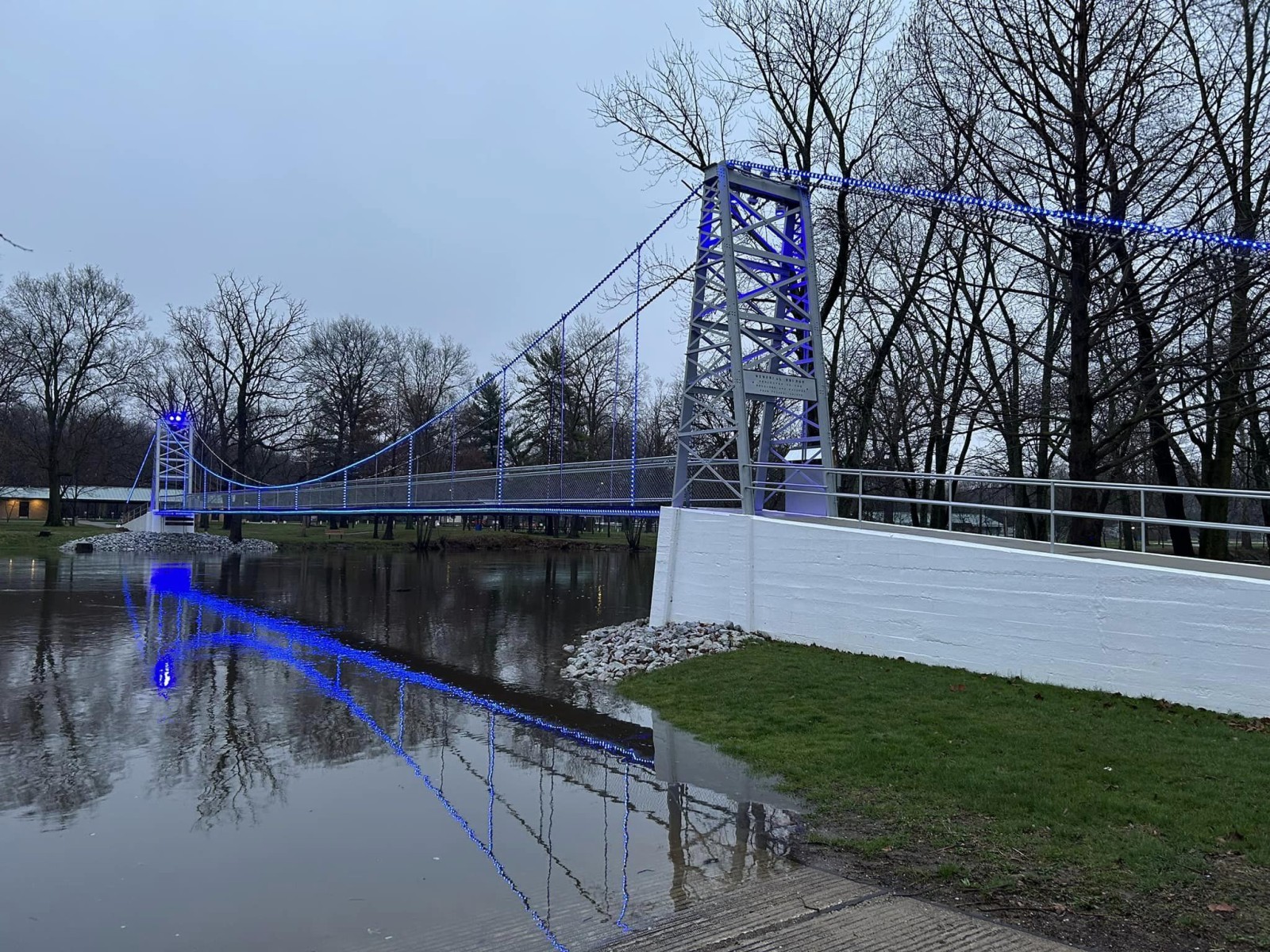

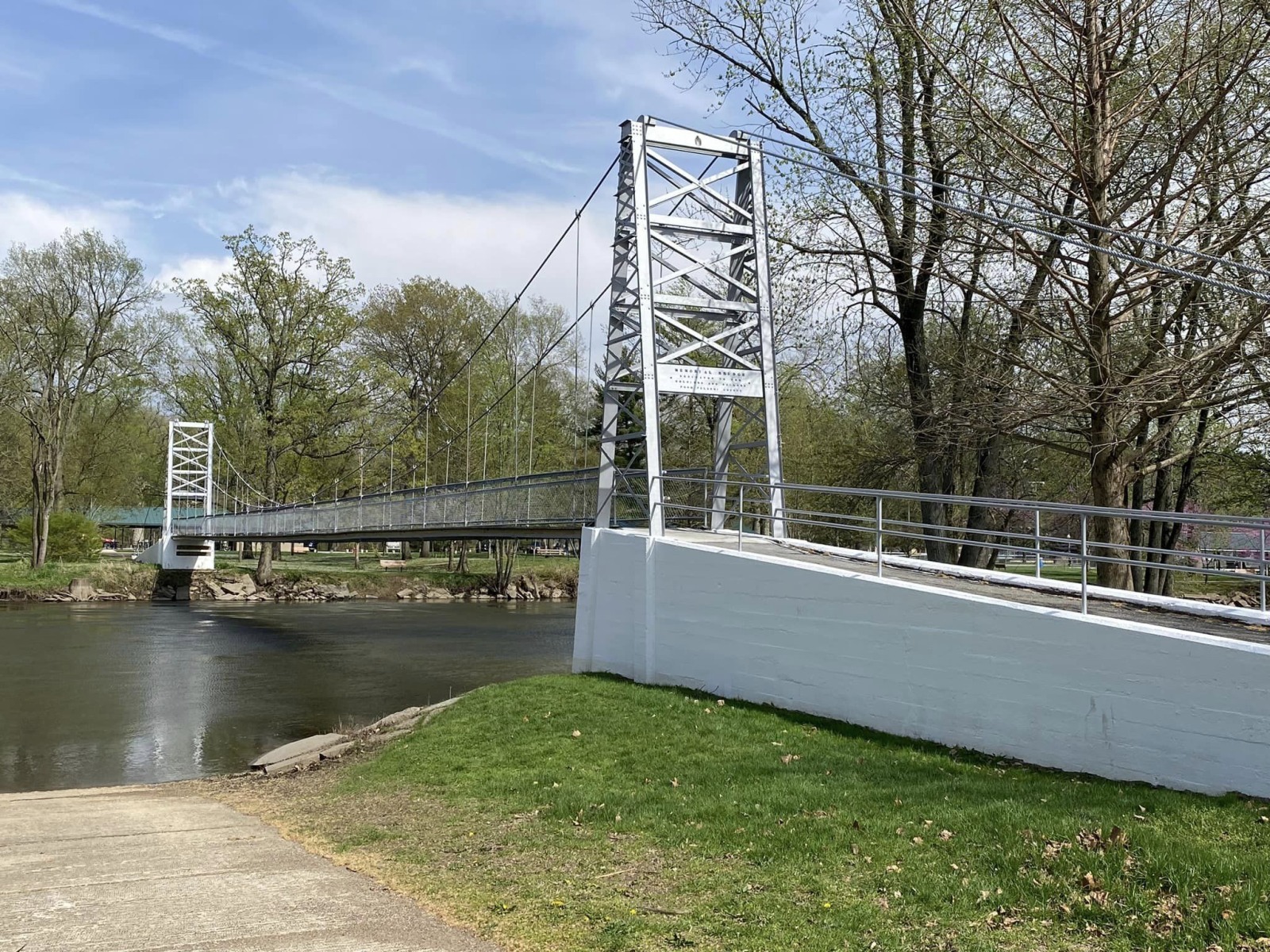
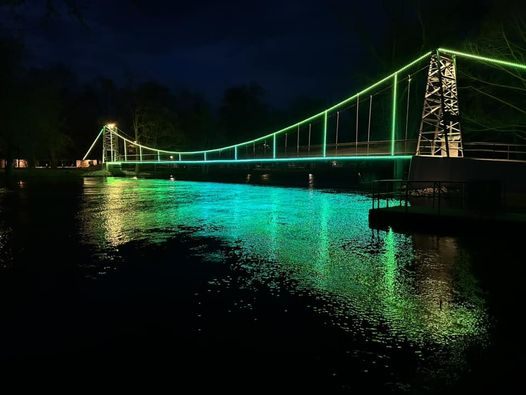

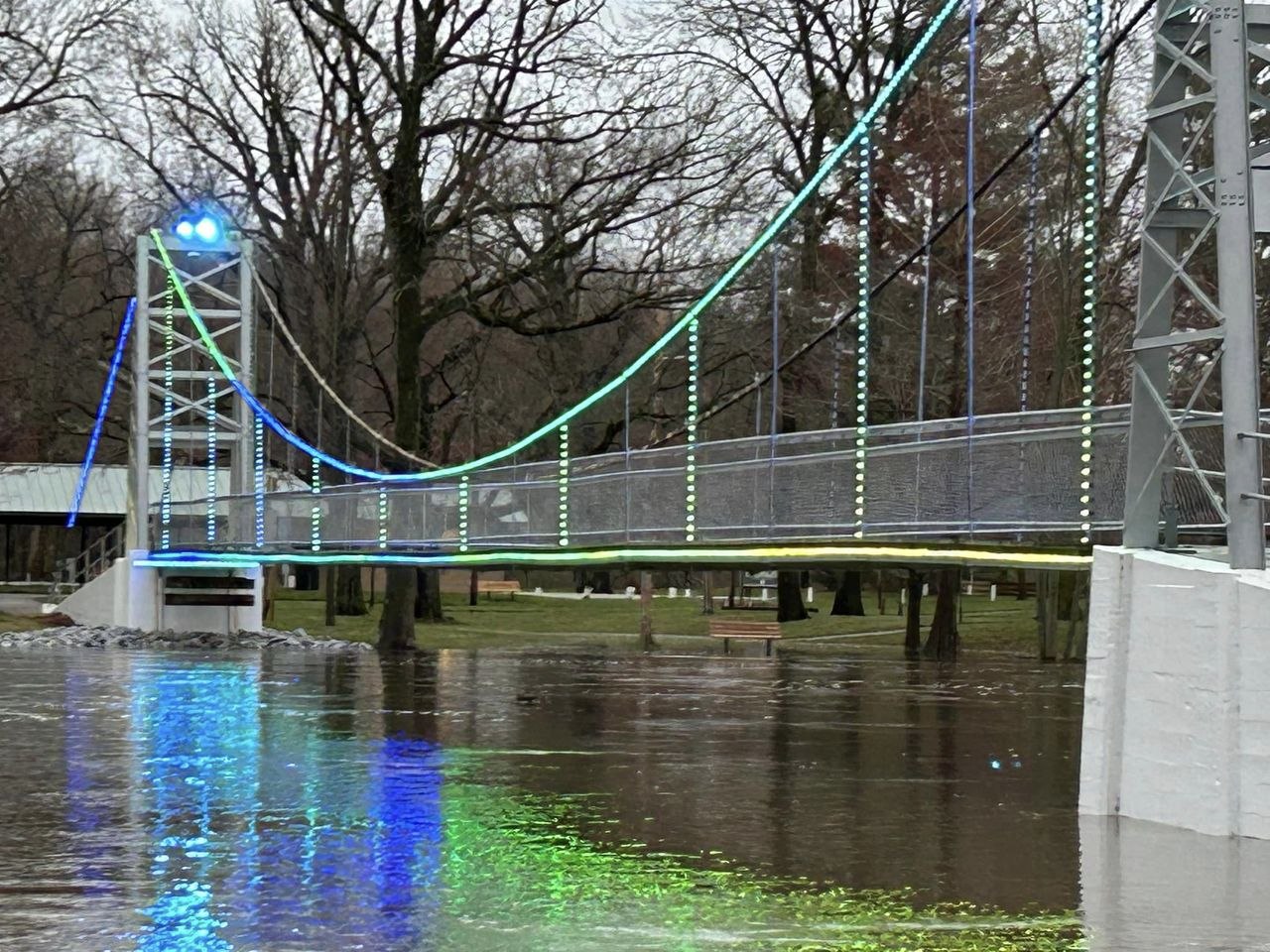

Bridge Renovations 2022 – 2023
The Town of Winamac hired Southern Road and Bridge to rehabilitate the bridge, starting in 2022. Their work was completed in time for the light company to come in.
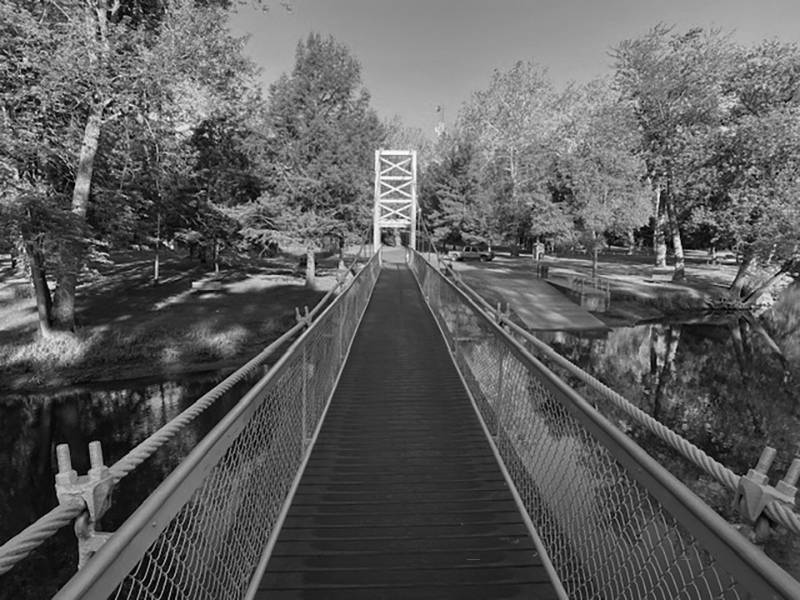
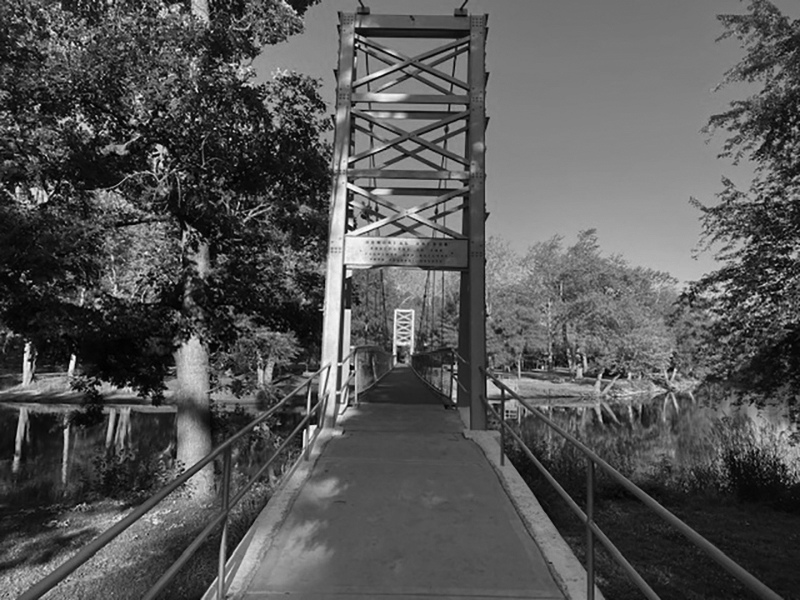
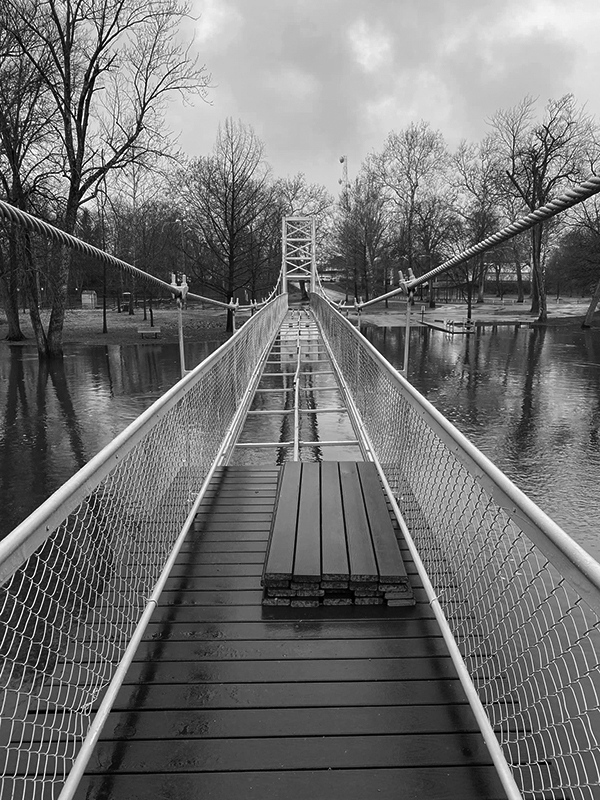


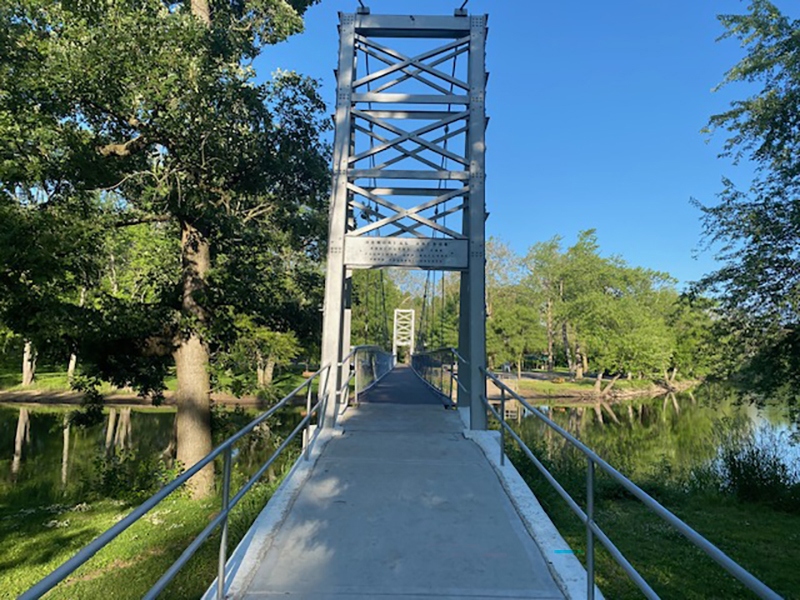


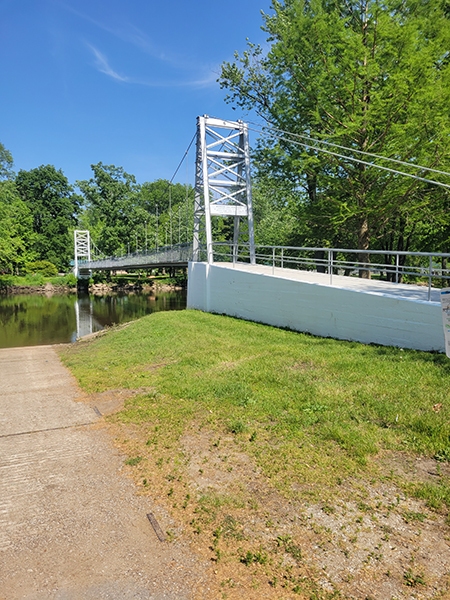
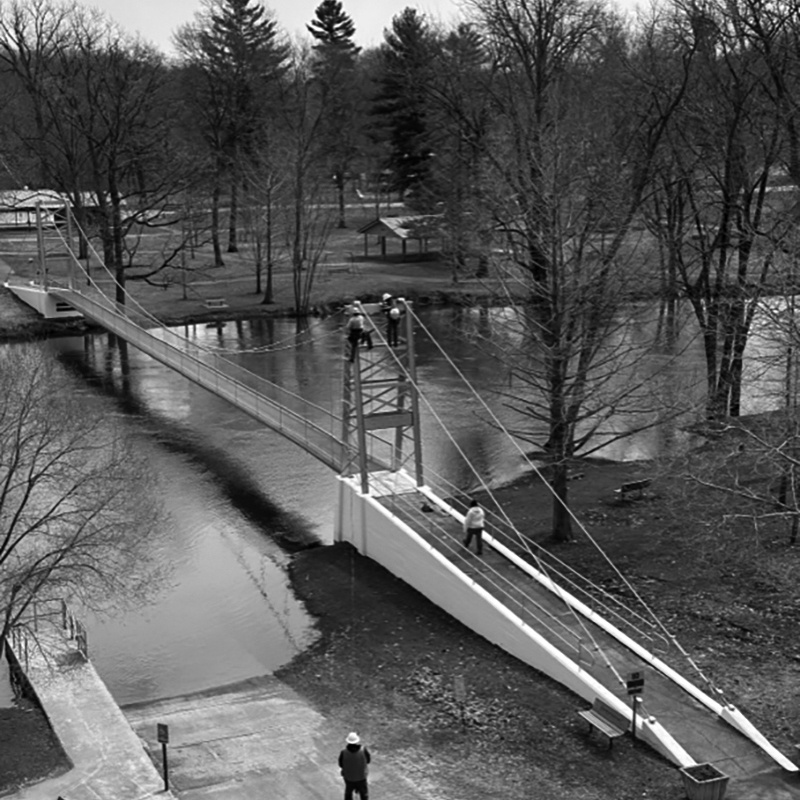
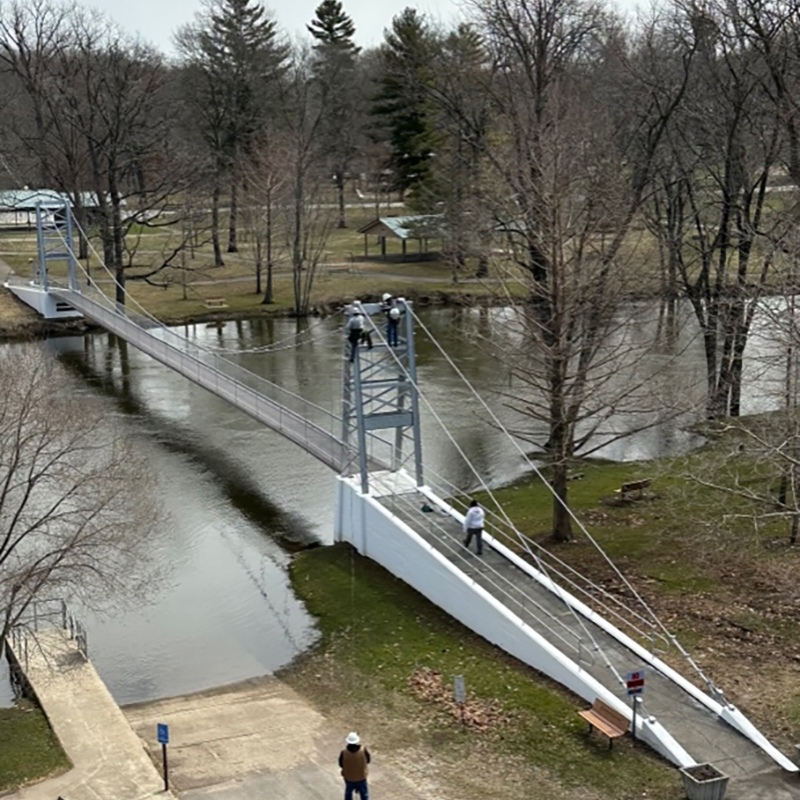
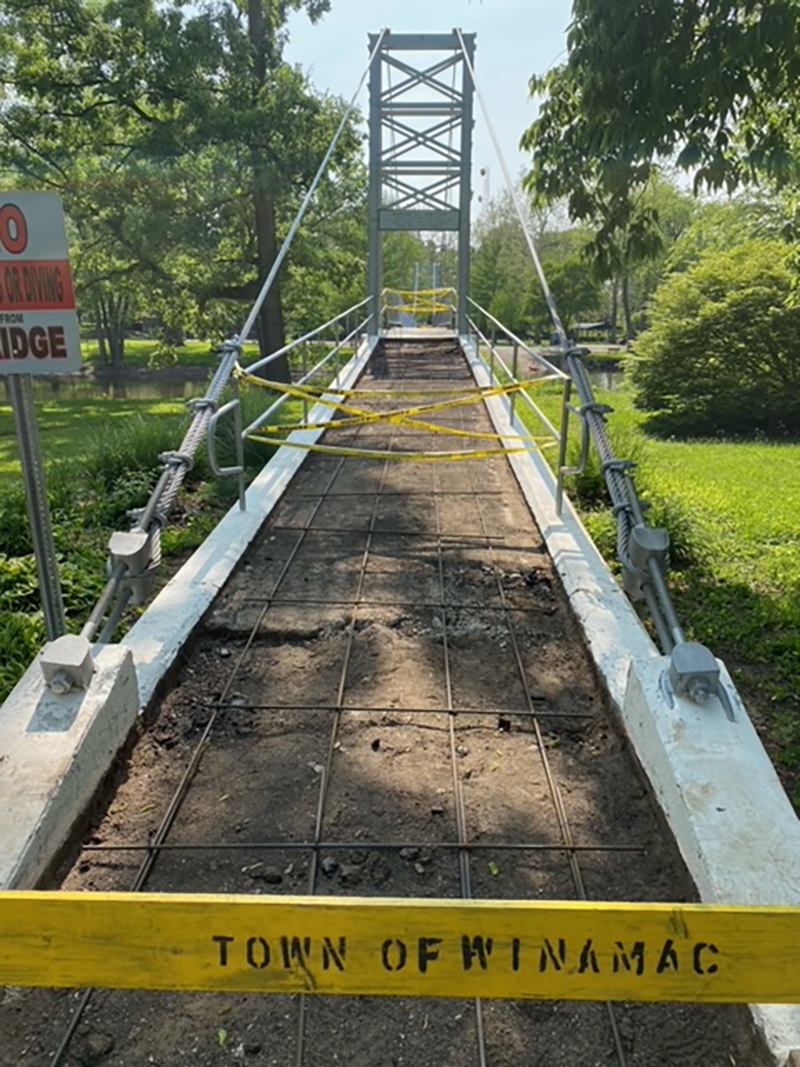


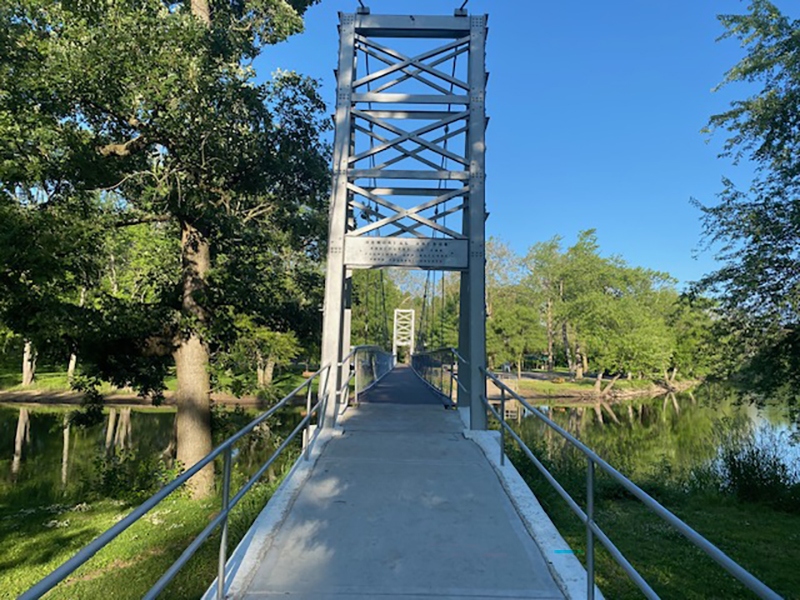
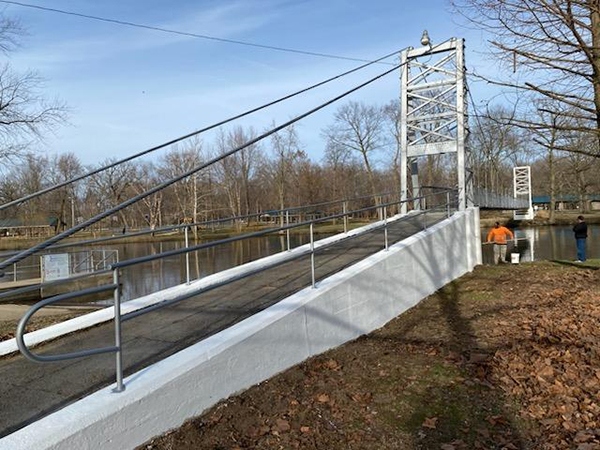
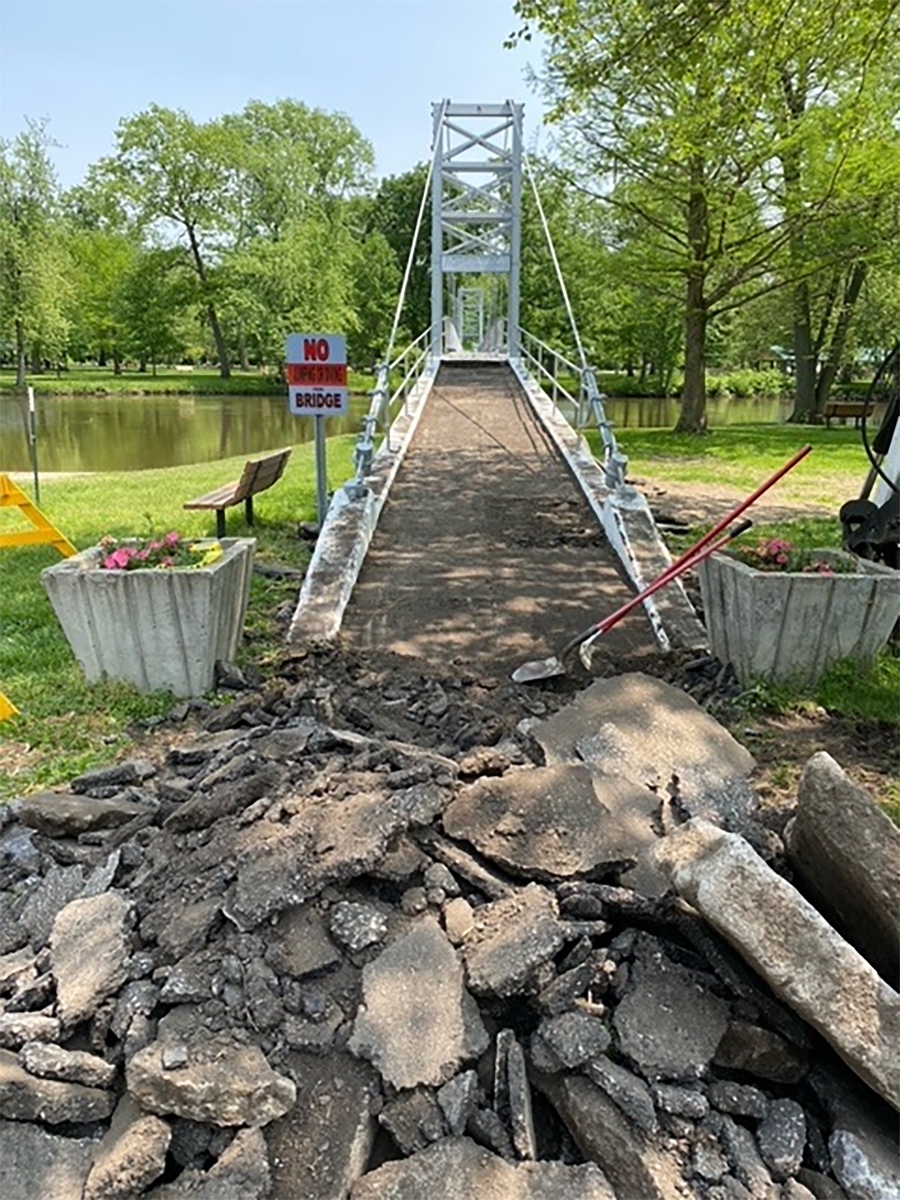
Vault and Marker
On July 3, 2024, the group gathered once again to bury the vault, now filled with historical information, and to place a memorial marker. The vault was buried at Veterans’ Park, at the corner of Washington and Monticello Streets.
The information contained in the vault begins with the same history found on this page and ends with the successful conclusion of the Memorial Swinging Bridge Project. The group hopes that 50 years from now, the vault will be opened and history revisited.
A celebration continued at the park. The evening, including the burying of the vault and the celebration, was called “An Evening at the Bridge.” This will not be the end of the story.