Gift to the museum from the Eastern Pulaski Community School Corporation, August 2024
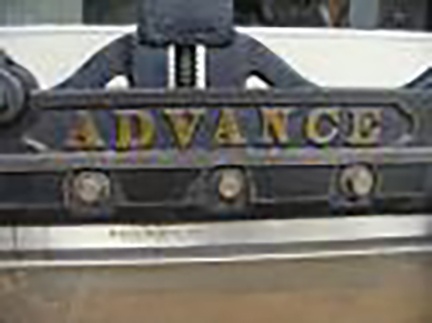
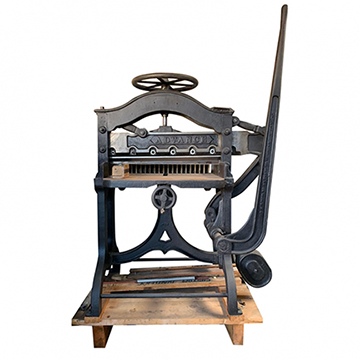
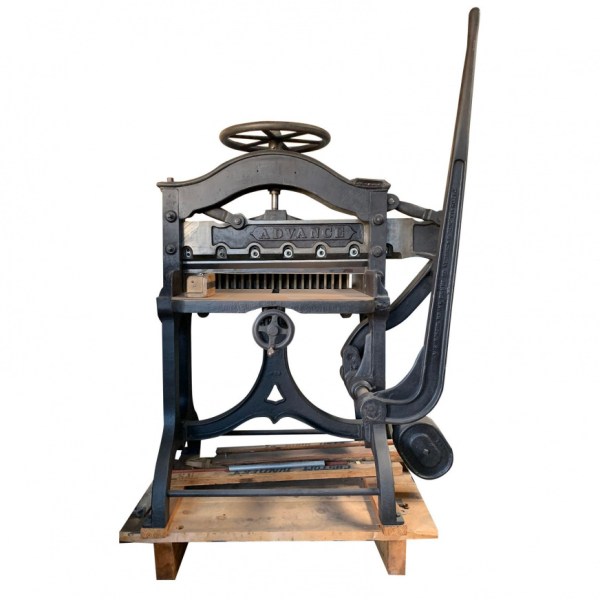 The Historical Society Museum has on display an 1889 Challenge Advance Guillotine Paper Cutter, used by the school for decades for bookbinding and programs. The paper cutter, which was still useable, had been gathering dust for many years. Bound books, becoming a thing of the past, no longer was an area of study for high school students.
This paper cutter was ahead of its time, and it was manufactured by a company that is still a prominent player in the bookbinding industry today.
The Challenge Advance Guillotine Paper Cutter
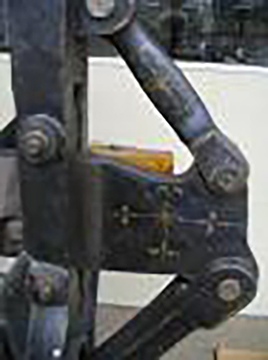
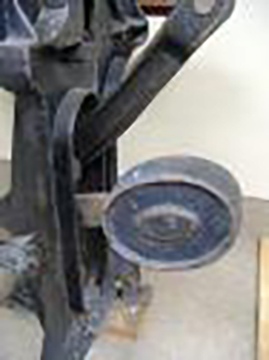
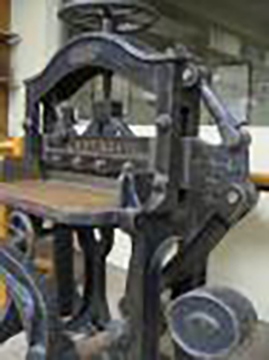
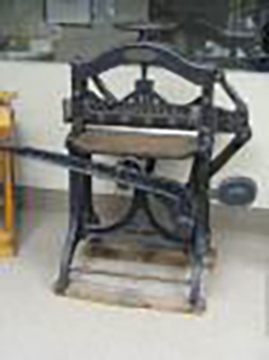
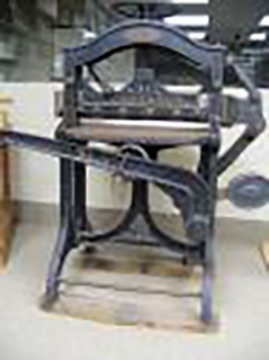
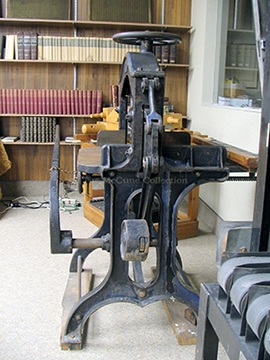
This paper cutter has a clamp hand wheel at the top, a lever to put pressure on the blade and a counterweight to help bring the lever to its start position.
There is also a back gauge hand wheel to move the bed of the paper cutter so that the proper size paper can be cut.
The clamp wheel is used to clamp the paper stock into place. Usually a piece of cardboard is used to protect the paper from any clamp marks. The paper is cut by the pressure of the lever.
At one time, the High School had a book binding class where this was used. According to former students, it was also used to cut booklets used for athletic and dramatic programs.
For a time, it was also used at the bookbinding program at Peak Community Services, their Winamac facility, then known as Pulaski Developmental Services.
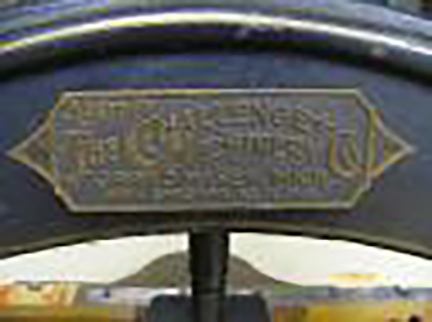
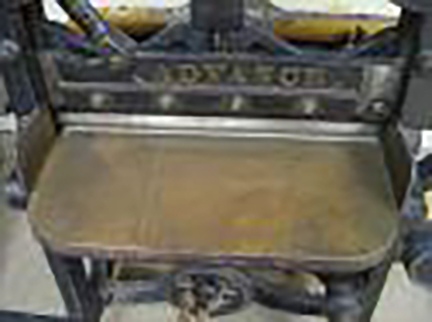
The following photos show the different parts. Click on individual thumbnails to see the full photos.




Challenge Company – A Timeline
The museum has a piece of history. The evolution of this company is a portrait of the evolution of paper cutting and bookbinding in general.
| 1870: In September 1870, an electrotype foundry was established in Chicago to produce cuts for letterpress printing. It was founded as Shniedewend & Lee. | 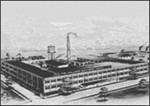 |
| 1871: The young company would have been wiped out by the Great Chicago Fire had it not been for the quick action of co-founder James L. Lee. He went into the burning city and their office to save important papers and electrotype plates just before the entire buliding was destroyed. Two weeks later, the firm reopened in a barn and in 1873, Shniedewend & Lee moved into larger quarters and opened a store for the wholesale and retail sale of printing machines, printer’s supplies, and foundry type. |  |
| 1887: The original paper cutter factory was established. | 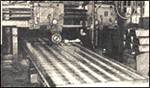  |
| 1893: Shniedewend & Lee Company was reorganized as The Challenge Machinery Company. | 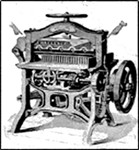 |
| 1899: The Challenge Advance Paper Cutter made its debut. | 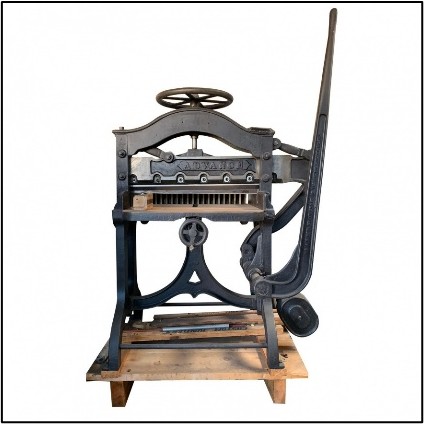 |
| 1903: The growing company moved to Grand Haven, Michigan across the same Great Lake whose water helped save the company over 33 years earlier. | 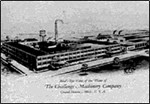 |
| 1907: A foundry as added fulfilling a Lee family ambition to begin with raw material and produce a finished product, all under one roof. By this point in its history, it was clear that Challenge had become an important name in the printing equipment industry. | 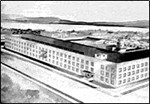 |
| 1928: The Precision Equipment Department, established in 1928 to serve the machine tool industry, was busy supplying the needs of war production customers. | |
| 1930: Challenge introduced the first paper drilling machine, a tremendous improvement over the paper punches. | 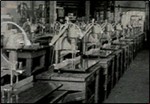 |
| 1940: The industry’s first hydraulic paper cutter.
|
 |
| 1950: Challenge introduces the first hydraulic knife and clamp cutter. | 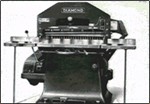 |
| 1960: The original Champion paper cutter was introduced. | 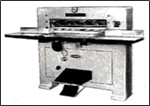 |
| 1961: The EH-3 drill was introduced. | 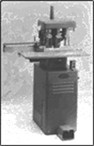 |
| 1965: The first Challenge multi-spindle drill, with up to 10 heads, was introduced. |  |
| 1968: Introduction of the Magna-Spacer, one of the first programmable backgauge controlled cutters. | 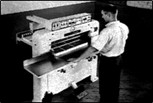 |
| 1972: The Single Cornering Machine model was introduced. | 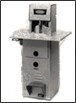 |
| 1978: The Touch Command Memory Digital Spacer was introduced. | 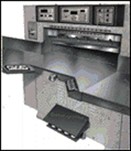 |
| 1990: The MS-5 multi-spindle drill was introduced. |  |
| 1994: The DocuTrim was developed – a single-knife, programmable, 3-sided book trimmer. | 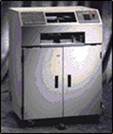 |
| 1996: The first of the Titan model of paper cutters was introduced – the Titan 200. | 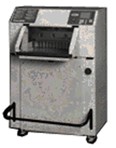 |
| 1997: The Titan 265, Champion 370 and 305 paper cutters, the EH-3C paper drill, and the addition of narrow heads for the MS-5 were introduced at Print 97. |  |
| 2000: Touch-screen color display XT programmer introduced for the Champion 305 & 370 paper cutters. | 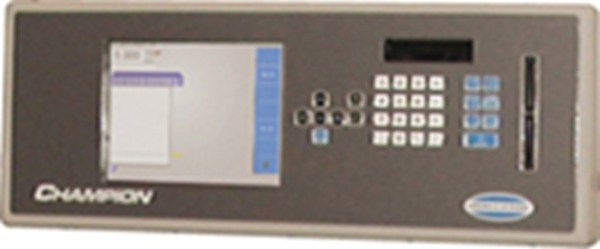 |
| 2001: The CMT-330 is introduced as the first fully automated, programmable three-knife trimmer for both inline and near line book trimming applications. | 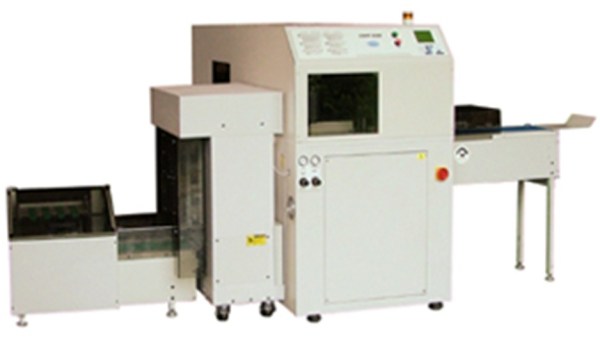 |
| 2002: After 99 years in Grand Haven, Michigan, Challenge moves eight miles north into a new facility in Norton Shores, MI. |  |
| 2006: The Heavy-Duty line of gear-driven, large-size cutters is added to The Challenge products line-up. |  |
| 2007: iJOG air assist, electro-mechanical paper joggers are introduced. | 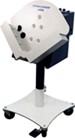 |
| 2009: The CMT-130 – a single knife 3-sided book trimmer – is developed and introduced as an affordable alternative to the 3-knife trimmers. | 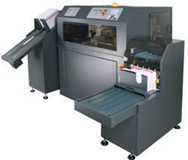 |
| 2015: Challenge Engineers developed the TC Touch-screen control and operating system that is now offered on several cutter and trimmer models across the product line. | 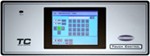 |
| 2020: Challenge teams up with Canon and C.P.Bourg to offer the Book Smart Suite – A fully automated book production workflow. | 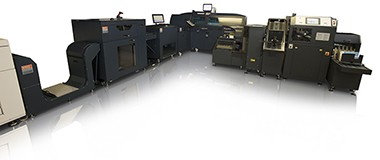 |
| 2022: Challenge introduces the CHAMP 150, CHAMP 185, and CHAMP 185Pro lines of fully-hydraulic paper cutters – the most powerful paper cutters of their size. |  |