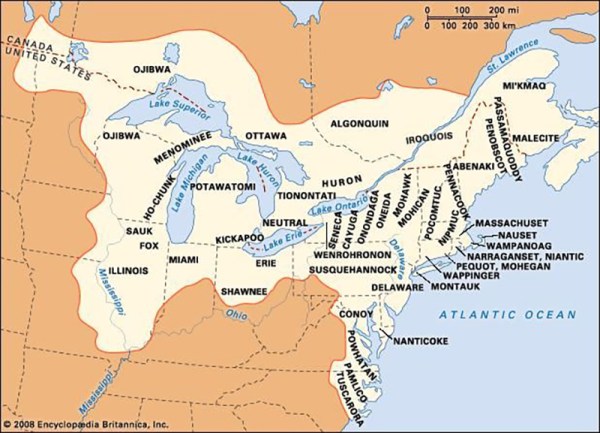
Eastern Woodland Indians lived east of the Mississippi River and south of the subarctic boreal forests. A slide show embedded at the bottom of the page will show how the Eastern Woodland Indians lived throughout the ages. The Eastern Woodland area is in gold, and the map following shows additional detail. 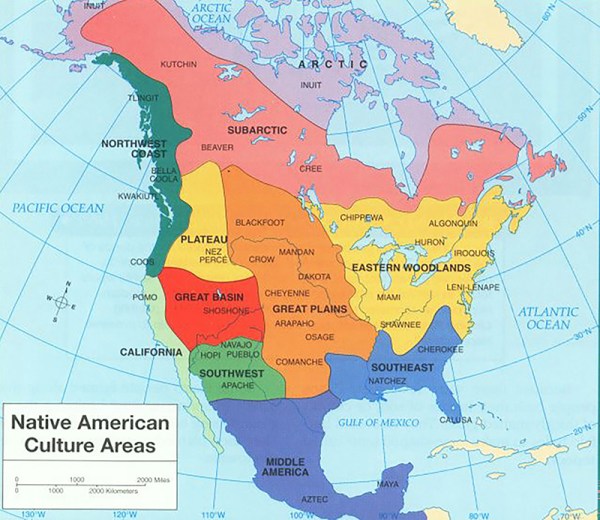
 As we travel from the Ice Age to the period of time 500 years ago – when Europeans came to the shores of the Americas – we will touch on the following periods
- Paleoindian Period: 12,000 – 10,000 Years Ago
- Pre-Clovis History
- Clovis Period
- Folsom Period
- Archaic Period: 10,000 – 2,500 Years Ago
- Woodland Era: 2,500 – 1,000 Years Ago
- Mississippian Era: 1,000 – 500 Years Ago
Paleoindian Period: 12,000 – 10,000 Years Ago
The Paleoindian Period begins at the end of the last ice age when humans first appeared in the archeological record in North America. One of the original groups to enter what is now Canada and the United States was the Clovis culture. Archaeologists divide the Paleoindian period into three subperiods: early, middle, and late. The early part of the period is identified with the fluted spear point (Clovis), while the middle and late portions are represented by a succession of fluted and non-fluted spear points (Folsom). Archeological sites from this period reflect a settlement pattern composed of base camps and special purpose sites, such as animal-processing stations and tool manufacturing sites.
Pre-Clovis History
From the Smithsonian Magazine online: The traditional story of human migration in the Americas goes like this: A group of stone-age people moved from the area of modern-day Siberia to Alaska when receding ocean waters created a land bridge between the two continents across the Bering Strait. Once across, the giant Laurentide and Cordilleran ice sheets, which blocked southern Alaska and the Yukon Territory in western Canada, halted the migrants’ progress. But about 13,000 years ago, the ice sheets began retreating, opening a 900-mile-long ice-free corridor following the Canadian Rockies. This, many researchers believe, is how the Clovis culture moved south and colonized other parts of the Americas. But new evidence over the last decade has made that timeline hazy. Research shows that humans were living south of the ice sheets before the ice-free corridor opened up. A settlement in Monte Verde, Chile, shows people had made it all the way down South America 15,000 years ago and a more recent discovery indicates that humans hunted mammoths in Florida 14,500 years ago. The photo on the next slide gives a map of known pre-Clovis settlements. The oldest known human burial associated with early Paleoindian tools was discovered in what is today Montana in 1968. The tools were recently dated to about 11,050 radiocarbon years before present. 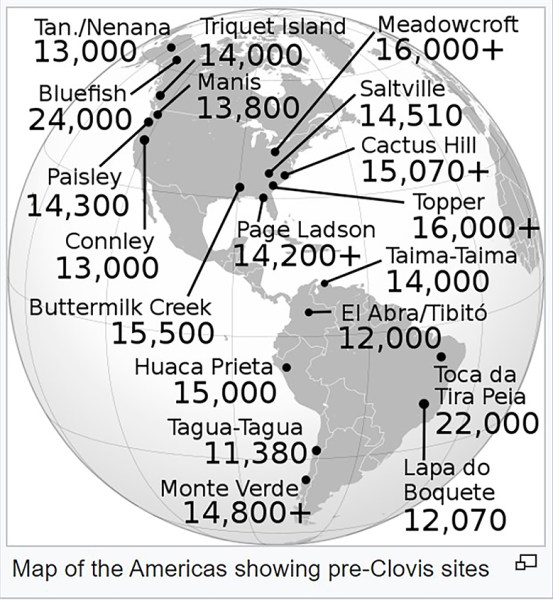
Clovis Complex
This ancient culture is named for the first archeological site found in 1929, near Clovis, New Mexico. Clovis was a hunting-and-gathering (foraging) culture, depending primarily on wild foods. Foraging economies demanded extensive land areas. It is estimated that people who depended on such methods needed seven to 500 square miles of land per person, depending on environmental conditions. Permanent villages or towns were possible only where food supplies were unusually abundant and reliable. Most foraging groups had to move whenever the local supply of food became exhausted, limiting them to the possessions that could be carried from one camp to another. Housing also had to be transported, or made on the spot, and usually consisted of huts, tents or lean-tos made of plant materials or the skins of animals. Social groups were small, because only a limited number of people could congregate without exhausting food resources. Groups normally consisted of extended family or a number of related families, typically with no more than 30 moving on foot, or perhaps 100 in a group with horses or other means of transportation. Throughout a region, the groups were known to one another, as they were tied by kinship and trade. Often, the larger group would gather for a short period every year. Clovis cultures in North America are generally believed to have hunted mammoths, extinct bison, mastodon, gomphotheres (elephant-like, but not related to the elephant family), sloths, tapir, camelops (an extinct genus of camel), horse and other smaller animals.
Folsom Complex
The Covis and Folsom Complex eras were distinguished by the shapes and sizes of tools and implements rather than specific time frames or geographic placing. The Folsom tradition was characterized by use of Folsom points as projectile tips. The first important excavation was in Folsom, New Mexico. Peoples in the Folsom era were also hunter-gatherers (foragers). Many of the archeological sites identified as Folsom-era were termed “kill sites,” areas where Folsom cultures had performed large kills of animals (bison, mountain sheep and deer). At least one area also bore evidence of dwellings. 
Archaic Period: 10,000 – 2,500 Years Ago
Archaic culture refers to any of the ancient cultures that developed from Paleoindian traditions and that led to the adoption of agriculture. Archaic cultures are defined by a group of common characteristics rather than a particular period of time or location. The primary characteristic is a change in subsistence and lifestyle. Their Paleoindian predecessors were highly nomadic, specialized hunters and gatherers who relied on a few species of wild plants and game. Archaic peoples lived in larger groups, were sedentary for part of the year, and partook of a highly varied diet that eventually included some cultivated foods. 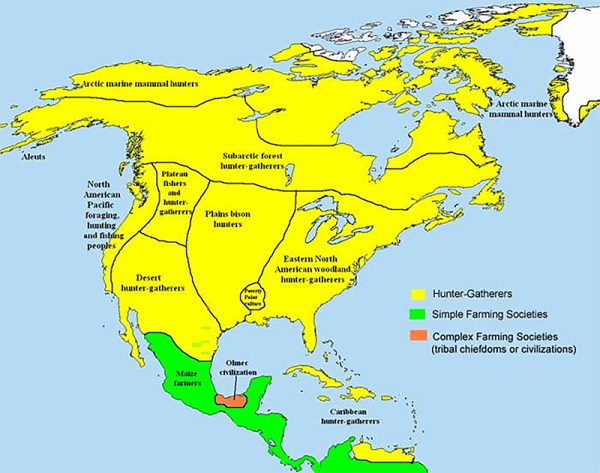 It was during the Archaic Period that people first domesticated plants that later became the staple grain crops of farmers. In some areas, communities became stable and sedentary, and ritual or sacred locations were marked with mounds and earthworks. Instead of moving across the landscape to use natural resources directly, some groups traded raw materials and craft objects across wide areas. Archaic peoples used a wide variety of food resources based on seasonal availability; food remains found at their archaeological sites include a range of mammals (including rabbits, antelope, deer, elk, moose, and bison), terrestrial and water birds, fish and shellfish, and plant foods such as tubers, roots, seeds, fruits, and nuts. Archaic peoples also created a number of tools not seen before in the Americas. Their use of new food sources and creation of new tool types probably developed in tandem, with innovations in each realm fostering additional developments in the other. Basketry and netting augmented the collection and storage of new plant foods, while grinding stones made hard seeds readily edible. Hunting was augmented with the development of improved projectile points, birding and small game nets, and fishhooks. As a more reliable subsistence base allowed the congregation of larger groups, people became more sedentary and social complexity increased. In the late Archaic period, people began to tend plants to a limited degree. In Northern America, Archaic peoples east of the Mississippi River focused on pigweed and related species, while groups in Mesoamerica worked with wild varieties of corn (maize) and those in South America worked with wild potato species. However, Archaic peoples continued to rely upon hunting and gathering for the majority of their food. When a population begins to place greater emphasis on food production and its associated technologies, it is generally said to have developed into a Woodland culture. Construction of mounds and earthworks, once seen as a Woodland Period development, is now known to have taken place first in the Archaic Period. Unlike later in history, Archaic mounds were not used mainly for burial or as platforms for buildings, but instead marked important sacred places and designated public community space.
Woodland Cultures: 2,500 – 1,000 Years Ago
By the beginning of the Woodland period, climate conditions had reached an approximation of the modern climate. The Woodland period is marked by the manufacture of ceramic vessels, construction of mounds, an unequal distribution of exotic raw materials and finished goods, and horticultural activity. The Woodland period is a label used by archaeologists to designate pre-Columbian Native American occupations dating between roughly 500 BC and AD 1100 in eastern North America. This time period is traditionally divided into Early, Middle, and Late subperiods.
Early Woodland Period
Until recently, the onset of the Woodland period was assumed to have been the time of the initial appearance of pottery vessels, the beginnings of mound ceremonialism, the emergence of sedentary village life with well-defined structures and settlements, and intensive cultivation of crops. It is now clear, however, that the beginnings of these developments lie deeper in the past by a thousand years or more. Mound construction dates back to at least 3000 BC. Intensive cultivation of native food crops such as sunflowers, and gourds was widespread by 1000 BC. Finally, in some regions, pottery predates the onset of Woodland cultures by over 1000 years.
Middle Woodland Period
The Middle Woodland period, dating between approximately 200 BC and AD 300, is noteworthy because of the widespread construction of small conical burial mounds, as well as long-distance exchange of distinctive artifact types and materials, such as copper from the Great Lakes area, mica from the southern Appalachians, and shells from the Gulf coast. The apparent increase in mound construction was not accompanied by major changes in community or settlement organization. People continued to live in small communities of several circular or oval structures. A tribal form of social organization may have been present, consisting of a number of interacting, more or less equal clans, or people claiming descent from common or mythic ancestors.
Late Woodland Period
The Late Woodland period, which is characterized by a lack of the non-local artifacts and materials (copper, etc.,) that had been seen in the previous 500 years, began around AD 300. Despite the apparent reduction of inter-regional exchange, the Late Woodland period was a time of important cultural changes. There is evidence for population growth and larger settlements. A major technological advance, the bow and arrow, appeared around AD 700, as reflected by the widespread appearance of small triangular and notched arrow points.
Eastern Woodland Cultures
The Eastern Woodland Culture consisted of Indian tribes inhabiting the eastern United States and Canada. The Eastern Woodlands were moderate-climate regions roughly from the Atlantic to the Mississippi River and included the Great Lakes. This huge area boasted ample rainfall, numerous lakes and rivers, and great forests. The rich earth and forests from the Ohio River to the Gulf of Mexico comprised the southeastern part of the Eastern Woodlands. This culture region abuts the Plains Culture to the west and the Subarctic to the north.
Adena and Hopewell Cultures
The Adena and Hopewell were the earliest historic Eastern Woodland inhabitants. Between 800 B.C. and A.D. 800, they lived in the Ohio and Mississippi river valleys. Both societies are noted for their prominent burial mounds, frequently graced with sophisticated grave goods. Like earlier archaic groups, the Adena were hunters and gatherers who erected seasonal camps. Adena is strongly identified from archaeology, genetics, and historical linguistics as Algonquian, its descendants being the Anishinaabeg, the Miami-Illinois, the Shawnee, the Kickapoo, the Meskwaki, and the Asakiwaki.  The Hopewell also were hunters and gatherers, but like later Woodland tribes, they lived in villages and supplemented their diet with cultivated plants. The Hopewell Culture is really just a more contemporary version of the Adena Culture. As the Adena Culture aged, many of its cultural practices were refined not only in their use of earth, but also the artifacts they created, their living style, and their development of agriculture as a major food source. The Goodall Focus was a Hopewellian culture from the Middle Woodland period peoples that occupied Western Michigan and northern Indiana from around 200 BCE to 500 CE. Extensive trade networks existed at this time, particularly among the many local cultural expressions of the Hopewell communities. This area included what is now Pulaski County.
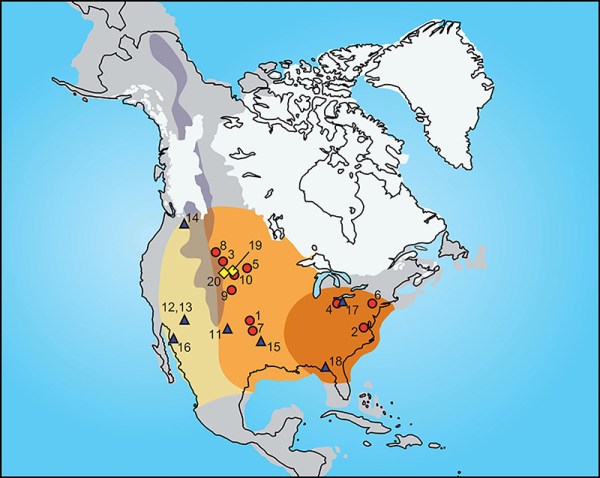
 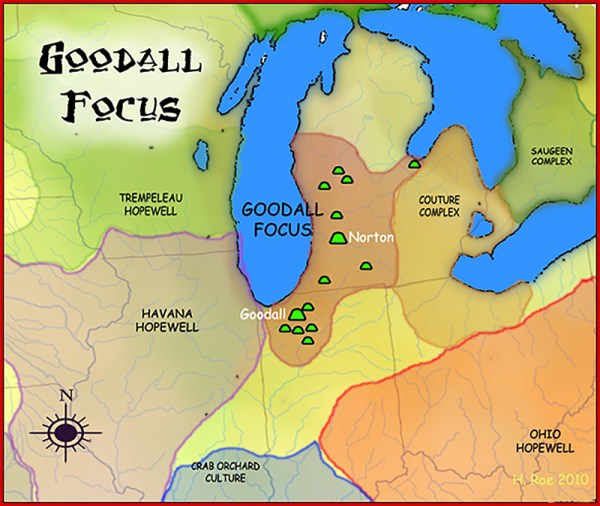 The photo below shows the approximate current locations of the Goodall focus, putting Pulaski County securely in this area.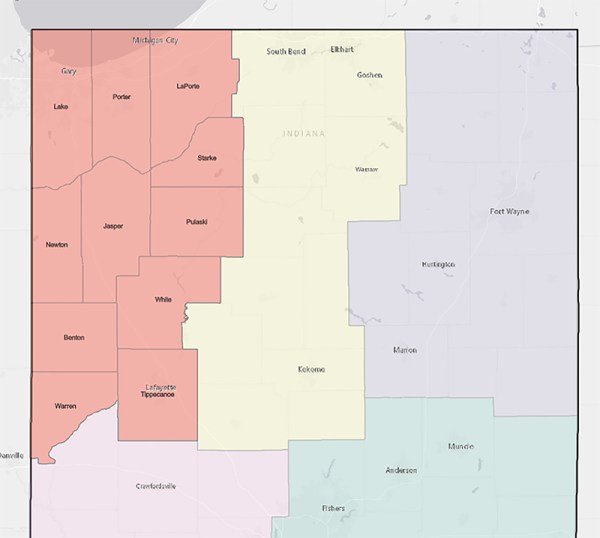
Descendants of the Eastern Woodland Indians
Later peoples of the Eastern Woodlands included the Illinois Iroquois, Shawnee and a number of Algonkian-speaking peoples such as the Narragansett and Pequot. 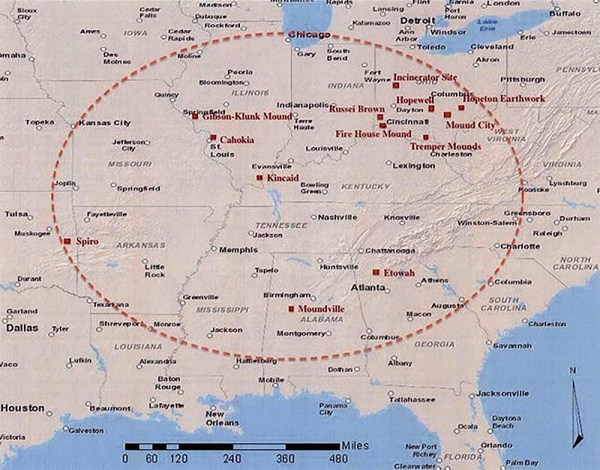
Mississippian Period: 1,000 – 500 Years Ago
The Mississippian period represents several major changes in prehistoric lifestyles. Among the many technological innovations were the introduction of small projectile points, indicative of the use of the bow, and the use of new manufacturing techniques in ceramics. There was also a change in subsistence with the shift from basic horticulture to an economy focused on cultigen agriculture (cultivated, plants with no known wild ancestor). A corresponding change occurred in the settlement pattern with a shift from small villages to a dispersed pattern of small farmsteads and hamlets around a central ceremonial center. Their complex societies were typically divided into classes, including a chief, his children, the nobility and commoners. Overall there were some variations in climate and harvestable flora and fauna. It followed that the tribes varied somewhat in diet, housing, apparel, and transportation. Since warfare was harsh and frequent, villages were often fortified by fencing reinforced with dirt. Causes of conflict between tribes varied, but typically involved territorial rights, male coming-of-age rituals, or retaliation. In general, the natives were deer-hunters and farmers. The men made bows and arrows, stone knives and war clubs. The women tended garden plots where beans, corn, pumpkin, squash and tobacco were cultivated. Women also harvested these crops and prepared the food. Black pottery or wood and bark vessels were used for cooking. They dried berries, corn, fish, meat and squash for the winter. The diet of deer meat was also supplemented by other game and shellfish. The tribes lived near water for transportation purposes. In general, the northern tribes fashioned birchbark canoes while southeastern tribes “dug out” canoes from tree trunks. On land, the natives traveled on foot and bore their cargo on their backs, having no pack animals. Dogs were their sole domesticated animals. Several sorts of houses were erected throughout the Eastern Woodlands. The most popular was likely the wigwam, a bark-covered structure and the longhouse, home to several families. Numerous hours were required to fashion the popular deerskin apparel. Women cut the skins with flint knives or shells and sutured them with animal sinew.
The End of the Mississippian Period
The Eastern Woodlands’ original inhabitants were the first the European colonists met. From the beginning, the settlers adopted many of the natives’ proven methods and paraphernalia, including deerskin clothing.
A Slide Show Presentation
Indigenous Peoples of Pulaski County The People
The Series
- The Land, from the Ice Age to Europeans Coming Ashore
- The People, From Ice to Europeans Coming Ashore
- Europeans Arrive
- French Fur Trade & Beaver Wars
- Indian Wars Pre-Revolutionary War
- Indian Wars During Revolutionary War
- Indian Wars Post-Revolutionary War
- Indian Removals 1700 to 1840
- United States Takes Shape
- Indiana Takes Shape
- Pulaski County Takes Shape
- Treaty of the Tippecanoe 1832
- Yellow River Treaty 1834
- Trail of Death
- Chief Winamac
- Keepers of the Fire
- The 7 Fires of the Anishinaabe