An ice age is a period of time where global temperatures drop so significantly that glaciers advance and cover over one third of Earth’s surface. During an ice age, a glacial is the period of time where glacial advancement occurs. An interglacial is the warmer period of time between ice ages where glaciers retreat and sea levels rise. When the temperatures drop, ice sheets spread from the Poles and cover much of the other continents. With so much water locked up as ice, sea levels fall, and land bridges form between continents, like the currently submerged connector across the Bering Strait between Asia and North America. The land bridges allow animals and humans to migrate from one continent to another. During warm spells, the ice retreats and exposes mountains that have been reshaped, rivers that have been reborn, and the giant basins into which they flow, like today’s Great Lakes. Plants and animals that sought warmth and comfort toward the Equator return to the higher latitudes. There have been five significant ice ages throughout Earth’s history.
- Huronian (2.4 – 2.1 billion years ago)
- Cryogenian (350 – 635 million years ago)
- Andean-Saharan (460 – 430 million years ago)
- Karoo (360 – 260 million years ago)
- Quaternary (2.6 million years ago to present)
Quaternary Ice Age
At the start of the Quaternary Ice Age, the continents were just about where they are today. Throughout the period, the planet has wobbled, causing glacial periods to come and go. The continents reached their present-day outline at the end of the last glacial period, known as the Paleolithic Ice Age. Since the outset of the Quaternary, whales and sharks ruled the seas, topping a food chain with otters, seals fish, squid, crustaceans, urchins and plankton filling in descending rungs. On land, the chilliest stretches of the Quaternary saw mammals like mammoths, rhinos, bison and oxen grow massive and don shaggy coats of hair. They fed on the small shrubs and grasses that grew at the ever-moving edges of the ice sheets. The most recent glacial period, the Paleolithic Ice Age, often known simply as the “Ice Age,” reached peak conditions some 18,000 years ago. 
Migration Patterns
Before going into detail of the various ages, included here is a map of supposed migratory patterns of humans to this continent. 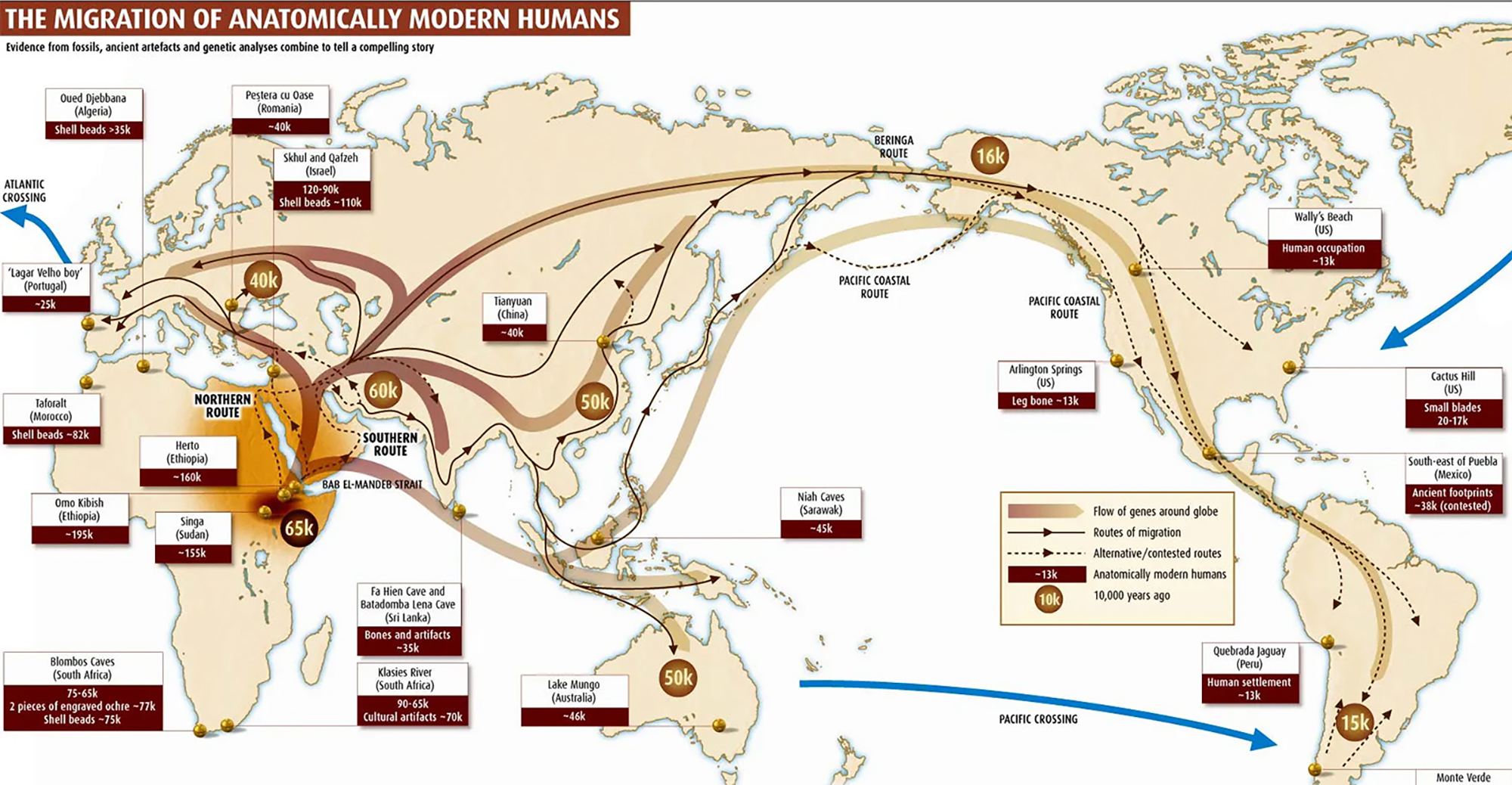
18,000 Beringia
From the U.S. National Science Foundation: “During the periodic ice ages over Earth’s history, global sea levels dropped as more and more of Earth’s water became locked up in massive ice sheets. At the end of each ice age, as temperatures increased, ice sheets melted and sea levels rose. These ice age cycles have repeated throughout the last 3 million years of Earth’s history, but their causes have been hard to pin down. … During the peak of the last ice age, … the low sea levels exposed a vast land area that extended between Siberia and Alaska known as Beringia, which included the Bering Land Bridge. In its place today is a passage of water known as the Bering Strait, which connects the Pacific and Arctic Oceans.” 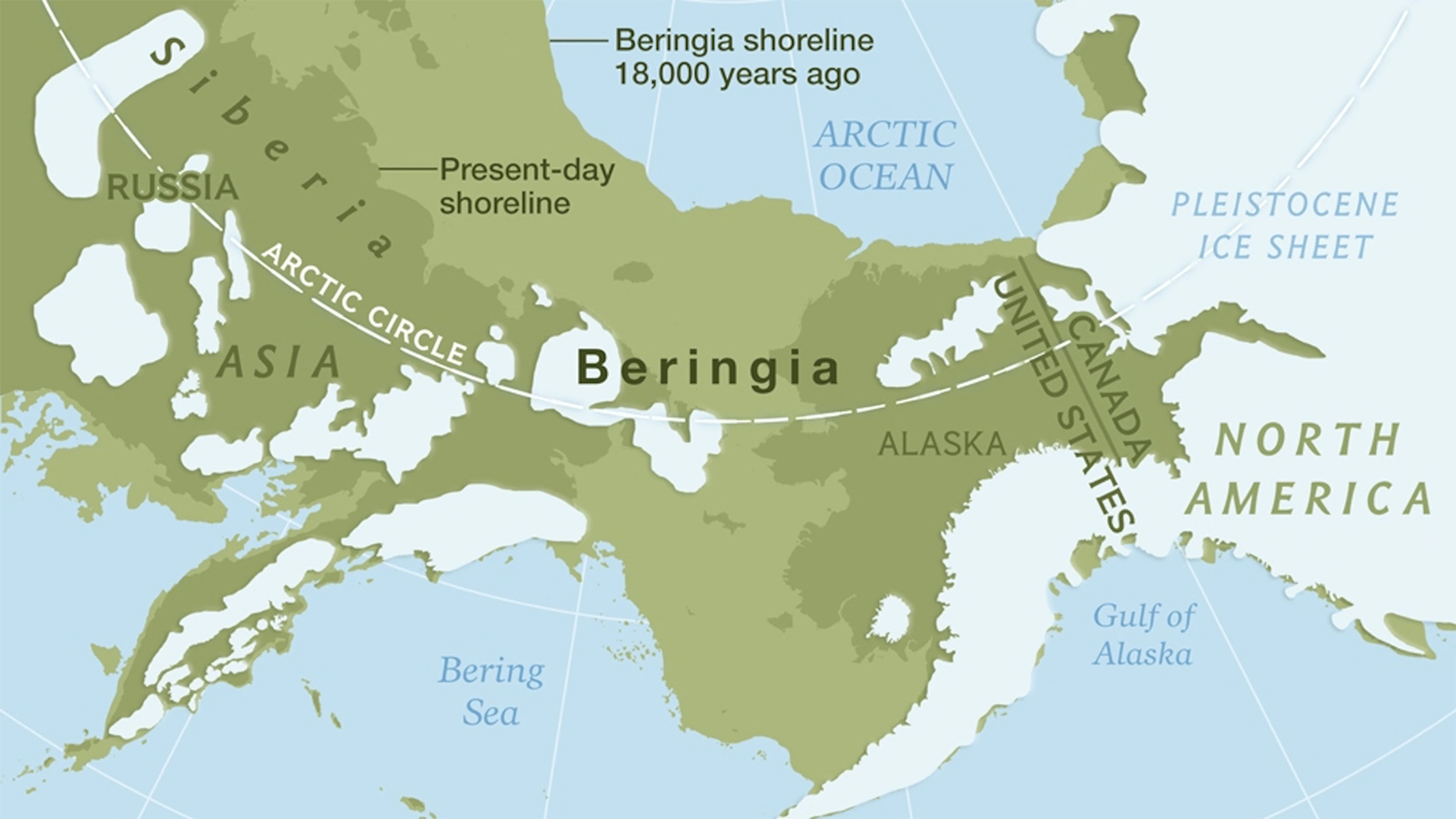
13,000 Ice Continues to Pull Back
 About 10,000 years ago, the climate began to warm and most of these “megafauna” went extinct. Only a handful of smaller representatives remain, such as Africa’s elephants, rhinoceroses and hippopotamuses. By this time, modern humans were rapidly spreading around globe. Some studies link the disappearance of the big mammals with the arrival of humans and their hunting ways. In fact, the Quarternary is often considered the “Age of Humans.” Homo erectus appeared in Africa at the start of the period, and as time went on, the hominid line evolved bigger brains and higher intelligence. The first modern humans evolved in Africa about 190,000 years ago, dispersing to Europe and Asia, then on to Australia and the Americas. Along the way, the species has altered the composition of life in the seas, on land, and in the air.
Holocene Epoch
The Holocene Epoch began 12,000 to 11,500 years ago at the close of the Paleolithic Ice Age and continues through today. Another term that is sometimes used is the Anthropocene Epoch, because its primary characteristic is the global changes caused by human activity. This term can be misleading, though; modern humans were already well established long before the epoch began. As Earth entered a warming trend, the glaciers of the late Paleolithic retreated. Tundra gave way to forest. As the climate changed, the very large mammals that had adapted to extreme cold, like mammoth and wooly rhinoceros, became extinct. Humans, once dependent on these “megafauna” for much of their food, switched to smaller game and increased their gathering of plant materials to supplement their diet. Evidence indicates that about 10,800 years ago, the climate underwent a sharp cold turn lasting for several years. The glaciers did not return, but game and plant materials would have been scarce. As temperatures began to rebound, human population began to increase and we began inventing the processes that would change the planet forever. 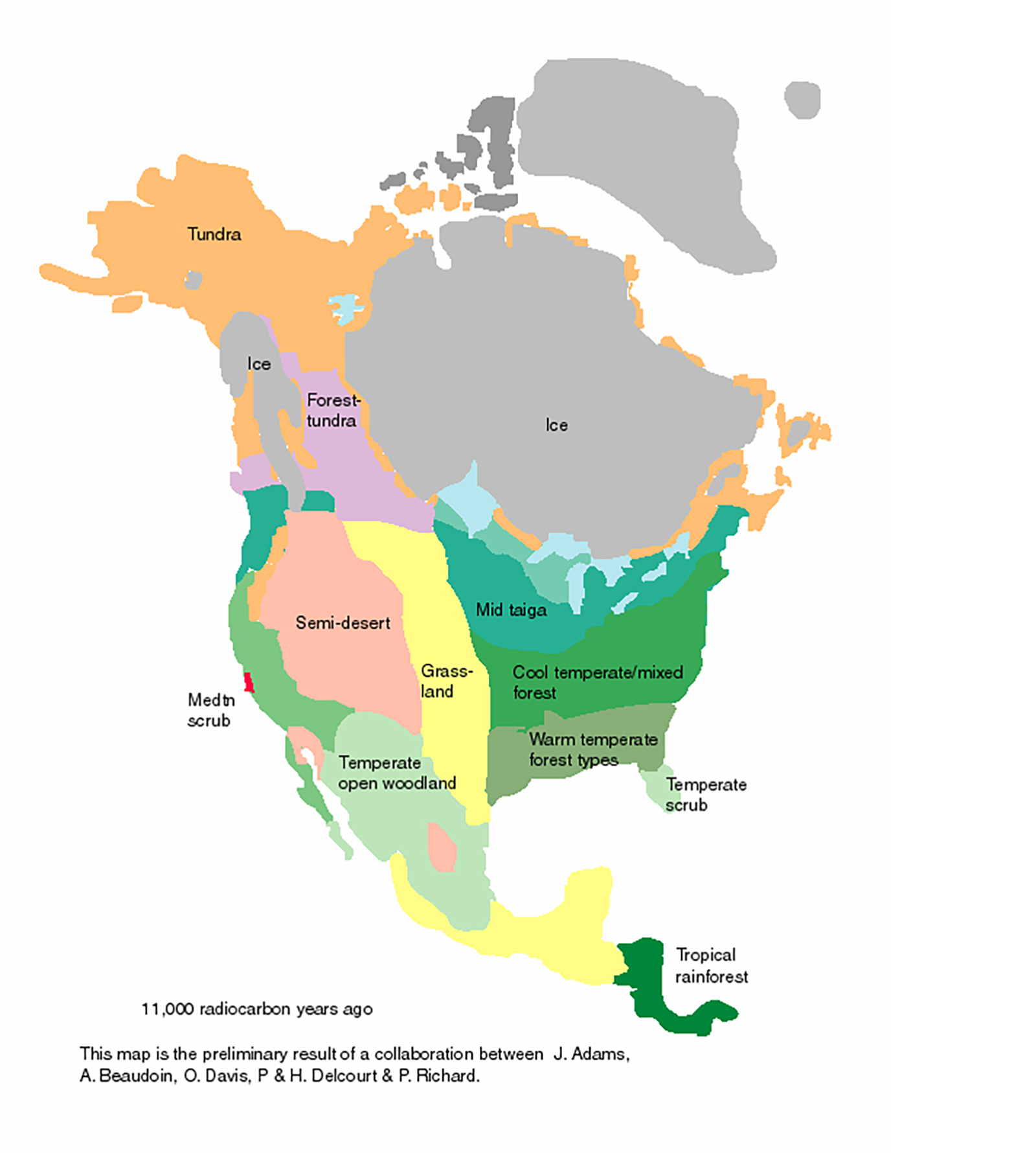 At that time, a significant change in forest composition occurred in what is now the northeastern United States. In most regions of North America, temperatures were several degrees warmer than that of today. According to the most recent data, a fairly broad swathe of land still existed across the Bering Straits around 11,000 and presumably could have remained in place until at least 10,000 years ago, acting as a continuing potential land bridge for human groups crossing from Siberia. Eventually, though, rising sea levels finally cut off the land bridge of Beringia. The retreating ice sheets had now exposed an ice-free corridor about 300 miles wide along much of its length. Animal remains start to appear at the southern end of the corridor about this time. The continuing retreat of the ice sheets and recolonization of vegetation allowed conifer forests to return across the Great Lakes region. Most of the Holocene era was slightly warmer than present temperatures. Although climates were as warm or slightly warmer than at present around 8,000 years ago, large ice masses remained in eastern Canada because there had not yet been enough time for the ice sheet to melt away completely. Retreating rapidly and cooling the climate at their immediate periphery, the ice masses exposed a rim of new land that took time for the forest to colonize fully.
  From that time until the present, warming and cooling occurred throughout the continent, changing the patterns of flora and fauna. Eventually, the earth reached what we know today, and, if humans had not continued to grow in population and change the way we live, the earth would still look much like the next map will show, at 500 years ago, when Europeans arrived on our shores.
 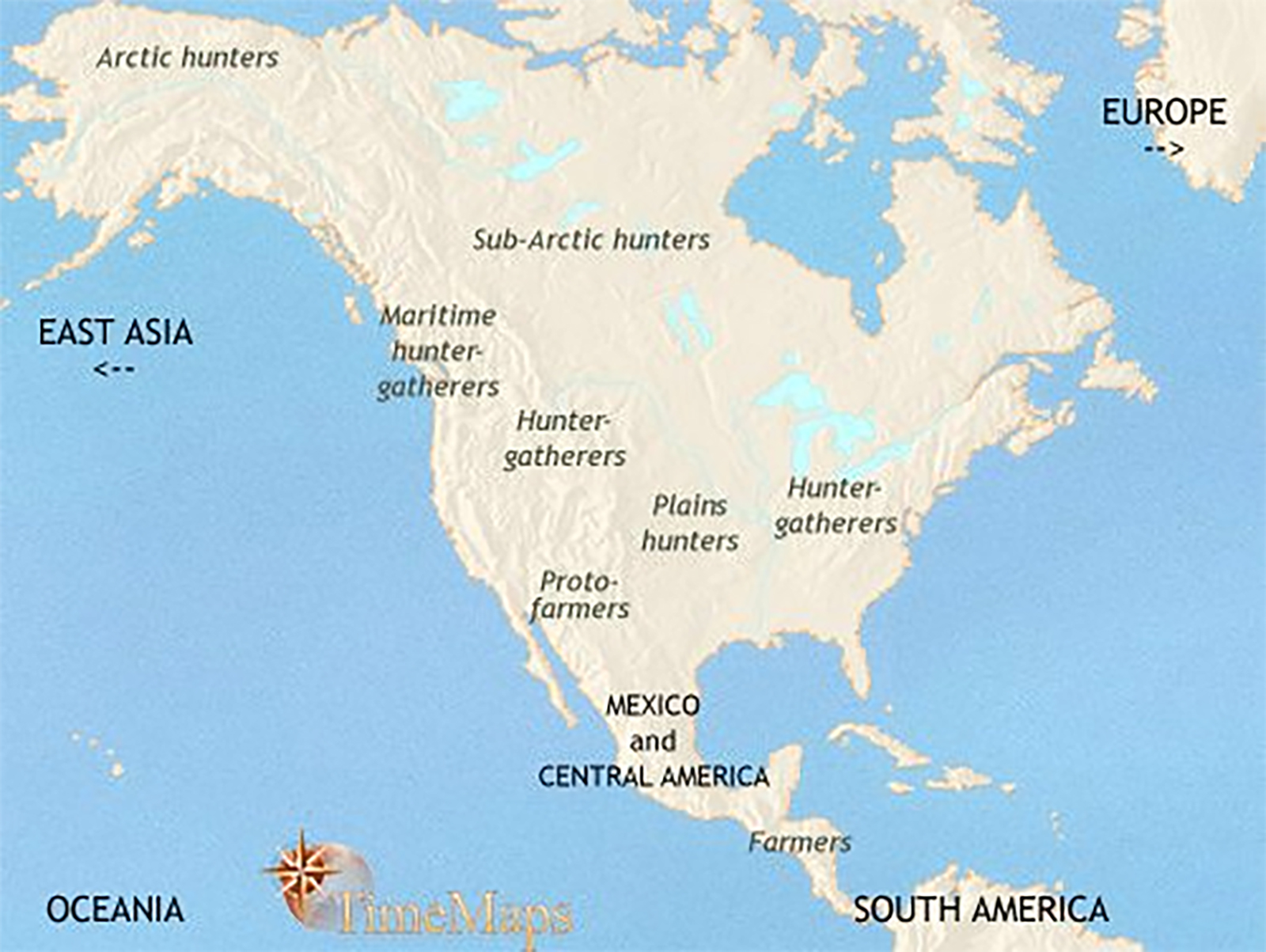 In the Paleolithic period, early humans lived in caves or simple huts or tepees and were hunters and gatherers. They used basic stone and bone tools, as well as crude stone axes, for hunting birds and wild animals. They cooked their prey, including woolly mammoths, deer and bison, using controlled fire. They also fished and collected berries, fruit and nuts. Ancient humans in the Paleolithic period were also the first to leave behind art. They used combinations of minerals, ochres, burnt bone meal and charcoal mixed into water, blood, animal fats and tree saps to etch humans, animals and signs. They also carved small figurines from stones, clay, bones and antlers. The end of this period marked the end of the last Ice Age, which resulted in the extinction of many large mammals and rising sea levels and climate change that eventually caused man to migrate. The Shell Mound People, or Kitchen-Middeners, were hunter-gatherers of the late Mesolithic and early Neolithic period. They get their name from the distinctive mounds (middens) of shells and other kitchen debris they left behind. During the Mesolithic period (about 10,000 B.C. to 8,000 B.C.), humans used small stone tools, now also polished and sometimes crafted with points and attached to antlers, bone or wood to serve as spears and arrows. They often lived nomadically in camps near rivers and other bodies of water. Agriculture was introduced during this time, which led to more permanent settlements in villages. Finally, during the Neolithic period (roughly 8,000 B.C. to 3,000 B.C.), ancient humans switched from hunter/gatherer mode to agriculture and food production. They domesticated animals and cultivated cereal grains. They used polished hand axes, adzes for ploughing and tilling the land and started to settle in the plains. Advancements were made not only in tools but also in farming, home construction and art, including pottery, sewing and weaving.
A Slide Presentation
Indigenous Peoples of Pulaski County The Land
The Series
- The Land, from the Ice Age to Europeans Coming Ashore
- The People, From Ice to Europeans Coming Ashore
- Europeans Arrive
- French Fur Trade & Beaver Wars
- Indian Wars Pre-Revolutionary War
- Indian Wars During Revolutionary War
- Indian Wars Post-Revolutionary War
- Indian Removals 1700 to 1840
- United States Takes Shape
- Indiana Takes Shape
- Pulaski County Takes Shape
- Treaty of the Tippecanoe 1832
- Yellow River Treaty 1834
- Trail of Death
- Chief Winamac
- Keepers of the Fire
- The 7 Fires of the Anishinaabe