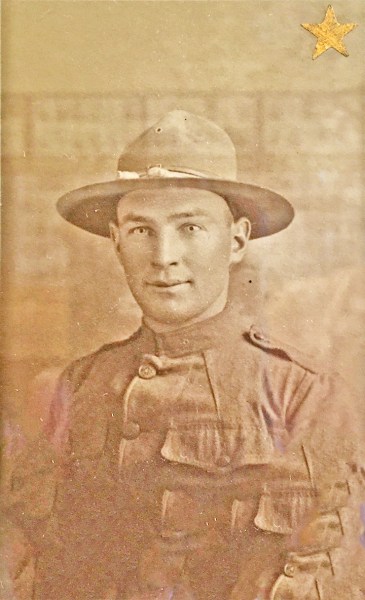
Winamac’s Veterans of Foreign Wars Post 1728 was given the name “Pfost–Jones” to honor the first Pulaski County veterans to perish in World War I and World War II. The flag displayed in the canteen is the original flag presented by the U.S. Government to Raymond Pfost’s family.
Another webpage focuses on David Jones. Find it
HERE.
Raymond Pfost
- Born July 5,1891 in Ripley, Indiana.
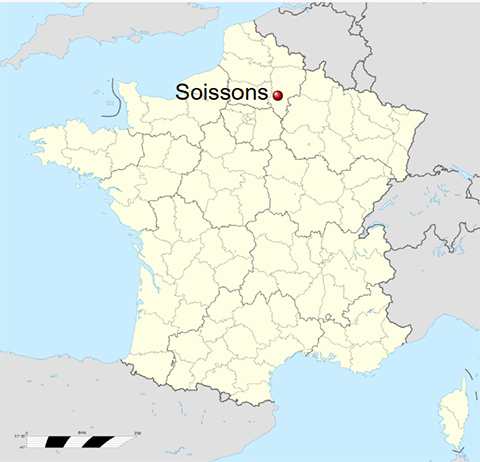
- Died July 18, 1918 (age 27) in Soissons, France.
Private Pfost was one of nearly 12,000 Americans killed in action during the Second Battle of the Marne. Covering four days (July 15 – 18, 1918), this was the last major German offensive on the Western Front. The offensive failed when an Allied counterattack, supported by several hundred tanks, overwhelmed the German Army on their right flank. The defeat marked the start of a relentless Allied advance which culminated in the Armistice about 100 days later.
Pfost Family
From Raymond’s draft registration card, we learn he was born in Ripley.

Per the 1900 census, when he was 8 years old, Raymond lived with his parents in Franklin Township, Pulaski County. Ripley is in the southwest corner of the township. Others living in the home were his father William (49), mother Tressa (38), brothers Albert (19) and Lucius (16), and sisters Edna (14), Nellie (10), and Emma (4). Per that census, his parents and the three eldest children were born in Ohio. Raymond and the two youngest were born in Indiana.
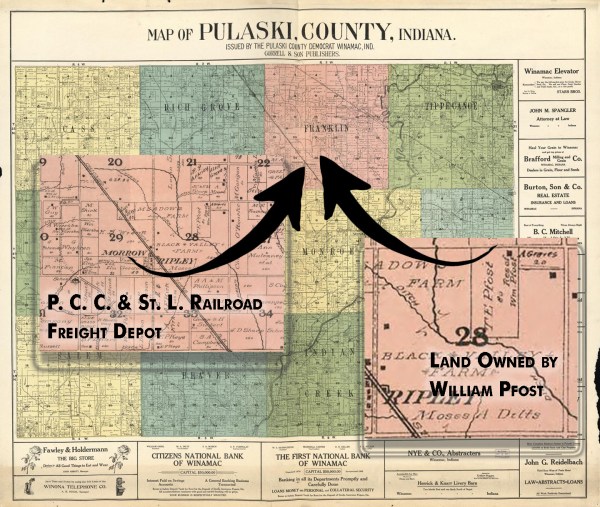
A plat map of Pulaski County dated 1910 (Indiana Historical Society) shows land owned by William Pfost in section 28 in Franklin Township, near Ripley.
At the age of 18, per the 1910 census, Raymond lived on West Street, Winamac (8b) with his sister Edna, her husband, and their daughter. He was single and worked as a railroad section hand. At the age of 26 he filled out a draft registration card. He was still single and still a railroad section hand with PCC & ST LRR (Pittsburg, Cincinnati, Chicago & St. Louis Railroad) in Ripley.
Employment
The Pittsburgh, Cincinnati, Chicago and St. Louis Railroad, commonly called the Pan Handle Route (Panhandle Route in later days), was part of the Pennsylvania Railroad system. The main line began at Pittsburgh, Pennsylvania, crossed the Northern Panhandle of West Virginia, and continued west to Bradford, Ohio. There it split into a northern line to Chicago and a southern one through Indianapolis to East St. Louis, Illinois. (Wikipedia)
From the book White and Pulaski Counties, printed in 1881, the first route of transportation through Franklin Township was the railroad. “The only thoroughfare crossing the township is the Cincinnati, Columbus & Indiana Central, which, however, is leased for a term of years by the Pittsburgh, Chicago & St. Louis, and which is more generally known as the Pan Handle. This internal improvement and aid to this section of country enters Franklin Township at the southeast corner [more like south central area] of Section 33, in said township, and runs in a northwesterly direction, leaving the township at the northwest corner of Section 18.” The path ran directly through what later became the town of Ripley.
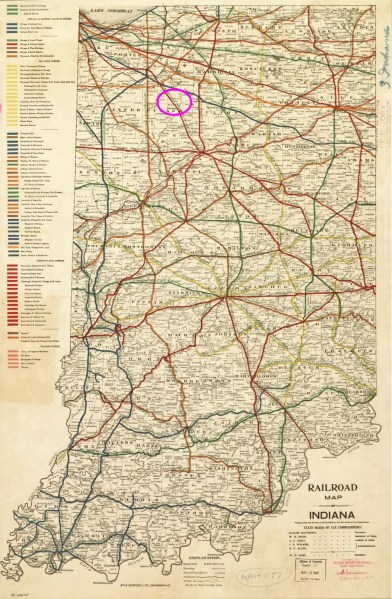
This Railroad Map (handwritten note from the Library of Congress states “before 1897”) shows the web of railroads through the state at the time, and the one route that goes through what is now Ripley.
In his job as a section hand, Raymond would have been responsible for maintaining a section of railroad track. He would have been assigned to a crew and the crew assigned to a specific section of track. In those years, railroad crews would have used some machinery, but primarily they would have relied on manual labor and tools. While some mechanized equipment – track laying machines and road maintenance equipment – existed, much of the work on the tracks, like tie placement, ballasting, and rail alignment, would have been done by hand. (Wikipedia)
Draft / Enters Service
The United States entered The Great War in April 1917. The country was sorely unprepared for war, and a draft was deemed imperative. The Selective Service Act passed on May 18, 1917, and all men aged 21 to 30 were required to register with local draft boards. Raymond, age 26, registered for the draft on June 5, 1917. He entered service on September 20, 1917, leaving for Camp Taylor. He was assigned to three separate units before arriving in France and joining a fourth.
Camp Taylor, Near Louisville, Kentucky

The country was not prepared for war. Neither soldiers nor sailors were plentiful. More important, none of the services – Army, Navy, Marine Corps, Merchant Marines – had the basic infrastructure needed to house and train recruits. Barracks and training facilities became a priority. Many of the bases familiar to us today were established in 1917, including Camp Taylor. Thirty camps and cantonments were built to handle hundreds of thousands of draftees.
Equipment was another problem. The first troops showed up and trained with wooden rifles. There were delays in getting uniforms and boots. The army did not have heavy equipment, machine guns, or artillery. It was decided that each division would have four infantry regiments, an artillery brigade, and ancillary units. Each division would have 28,000 soldiers, two to three times the size of British or French divisions. The stated reasoning was to give each unit combat power. In reality, the army did not have enough qualified military leaders to go around.
First Assignment: 27th Company, 7th Battalion, 159th Depot Brigade
This photo, taken September 17, 1917, is of the 159
th Depot Brigade at Camp Zachary Taylor in Kentucky. The photo is indicative of the unit in which Raymond served; however, he did not enter service until September 20. He would not have been in this photo.

In WWI, a depot brigade was responsible for receiving, organizing, and training new recruits. They provided uniforms, equipment, and basic military training before sending troops to the front lines in France.
Second Assignment: Company D, 309th Engineers
During World War I, Company D of the 309th Engineers was part of the 84th Division, also known as the “Lincoln Division.” Primarily composed of recruits from Indiana and Kentucky, the Division initially trained at Camp Taylor and later deployed to France. The 309th Engineers served as a training formation, preparing replacements for the Western Front.
The division was activated in September 1917, remaining at Camp Taylor until August 1918. This unit was not deployed to France until October 1918; they were not engaged in direct combat.
Third Assignment: Company B, 151st Infantry
Raymond, unlike most of the 309
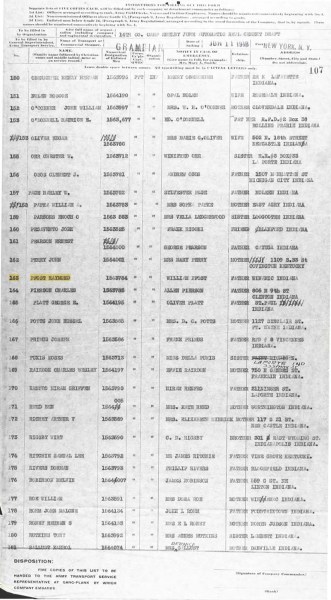
th, was assigned to the infantry. Company B of the 151st Infantry Regiment was part of the 38th Division. This unit was mobilized in 1917 and demobilized in 1919. After the war, the 151st was demobilized at Camp Taylor and reconstituted in the National Guard. It was as a part of this Company that Raymond boarded the SS Grampian, leaving from New York on June 11, 1918. Once in France, he was assigned to a unit that did not originate at Camp Taylor.
Note: You’ll notice that every serviceman on this list was from Indiana.
Pfost Narrowly Misses Flu Epidemic
As noted above, Raymond left for Europe in June. Beginning in September, a new and immediate danger threatened Camp Taylor: Spanish influenza. The densely packed troops provided a fertile environment for the epidemic to take hold. More than 10,000 soldiers were hospitalized. Fifteen barracks were converted into hospital wards. Ultimately, more than 1,500 died at Camp Taylor from the epidemic, taking a much higher toll than that exacted on the battlefields of Europe.
American Troops are Still Unprepared
Training and execution was under the admininstration of General John “Black Jack” Pershing, commander of the American Expeditionary Force.
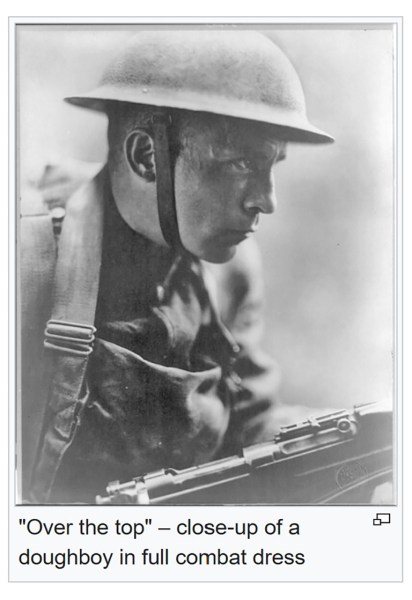
United States Army divisions arriving in France were made up mostly of raw recruits augmented by regulars who had never fired a Springfield rifle. Upon arrival, “doughboys” were subjected to a training regimen which began with a heavy dose of physical conditioning and drilling with emphasis on discipline. The training then shifted to the practice trenches the doughboys dug in their training areas. Here they were taught the intricacies of the weapons they would be using as well as solutions to tactical problems in trench warfare.
When training in the practice trenches was finished, the Americans were assigned a four-week stint in a quiet French or British sector to complete their trench warfare training. Here they became accustomed to life at the front. They went out into no man’s land to listen for enemy activity, became familiar with body lice, fought off the trench rats, and saw their first action.
Prior to being committed to battle, Pershing had his men train at the division level with artillery and aviation in offensive maneuvers. The purpose of this portion of the training was to emphasize open warfare rather than trench warfare.
By July 15, Pershing had 26 American divisions in various states of readiness in France. Of these divisions, he believed 17 were ready for service. The 1st and 2nd Divisions were in need of replacements after their engagements at Cantigny and Château-Thierry – Belleau Wood, respectively. Thus, Raymond was assigned to yet another unit.
Fourth Assignment: Company F, 28th Infantry, 1st Division
The 28th Division, including Company F, gained notoriety for its heroic stand during the Champagne-Marne Offensive on July 15, 1918.
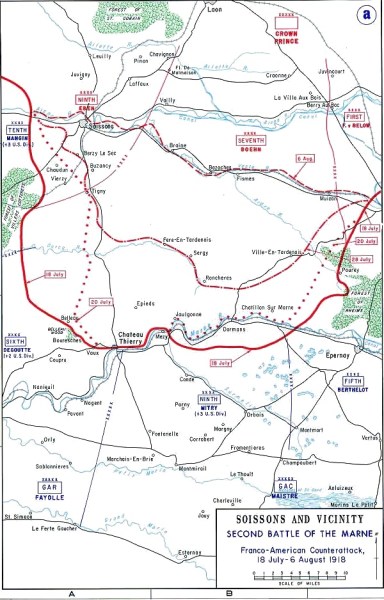
July 15, 1918: The Second Battle of the Marne Begins
Four companies from the 28th, including Company F, were attached to a French division on the front lines during the Champagne-Marne Offensive. Two of these companies held their positions against a German attack, inflicting heavy casualties.
On July 15, Company F was engaged in combat near the Marne River. That morning, 23 divisions of the German 1st and 3rd Armies attacked the French 4th Army east of Reims, while 17 divisions of the 7th Army, assisted by the 9th Army, attacked the French 6th Army to the west of the city. The dual attack was an attempt to divide and conquer the French forces, which were joined by 85,000 U.S. troops as well as a portion of the British Expeditionary Force (BEF), most of which were located in Flanders.
When the Germans began their advance after an initial artillery bombardment, however, they found that the French had set up a line of false trenches manned by only a few defenders. The real front line of trenches lay further on and had scarcely been touched by the bombardment. As the Germans approached the “real” Allied front lines, they were met with a fierce barrage of French and American fire. Trapped and surrounded, the Germans suffered heavy casualties, setting the Allies up for the major counter-attack they would launch on July 18.
Men of Iron
After the battle, General Pershing visited the battlefield and declared that the 28th Division soldiers were “Men of Iron.” He named the 28th his “Iron Division.”
Battle of Soissons (July 18 – 22)
This battle focused on cutting off German supply lines, which were crucial for their defense. The American 1st Division was bivouacked in the Forêt de Compiègne on July 16 and spent the entire day under cover of the woods to avoid detection by German aircraft.
On July 17, the division moved to the area near Mortefontaine, approximately 8 miles from their jump-off point. At 9:00 P.M. the division began to move eastward through the forest along trails cratered with shell holes. Soon after, a thunderstorm began turning the trails into a quagmire. Compelled to march off the trail and aided only by flashes of lightning, the infantry moved forward hanging onto the equipment of the man ahead to maintain the column.
The American 1st Division was assigned to the northernmost attack zone. On July 18, the first day of the battle, the Division took heavy fire.
Burial
According to records, Raymond was “buried where he fell” in Soissons, France. In 1919, the temporary cemeteries were closed, and the families of the fallen were given three choices for the remains of their loved ones. They could repatriate them to the United States; recent immigrants could be returned to their country of origin; or the family could choose to leave their beloved interred in an American cemetery in Europe.

As plans were made, however, burials had to take place. On August 4, 1922, the body of Raymond Pfost was buried in Oise-Aisne American Cemetery in Fère-en-Tardenois, France, Grave 7, Row 36, Block D.
His body was disinterred on June 18, 1925, and sent to Dunkerque (French spelling for Dunkirk), Nord, France. His body left the port on the SS Waukegan headed for New York on August 10, 1925, arriving on August 26. His body arrived in Winamac, delivered to North Front Street, on September 2, 1925.
Funeral Services
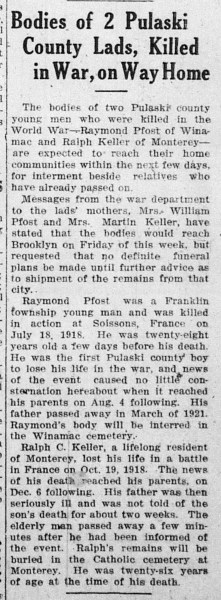
When the body was returned, funeral services were held.

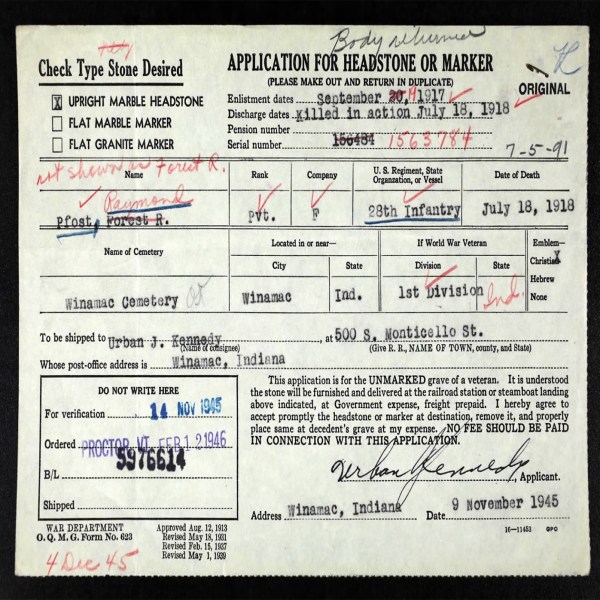
He was buried in Winamac Cemetery. It is not known how his grave was marked in the beginning, but local funeral director Urban Kennedy applied for a marker in November 1945. The headstone, per the application, would be made and shipped by the War Department. Any markings – aside from the Christian symbol as requested – would be the responsibility of the family or the funeral director. The stone arrived in February 1946.
Urban Kennedy’s Application
Mrs. Pfost died in November 1945. It is possible she made the request for a marker as she was making her own arrangements, or that her remaining children took care of the request. It’s also possible that Mr. Kennedy, who would have been aware of the Army’s service in this regard, took care of the marker on his own.
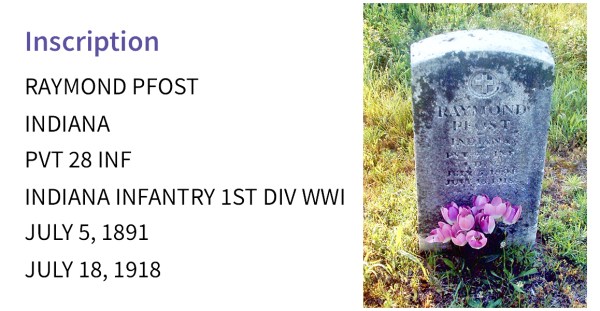
Marker and Inscription
Commendations
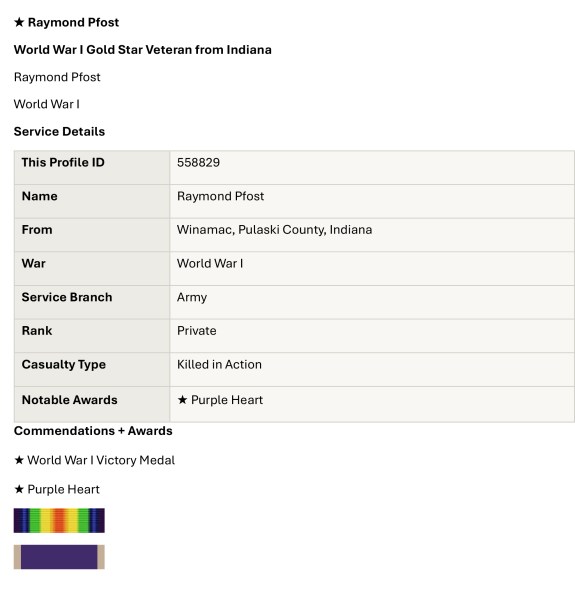
One source noted that Raymond had received a silver star. However, confirmation was only found for his receipt of the World War I Victory Medal and a Purple Heart.
Thank You
Private Pfost receives thanks from a grateful nation. His name will live on, preserving his memory, as long as VFW Post 1728, “Pfost-Jones,” serves veterans.
Military History