Compiled by Karen Fritz, November 2011
As early as 1838, a Methodist circuit rider was visiting the faithful in Pulaski County, and by 1839 – the year Winamac and Pulaski County were founded – these early pioneer residents had formed a class of “Methodism” that met at the home of John Davis.
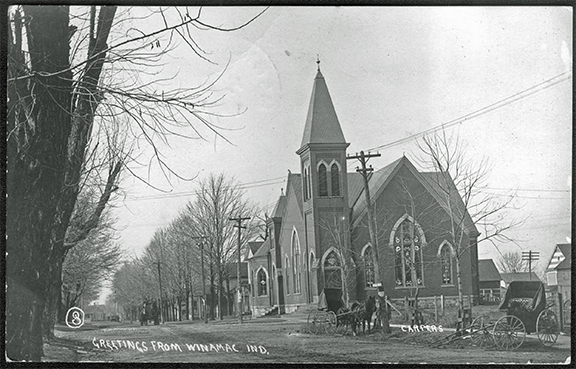
The congregation purchased Lot 104 in Winamac in April 1863, and their first white-framed church was built in 1868. Later, another generation of the Methodist congregation undertook the huge step of constructing a new red-brick church in 1901. A Christian education annex was added in 1954. The sanctuary and front entrance were extensively remodeled in 1977.
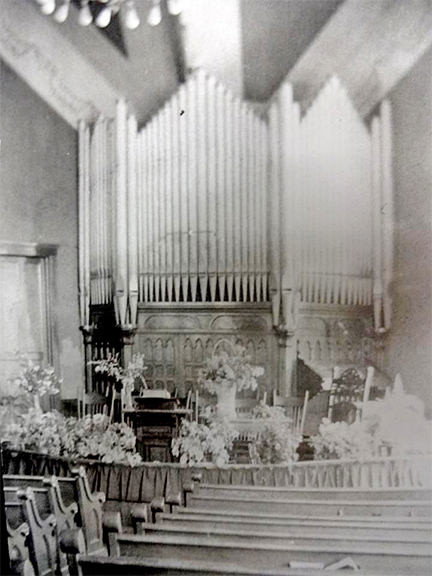
Worldwide, the “United” Methodist Church was created through a merger on April 23, 1968, of the former Evangelical United Brethren (EUB) Church and the Methodist Church. The new denomination was given birth by two churches that had distinguished histories and influential ministries in various parts of the world. Their theological traditions were steeped in the Protestant Reformation and Wesleyanism, similar ecclesiastical structures, and relationships that dated back almost 200 years.
The United Methodist Church shares a common history and heritage with other Methodist and Wesleyan bodies. The lives and ministries of John Wesley (1703–1791) and of his brother, Charles (1707–1788), mark the origin of their common roots in the revival movement within the Church of England. John and Charles Wesley were the sons of Samuel and Susannah Wesley, and their home was at Epworth in England.
While studying at Oxford University in England, John and Charles Wesley and several other students formed a group devoted to study, prayer and helping the underprivileged. They were labeled “Methodist” by their fellow students because of the way they used “rule” and “method” to go about their religious affairs.
In 1735, the Wesley brothers came to America to preach the gospel to the American Indians in Georgia. In the U. S., the United Methodist Church ranks as the largest Mainline denomination, the second largest Protestant church after the Southern Baptist Convention, and the third largest Christian denomination. The ranking of church membership in the U.S. (in 2002) is (1) Catholic Church 66.4 million, (2) Southern Baptist Convention 16.4 million, and (3) United Methodist Church 8.3 million.
Estimates on religious (or non-religious) membership in the U.S. in the year 2000, were Christianity 159 million, Non-religious/secular 27.5 million, Judaism 2.8 million, Islam 1.1 million, and Buddhism 1.08 million.
The Winamac First United Methodist Church has a rich heritage of serving not only its congregation, but also its community and people beyond state and national borders. The church facility, too, has not only been a place of worship for its congregation, but has long opened its doors to provide space for other community organizations to gather for meetings or events – always reaching out to others.
All Tour Stops
YOU BEGAN THE TOUR ON THIS PAGE
-
- First Brick Block Building in Winamac
- Courthouse (1894-95)
- Vurpillat’s Opera House (1883)
- Winamac Freight Depot
- Panhandle Pathway
- St. Peter Catholic Church
- Location of First Frame House
- First United Methodist Church (1901)
- ISIS Theatre (1936)
- Pulaski County Public Library (a Carnegie library, 1916)
- Log Cabin Replica
- Artesian Well (1887)
- Memorial Swinging Bridge (1923)
- Winamac Town Park (former hunting and fishing ground of the Potawatomi)
- Park Pavilion (1891)
- Kelly Hardware (1898)
You’re back where you started!