Architectural Style
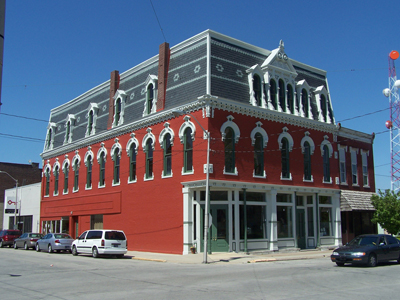
 The architectural style of J. D. Vurpillat’s building is Late Victorian, Second Empire, with a Mansard roof; it was designed by James Rhodes. The building is on lot 10 of the original town plat. It stands at the corner of Main Street and Market Street and is directly across from the County Courthouse on Main Street. It fronts south on Main Street and is three stories high. Originally, two business rooms were on the first floor: one on the corner, 65 feet deep, and the other with south and west fronts, 90 feet deep.
It was built of brick with a stone foundation and slate mansard with tin decorative details. The roof has a slight pitch and is peaked in the center, which allows water to drain to the sides and then toward the north end of the building. The exterior of the second and third floors seems to be almost original in appearance with the exception of a missing chimney on the northwest end and two missing windows on the southwest corner. The ground floor has been extensively remodeled both inside and out and has lost most of its original style.
Known Historical Information
 Citizens bank, the first tenant, relocated after 1900. The wall dividing the bank from Vurpillat’s business was removed and the entire first floor taken over by Vurpillat’s Store, which had expanded to include dry goods. The ground floor remained in use, first as a general and dry goods store and later as a drug store, until the building was vacated in 1998.
Doctors, dentists, chiropractors, lawyers and photographers used offices on the second floor. One exception was during the mid-1880s when the Tippecanoe Athletic Association leased the entire floor. The removal of second floor partitions caused concern that the upper floor was being weakened. It was explained that only a few short cross partitions were being removed, and the long partitions, the real supports, remained in place. As Mr. Vurpillat was also putting in some iron posts, the public was assured that the top floor would be stronger than before. When the Athletic Association moved, the second floor was returned to its original configuration. Exact dates are not known, but the following business owners are on record: John Russell owned a shoe store; O.J. Bright, Township Trustee, had an office in the building; two dentists of record are Dr. Harry Ginther and Dr. John Shill; Ab Freeman had a real estate office; Horner & Thompson practiced law.
The third floor was the opera house. The hall seated 600. The last few rows of seats were slightly elevated above the one in front, so that the rear part of the audience had a good view of the stage. This section was commonly referred to as the “hayloft.” The hall was lighted by huge gas chandeliers and heated by stoves. The focal point was a large stage flanked on either side by dressing rooms and reached by a rear entrance way. Floodlight troughs were hung suspended in the fly-loft and a depression for the foot-lights was found in the front of the stage. To one side stood the gong used to signal that the curtain was about to go up. Scenery painted by Fields & Phillips, artists, was placed in the slots allotted for it. Occasionally, traveling companies brought their own backdrops and props, including live dogs that added to the drama of the scenes and caught the interest of the audience.
The Opera House opened just over a year from the ground-breaking. On May 12, 1883, “The Spectre Bridegroom,” opened to fair audiences. The opera house was seldom closed over the next few years. Entertainment varied from crowd-pleasers James Whitcomb Riley, the Hoosier poet, and Eli Perkins, humorous lecturer, to several different versions of “Uncle Tom’s Cabin,” some more pleasing than others. Lincoln J. Carter’s scenic melodrama, “The Fast Mail,” with its realistic train of cars shooting across the stage thrilled the crowd, which was far less pleased by the high-ticket price.
In 1890, Winamac High School held its first commencement in the opera house. The school also used the opera house to present plays and other forms of entertainment. The Golden Slipper Club gave social dances, the Embroidery Club held meetings, and Democrats and Republicans held conventions, with speakers ranging from Senators David Turpie and Albert J Beveridge to William Jennings Bryan. Winamac churches, both separately and together, formed groups and entertained their friends and neighbors with such offerings as “Rose of Savoy” and the “Congress of Nations.” Home talent was also enjoyed in the form of the juvenile orchestra and band organized in 1895.
In January 1904, following the tragic theatre fire in Chicago, Indiana lawmakers became more aware of the dangers inherent in facilities having only one exit. The opera house was condemned as a firetrap. Mr. Vurpillat closed the house temporarily until he was able to build a neat, modern two-story brick store building adjoining the opera block on its east side. At the same time, he overhauled and remodeled the opera house and built a stairway connecting with the new building, thus giving it the required two exits.
That following year Vurpillat sold his mercantile business and retired after being in business in Winamac for over forty years. He continued to take an interest in the opera house, however.
In 1910, prompted by either popular demand or financial considerations – the opera house was being challenged by new-fangled, upstart picture shows – Vurpillat tore out the raised seats in the rear of the hall, extended the hardwood floor and moved the stairway to one side to make a large floor for roller-skating.
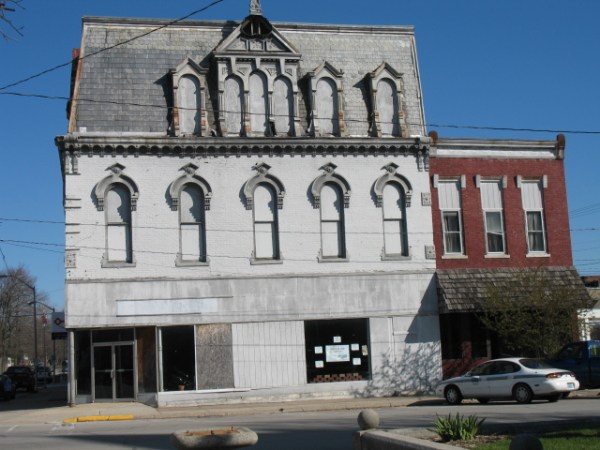
The opera house continued to be a focal point of activity until January 15, 1915, when, at 5:30 AM, the building was discovered to be on fire. The southwest corner of the third floor was destroyed along with that portion of the roof, and a hole burned through the floor to the second story before the fire could be contained. There had been a dance in the opera house the night before, and it was presumed that the fire started from a stove that sat in that corner. It may have become overheated after the crowd left, or the flue may have been defective. There was even speculation about the ubiquitous cigarette stub. Whatever the cause, water and smoke damage was extensive on all three floors of the building. Only the third floor opera house sustained structural damage, however, and when the corner was rebuilt, one window on each side of the corner was not replaced. This gave the building an asymmetrical look and still serves as a visual reminder of the fire. Inside, the block required re-plastering. Shill’s dry goods store on the main floor, while not damaged by fire, was thoroughly soaked by torrents of water that poured down into the room from above. Much of the merchandise was ruined, with the exception of the shoe department. While John Shill’s losses were covered by insurance, Vurpillat had allowed the insurance on the building to lapse. His loss was complete. Repairs were made promptly, though, and, according to one of Winamac’s older residents, amateur boxing and wrestling matches took place in the hall. There may have been a few more dances and local talent shows, but for all practical purposes, the history of the third floor opera house ended with the fire.
Chronological History
- 1882: First ground is broken for Joseph D. Vurpillat’s brick block building.
- 1883: Citizen’s Bank moves into the corner room.
- 1883: Opera House opens with “The Spectre Bridegroom.”
- 1885: James Whitcomb Riley gives a recitation “full of humor and pathos” (reserved seating costs 35 cents).
- 1885: Vurpillat builds an addition to the east side for a tin shop and implement shed.
- 1886: Democratic Mass Convention is held.
- 1886: Law office of J.P. Gray moves in.
- 1887: Winamac Gas & Oil Company holds organizational meeting.
- 1887: GAR (Grand Army of the Republic, an influential veterans’ group) entertains 500 people.
- 1888: Vurpillat is elected County Treasurer.
- 1889: Presbyterian Church holds a concert for the purpose of swelling the building fund.
- 1889: Lecture by Dr. Longstreet and his Sioux Indian Troupe.
- 1890: First annual Commencement of Winamac High School (seven students).
- 1891: Master Irvin J. Steininger, the Hoosier Boy Orator, fills the house.
- 1892: A ceiling is placed over the stage. Honorable David Turpie, US Senator, fills opera house to capacity.
- 1894: Eli Perkins, humorous lecturer, speaks.
- 1895: New hardwood floor is put down on the third floor. (This was a splendid surface for dancing.)
- 1895: Stereoptican views of war scenes are displayed. (A stereopticon was a slide projector or “magic lantern” which had two lenses, usually one above the other. Dating back to the mid-19th century, they were a popular form of entertainment and education before the advent of moving pictures.)
- 1895: Tippecanoe Athletic Association leases the entire second floor.
- 1901: There are rumors of several more opera houses to be built, one by Frank Vurpillat, Joseph’s brother.
- 1904: Opera house is condemned as a fire hazard; a two-story brick building is built on the east side of the building; access to that building is secured to serve as a second exit.
- 1904: Republican County Convention is held and Colonel James S. Dodge of Elkhart gives the address.
- 1904: J.D. Vurpillat sells the mercantile business to his sons, Charles and Aaron.
- 1904: John Reidelback opens a law office on the second floor with his brother Lewis.
- 1905: Charles & Aaron Vurpillat sell store to Frank Wittmer of Star City (general merchandise).
- 1910: Roller skating rink is installed in third floor opera house.
- 1915: The southwest corner of the third floor is discovered to be on fire.
- 1927: Joseph D. Vurpillat dies; building is given a “fair market value” of $10,000.
- 1945: Bill Logan buys the block building from heirs of J.D. Vurpillat’s estate for $4,000.
- 1959: Bill Logan moves Logan Drug Store into the building.
- 1963: Bob Jackson purchases the business (not the building). The drug store becomes Jackson Quality Drugs.
- 1971: Ann Jackson divorces Bob Jackson and purchases Bob’s interest in the drug store, becoming the sole proprietor of Jackson Quality Drugs. (She later marries Adrian Miller.)
- 1975: The building passes to William Logan’s heirs, his three children.
- 1978: The Logan children sell the building to Adrian and Ann Miller. Ann continues to operate Jackson Quality Drugs.
- 1979: Adrian and Ann Miller sell the building and the business to Dan and Karen Dilts, who change the name of the business to Sterling Drug Store.
- 1986: Dan and Karen Dilts sell the business (not the building) to Fagan Pharmacy.
- 1994: Fagan Pharmacy becomes Medicine Man Apothecary.
- 1998: Dan and Karen Dilts sell both their house and the Vurpillat building to Todd and Michelle Schmicker.
- 2000: Stuart Gast donates money to the Pulaski County Historical Society to buy the building from Todd and Michelle Schmicker for $13,328.
- 2020: After extensive renovations – and the leasing of the building to several organizations – the Historical Society returns the property to tax rolls with the sale of the building to Mike & Jenny Kasten.
- 2020: One Eyed Jacks’ Celebration Station, an event center, opens.
All Tour Stops
YOU BEGAN THE TOUR ON THIS PAGE
-
- First Brick Block Building in Winamac
- Courthouse (1894-95)
- Vurpillat’s Opera House (1883)
- Winamac Freight Depot
- Panhandle Pathway
- St. Peter Catholic Church
- Location of First Frame House
- First United Methodist Church (1901)
- ISIS Theatre (1936)
- Pulaski County Public Library (a Carnegie library, 1916)
- Log Cabin Replica
- Artesian Well (1887)
- Memorial Swinging Bridge (1923)
- Winamac Town Park (former hunting and fishing ground of the Potawatomi)
- Park Pavilion (1891)
- Kelly Hardware (1898)
You’re back where you started!