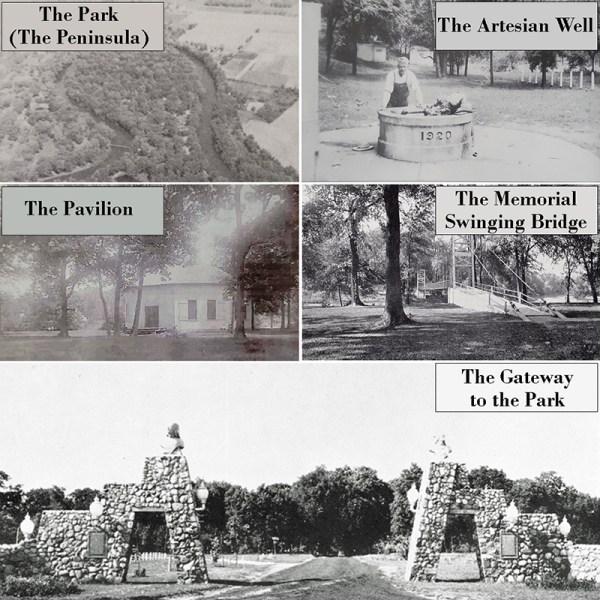
The land now occupied by the Town Park is situated on a natural and beautiful peninsula in the horseshoe bend of the Tippecanoe River. Tradition holds that this area had been a Native American campground.

For purposes of this article, we’ll just say that Pulaski County was formed by the State Legislature in 1835, and the Town of Winamac in 1839. The forced removal by militia of Native Americans from this part of the state – in 1838 – started at Twin Lakes, less than 22 miles from Winamac. It was known as the Trail of Death. The writer hates to leave it at this, but this article focuses on the history of the park.
This writer has to say that she is fascinated by the history of her family, when and how they entered the county, how the towns and townships were formed, and just about everything that has to do with the “white” history of the State of Indiana and Pulaski County. That history can begin when Indiana became a state (1816), when the United States of America became a country (let’s just say 1776), when the continent was owned by a variety of European governments … To be frank, the history of these regions goes back centuries. Those stories are told on other web pages.

White settlers began to populate the area of Monroe Township, where Winamac is now situated, in 1838. When Winamac was platted in 1839, the peninsula and some surrounding properties were owned by W. C. Barnett, a pioneer resident. A county map published in 1873 shows the property still in his name. The area was known as Barnett’s grove, or Barnett’s peninsula. It was used as pasture for milk cows that were owned by several residents. Some of the virgin timber had been cut off, but it was still heavily wooded with second-growth trees. From local stories, it was a great place to graze cattle, or, if you were careful about where you spread your blanket, to go for a picnic. (I love that line. It was stolen from a newspaper….)
In 1891, the land was purchased by John C. Nye, then a Winamac attorney, later to become Judge of the Circuit Court. He fenced off an area for cattle and added incandescent lights. While Mr. Nye owned the land, from 1891 to 1908, he allowed citizens to use the peninsula as a park. He also commissioned, through his father, the construction of an octagon pavilion.
Over time, Mr. Nye discovered that trying to hold attractions that would raise money was not enough to cover taxes and expenses. Unable to sustain the park, Mr. Nye sold the land in 1908 to Ben Herrick. The new owner planned to convert the land to private use. On the day he began cutting trees, citizens banded together to raise funds to purchase the property. They raised enough on the first day to retire the debt, $5,000.
Private Park Association
A private group, the Winamac Park Association, was formed. The organization purchased the land, allowing the “river park” to be used free-of-charge by citizens.
Fourteen years later, in 1922, the Park Association found itself in the same situation as Mr. Nye. They could no longer afford to maintain the park with the meager fees they were able to raise. The association reincorporated in order to raise funds. Also, at the end of 1921, the Winamac Kiwanis Club had been formed. The two organizations joined forces and imagined Winamac as a tourist destination.
The Park Association raised enough money to improve the river park on the peninsula. They purchased and installed new playground equipment, bath houses, a band stand, a dance pavilion and other amenities. A dedication ceremony was held on July 23, 1922, to celebrate the newly outfitted park.
On the “river park” side, the Park Association made additional improvements. A twenty-foot-wide graded cinder drive from the road entrance to the park was installed to enable two rows of cars to pass. It extended through the park as far as the bathing bench. Another band stand was erected with lumber remaining from the previous footbridge, and a permanent refreshment stand was built that contained kitchen conveniences and refrigerator. An additional bath house was built containing eighteen private compartments, an office, and separate sections for men and women. Bathing suits were purchased for rental for men, women, and children. This bathhouse was for persons who could afford to pay. The bathhouses erected the year before were still available to the public at no charge. Gravel and stones were dredged from the beach, and depths on the now-sandy bottom were marked for bathers. Two additional diving boards at various depths were added. Steps were built to the water’s edge, and a number of seats were placed on the bank for visitors to watch water sports.
The Park Moves Into The Future
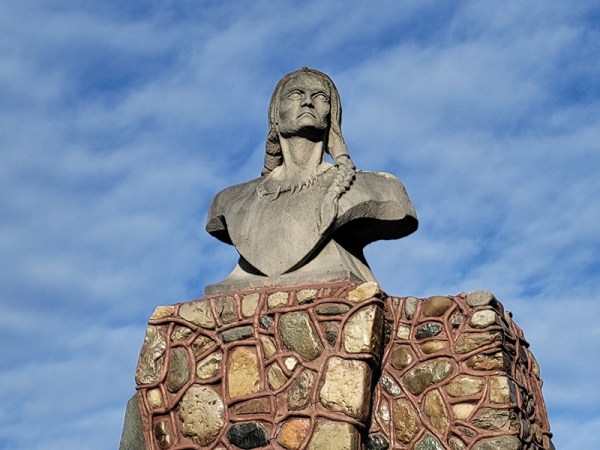
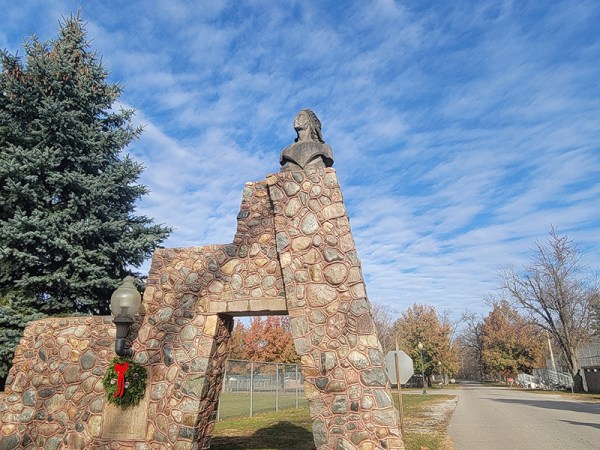
The 1930s brought several turning points to the Winamac Park. Stock was transferred and the land became the property of the town of Winamac. Plans for the gateway were made and busts of Native Americans were carved to adorn the entrance. Completed in 1934, the gateway has received national mention for its artwork.

The Winamac Conservation Club was created in 1933. In 1940, the club financed a fish hatchery pond and erected a large open fireplace. The Club built a bird sanctuary and observation hut in 1941.
In 1931, Richard S. Rogers retired the park debt, with some stipulations, and he established a trust fund of $5,000. The $5,000 was to be dispersed upon his death, which occurred in 1945. His gift was used, in large part, to build new restrooms in1950. The structure was to be made up of two small buildings, standing at opposite ends of a concrete slab, connected by a roof. Rest rooms, “equipped with electric pump and running water” would occupy one building, and the other would accommodate a concession stand.
In June of 1948, the Town of Winamac officially extended its boundaries to include the park.
In 1950, the Town Council granted control of the north end of the park to the fair board for use by their fair. The agreement was to run for thirteen years, giving the fair board the right to build, equip and maintain that portion of the park. Because the town could not lease park grounds, the fair board was given only partial control, during the month of August.
All Tour Stops
YOU BEGAN THE TOUR ON THIS PAGE
-
- First Brick Block Building in Winamac
- Courthouse (1894-95)
- Vurpillat’s Opera House (1883)
- Winamac Freight Depot
- Panhandle Pathway
- St. Peter Catholic Church
- Location of First Frame House
- First United Methodist Church (1901)
- ISIS Theatre (1936)
- Pulaski County Public Library (a Carnegie library, 1916)
- Log Cabin Replica
- Artesian Well (1887)
- Memorial Swinging Bridge (1923)
- Winamac Town Park (former hunting and fishing ground of the Potawatomi)
- Park Pavilion (1891)
- Kelly Hardware (1898)
You’re back where you started!