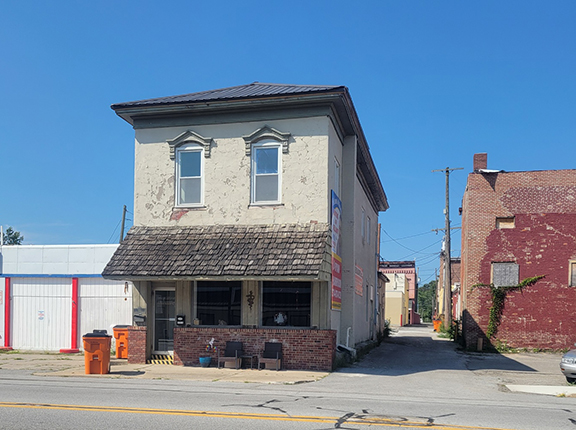
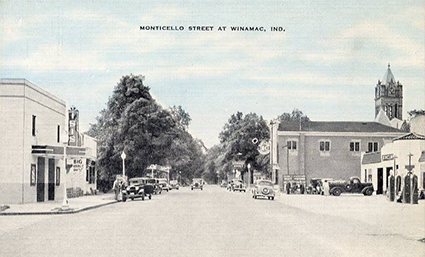
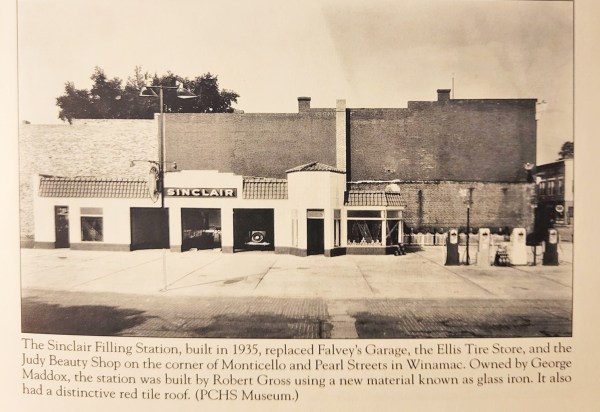
For purposes of this stop, not only are we tracking this – the first commercial brick block building in town – but we pay a little attention to the Holland Garage, later the Sinclair Station, now a vacant lot to the north of the building.
We’ll track this building from it’s first recorded inhabitants, Morehart Bros., through today.
COUNTIES OF WHITE & PULASKI 1883
Business Blocks. —Prior to three or four years ago, no business building of considerable size had been erected. The Rowan store building, and the small brick now occupied by Morehart Bros., were about the largest. But within the past four years an era in improvements has occurred which will not be overlooked even with the lapse of time. In 1879, the Keller-Huddleston brick was erected, followed in 1880 by the Frain Hotel brick, and in 1882 by the Vurpillat brick, neither building costing less than $20,000. Either building would be a credit to a town of five times the population of Winamac. Other buildings of similar cost are talked of, and the business future of the county seat appears with a silver lining and without a cloud.
[NOTE: the building could have been erected as early as the early 1860s when the railroad came to town, allowing for shipments of brick.]
WP: Feb. 29, 1888
Frank Williams has procured himself a huckstering outfit and will soon be making his trips to the country and exchanging goods for farm produce.
PCD. Jan. 14, 1891
Frank Williams has made arrangements to continue buying pulp wood. [shipped to Paper Mills at Kokomo] – Notice – I have stopped buying pulp wood. F. M. Williams
PCD: July 28, 1893
Frank Sowers has transferred his poultry business here to Frank Williams, who takes possession tomorrow. Mr. Sowers goes at once to Delphi, where he will begin next Monday in the same business.
M. Williams. I am now paying the highest prices for pulp wood, game, furs, hides, tallow, old rubber, etc., etc.
PCD: Sep. 25, 1913
Dr. E. H. Marshall of Butler, Pa., has come here and has associated himself with Dr. W. C. Moss in the practice of medicine.
PCD: May 10, 1917
WR: The old canning factory building on the corner next to Hoffman’s Hardware store is being torn down this week for the erection of an extensive addition to the Holland Garage . The entire corner lot will be covered with the new garage building, making a floor space about 55 by 100 feet with entrances on both Monticello and Pearl streets. The new addition will be of brick construction and one story in height. The floor space of the garage will be more than doubled by the added quarters. The present north wall of the garage will be entirely removed in making the improved. The addition will probably not be ready for occupancy before July but work will commence promptly.
PCD: May 10, 1917
BUILT IN 1860. The frame building at the corner of Monticello and Pearl streets, erected 57 years ago by Mr. Joseph Vurpillat’s father, is being torn down for a new cement garage building, an extensive addition to the Holland Garage . The entire corner lot will be covered with the new garage building, making a floor space about 55 by 100 feet with entrances on both Monticello and Pearl streets. The new addition will be of brick construction and one story in height. The floor space of the garage will be more than doubled by the added quarters. The present north wall of the garage will be entirely removed in making the improved. The addition will probably not be ready for occupancy before July but work will commence promptly.
WR: Jun. 28, 1917
BIRDSEYE VIEW 1867
Appearance of Little Old Winamac in the Year 1867—Half Century Ago
Fifty years has brought almost unbelievable change in the appearance and personnel of the business and residence parts of Winamac. In a building where Dr. E. H. Marshall’s physician’s office now stands, Wils Williams, father of F. M. Williams, had a grocery and produce store.
Lewis Hoffman conducted a general store in the wooden building just torn down to make way for the Holland Garage enlargements on the corner of Pearl and Monticello streets.

PCD: Jan. 2, 1919
Dr. E. H. Marshall and wife plan to move from Winamac to Clinton, Ill.
PCD: Jan. 16, 1919
Dr. C. S. Campbell of Xenia, Ill., came here the fore part of the week, gained a favorable impression of this place as a location for a physician, closed a deal with Dr. E. H. Marshall for the purchase of his office and fixtures and is now here as a permanent practitioner. Dr. Campbell is a man of pleasing personality, neither too young nor too old, and comes highly recommended. He has been in the army since last summer as a first lieutenant and sought a new location following his discharge because he dislikes the mud roads where he has been.
PCD: Feb. 20, 1919
Dr. George W. Campbell, brother of Dr. C. S. Campbell, has come here this week and has definitely decided to locate in Winamac, associating himself with Dr. C. S. under the firm name of Campbell & Campbell. Dr. C. S. Campbell came here recently and took over the former Dr. Marshall office.
WR: Jan. 15, 1920
WINAMAC NOW HAS A HOSPITAL
Drs. C. S. and G. W. Campbell Open Modern Operating Room and Wards
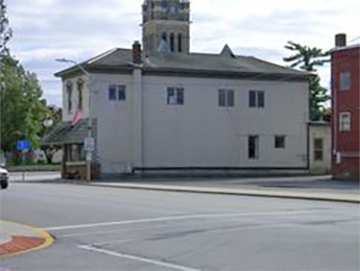
Drs. C. S. and G. W. Campbell have just completed the equipment of their hospital rooms which occupy the upper floor of their office building. The front room has been furnished as an operating room, and is ideal for the purpose, receiving light from three directions. There are two wards and if necessary the facilities could at present care for four or five patients. The west room is to be used for a diet kitchen and medicine room.
Miss Nettie, eldest daughter of Mr. And Mrs. Elmer Poor, was the first patient, being operated upon for appendicitis on Tuesday morning.
Miss Mabel Cain, a nurse from Indianapolis, is caring for Miss Poor.
The opening of the hospital rooms came upon the first anniversary of Dr. C. S. Campbell’s arrival in Winamac. In an interview with a Republican representative, Dr. C. S. Campbell stated that they plan to enlarge their equipment even more in the next year than they did in the past one, in order to accommodate the needs of the vicinity. Although their quarters at present are somewhat small, Dr. Campbell stated that their facilities for operating and the matter of sanitation is as good as found in any city hospital.
WR: Jan. 29, 1920
BUILDING BOOMS FOR THIS YEAR.
[Note: This begins a venture wherein the Drs Campbell maintain their practice in this building but also build a larger hospital on Franklin Street.]
Building will be in full blast during the coming season, according to present prospects. Some of the owners of buildings recently condemned by the state fire marshal’s department and start tearing down the buildings and others have applied for re-hearings.
Drs. Campbell have outgrown the hospital facilities installed in the suite of rooms above their offices and on Wednesday closed a deal for the purchase of the large residence property on South Franklin street known as the Hoffman house.
The physicians will take possession of the property about the middle of February and began remodeling for a modern hospital structure at once. They hope to be able to open the hospital by March 1.
Eight or ten hospital rooms will be fitted out at present. Water and sewer connections will be run to the property as soon as possible and general remodeling started.
PCD: Apr. 15, 1920
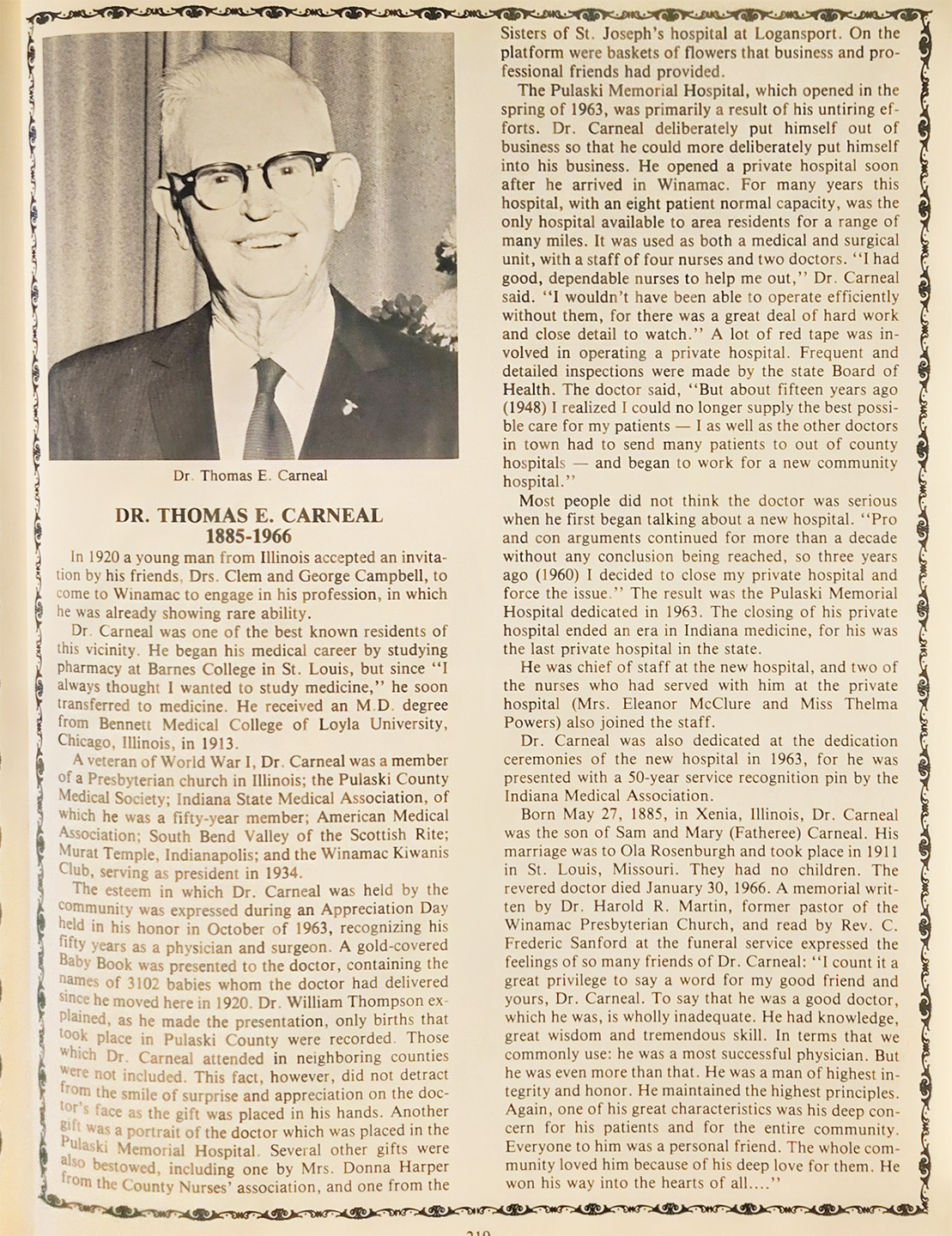
New Hospital Interest Taken by Illinois Doctor. Dr. T. C. Carneal has come here this week from Iuka, Ill. and is to be a permanent resident of the community. He has associated himself with the Drs. Campbell in the establishment and maintenance of the hospital now under construction and will be superintendent and manager of the new institution. The Drs. Campbell will thus be enabled to give their entire time to surgery and to their general practice.
Dr. Carneal is a specialist in diseases of the eye, ear, nose and throat. He was here for a week or more at different times last summer and fall when he performed a large number of successful operations in that line. He will leave in a few days to take a six week postgraduate course.
An X-ray equipment and laboratory outfit will be installed at the hospital and Dr. Carneal will also be in charge of this work. Mrs. Carneal is to come here in a few days, and they will make their home at the hospital.
The work on the building is progressing as rapidly as the weather will permit. The frame of the addition is up and some of the inner changes have been completed.
WR: May 20, 1920
WORK ON HOSPITAL.
The contractor, J. Frank Shine, and painters have almost completed remodeling the old Hoffman house on South Franklin street for the new hospital and it will be ready for occupancy next week, if the equipment which has been shipped from Buffalo, N.Y. and is tied up by the freight strikes, arrives. The hospital is owned by Drs. Campbell, Campbell & Carneal and will be known as the Winamac Sanitarium.
WR: Jun. 3, 1920
SANITARIUM OPENED MONDAY – Winamac’s New Institution Fills Need of Years—Up-To-Date in Every Way.
The new Winamac Sanitarium was opened on Monday of this week in its newly remodeled building on South Franklin street. The structure consists of the large house on that site and basement and one story addition to the west. The capacity is now sixteen beds, the sanitarium having two wards and twelve private rooms.
An air of cheeriness and cleanliness pervades the hospital the woodwork being finished in ivory white and the walls in dainty tints. Each private room is decorated in a color of its own. Perhaps the most interesting room to a visitor is the operating room. Everything in the room is pure white, woodwork, walls, ceiling and furnishings, with the entire west side of the room consisting of windows. In the adjoining room is the steam sterilizer.
The large reception room and office are located first rooms to the left at the front hall. In the basement is the steam heating plant, the kitchen, the dining room and the laundry all well lighted from outside. A gravel drive will lead to the covered south entrance, with wide enough doors to permit entrance of a patient on cot or stretcher.
Bathrooms will be located on both first and second floors. In each room are electric light concealed sockets permitting extension lights to any part of the room and electric call bell connections.
The present hospital rooms on the second story of the office building of the Drs. Campbell will be discontinued and remodeled into a laboratory with X-ray outfit and pathological and chemical laboratories.
A staff of graduate trained nurses will be kept at the hospital and Drs. Campbell state that other physicians of the county and other towns will be at liberty to bring patients to the Winamac Sanitarium for care. Drs. Campbell and Carneal have financed the Sanitarium and state that its growth is limited only by the moral support of the people of the community.
Visitors declare the Sanitarium is unsurpassed in its up-to-dateness and sanitary features.
WR: Jul. 1, 1920
INSTALL X-RAY OUTFIT IN CITY.
Work of installing an X-ray machine in the office of Drs. C. S. and G. W. Campbell was completed on Wednesday. The X-ray outfit has been placed in one of the room’s above the doctor’s office, formerly used as a hospital ward. The room just back of this will be made into a dark room for developing the plates.
Dr. Carneal will have charge of the Roentgen Ray department and states that they can do all kinds of X-ray work. The nearest other X-ray machine is thought to be at Logansport.
WR: Jan. 6, 1921
HOSPITAL FIRE DAMAGE $12,000
Night Blaze Takes Main Building of Winamac Sanitarium—Patients Escape Uninjured
Fire damage estimated by Drs. Campbell and Carneal at from $12,000 to $15,000 resulted when the Winamac Sanitarium main building was gutted by a blaze on Tuesday night starting about 9:45 o’clock. Insurance carried was $5,000 on the building and $3,000 on the equipment. The fire started on the roof at the rear of the two-story building and is thought to have originated from sparks from the chimney, a strong west wind carrying the flames through the attic as soon as they had eaten through the roof.
Within a quarter of an hour after the blaze was discovered the fire was appearing through the roof at places in the extreme east part of the building and the attic girders burned before control could be gained. The fire from the attic dropped to the base of the building between the siding and the plaster, so that the fire was raging in nearly all parts of the structure even before the roof had been burned off.
By good fortune only two patients were in the hospital on the evening of the fire. Mrs. Lewis Morgan, one of the patients, was able to walk to a nearby house, and the other patient, who was an elderly patient, was carried to the house across the street. The latter was Mrs. Eleanor Clem of Brooklyn, N. Y., who had been at her farm near North Judson recently, and was being treated at the local hospital for heart trouble and rheumatism. Had the fire occurred three days previous there would have been 14 patients to have been removed from the burning building.
While the upper part of the main hospital building was burned almost completely and the walls of the lower story were left merely a shell in many places, the new addition to the west of the main building was not touched by the flames.
The electric light fuse burned out almost at the beginning of the fire and the work of removing the furnishings was accomplished with the aid of a few lamps and candles. All the furniture was removed except that in the double room in the upper southeast corner of the building. However and large portion of the chinaware from the pantries and dining room was broken in the haste of removal.
The operating room and the adjoining instrument and dressing room was one of the first parts of the building to suffer, and practically nothing in them was saved. The sterilizing outfit alone, which was completely ruined, cost $300. The owners estimate that about $1,000 worth of surgical dressing, gauze and cotton was destroyed. A large amount of blankets and bed clothing was also ruined.
Two nurses were at the hospital at the time the fire was discovered, but the three physicians were not at the building at the time. The blaze was discovered by a neighbor, who first saw a small blaze on the roof.
The fire truck responded promptly, but the chemical hose was not able to cope with the flames and the city fire hydrant was connected with the hose carried by the truck. The pressure was not sufficient at the great distance from the standpipe to meet the situation, and by the time the fire pumps were under full power damage done was unavoidable.
The basement was flooded with water, but the place had been cleared up sufficiently by Wednesday morning to start the furnace fire. The equipment taken from the burning building was returned into the unburned portion and partly stored in the nearby garage of O. J. Shaw.
The hospital property was estimated at a value of from $20,000 to $25,000.
WR: Apr. 7, 1921
Physician to New Location:
Dr. George W. Campbell, who last week sold his Winamac business interests to Drs. C. S. Campbell and T. E. Carneal, states that he has not yet decided upon his new location, although he has investigated several openings in other cities. He has closed his practice in Winamac, but will not move his family from Winamac as yet. Mrs. Campbell has several weeks remaining of instruction among the music pupils of the high school and will not leave before the close of school…
WR: Feb. 8, 1923
Local Physician Goes to South Bend:
Dr. T. E. Carneal last Friday bought out the interests of Dr. C.S. Campbell in the professional firm of Campbell & Carneal and will continue the medical practice of the firm.
Dr. Campbell will go to South Bend, where he will open offices at once, and later expects to be located in the physician’s clinic building, when opportunity presents itself. The Winamac Sanitarium was organized by Dr. Campbell and was making good strides until the disastrous fire, after it had been in operation only about eight months.
Dr. Carneal came here shortly after the opening of the sanitarium and was house physician until the fire. Since that time he has been associated with Dr. Campbell at their downtown offices and has developed an enviable practice in his profession. He will continue his professional practice in this community and will maintain his offices in his present building.
Later Years
Dr. Carneal’s last business partner was Dr. William R. (Dr. Bill) Thompson.
When that practice closed, the building was used by Dr. Michael Rausch DVM, who operated the Winamac Pet Med. [Personal note from the editor: When I moved “home” to Pulaski County, Dr. Rausch took over care of my first cat, Tiger Lily. I took photos of the building with the sign – which, unfortunately, I cannot locate – and showed it to my city friends. “This is the building where I was born; we called it the Carneal Clinic. Now it’s my cat’s doctor’s office….”]
Following Dr. Rausch’s retirement, it was used as a beauty shop – Studio 218. Later, the building was used primarily for apartments. It now houses one of the town’s most recent day care facilities.
All Tour Stops
YOU BEGAN THE TOUR ON THIS PAGE
-
- First Brick Block Building in Winamac
- Courthouse (1894-95)
- Vurpillat’s Opera House (1883)
- Winamac Freight Depot
- Panhandle Pathway
- St. Peter Catholic Church
- Location of First Frame House
- First United Methodist Church (1901)
- ISIS Theatre (1936)
- Pulaski County Public Library (a Carnegie library, 1916)
- Log Cabin Replica
- Artesian Well (1887)
- Memorial Swinging Bridge (1923)
- Winamac Town Park (former hunting and fishing ground of the Potawatomi)
- Park Pavilion (1891)
- Kelly Hardware (1898)
You’re back where you started!