Attached isthe application for entry into the National Register of Historic Places for the Monterey Bandstand, or the Kleckner Park Bandstand, as well as some photos. The bandstand is no longer in the park, and no longer on the register.
Monterey Bandstand Application
Information from the Application
The bandstand in Kleckner Park, Monterey, Indiana appears to have had very little alteration in its approximately 100 year history. The building is located near the center of the park and is elevated on concrete piers. The bandstand is constructed of wood and is mostly open with turned posts and columns supporting its hipped roof. Periodic flooding of the adjacent Tippecanoe River has caused some damage and required repairs to the structure; most notably a new floor structure was reconstructed in 1979. The building is a rare surviving example of Victorian-era public structures of this type used in town parks and public squares. The park itself is not being nominated, only the bandstand.

Narrative Description
Kleckner Park is a lowland area created in the floodplain of the Tippecanoe River and donated to the Town of Monterey at about the turn of the 19th/20th Centuries. The park is immediately north of the town on the north side of the Tippecanoe River and east of Walnut Street (North County Road 625 East), which was also known as the “River Drive”. This road is the main north/south street in the Town of Monterey; ii crosses the Tippecanoe River on a 1948 Pratt Pony Truss Bridge which is visible from Kleckner Park.
The park consists of several acres of mostly mowed lawn and large deciduous trees that appear to have grown naturally rather than to have been planted. There are several picnic tables and grills located in the park near the bandstand. These dale to c. 1980 through the present. A paved drive and parking are located in the park. A boat launch is located along the river. The park is fenced with older woven wire fencing.
The bandstand is the only building in Kleckner Park. Its appearance dominates the park because it is elevated on 30″ tall concrete piers. The building is 12′-6″ wide and 20′ long (at the walls) and is 13′ tall above the piers. There are two rows of 12″ square concrete piers: four across the front and four across the back. Bare ground is beneath the bandstand. The bandstand faces northeast with a set of steps on the north half of its southeast facade. The steps are constructed of wood treads and stringers; the steps were constructed in the last twenty years. There is no handrail. The floor structure was replaced during a 1979 restoration of the building; this includes new floor joists, wood floor decking and wood skirt board around the outside perimeter of the building.
The northeast facade’s wall is constructed of wood clapboards to a height of 30″ with a small gap between the bottom of the wall and the floor. The inside surface of the wall is plywood. The wall has a wood cap with a small cove piece beneath the cap against the wall. The area above the wall is divided into three equal openings by four turned wood posts. Wood trim and lattice form slightly pointed arches between the posts. The lattice encloses the top of the openings just below the eaves.
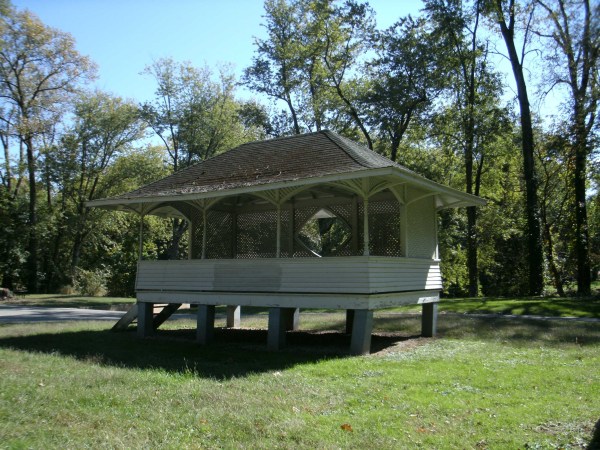
The northwest elevation is similar to the front fa9ade with a few exceptions. It is divided into two equal openings above the short wall. The turned wood post forming the front corner of the structure forms the north side of the north opening. The other two posts that divide the fa9ade into two parts are square wood posts. The north opening has lattice and a slightly pointed arch at the top of the opening, matching arches on the facade. The south opening is filled in with wood lattice which was installed in the recent restoration. The southeast elevation is a mirror image of the northwest elevation except its north opening has an opening to the set of wood steps and does not have a continuation of the 30″ tall wall. A curved piece of wood trim acts as an end cap on the outside edge of the wood clapboards on the fa9ade and the north edge of the clapboards on the southeast elevation at the opening for the steps. A small brass plaque is located at the bottom of the turned wood post at the north corner of the southeast elevation. It is engraved with the date of restoration (1979) and those responsible (Tippi ’61 Extension Homemakers).
The southwest elevation also has a continuation of the 30″ wall. This elevation is divided into three equal parts above the walls by square wood posts. The two outside openings are filled in with wood lattice that dates to the recent restoration. The center opening is filled in with historic wood lattice that surrounds a large four sided diamond shaped opening whose framing sides are slightly curved.
The roof of the structure is hipped with flared eaves. The eaves are supported by slightly curved wood struts attached to each of the outside faces of the square and turned wood posts. The struts attach to exposed eave rafters that curve upward with the flared eaves. A wood fascia board is attached to the rafter tails. The underside of the eaves are constructed with narrow wood plank decking, or car siding. In some locations repairs were made during the restoration and larger wood planks were installed in place of the car siding. The roof is covered with asphalt shingles. The roof structure is exposed on the interior of the bandstand. The roof rafters are attached to a ridge board at the top of the structure and are supported near the eaves by wood plates supported by the posts. The rafters are notched to set on the plates. Wood cross bracing is located between the beams. Two vertical knee braces are located on the cross bracing and support each end of the ridge beam. The underside of the roof decking is exposed and is constructed of wood planks.
The entire structure is painted white except for the wood floor deck which is painted light gray. The bandstand is in good condition with some minor graffiti on the interior plywood walls. One turned post is cracked. The wood lattice added during the recent restoration mimicked lattice originally installed in the openings. The asphalt shingle roof is older and should be replaced in the near future. The original roof was likely constructed of wood shingles. Due to frequent flooding the concrete piers have shifted and will need to be corrected or replaced. The piers do not appear to be historic.
News After The Fact
The application was submitted in 2012. After that, the bandstand came upon hard times.
DNR informed the town that they had to do something with the bandstand because the river floods there so often. They also said the structure was a danger to the public. The Town had a decision to make. Either remove it or spend thousands of dollars raising it above flood level and making it ADA compliant. An auction was held, and Becky Hisson won the bid.
It was moved to private property between Leiter’s Ford and Delong in Aubbeenaubbee Township, Fulton County, Indiana, on the Tippecanoe River. While the original purchaser is no longer living, the bandstand is still (in 2024) sitting along the north side of the river. Becky Hisson states she loves to sit in it and watch the river flow past. She says the river never floods at that point. It has been mounted on concrete blocks and now has a new roof.