Attached here are the application for the listing the Mallon Buidling on the National Register of Historic Places and several photos. The application was prepared by Chrisann Guitwein.
Narrative from the Application
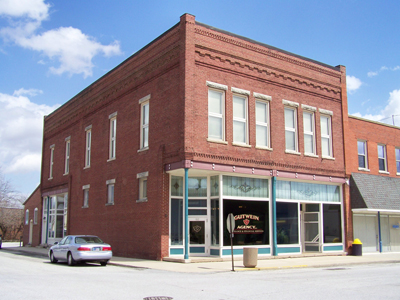
The Mallon Building in Francesville, Pulaski County, Indiana is a two-story Commercial Style structure. The property was erected in 1899 by local businessman J.H. Mallon to house his dry goods business, replacing an earlier building which burned in 1893. Since its construction, the Mallon Building has been the center of Francesville’s commercial area.
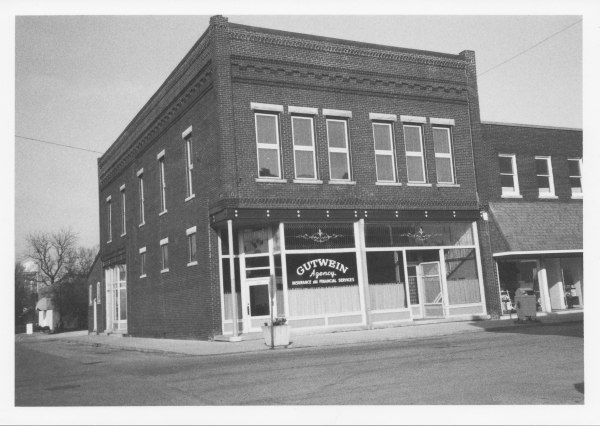
The Mallon Building is rectangular in plan with a small lean-to section off the rear of the main mass. This 80 feet by 40 feet structure is of common bond brick construction and rests upon a brick foundation. The exterior and interior walls are each brick and four inches thick, separated by four inches of air space. The building is two stories in height with a flat roof. Located on the corner of East Montgomery and North Bill Streets, the Mallon Building is the most imposing structure within the local business district. Both the south (main) facade and the west facade offer storefronts.
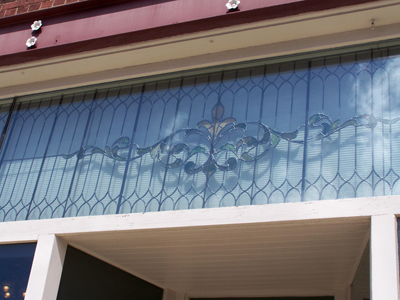
The front elevation features a fulI length, two-part storefront on the ground floor (photo 1). Two window groupings, one over each part of the storefront and each containing three one-over-one, double-hung windows, make up the second floor of the main facade. The right (east) portion of the ground floor storefront consists of two display windows on either side of the recessed entryway. The entrance door is directly flanked by two angled windows which line the entrance recession. Window panels, several inches in width, run along the bottom of each window. The doorway is single glazed with full light window atop a single panel. Above the door is a multi-lighted transom. The doorway also contains a wood frame screened door. The transom above the display windows is composed of a leaded glass window with a stained glass design. An engaged iron post with some decorative molding divides the two halves of the ground floor storefront.
The left (west) division of the ground floor storefront also features a recessed entrance. This corner entrance is flanked by full length, angled windows atop single panels. The door is single glazed with full light window and a single panel. The transom window is one over one. The large display window east of the entryway rests on double panels and is topped by a leaded glass with stained glass detail window. Smaller windows of this type also top each of the windows flanking the doorway and the transom of the doorway. An iron post stands at the corner of the building a few feet directly in front of the corner entryway.
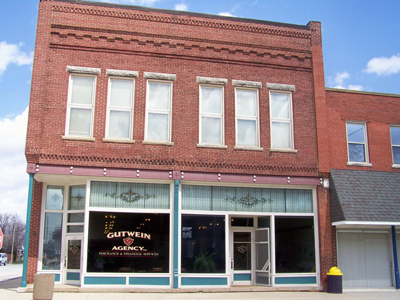
The entire storefront rests upon a slab of limestone, elevating it several inches above sidewalk level. The entire storefront is also topped with an iron frieze featuring ten pairs of rosettes. Above the frieze is a band of brick layered in a dentil design. At the corners, between the brick and iron frieze, the brick corbels outward make up the lower portion of corner turrets (present at all four corners of the building).
All six second story windows on the front elevation are one-over-one, double hung. Each opening has a flat with plain lintel and sill made of limestone. Stringcourses of different pattern enrich the upper third of the facade. The lowest is a double band above which is a wide, corbeled dentil course.
Another stepped stringcourse frames a broad panel that in turn is topped by a string of brick dentils.
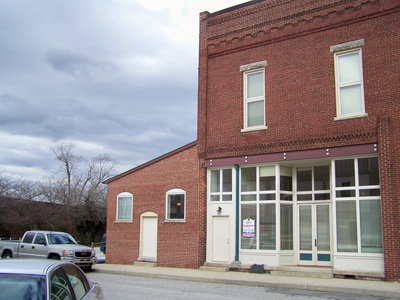
The upper-level brick detailing on the main facade continues along that part of the west elevation (photo 2). The west elevation is five bays wide, each bay consisting of a single, one-over-one, double hung window. Like those on the front facade, these second story windows have flat openings with plain limestone lintels and sills. The first floor features single pane, fixed sash windows with plain limestone lintels and sills under the southern most three bays. Under the other two bays is a side storefront.
The side storefront, like the one at the front of the structure, sits elevated upon a limestone slab. This storefront is framed by a band of dentil crenellated brick above and a brick buttress beside. An iron frieze with five pairs of rosettes runs along the upper portion of the storefront (below the string of angled brick). The northern most quarter of the side storefront is a double glazed door with double panels at the base of each part of the door. A multi-lighted transom is topped by two full light windows. This door is flush with the building and opens into a stairwell to the second floor. A spiral iron post stands between the door and the other three-fourths of the side storefront. This southern three-quarters of the storefront consists of a recessed double glazed door with single panels flanked by a single full light window and a double full light window on each side. The double windows are flush with the building while the two singles stand at an angle to the street, connecting the doorway with the outer, double windows. The windows and the door all stand on single panels and are topped with full light transoms below full light windows.

The small lean-to section at the rear of the Mallon Building, added at a later date, stands just to the north of the side storefront. The lean-to has a single flush door with a limestone step. To the left and right of the door is a flat, single pane, fixed sash window with limestone sill. The openings for the windows and the door are segmentally arched and topped with arched brick headers.
The interior of the Mallon Building is essentially two open floors above a basement. Interior brick walls are covered with lath and plaster. The original wood floors are in very good condition throughout the building, with the exception of the area around the side entrance where coal was brought inside for upstairs and downstairs stoves. Windows are framed with 5 ½” wide wood trim. Hanging pipes used for gas lighting are still present, though wiring was later installed for electrical lighting.
Dividing the ground floor down the middle are five round iron supports (photo 4). These supports lead up to a 14′ high ceiling. The ceiling of the Mallon Building is a very ornate pressed metal ceiling (photo 3). The stairway to the second floor is found through an entryway located toward to the back of the building. The 4′ 3″ wide staircase leads to an open second floor. Like the first floor, the walls are covered in lath and plaster and two openings remain from pot bellied stoves along the west wall. Solid square roof supports are 15′ high. A dropped ceiling has recently been installed on the second floor.
A 15′ x 20′ basement, which includes an outside coal door and coal chute, and the rear addition, containing a rest room and furnace area, makes up the remainder of the Mallon Building.
Narrative Statement of Significance
The town of Francesville was laid out by James Brook of New Albany. Brook, later the president of the Louisville, New Albany, & Corydon Railroad, named the town in honor of his daughter Frances. Most of the earliest settlers were Pennsylvania Dutch; The western part of Pulaski County, with its cheap land and rich soil, drew many more settlers to the area. As late as the 1870s, there was a strong demand for housing. “Had we twelve vacant dwelling houses in this place at present they would be taken in less than ten hours after being announced” reported the Local Topic in 1871.
As a railroad town, Francesville was assured of a stable source for commerce and prosperity. Nearby farms produced a variety of grain products which were shipped to major markets through the town’s grain center. By 1900, the town was considered the best grain center of its size between Michigan City and Lafayette. Today, a century later, the town continues to be a major shipping center for grain products.
Commercial activity in Francesville has always been centered on the railroad and the grain el vators which stand beside it. In the center of town, a small commercial area grew up to handle the needs of the farmers, railroad workers, and residents. The first store in Francesville was constructed by Alonzo Star in 1853. By 1875, the town’s commercial district had grown to include a variety of other businesses including groceries, harness makers, liveries, cabinetmakers, and confectioners. One of these merchants was J.H. Mallon, who began keeping store in the “Bee Hive” building in 1869.
Mallon’s first store sold “dry goods”- a 19th century term which encompassed everything from pins and nails to fine hats and silk dresses. Business was good for Mallon, and in 1872 he purchased a
$300 lot from Payton Davidson for a new store. The new store was completed that year, and Mallon moved in for business on December 19th. There he remained until October 9, 1893, when his store and the drug store next to it burned.
Francesville’s commercial district had grown quite a bit since 1872, and the area around Mallon’s building was crowded with other frame structures. The raging fire, fueled by the goods in Mallon’s store and the volatile contents of the neighboring drug store, threatened to burn the entire block. It was the largest fire in Francesville’s history. It was only by the heroic efforts of the townsmen that many of the surrounding buildings were saved. After the fire, Mallon put what goods he could salvage from his ruined store into a neighboring building. For the next six years he operated out of a business room on Bill Street.
The fire spurred a new period of development in Francesville. Many merchants replaced their frame buildings with substantial new “fire-proof” brick structures. For example, when the “Old Andrew” hotel (1853) burned down in 1893, it was re-built as a large brick building. Civic pride also resulted in new developments. The town had grown almost a half mile from its center in almost every direction. Under the guidance of local government, streets were paved with gravel, sidewalks were laid, and roads were built. Local business also prospered; when the town’s grain elevator burnt down in 1899 it was quickly replaced. Two tile factories added an industrial edge to the town’s traditional agricultural economy.
All of this prosperity and development is best reflected in the current Mallon Building, which was built in 1899. Mallon, by this time considered the town’s leading merchant, constructed a substantial two-story building which became the center of the town’s business district. There he continued to run his business until selling the property in 1948. The building remained a department store for another 44 years under the ownership of a Mr. Minkert. Today the Mallon Building remains the heart of the town’s commercial area and stands as the largest and finest commercial building extant in Francesville. It represents the boom period of the town, when agricultural prosperity led to the construction of many fine commercial structures. The Mallon Building retains many of its original features and was recently restored. Its significance to local history as a fine representative of Commercial Style architecture during Francesville’s boom period warrants the Mallon Building’s listing in the National Register of Historic Places.